
MSAZ-190 · Lesson 11 of 12 · 22 min
Common traps in fundamentals questions
▶ Video coming soon A video version of this lesson is on the way.
At the last Friday lunch before the holidays, Renata runs a game. She shows twelve original practice items on the screen, one at a time, and the group has thirty seconds to answer each. Then, before revealing the answers, she asks each person to say which word in the question decided it. The scores are respectable, but the second part is revealing. Theo got one wrong because he answered the question he expected rather than the one on the screen. Keiko missed one because the question said least administrative effort and she chose the option she would personally prefer. Ama missed one because two options named real products and she picked the one from the wrong family. Hana missed one because she knew the product's old name but not its new one. "None of those are knowledge gaps," Renata says. "They are traps. Traps can be learned." This lesson collects the traps that catch fundamentals candidates most often, with a way to avoid each.
Trap 1: answering the question you expected
After weeks of study, it is easy to see a few familiar words and answer the question you have practiced many times, rather than the one in front of you. A question that begins like a familiar item on availability zones may actually ask about region pairs, or about cost, or about which option is not a benefit. The defense is to read the final sentence of the question first, the one that actually asks something, and only then read the scenario. Before choosing, say to yourself in a few words what is being asked: "which feature prevents deletion", "which is not a type of identity". If your chosen option does not answer that short sentence, it is wrong, however true it may be.
Trap 2: ignoring the qualifier
Many questions contain a qualifier that decides between several options that would all work: least administrative effort, most cost-effective, without changing the application code, with the least privilege, must remain in a specific country. In fundamentals exams, the qualifier often points toward a managed service, because managed services reduce administration, or toward a built-in feature rather than custom code. A question that asks for the least administrative effort to host a web application will usually prefer App Service to a virtual machine, even though both could host the site. Underline the qualifier mentally and test each remaining option against it.
| Qualifier | What it usually favors |
|---|---|
| Least administrative effort | Managed services and built-in features over self-managed ones |
| Most cost-effective | Options matched to actual need, such as cheaper tiers, reservations or stopping unused resources |
| Without changing code | Configuration, policy or platform features rather than application changes |
| Least privilege | The narrowest role or scope that does the job, ideally time-limited |
| Must remain in a country or region | Region choice, residency features and policies that restrict locations |
Trap 3: lookalike products
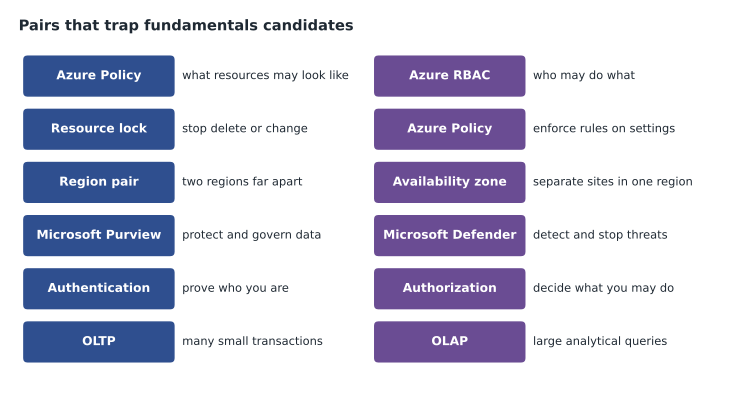
Microsoft's product families contain many names that sound alike, and fundamentals exams use them as distractors. The figure shows pairs that catch candidates most often. The defense is to know, for every product in your outline, one sentence describing its job, and to check each option against that sentence. If an option is a real product that does a different job, eliminate it, however familiar the name.
Trap 4: renamed and retired products
Microsoft renames products often, and older study material, forum posts and videos keep the old names. Azure Active Directory became Microsoft Entra ID. Microsoft 365 Defender became Microsoft Defender XDR. Azure Sentinel became Microsoft Sentinel. The AI development portal has carried several names on its way to Microsoft Foundry. Tools retire, too: as MSAZ-102 noted, Microsoft Learn now says the Total Cost of Ownership calculator has been retired, and the AZ-900 outline dated July 2026 no longer names the Service Trust Portal, though SC-900's still does. The exam uses current names. If an option uses a name you only know from older material, treat it with suspicion; it may be a distractor built from a retired name, or it may be the current name of something you know under an old one.
The defense is to build a two-column list of old and new names as you study, and to check the current study guide's wording for every product it names. Hana's list for AI-901 has six entries by the end of her review. Ama's for SC-900 has four.
Trap 5: absolute words
Options that say always, never, all, none, only or guarantees are often wrong in cloud questions, because cloud services rarely behave the same way in every circumstance. "Azure guarantees that a virtual machine will never fail" is false; Azure offers service level agreements for availability under specific configurations. "Tags are always inherited" is false. But absolute words are not automatically wrong: "A resource can belong to only one resource group" is true. Treat an absolute word as a signal to check the claim carefully, not as a reason to reject it.
Trap 6: a statement series with a pattern
Lesson 3 described the statement series format, in which several statements each need Yes or No. A common trap is to assume the answers must be mixed, or to let one statement influence the next. Another is to answer a statement that is partly true. If a statement says "Azure Policy can deny the creation of resources in disallowed regions and assigns roles to users," the first half is true and the second false, so the whole statement is false. Read every word of every statement, and decide each one alone.
Trap 7: confusing what with how
Fundamentals objectives use describe and identify. Distractors sometimes offer an option that is a step in how to do something rather than an answer to what it is. A question asking which service provides private connections from an office to Azure wants a service name, ExpressRoute, not a configuration step such as creating a gateway subnet. Match the type of answer to the type of question: a what question wants a thing, a which question wants a choice, a why question wants a reason.
Trap 8: misreading not and except
Negative questions ask which option is not a benefit, which feature cannot do something, or which statement is incorrect. Under time pressure, many people miss the negative word and choose the first true option. Microsoft usually emphasizes negative words, but not always. The defense is to notice negatives on your first read and restate the question positively: "which of these is not a benefit of the cloud" becomes "three of these are benefits; find the odd one out". Then check each option as true or false, and pick the false one.
Trap 9: overthinking a fundamentals question
Candidates with real experience sometimes talk themselves out of the right answer by imagining edge cases. Theo knows from his server work that a backup can fail for a dozen reasons, so when a question asks whether geo-redundant storage protects data against a regional outage, he hesitates. The fundamentals exam is testing the documented purpose of the feature, not every way it might go wrong in practice. Answer at the level of the outline: describe and identify. If an option matches what Microsoft Learn says the feature is for, choose it, and save the edge cases for associate exams.
Trap 10: scope words
Azure, Entra and Purview all organize settings by scope, and questions often hinge on which scope is named. In Azure, management groups contain subscriptions, subscriptions contain resource groups, and resource groups contain resources; policies and role assignments apply to the scope where they are assigned and to everything beneath it. In Entra, a setting may apply to a user, a group, an application or the whole tenant. In Purview, a policy may cover all mailboxes or only some locations. A question that says "at the subscription level" or "for a single resource group" is telling you which scope the answer must work at. Read scope words as carefully as qualifiers, and picture the hierarchy before you choose.
Theo's version of this trap came in a practice item asking whether a role assigned at a resource group gives access to another resource group in the same subscription. He answered Yes, thinking of the subscription. The answer is No: access flows down from the scope of assignment, not sideways or up. He drew the hierarchy on a card and has not missed one since.
Trap 11: preview and general availability
The study guides for AI-901 and DP-900 say that most questions cover generally available features, but that preview features may appear if they are commonly used. That creates two traps. The first is assuming nothing in preview can be tested, and skipping a commonly used preview feature mentioned in Microsoft Learn. The second is the opposite: chasing every preview announcement in blogs and news, which wastes time on features that may change or vanish before they ever reach an exam. The balance is to study what Microsoft Learn's current modules for your exam teach, including any preview features they cover, and to leave announcements alone unless they appear there.
Building your personal trap list
Everyone falls into some traps more than others. Go back through your mistakes log and tag each entry with the trap that caused it, if any: expected question, qualifier, lookalike, renamed product, absolute word, statement series, what versus how, negative, overthinking, scope or preview. After a few weeks, one or two tags will dominate. Those are your traps. In the final week, read your top two traps before every practice set, and after each set check whether they caught you again. Keiko's top trap turns out to be the qualifier; Ama's is lookalike products; Theo's is scope. Knowing your own pattern turns a vague feeling of "I make silly mistakes" into a specific habit you can fix.
Worked problem
Spotting the trap
For each original item, identify the trap. (a) "A company wants to host a web app with the least administrative effort. Which option?" A candidate picks a virtual machine because it gives more control. (b) "Which of the following is NOT a Zero Trust principle?" A candidate picks verify explicitly. (c) "Which service manages identities in the cloud?" A candidate rejects Microsoft Entra ID because they learned the name Azure Active Directory. (d) "Tags applied to a subscription are always inherited by every resource." A candidate answers Yes.
Show solution
- (a) Ignoring the qualifier: least administrative effort favors a managed service such as App Service.
- (b) Missing the negative: verify explicitly is a Zero Trust principle, so it is the wrong choice for a NOT question.
- (c) A renamed product: Microsoft Entra ID is the current name for Azure Active Directory.
- (d) An absolute word: tags are not inherited automatically, so the statement is false.
Answer: Qualifier, negative, renaming and absolute-word traps; each is avoided by a specific reading habit.
After the game, the group agrees on a single reading routine for their exams: last sentence first, find the qualifier, spot any negative, eliminate wrong families, check names, then choose. Hana writes it on a card. On exam day she cannot take the card in, but by then she does not need it.
Common mistakes
MistakeAnswering a familiar-looking question from memory.
InsteadRead the final sentence first and restate what is asked.
MistakeChoosing the option you would prefer in real life.
InsteadChoose the option that best meets the stated qualifier.
MistakeTrusting a familiar product name.
InsteadCheck each product against a one-sentence description of its job.
MistakeRejecting every option with an absolute word.
InsteadCheck absolute claims carefully; some are true.
MistakeAnswering a statement that is half true as Yes.
InsteadA statement is true only if every part is true.
Summary and key terms
- Read the question's final sentence first and restate what is being asked.
- Find the qualifier; it often favors managed services, built-in features and least privilege.
- Know one sentence for each product so lookalikes can be eliminated.
- Keep a list of old and new product names; the exam uses current names.
- Treat absolute words as a reason to check, not to reject.
- Decide each statement in a series alone, and only Yes if every part is true.
- Watch for negative words, and answer at the describe and identify level.
- Qualifier
- A phrase that sets the deciding requirement, such as least cost or least effort.
- Distractor
- A wrong option designed to look plausible.
- Lookalike product
- A real product with a similar name or purpose to the correct answer.
- Absolute word
- A word such as always or never that makes a claim universal.
- Negative question
- A question asking which option is not true or not appropriate.
- Retired name
- An earlier product name no longer used by Microsoft.
Practice problems
Work each problem on paper first, then reveal the answer to check.
What should you read first in a long question?
Show answer
The final sentence that asks the question.
What does least administrative effort usually favor?
Show answer
Managed services and built-in features.
What is the current name for Azure Active Directory?
Show answer
Microsoft Entra ID.
Is every option containing never wrong?
Show answer
No; check absolute claims carefully.
When is a statement with two claims true?
Show answer
Only when both claims are true.
How do you handle a NOT question?
Show answer
Restate it as finding the odd one out and pick the false option.
Why avoid overthinking edge cases on fundamentals exams?
Show answer
The exam tests documented purpose at the describe and identify level.
Lesson quiz · 5 questions
Score 60% or more to complete this lesson.
Create a free account to save your progress, take quizzes and earn a certificate.