
MELU-325 · Lesson 9 of 12 · 20 min
Contracts and mechanics' liens in Wyoming
▶ Video coming soon A video version of this lesson is on the way.
Every job Sagebrush Line takes begins with a promise: the company will do described work, and someone will pay for it. The contract turns that promise into terms, and Wyoming's lien law gives contractors, subcontractors, suppliers and laborers a way to secure payment against the property they improved. The lien rules are strict. They have short deadlines, required notices and specific forms, and a missed step can cost the right entirely. This lesson covers the contract terms a master should read before signing, then the Wyoming lien statutes in Title 29, Chapter 2, then public works bonds and lien waivers.
As in the rest of the course, this is an exam-level summary, not legal advice. The deadlines and notices below come from the statutes as published and from construction law summaries checked in November 2026. Read the current sections, and use a lawyer for any real claim.
Contract basics
A construction contract should state the parties by their legal names, the scope of work, the price or the method of pricing, the schedule, how changes are handled, how and when payment is made, warranties, insurance and indemnity requirements, and how disputes are resolved. Electrical subcontracts often add the general contractor's terms through a 'flow-down' clause that binds the subcontractor to the prime contract. A master should read the flow-down terms, because the prime contract may contain the schedule, the retainage, the insurance requirements and the dispute clause that will actually govern the job.
Several clauses deserve particular attention. A change order clause should require written change orders signed before extra work starts, with the price or the method of pricing. A pay-when-paid or pay-if-paid clause ties the subcontractor's payment to the general contractor's receipt of payment; the wording decides whether it only sets timing or shifts the risk of nonpayment. Retainage holds back part of each payment until completion. An indemnity clause decides who pays for claims; a broad one can make the electrical contractor pay for losses it did not cause. A waiver of lien rights in advance, if a contract tries to include one, should be reviewed by a lawyer.
| Clause | Question to ask | Why it matters |
|---|---|---|
| Scope | Is every item listed, with exclusions? | Unlisted work becomes disputed extra work |
| Change orders | Must they be written and priced before work starts? | Unsigned changes are hard to collect |
| Payment terms | When, and is it pay-when-paid or pay-if-paid? | Decides cash flow and risk |
| Retainage | How much, and when is it released? | Can hold back a large share of profit |
| Indemnity | Does it cover only our own negligence? | Broad indemnity shifts others' losses |
| Flow-down | What prime contract terms bind us? | Hidden terms may govern the job |
Who may claim a lien
Wyoming's lien law gives a lien to persons who perform work or furnish materials for the construction, alteration or repair of a building, structure or improvement under a contract with the owner or the owner's agent, contractor or subcontractor. In practice that includes the prime contractor, subcontractors at each tier, suppliers and laborers. The lien attaches to the building and the land it sits on, to the extent of the owner's interest. Liens cannot be filed against public property; on public jobs, payment bonds take their place.
The preliminary notice
W.S. 29-2-112 requires notice early in the job. A contractor must give the record owner a notice of the right to file a lien before receiving any payment. A subcontractor or supplier must send its notice to the record owner within 30 days after first furnishing work or materials. The notices use the statute's form and are sent by certified mail. A claimant who skips the required notice puts its lien rights at risk. The rule exists so that owners know who is working on their property and can protect themselves by making sure those parties are paid.
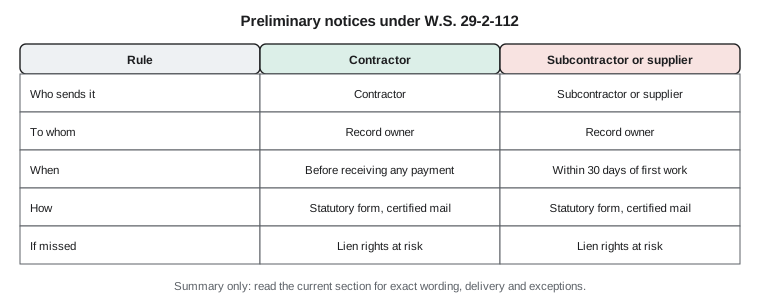
Sagebrush Line built the notice into its job start checklist. For a prime contract, Ruth sends the notice with the signed contract, before the company accepts any deposit. For a subcontract, she sends the notice to the record owner within the first week of work, using the county assessor's records to find the record owner's name and address. She keeps the certified mail receipts in the job file.
The notice of intent and the lien statement
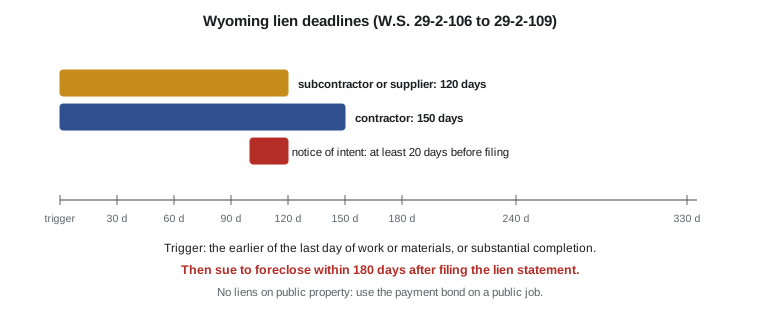
Before filing a lien statement, every claimant must send the owner a notice of intention to file, by certified mail, at least 20 days before filing, under W.S. 29-2-107. The notice states the amount claimed and gives the owner a chance to resolve the claim. If the claim is not resolved, the claimant files a sworn lien statement in the office of the county clerk of the county where the property is located.
The filing deadline comes from W.S. 29-2-106. A contractor must file within 150 days, and every other claimant, including subcontractors and suppliers, within 120 days. The period runs from the earlier of the last day the claimant performed work or furnished materials under the contract, or the date of substantial completion of the project. For a subcontractor, the statute also allows the period to run from the last day it performed work at the contractor's direction. The record owner may record a notice of substantial completion, which creates a rebuttable presumption that the recording date is the substantial completion date. The notice cannot extend the filing time. The parties may agree in writing, signed and notarized by the owner, the contractor and the other parties, to extend the filing time, but not beyond twice the time otherwise allowed.
After filing, the claimant sends the owner a copy of the lien statement by certified mail. Summaries checked for this course give different deadlines for that mailing, so read the current statute and send the copy promptly. Finally, the claimant must sue to foreclose the lien within 180 days after filing the lien statement, under W.S. 29-2-109, or the lien is lost.
Worked problem
Counting a subcontractor's lien deadlines
Sagebrush Line is a subcontractor on a private retail building. Its last day of work was March 10, and the project was substantially complete on March 20. The general contractor has not paid the final 42,000 dollars.
Show solution
- Trigger: the earlier of last work (March 10) and substantial completion (March 20), so March 10.
- Filing deadline for a subcontractor: 120 days after March 10, which is July 8.
- Send the notice of intent at least 20 days before filing, so send it no later than June 18 to keep July 8 available.
- Foreclosure: sue within 180 days after the lien statement is filed.
Answer: Send the notice of intent by June 18, file by July 8, and calendar the 180-day foreclosure deadline from the filing date.
Lien waivers
Owners and general contractors commonly require lien waivers in exchange for progress and final payments. Wyoming provides statutory waiver forms, and a waiver that does not substantially follow the statutory language may be unenforceable. A careful contractor signs conditional waivers, which take effect only when the payment actually clears, for progress payments, and signs an unconditional final waiver only after the final payment has cleared. Signing an unconditional waiver before the money arrives can give away the lien right for nothing.
Bonding off a lien
An owner or contractor who disputes a lien may be able to release it from the property by posting a bond. Summaries of Wyoming law describe a bond of one and a half times the claim amount in some settings; read the current statute before relying on the figure. The claimant then pursues the bond instead of the property. The practical effect is that the property can be sold or refinanced while the dispute continues.
Public works
Liens cannot be filed against public property, so subcontractors and suppliers on public jobs rely on the contractor's payment bond. Wyoming's public works statutes require bonds on public contracts, and the bond claim procedure, notice deadlines and thresholds are set out in the statute and repeated in the bid documents. A subcontractor on a school, county or city job should read the bond provisions at the start of the job, send any required notices on time, and calendar the deadlines. Missing a bond notice is as costly as missing a lien deadline.
Prompt payment and records
Wyoming has prompt payment rules for public contracts, setting time limits for paying contractors and for contractors to pay subcontractors, with interest on late payments. Private contracts depend mainly on their own terms. Whatever the rules, good records decide most payment disputes: signed contracts and change orders, daily reports, delivery tickets, inspection records, and correspondence. Ruth keeps all of them in the job file from the first day.
# Wyoming lien deadline calculator (summary of W.S. 29-2-106, -107, -109; confirm current law)
from datetime import date, timedelta
last_work = date(2027, 3, 10)
substantial_completion = date(2027, 3, 20)
claimant = "subcontractor"            # or "contractor"
trigger = min(last_work, substantial_completion)
days = 150 if claimant == "contractor" else 120
file_by = trigger + timedelta(days=days)
notice_by = file_by - timedelta(days=20)
print("Trigger:", trigger)
print("Send notice of intent by:", notice_by)
print("File lien statement by:", file_by)
print("Then sue within 180 days of the filing date")Trigger: 2027-03-10 Send notice of intent by: 2027-06-18 File lien statement by: 2027-07-08 Then sue within 180 days of the filing date
Residential customers
Homeowners often do not know the lien law exists. The preliminary notice under W.S. 29-2-112 is how the law tells them, and the statutory form explains in plain words what a lien is and how the owner can protect the property. A contractor who sends the notice before the deposit, explains it in a sentence, and answers questions builds trust instead of alarm. A contractor who skips the notice to avoid an awkward conversation may find later that the lien right was lost along with the conversation.
On residential remodels, Sagebrush Line uses a short written contract with the scope, the price, the payment schedule, the change order process, the permit responsibility and the warranty. It attaches the preliminary notice and asks the homeowner to sign a receipt for it. Most residential payment disputes are settled with a phone call when the paperwork is that clear.
Disputes short of a lien
A lien is a strong tool but an expensive one, and it often ends a working relationship. Most payment problems are better handled earlier: a call to the owner or general contractor, a written statement of the amount due with the supporting documents, a meeting to resolve disputed change orders, and, if the contract provides for it, mediation. The lien deadlines keep running during those talks, so the master should calendar the notice of intent and filing dates on the day the last work is done and keep the lien available while negotiating.
Keep a lien calendar for every open job. Ruth's calendar lists, for each job, the date the preliminary notice was sent, the last day of work, the substantial completion date if the owner recorded one, the notice of intent deadline, the filing deadline and, once a lien is filed, the 180-day suit deadline. The calendar is reviewed every Monday with the open accounts receivable, so that a slow-paying account never reaches its deadline unnoticed.
Common mistakes
MistakeCounting the filing deadline from the date of the final invoice.
InsteadCount from the earlier of last work or materials, or substantial completion.
MistakeGiving a subcontractor 150 days.
InsteadContractors have 150 days; subcontractors, suppliers and other claimants have 120.
MistakeFiling the lien statement without the 20-day notice.
InsteadSend the notice of intention by certified mail at least 20 days before filing.
MistakeWaiting a year to sue on a lien.
InsteadSue to foreclose within 180 days after filing the lien statement.
MistakeFiling a lien on a public school.
InsteadPublic property cannot be liened; use the payment bond.
Summary and key terms
- Read scope, change order, payment, retainage, indemnity and flow-down clauses before signing.
- Under W.S. 29-2-112, a contractor gives notice before receiving payment; a subcontractor or supplier within 30 days of first work.
- Send a notice of intention to file at least 20 days before filing (W.S. 29-2-107).
- File within 150 days (contractor) or 120 days (others) from the earlier of last work or substantial completion (W.S. 29-2-106).
- Sue to foreclose within 180 days after filing (W.S. 29-2-109).
- Public property cannot be liened; payment bonds protect subcontractors and suppliers on public work.
- Mechanics' lien
- A claim against improved property to secure payment for work or materials.
- Preliminary notice
- The early notice of a right to file a lien that W.S. 29-2-112 requires.
- Intention notice
- The notice of intention, sent to the owner before a lien statement is filed.
- Substantial completion
- The point at which the project can be used for its purpose; one trigger for the filing deadline.
- Conditional waiver
- A lien waiver that takes effect only when the payment clears.
Practice problems
Work each problem on paper first, then reveal the answer to check.
A contractor's last work was May 1 and substantial completion was May 15. When must it file?
Show answer
Within 150 days of May 1, the earlier date.
How many days before filing must the notice of intent be sent?
Show answer
At least 20 days.
When must a subcontractor send its preliminary notice?
Show answer
Within 30 days after first furnishing work or materials.
How long does a claimant have to sue after filing?
Show answer
180 days.
Can an owner's notice of substantial completion extend the filing deadline?
Show answer
No.
Lesson quiz · 5 questions
Score 60% or more to complete this lesson.
Create a free account to save your progress, take quizzes and earn a certificate.