
MELU-325 · Lesson 6 of 12 · 20 min
Permits, inspections and the inspection authority
▶ Video coming soon A video version of this lesson is on the way.
A Wyoming electrical permit is the job's legal starting point. It tells the inspection authority that work is coming, identifies the licensed contractor and master responsible for it, and sets up the inspections that confirm the work meets the code. In most of the state the permit comes from the Department of Fire Prevention and Electrical Safety and the inspector is a state electrical inspector assigned to the county. In cities and counties that hold delegated authority, the local building department issues the permit and its certified electrical inspector does the inspections. This lesson covers when a permit is needed, how the state's online process works, the inspection cycle, and how corrections and appeals are handled.
When a permit is required
The Department's wiring permit page states the trigger in practical terms: a permit is required before new construction or remodeling of any building, mobile home or premises if the work requires a public utility to connect, or to disconnect and restore, power. Temporary power also requires a permit. In other words, if the utility will set or reset a meter, the job needs a permit. Work in a delegated city follows the city's permit rules, which are commonly broader and may require permits for alterations that never involve the utility. Check local rules for every delegated jurisdiction.
The utility link is a strong enforcement tool. A Wyoming electric utility generally will not connect or reconnect service for new construction or remodeling without the release that follows a passed inspection on a permitted job. A contractor who skips the permit can find the customer without power at the moment the job is supposed to be finished.
Exemptions
Installations exempt from licensing under W.S. 35-9-123, such as work by oil and gas operations and related facilities, by public utilities on their own facilities, by certain telecommunications providers on low voltage work, and on farms and ranches of forty acres or more of deeded land, do not need a state wiring permit. The Department's page adds the important limit: the exemption does not apply if the exempt person or company uses a subcontractor to do work governed by the NEC. A ranch owner wiring his own barn does not need a state permit. Sagebrush Line, hired to wire the same barn, needs one.
Homeowners are a separate case. The Department offers a homeowner wiring permit for a property owner doing work on their own property, applied for through the same portal. The homeowner takes responsibility for the work and the inspections. A contractor should never pull a homeowner permit or let a customer pull one for work the contractor performs.
The state's online permit process
The Department no longer issues counter permits; applications go only through its online portal. For a contractor, the portal account must be tied to a current electrical contractor license in good standing, and only the master of record and the company's designated contractor administrators can reach the permit application. The applicant gives the job address or GPS coordinates, the scope of work and the service size, and pays the fee. The Department's page lists the wiring permit fee at 50 dollars, waived if the applicant requests and pays for an electrical inspection under the inspection fee chart, and a temporary wiring permit at 40 dollars. The processing fee on card payments, effective April 1, 2025, is 2.5 cents on the dollar with a one-dollar minimum. Fees change; confirm them before applying.
Once issued, the permit is printed and posted at the job. The Department's homeowner instructions tell the applicant to place the printed permit in a waterproof bag and attach it to the meter housing, and contractors follow the same practice. A temporary permit is valid for 90 days unless the applicant requests a longer period, matching the NEC's treatment of temporary installations in Article 590 as a short-duration use.
| Item | State jurisdiction | Delegated city or county |
|---|---|---|
| Who issues the permit | Department, online portal | Local building department |
| Who inspects | State electrical inspector for the county | Local certified electrical inspector |
| Fee schedule | State fee and inspection fee chart | Local fee schedule |
| Code edition | State-adopted edition and amendments | Local adoption, at least as strict as the state's |
| Contractor license | State electrical contractor license | State license plus any local registration |
Plan review
Larger projects may require plan review before construction. The Department's permit page describes its plan review timelines: submittals are accepted or rejected for completeness within five business days, and a complete submittal is reviewed within 21 business days after acceptance, or within 10 business days after the Department receives information it requested, whichever is longer. No work may begin until the permit to construct is issued. State-owned and state-leased buildings, including schools, follow special rules, and some delegated localities hold sole plan review authority for them under W.S. 35-9-121(b). On a large job, plan review time belongs in the schedule from the first meeting.
The inspection cycle
Inspections follow the order of the work. A typical new building has an underground or slab inspection where conduits or cables are buried, a rough-in inspection before walls are covered, a service inspection before the utility connects, and a final inspection when the work is complete. A small job may need only a final. Each inspection must be requested; the inspector does not appear on his own. For state jobs, the permit holder contacts the county's state electrical inspector to schedule. The Department's page lists inspectors by county with their contact details and a jurisdiction map.
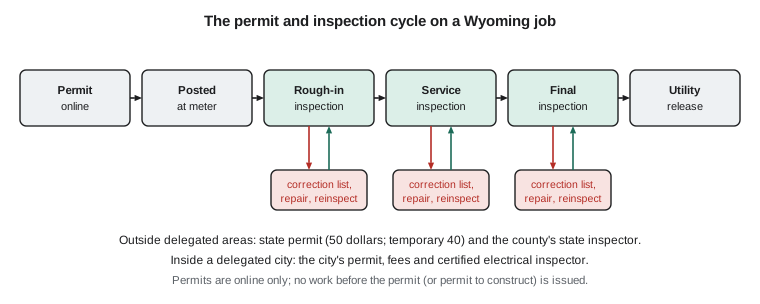
Wyoming's distances shape the schedule. A state inspector may cover a large county or more than one county, and a rough-in in a remote area may need to wait for the inspector's next trip. Ruth books inspections as soon as the crew can predict a ready date and tells the superintendent the confirmed date, so that drywall is not scheduled ahead of the inspection. Covering work before inspection is one of the most expensive mistakes a contractor can make, because the inspector can require the cover removed.
Corrections and reinspection
When work fails, the inspector writes a correction notice that cites the code sections and describes what must change. The contractor corrects the work and requests a reinspection; there may be a reinspection fee. The master of record should read every correction notice, not just the foreman, because repeated violations are a pattern the Department can treat as grounds for discipline. Dana keeps a log of every correction Sagebrush Line receives, with the code section, the crew and the cause. Over a year, the log showed her that most corrections came from three causes: working space in front of panels, box fill in remodel work, and missing bonding jumpers on metal piping.
Worked problem
A failed rough-in
A state inspector fails a rough-in at a ranch shop because two device boxes are overfilled and a panel's working space is blocked by a framed shelf.
Show solution
- Read the notice: it cites the box fill section in Article 314 and the working space rule in Article 110.
- Correct the boxes by replacing them with deeper boxes or adding extension rings, calculated in the code book.
- Remove the shelf from the working space, and confirm the depth, width and height clearances.
- Request reinspection and do not cover the walls until it passes.
Answer: Correct both items, request reinspection and record the causes in the correction log.
Who holds authority where
Delegation can be partial. A locality may hold electrical authority but not building authority, or the reverse, and a locality with authority over only some standards must notify the Department of submitted project plans within ten days. When a city's authority reverts, for example because it has gone 120 days without a certified electrical inspector, the state takes over permits and inspections there until the city qualifies again. That is why Ruth confirms the authority for every new job rather than relying on what was true last year.
Disagreements and appeals
An inspector's decision can be discussed and, if necessary, appealed. The first step is a conversation: ask the inspector which section is cited and how the inspector reads it, and bring the code book. Many disagreements end there. In a delegated jurisdiction, the local appeals board hears requests for alternate methods and variances, and its decisions can go to the state Council and then to district court. Appeals must be heard within 30 days of the request. For state inspections, the Department's chief electrical inspector is the next step. A master should keep the discussion professional; the inspector will be back on the next job.
Closing out the job
When the final inspection passes, the inspector releases the job, the utility can connect, and the permit closes. Ruth files the permit, inspection results, correction notices and any plan review comments with the job record. For jobs canceled before completion, she asks the permit office to close or void the permit so that it does not sit open under the master's name. An open, expired permit can surface years later when an owner sells the building.
# Inspection scheduling check (illustrative)
ready_days = {"underground": 3, "rough-in": 12, "service": 18, "final": 40}
inspector_lead_days = 4   # days' notice the county inspector usually needs
for stage, ready in ready_days.items():
print(f"{stage}: request by day {ready - inspector_lead_days}, crew ready day {ready}")underground: request by day -1, crew ready day 3 rough-in: request by day 8, crew ready day 12 service: request by day 14, crew ready day 18 final: request by day 36, crew ready day 40
State-owned buildings and schools
State-owned and state-leased buildings, including public schools, follow special rules. The state fire marshal and the chief electrical inspector keep authority over them except where a delegated locality has taken sole plan review and inspection authority under W.S. 35-9-121(b). Plan review is usually required, and electrical plans examiners and inspectors for state buildings must meet higher certification levels: the delegation rules require a current Wyoming master license for an electrical plans examiner, and for an electrical inspector who inspects state-owned or leased facilities. A contractor bidding a school job should expect longer plan review times, a separate inspection sequence and stricter documentation.
Working with inspectors
Inspectors are busy people covering large territories. The jobs that go best are the ones where the contractor is ready: work complete for the stage, panel covers off where needed, the permit posted, the plans on site, labels in place, and a person on site who can answer questions. Dana's rule for her crews is that nobody calls for an inspection until the foreman has walked the work with the inspection checklist. The rule cut Sagebrush Line's reinspection rate in half in one year.
The same readiness applies to paperwork. On a state job, the permit must be posted at the meter base, and the job address on the permit must match the site. On a job in a delegated city, the city's permit card and approved plans should be on site. When an inspector cannot find the permit or the plans, the inspection can fail for that reason alone, and the crew loses a day waiting for the next trip.
Common mistakes
MistakeStarting work before the permit is issued.
InsteadNo work may begin until the permit or permit to construct is issued.
MistakeAssuming the ranch exemption covers a hired contractor.
InsteadThe exemption does not apply when an exempt owner uses a contractor or subcontractor.
MistakeCovering work before rough-in inspection.
InsteadRequest inspections early and do not cover work until it passes.
MistakeLetting a customer pull a homeowner permit for contractor work.
InsteadHomeowner permits are for owners doing their own work.
MistakeAssuming last year's authority still applies.
InsteadDelegated authority can change or revert; confirm it for every job.
Summary and key terms
- A state permit is required for new construction or remodeling when the utility must connect, or disconnect and restore, power, and for temporary power.
- State permits are online only; only the master of record and contractor administrators can apply for the company.
- The Department lists the wiring permit at 50 dollars and the temporary permit at 40 dollars, valid for 90 days.
- Inspections follow the work: underground, rough-in, service and final, each requested by the permit holder.
- Delegated cities and counties issue their own permits and inspect with certified inspectors.
- Appeals in delegated areas go to the local appeals board, then the Council, then district court.
- Wiring permit
- The state's authorization to perform electrical work at a location.
- Permit to construct
- The authorization, after plan review, to start work on a reviewed project.
- Correction notice
- An inspector's written list of violations to correct before reinspection.
- Release
- The inspector's approval allowing the utility to connect.
- Reversion
- The return of delegated authority to the state when a locality stops qualifying.
Practice problems
Work each problem on paper first, then reveal the answer to check.
Does a service upgrade that requires the utility to disconnect and restore power need a state permit outside delegated areas?
Show answer
Yes.
Who can apply for a permit on Sagebrush Line's portal account?
Show answer
The master of record and the company's contractor administrators.
How long is a temporary wiring permit valid?
Show answer
90 days, unless a longer period is requested.
What must happen before work begins on a project that requires plan review?
Show answer
The permit to construct must be issued.
Who inspects a job inside a city with delegated electrical authority?
Show answer
The city's certified electrical inspector.
Lesson quiz · 5 questions
Score 60% or more to complete this lesson.
Create a free account to save your progress, take quizzes and earn a certificate.