
MELU-325 · Lesson 10 of 12 · 22 min
Workplace safety law and OSHA for electrical contractors
▶ Video coming soon A video version of this lesson is on the way.
Electrical contracting is dangerous work, and Wyoming's law reflects that in two ways. Workplace safety for private employers is enforced by Wyoming OSHA, a state plan run by the Department of Workforce Services, rather than directly by federal OSHA. And workers compensation is provided only through the state's own fund, which every electrical contractor with employees must join. A master of record is not the company's safety officer by title, but as the person who directs and supervises the work, the master shapes how safely it is done. This lesson covers the safety standards that apply, the injury reporting clocks, and the workers compensation system.
Wyoming OSHA
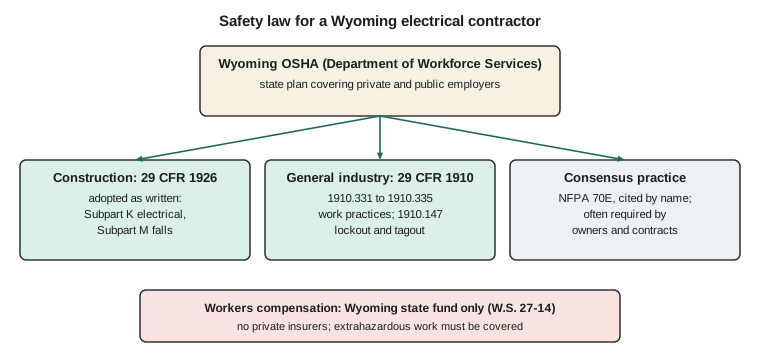
The federal Occupational Safety and Health Act allows states to run their own safety programs if they are at least as effective as federal OSHA. Wyoming does. Wyoming OSHA, part of the Department of Workforce Services with its main office in Cheyenne, covers private-sector workplaces in the state and state and local government employers. Federal OSHA keeps jurisdiction over some workplaces, such as Yellowstone National Park, federal employers including the Postal Service, F. E. Warren Air Force Base and certain federal energy facilities, but almost every job Sagebrush Line does falls under Wyoming OSHA.
Wyoming adopts federal OSHA standards as they are written, with small changes to the administrative subparts so that they fit the state law, and it adopts new federal standards within six months of their promulgation. The state plan also has some standards of its own, for oil and gas well drilling and servicing and for anchors. For an electrical contractor, that means the federal construction standards in 29 CFR Part 1926 and the general industry standards in Part 1910 apply in Wyoming as written, enforced by state inspectors.
The standards that matter most
On construction sites, Subpart K of Part 1926 covers electrical safety: ground-fault protection for temporary power through GFCIs or an assured equipment grounding conductor program, the condition of cords and tools, guarding of live parts, and lockout and tagging of circuits. Subpart M covers fall protection, which applies to electricians on roofs, mezzanines and lifts. Subpart X covers ladders, where many electrical injuries begin. Subpart CC covers cranes, including the clearances from overhead power lines. Subpart V covers power transmission and distribution work.
In existing buildings and plants, the general industry standards apply to maintenance work. Sections 1910.331 through 1910.335 set electrical safety-related work practices: deenergizing before work, lockout and tagging, qualified persons, approach distances, protective equipment and alerting techniques. Section 1910.147 sets the general lockout and tagout program. NFPA 70E, the consensus standard for electrical safety in the workplace, is not itself an OSHA regulation, but it describes how to meet OSHA's general requirements for electrical hazards, and many owners, especially in energy and industrial work, require contractors to follow it.
| Topic | Main rule | Typical electrical example |
|---|---|---|
| Temporary power | 29 CFR 1926.404 (GFCI or assured grounding program) | Cords and tools on a construction site |
| Lockout and tagging | 29 CFR 1926.417; 1910.147 and 1910.333 | Working on a panel in an occupied plant |
| Fall protection | 29 CFR 1926 Subpart M | Installing rooftop equipment |
| Ladders | 29 CFR 1926 Subpart X | Pulling wire in a high ceiling |
| Power lines and cranes | 29 CFR 1926 Subpart CC | Setting equipment near overhead lines |
| Arc flash practice | NFPA 70E (consensus standard) | Energized troubleshooting |
Energized work
The core rule for electrical work is simple: deenergize, lock and tag, and test before touching. OSHA's work practice rules allow energized work only where deenergizing would create a greater hazard or is infeasible because of the equipment design or operating limits, and then only by qualified persons with the right protective equipment and procedures. Troubleshooting and testing are the common legitimate cases. Convenience is not. A customer who asks Sagebrush Line to replace a breaker in a live panel because a shutdown is inconvenient is asking for something the rules do not allow.
Worked problem
A shutdown request
A retail customer asks Dana's crew to add a circuit in a panel that feeds the store's registers, without shutting the panel off during business hours.
Show solution
- Ask whether deenergizing creates a greater hazard or is infeasible: closing registers is an inconvenience, not a greater hazard.
- Schedule the work before opening or after closing, with the panel deenergized, locked, tagged and tested.
- Write the schedule into the work order and get the customer's signature.
- Do not let a crew member work the panel live to save time.
Answer: Schedule a deenergized shutdown; the convenience of the customer does not justify energized work.
Reporting serious injuries
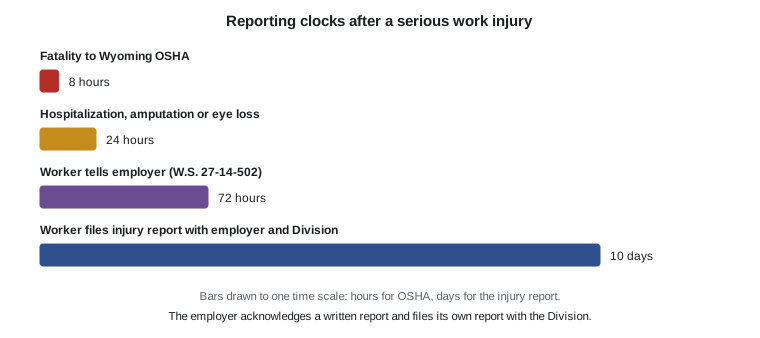
Wyoming has adopted the federal recordkeeping and reporting rules. Under 29 CFR 1904.39, an employer must report a work-related fatality to OSHA within 8 hours of learning of it, and an inpatient hospitalization, an amputation or the loss of an eye within 24 hours. In Wyoming, those reports go to Wyoming OSHA. Employers with more than ten employees in most industries, including construction, must also keep the OSHA injury and illness log and post the annual summary.
Workers compensation has its own clocks. Under W.S. 27-14-502, an injured employee must report the occurrence and general nature of the injury to the employer as soon as practical, and no later than 72 hours after the injury's general nature became apparent. Within ten days after the injury became apparent, the employee must file an injury report with both the employer and the Workers' Compensation Division. The employer must acknowledge a written report it receives and file its own report with the Division. A worker who fails to report as required faces a presumption that the claim will be denied, which the worker can overcome only with clear and convincing evidence that the employer and the Division were not prejudiced.
Workers compensation in Wyoming
Wyoming's workers compensation system is a state fund, administered by the Workers' Compensation Division of the Department of Workforce Services under W.S. 27-14-101 and the following sections. Private insurers do not write Wyoming workers compensation coverage. Coverage is compulsory for employers in occupations the statute lists as extrahazardous, which include construction and electrical work, and other employers may elect coverage. Premiums are based on the employer's payroll, its industry classification and its experience, and the state offers premium discounts through safety programs.
Workers compensation is a trade. Injured workers receive medical benefits and wage replacement without having to prove the employer was at fault, and in return covered employers are generally protected from lawsuits by their employees for workplace injuries. An employer that fails to keep required coverage loses that protection and can face penalties and liability for the full cost of the injury. Contractors are also responsible for making sure subcontractors have their own coverage, because an uncovered subcontractor's workers can become a claim on the general contractor's account.
Sagebrush Line registers each new employee on its account, reports payroll as the Division requires, and keeps a letter of good standing on file to send to cities and general contractors. When it hires a subcontractor, Ruth asks for the subcontractor's own Wyoming letter of good standing before the subcontractor starts work.
Building a safety program
The best way for a master to meet the duty to supervise safely is a written program the crews actually use. Sagebrush Line's program has a lockout and tagout procedure with locks issued to each electrician, a GFCI or assured grounding program for temporary power, a ladder and lift policy, a fall protection plan for roof work, arc flash labels and personal protective equipment matched to the company's typical equipment, a weekly toolbox talk, and an incident reporting procedure that starts with the clocks above. Wyoming OSHA offers free consultation services for small employers that want help building such a program without the risk of a citation.
Safety is also a business issue. A company with a good safety record pays lower workers compensation premiums, wins more work from owners who check safety records, and keeps its experienced people. A serious injury can cost far more than the job that caused it.
# Reporting deadline check after an incident (illustrative)
from datetime import datetime, timedelta
event = datetime(2027, 2, 9, 14, 30)
clocks = {
    "fatality report to Wyoming OSHA": timedelta(hours=8),
    "hospitalization/amputation/eye loss report": timedelta(hours=24),
    "worker notice to employer (W.S. 27-14-502)": timedelta(hours=72),
    "worker injury report to employer and Division": timedelta(days=10),
}
for name, span in clocks.items():
print(f"{name}: by {event + span:%b %d %H:%M}")fatality report to Wyoming OSHA: by Feb 09 22:30 hospitalization/amputation/eye loss report: by Feb 10 14:30 worker notice to employer (W.S. 27-14-502): by Feb 12 14:30 worker injury report to employer and Division: by Feb 19 14:30
Investigations and citations
Wyoming OSHA inspects workplaces after serious accidents, in response to complaints and referrals, and through programmed inspections of high-hazard industries such as construction. Inspectors present credentials, hold an opening conference, walk the site, interview workers and review records, and close with a conference that describes any apparent violations. Citations list the standard violated, the abatement date and the proposed penalty. An employer may contest a citation within the time the citation states. A master should know the company's procedure for an inspection: who meets the inspector, who walks with the inspector, and where the safety program, training records and the injury log are kept.
Training records matter in every inspection. OSHA's electrical work practice rules require that employees be trained in the safety practices that apply to their jobs, and the lockout and tagout rule requires training and periodic inspections of the procedure. A company that trains its people but cannot prove it is in a weak position. Sagebrush Line records every toolbox talk, every lockout training session and every lift or ladder training, with the date, the topic, the trainer and the signatures of those who attended.
Retaliation
Workers have the right to report hazards, injuries and safety concerns without retaliation. Wyoming OSHA handles retaliation complaints for private and public workplaces under the state law, and federal OSHA keeps its own authority for private-sector complaints under Section 11(c) of the federal act. A supervisor who punishes a worker for reporting an injury or refusing an imminently dangerous task exposes the company to a retaliation claim, and destroys the trust a safety program needs. The master should make clear that reporting is expected, not punished.
Worked problem
A first report
An apprentice cuts his hand on a sharp box edge on Monday morning and tells his journeyman at lunch. He finishes the day and sees a doctor that evening, who closes the cut with stitches.
Show solution
- The apprentice reported to his supervisor the same day, within the 72-hour limit of W.S. 27-14-502.
- He must file the injury report with the employer and the Workers' Compensation Division within ten days after the injury became apparent.
- The company acknowledges the written report and files its own report with the Division.
- Stitches are medical treatment beyond first aid, so the case is recorded on the OSHA log; it is not a hospitalization, so no 24-hour report is needed.
Answer: Report and record the injury on time; no OSHA phone report is required for this case.
Common mistakes
MistakeAssuming federal OSHA inspects private Wyoming job sites.
InsteadWyoming OSHA, a state plan, covers most private and public employers in the state.
MistakeTreating NFPA 70E as an OSHA regulation.
InsteadIt is a consensus standard often used to meet OSHA's general requirements and required by many owners.
MistakeWorking a live panel because a shutdown is inconvenient.
InsteadEnergized work is allowed only when deenergizing creates a greater hazard or is infeasible.
MistakeLetting an injured worker wait a week to report.
InsteadThe worker must tell the employer within 72 hours and file the injury report within 10 days.
MistakeHiring a subcontractor without checking its workers compensation.
InsteadAsk for the subcontractor's Wyoming letter of good standing before it starts.
Summary and key terms
- Wyoming OSHA, a state plan in the Department of Workforce Services, covers private and public employers in the state.
- Federal standards in 29 CFR 1926 and 1910 apply as adopted; NFPA 70E is a consensus standard.
- Report a fatality within 8 hours and a hospitalization, amputation or eye loss within 24 hours.
- An injured worker must notify the employer within 72 hours and file an injury report within 10 days.
- Workers compensation is provided only through the state fund; electrical work is extrahazardous and must be covered.
- A written safety program protects workers, the master and the company.
- State plan
- A state safety program approved by federal OSHA that enforces standards in place of federal OSHA.
- Extrahazardous
- The Wyoming classification of occupations for which workers compensation coverage is compulsory.
- Lockout and tagout
- Procedures that keep equipment deenergized while people work on it.
- Qualified person
- A worker trained to recognize and avoid electrical hazards on the equipment involved.
- State fund
- A workers compensation system in which the state, not private insurers, provides coverage.
Practice problems
Work each problem on paper first, then reveal the answer to check.
Who would inspect a Sagebrush Line job site after a serious injury?
Show answer
Wyoming OSHA.
Within how many hours must a fatality be reported?
Show answer
8 hours.
Within how many hours must an injured worker tell the employer?
Show answer
72 hours.
Can Sagebrush Line buy workers compensation from a national insurer?
Show answer
No, only the Wyoming state fund provides it.
Is NFPA 70E a federal regulation?
Show answer
No, it is a consensus standard.
Lesson quiz · 5 questions
Score 60% or more to complete this lesson.
Create a free account to save your progress, take quizzes and earn a certificate.