
MELU-325 · Lesson 4 of 12 · 22 min
The exam format and the references allowed
▶ Video coming soon A video version of this lesson is on the way.
Three weeks before her appointment, Dana printed the ICC bulletin page for exam 701 and taped it inside the cover of her code book. The bulletin is the contract between the candidate and the testing program: it states the number of questions, the time, whether the exam is open book, the code edition and the references allowed. A candidate who studies from memory of what a coworker took five years ago is studying for a different exam. This lesson works through the published facts, the references, how to prepare a code book within the rules, and how the question styles reward a well-organized candidate.
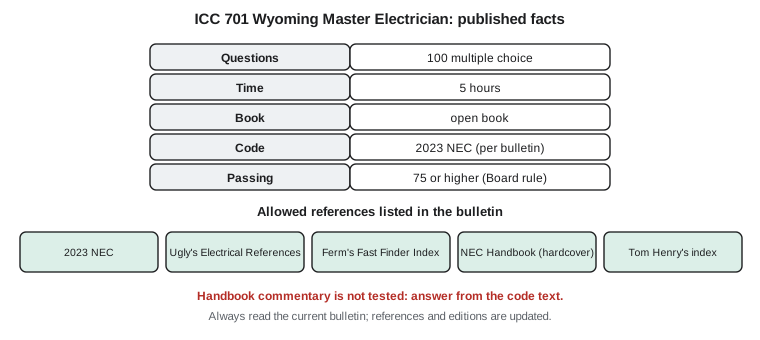
The published facts
The ICC bulletin for Colorado and Wyoming electrical exams describes exam 701, Wyoming Master Electrician, as 100 multiple choice questions with a five-hour time limit, open book, based on the 2023 National Electrical Code. The bulletin does not print the passing score; the Board's rule in Chapter 5 sets it at 75 for the master license. The Department's licensing page says only that the exam is based on the current NEC, so the bulletin is the document to follow for the edition. Lesson 5 explains why the exam's edition and the edition in force on job sites can differ.
Five hours for 100 questions is three minutes a question on average. That is generous for a question that needs one quick lookup and tight for a load calculation with several steps. The time is enough only for a candidate who knows where things are in the code and does not research every question from scratch.
| Item | Exam 701 as published | Where it comes from |
|---|---|---|
| Questions | 100 multiple choice | ICC bulletin |
| Time | 5 hours | ICC bulletin |
| Open or closed book | Open book | ICC bulletin |
| Code edition | 2023 NEC | ICC bulletin |
| Passing score | 75 | Board rule, Chapter 5 Section 3 |
| Fee | 115 dollars | ICC bulletin |
| Retake | After a 10-day wait | ICC bulletin |
The allowed references
The bulletin lists the references a candidate may bring into the exam room: the 2023 National Electrical Code, Ugly's Electrical References, Ferm's Fast Finder Index published by the IAEI, the NFPA National Electrical Code Handbook in hardcover only, and Tom Henry's Key Word Index. The bulletin also states that the Handbook's explanatory material is not tested; questions are based only on the code provisions themselves. A candidate may bring the Handbook for its index and its full code text, but should never answer from the commentary when the commentary and the code text seem to differ.
Each reference has a job. The NEC itself is the authority; every answer must come from it. A key word index or fast finder helps a candidate find the right article quickly when the question uses a term the NEC's own index does not. Ugly's is a quick source for formulas, conversions and common values, useful for checking a calculation. The Handbook's diagrams and explanations can help a candidate understand a rule during study, but in the exam room the commentary is a trap if it tempts the candidate to answer from explanation rather than from the rule text.
Preparing a code book within the rules
Candidates usually tab and highlight their code books, and testing programs generally allow it within limits. Permanent tabs marking articles, and highlighting of key words, are common. Loose sheets, inserted pages, handwritten formulas and sticky notes with notes on them are usually not permitted. The limits are set by the bulletin and by the testing company's rules, and they are enforced at check-in. Read the current wording before you buy a tab set, and do not write anything in the book that a proctor could treat as a note.
Dana's tabbing plan followed the structure of the code rather than her memory of past exams. She tabbed every chapter, then the articles she uses most: Article 90 for scope, Article 100 for definitions, Article 110 for working space, Articles 210, 215, 220 and 230 for branch circuits, feeders, calculations and services, Article 240 for overcurrent protection, Article 250 for grounding and bonding, Articles 300 through 358 for wiring methods, Article 310 for conductor ampacity, Articles 430 and 450 for motors and transformers, Article 517 for health care facilities, Chapter 5 for hazardous locations, Article 680 for pools, and Article 690 for solar systems. She highlighted the key word in each section heading she had to search for more than once during practice.
Question styles
Master exams use several question styles, and each rewards a different skill. A direct lookup question names a rule's subject and asks for a value or a condition. A definition question asks what a term means under Article 100. A scenario question describes an installation and asks whether it complies or what is required. A calculation question asks for a load, a conductor size, a voltage drop, a box fill or a motor overcurrent setting. Some questions combine styles, such as a scenario that requires a calculation and then a table lookup.
Calculation questions take the most time, and they are often worth the same single point as a lookup. A candidate who spends twelve minutes on one calculation has spent the time of four lookup questions. The three-pass method in Lesson 12 deals with this: answer quick questions first, flag long ones, and return to them with the time that remains.
Worked problem
Reading a question carefully
A question asks for the minimum size of an equipment grounding conductor for a feeder protected by a 200-ampere breaker, copper conductors, and gives several distractors including the size of the ungrounded conductors.
Show solution
- Identify the rule: equipment grounding conductors are sized from the rating of the overcurrent device, under Article 250.
- Ignore the distractor: the ungrounded conductor size is not the input for this lookup, unless the question says the ungrounded conductors were increased in size.
- Find the value in the code's table for the 200-ampere device and copper material, in your own code book.
- Check whether anything in the question triggers an adjustment, such as conductors increased for voltage drop.
Answer: Answer from the device rating, not the conductor size, unless the question describes an increase that requires a proportional adjustment.
Wyoming content
Because exam 701 is a Wyoming exam rather than a generic national master exam, candidates should expect some questions grounded in Wyoming practice. The bulletin's content outline is the guide, and a candidate should read its list of subject areas and weights. Questions on Wyoming law, such as licensing categories, apprentice supervision or the master of record's responsibilities, are answered from the statute and rules, not from the NEC. A candidate who cannot bring the Wyoming statutes into the room must know those rules well enough to answer without them. Lessons 1, 2, 7 and 8 of this course cover the material most likely to appear.
Edition discipline
The single most common avoidable mistake on a code exam is answering from the wrong edition. Dana's daily work since July 2026 uses the edition the state now lists, while her exam uses the 2023 NEC named in the bulletin. Values, section numbers and even article structure change between editions. She studied only from the 2023 book for the exam and kept her newer book at the office. If the bulletin is updated to a newer edition before her test date, she will switch books and re-tab. A candidate should check the bulletin again in the week before the exam.
Practice under real conditions
Open book exams punish candidates who never practiced with the book. Dana took her practice exams sitting at a table with only the allowed references, a basic calculator and a timer, and she did not use the internet or her phone. After each practice exam she logged every miss by cause: did not know where to look, found the wrong rule, misread the question, made a calculation error, or ran out of time. Lesson 12 shows how she used the log.
# Pacing check for exam 701 (100 questions, 5 hours)
questions = 100
minutes = 5 * 60
avg = minutes / questions
print(f"Average time per question: {avg:.1f} minutes")
# A plan that answers 60 quick questions at 1.5 minutes each
quick = 60 * 1.5
remaining = minutes - quick
print(f"Time left for the other 40 questions: {remaining:.0f} minutes, "
f"{remaining / 40:.1f} minutes each")Average time per question: 3.0 minutes Time left for the other 40 questions: 210 minutes, 5.2 minutes each
Building a study plan around the bulletin
The bulletin's content outline lists the subject areas the exam covers and, in most ICC bulletins, how many questions come from each area. Dana turned the outline into a twelve-week plan. She listed each area, the number of questions it carried, and her own confidence in it from one to five. Areas with many questions and low confidence went first. Areas with few questions and high confidence went last. She then matched each area to a core course in this series: general requirements and definitions to MELU-101, calculations to MELU-102, conductors and overcurrent protection to MELU-103, grounding and bonding to MELU-104, motors and transformers to MELU-105, special occupancies to MELU-106, and business, law and safety to MELU-107 and the Wyoming lessons of this course.
The plan gave each week a target: read the relevant articles, work the course's practice questions for the area, take a short timed drill of twenty questions, and log every miss. Every third week she took a full practice exam instead of a drill. The routine kept her studying the code the way the exam tests it, by looking things up under time pressure, rather than by reading it from front to back.
Calculators and scratch material
Testing centers allow a basic calculator under rules the testing company sets, and they provide scratch material or an erasable board. Bring a calculator that is clearly allowed, usually a non-programmable model without a text memory, and practice with that exact model. A candidate who switches calculators on exam day can lose minutes to unfamiliar keys. Plan to write each calculation in the same order every time on the scratch material: the rule or table used, the inputs, each step, and the result with units. When a calculation answer does not match any option, the written steps show where to look for the error.
Reading the stem
Many wrong answers come from reading the question too fast. Read the whole stem before opening the book. Underline, mentally or on the scratch board, the words that change the answer: minimum or maximum, not or except, the voltage, the occupancy, the location, the conductor material, the insulation temperature rating, and whether the question asks about a dwelling or another occupancy. A question about a dwelling unit kitchen and a question about a commercial kitchen may point to different rules. Then decide which article should answer the question, open the book there, and confirm.
Worked problem
A stem with a trap word
A question asks which installation is NOT permitted for a particular wiring method in a wet location, and lists three permitted installations and one prohibited one.
Show solution
- Spot the trap word: NOT. The answer is the one installation the code prohibits.
- Find the article for the wiring method and its uses permitted and uses not permitted sections.
- Check each option against the uses not permitted list and any wet location conditions.
- Choose the option the code excludes, and confirm that the other three are permitted.
Answer: Answer with the excluded installation; a candidate who misses the word NOT will choose a permitted one.
Common mistakes
MistakeAnswering from the Handbook's commentary.
InsteadThe bulletin says explanatory material is not tested; answer from the code text.
MistakeStudying from the edition used on job sites.
InsteadUse the edition the current bulletin names for the exam.
MistakeWriting formulas inside the code book.
InsteadFollow the bulletin's limits on tabs and highlighting; handwritten notes are generally not allowed.
MistakeSpending ten minutes on the first calculation.
InsteadFlag long questions and return to them after the quick ones.
MistakeIgnoring Wyoming law questions because the NEC is open.
InsteadKnow the statute and rules well enough to answer without them.
Summary and key terms
- ICC exam 701 is 100 multiple choice questions in 5 hours, open book, on the 2023 NEC per the bulletin.
- The master passing score of 75 comes from the Board rule.
- Allowed references include the 2023 NEC, Ugly's, Ferm's Fast Finder, the NEC Handbook in hardcover and Tom Henry's Key Word Index.
- Handbook commentary is not tested; answer from code provisions.
- Tab and highlight within the bulletin's limits and practice with only the allowed books.
- Check the current bulletin again shortly before the exam.
- Candidate bulletin
- The testing program's document stating the exam's format, references and rules.
- Open book
- An exam in which approved references may be used.
- Key word index
- A reference that points from common terms to NEC articles and sections.
- Explanatory material
- Commentary in the NEC Handbook that is not part of the code and is not tested.
- Pacing
- Planning time per question so that every question gets an attempt.
Practice problems
Work each problem on paper first, then reveal the answer to check.
How many questions are on exam 701, and how long is it?
Show answer
100 questions in 5 hours.
Which edition does the bulletin name?
Show answer
The 2023 NEC; check the current bulletin.
May the NEC Handbook be brought in paperback?
Show answer
No, the bulletin allows it in hardcover only.
Is the Handbook's commentary tested?
Show answer
No; questions are based on the code provisions.
What is the average time per question?
Show answer
Three minutes.
Lesson quiz · 5 questions
Score 60% or more to complete this lesson.
Create a free account to save your progress, take quizzes and earn a certificate.