
MELU-325 · Lesson 1 of 12 · 21 min
How electrical licensing works in Wyoming
▶ Video coming soon A video version of this lesson is on the way.
Dana Whitfield has spent thirteen years in the electrical trade in Casper. She started in 2013 as a registered apprentice electrician with a small residential shop, finished her four years of classroom instruction through an approved apprenticeship program while she worked, and passed the Wyoming journeyman electrician exam in late 2020. Her journeyman license was issued in January 2021. For the last five years she has run crews for Sagebrush Line Electric, LLC, an eighteen-person contractor on the east side of Casper that wires homes, shops, oil field support buildings and a steady run of commercial tenant finishes. The company is invented for this course, but the questions it faces are real. Its owner, Carl Brandvold, has held a Wyoming master electrician license since 1999 and is the company's master of record. Carl is sixty-three and wants to step back. He has asked Dana to earn her own master license so that she can take over as master of record, and this course follows her from her first question to exam day.
This is the Wyoming course in the HSM University master electrician exam prep series. The core courses, MELU-101 through MELU-107, teach the National Electrical Code skills that every master-level exam tests: navigating the code, load calculations, conductors and overcurrent protection, grounding and bonding, motors and transformers, special occupancies, and business and law. This course adds what is specific to Wyoming: who licenses electricians and contractors, how a candidate qualifies, how the exam is booked and delivered, which edition of the code applies, how permits and inspections work across a large and thinly populated state, what the law expects of a master of record, and the contract, lien, safety and workers compensation rules a contractor lives with.
Two cautions apply to every lesson. First, licensing rules change. The facts in this course were checked in November 2026 against the Wyoming Statutes, the rules of the Department of Fire Prevention and Electrical Safety and its Electrical Board, the Department's licensing, permit and code pages, the International Code Council's candidate bulletin for the Wyoming master exam, the Wyoming Department of Workforce Services and the federal OSHA state plan page. Where a fact comes from a secondary source or could not be confirmed, the lesson says so. Before you apply, pay a fee or book an exam, check the current pages yourself. Second, electrical codes are copyrighted. This course cites code articles and sections by number and explains them in plain words, but it never reproduces their text, tables or figures. Keep your own copy of the code your exam uses open beside you.
One state system
Wyoming licenses electricians at the state level. A license issued by the state is valid anywhere in Wyoming, from Cheyenne to Cody, and the same agency that licenses electricians also issues electrical permits and runs inspections across most of the state. That agency is the Wyoming Department of Fire Prevention and Electrical Safety, headquartered in Cheyenne. Inside it, the Electrical Safety Division is led by the chief electrical inspector, and a team of state electrical inspectors covers the state county by county.
The legal framework is Title 35, Chapter 9, Article 1 of the Wyoming Statutes, which runs from W.S. 35-9-101 through 35-9-130. Those sections create the Department, the Council on Fire Prevention and Electrical Safety and the Electrical Board, set the licensing requirements, require permits and inspections, list the exemptions and set the penalties. The details sit in rules. The Department's rules include a chapter on electrical licensing, Chapter 5, which sets the experience and classroom requirements, the passing scores, the reciprocity conditions and the rules for contractors. Other chapters adopt codes and set out how enforcement authority can be delegated to cities and counties.
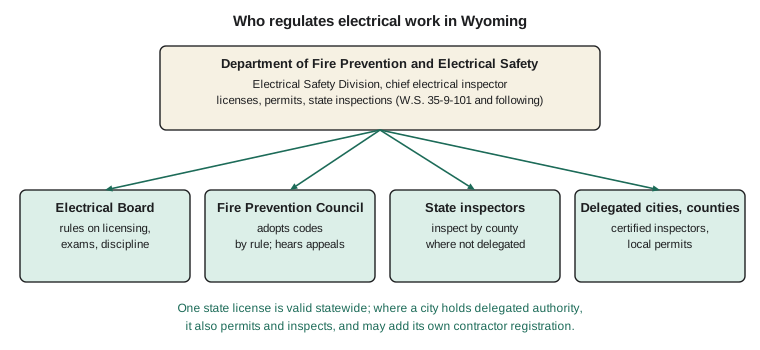
The bodies in the system
Three bodies matter most. The Department administers the program: it takes applications, issues licenses and permits, employs the inspectors and keeps the records. The Electrical Board, made up largely of people from the trade, makes rules on licensing and examinations and hears disciplinary matters. The Council on Fire Prevention and Electrical Safety adopts the fire and electrical codes by rule and hears appeals from local decisions. On the exam, the most common trap is to give one body a power that belongs to another, so it pays to remember who does what.
| Body | Main role | What a candidate meets |
|---|---|---|
| Department of Fire Prevention and Electrical Safety | Administers licensing, permits and state inspections | Application, approval letter, license card, permits |
| Electrical Board | Rules on licensing and exams; discipline | Experience and exam rules in Chapter 5 |
| Council on Fire Prevention and Electrical Safety | Adopts codes by rule; hears appeals | The code edition in force |
| Delegated city or county | Local permits and inspections where authority is delegated | Local permit office and inspector |
| Testing company | Delivers the exam | Pearson VUE booking for ICC exam 701 |
The license types
Wyoming issues individual licenses and contractor licenses, and the two work together. The individual licenses are apprentice electrician, journeyman electrician and master electrician, plus apprentice technician and technician licenses for low voltage and limited work such as alarms, communications, signs, elevators, water wells and HVAC controls. The contractor licenses are the electrical contractor license and the low voltage or limited contractor license. The individual license says what a person may do with their own hands and whom they may supervise. The contractor license says which businesses may contract to do electrical work for others.
The two levels connect through the master of record. An electrical contractor license requires a full-time master electrician licensed in Wyoming who serves as the company's master of record, and that master may serve only one company at a time. Every person doing electrical work for the contractor must be a licensed master or journeyman, or a registered apprentice working under the supervision the rules require. Lesson 7 covers the master of record's duties and Lesson 8 the contractor license.
That structure is why Carl's retirement matters to Sagebrush Line. If Carl stopped working full time for the company tomorrow, the company would lose its master of record. The rules give a contractor a short window, up to 30 days, to register a new master of record, and in the meantime the company must send the Electrical Safety Division a weekly report listing the licensed people who worked, the projects and hours, and each apprentice's supervision. Carl does not want the company to live on that clock. He wants Dana licensed and ready well before he leaves.
Where the state shares the work
Although licensing is statewide, inspection does not have to be. Under W.S. 35-9-121, the state fire marshal may delegate authority to enforce and interpret the fire, building and electrical standards to a city or county that applies and meets the requirements. A delegated locality must adopt standards at least as strict as the state's by ordinance or resolution, keep them current within six months of a new state standard, and employ properly certified inspectors. An electrical inspector in a delegated locality must hold an ICC or IAEI electrical inspector certification and a current Wyoming journeyman or master license. If the locality falls behind on its standards or goes without a certified inspector for 120 days, its authority reverts to the state.
In practice, this means a contractor working in a delegated city deals with the city's building department for permits and inspections, while the same contractor working in the county outside the city deals with the state. Casper's building and inspections division, for example, lists its own electrical inspector, and Gillette runs its own contractor licensing for electrical contractors. The license in Dana's wallet is the same everywhere; the permit office and the inspector change with the job's location. This course does not list every delegated locality, because the list changes. Before each job, confirm who holds electrical authority where the work sits.
What stays with each job
Sagebrush Line's office manager, Ruth Okafor, keeps a job sheet for every project. It names the jurisdiction, the permit number, the inspector, the code edition in force on the permit date, any local registration or insurance certificate on file, and the dates of each inspection. Last month the company had a tenant finish inside Casper, a shop building on a ranch property in unincorporated Natrona County, and a service upgrade for a retail building in Gillette. Each job had a different permit office. The Casper job went through the city. The Natrona County job went through the state's online portal and the county's state electrical inspector. The Gillette job required the company to hold Gillette's electrical contractor license, which in turn required a city master license for the master of record and a certificate of insurance on file with the city.
That variety is normal in Wyoming, and the exam expects a master to understand it. A question may describe a job and ask who issues the permit, who inspects, or what a contractor must do before starting work. The answer usually turns on two facts: whether the work is subject to licensing at all, and whether the location has delegated authority.
Exemptions
Not every electrical installation in Wyoming falls under the licensing and permit requirements. W.S. 35-9-123 lists exemptions, including work by oil and gas operations and related facilities such as refineries, mines and pipelines, by public utilities on their own facilities, by certain telecommunications and cable providers limited to low voltage work, and on farms and ranches of forty acres or more of deeded land. The exemptions are narrower than they look. Exempt persons must still meet the other code requirements, and the exemption does not extend to a contractor or subcontractor who is hired by an exempt owner. When a ranch owner hires Sagebrush Line to wire a shop, the company needs its license and a permit even though the rancher could have done the work personally.
This point appears on exams in many forms. A rancher wiring his own barn may be exempt. An electrician he hires is not. An oil company's own employees working on production facilities may be exempt. The electrical contractor the oil company hires to wire its new office building is not. Lesson 6 returns to exemptions when it covers permits.
Enforcement
Licensing would mean little without enforcement. The Department can refuse, suspend or revoke a license for causes set in the statute and rules, such as fraud in obtaining a license, gross negligence or incompetence, repeated code violations or allowing an unlicensed person to work. Inspectors can reject work and require corrections, and the statute makes violations of the licensing and permit requirements a criminal offense. Exam questions tend to ask who has which power and what conduct is a violation rather than the exact fine, and fine amounts can change, so check the current statute before relying on a number.
For a master of record, enforcement is personal. The master is the licensed person accountable for the company's electrical work. Carl has told Dana that his best protection has always been dull paperwork: a current license, permits pulled before work starts, inspections called on time, every worker on the job licensed or registered, apprentice ratios respected and a file for every job. Lesson 7 returns to these habits.
The exam picture
Wyoming uses a state-specific master exam delivered by the International Code Council through Pearson VUE. The ICC bulletin for exam 701, Wyoming Master Electrician, describes 100 multiple choice questions in five hours, open book, based on the 2023 National Electrical Code, and lists the references allowed in the room. The Board's rule sets the master passing score at 75. Unlike some states, Wyoming asks candidates to apply to the Department first; only after the Department approves the application does the candidate book the exam. Lessons 3 and 4 cover booking and the exam format.
How this course is organized
The lessons follow Dana's path. Lesson 2 covers eligibility for the master license, Lesson 3 the application and booking process, and Lesson 4 the exam format and references. Lesson 5 explains how Wyoming adopts the NEC and Lesson 6 permits and inspections. Lesson 7 covers the duties of the master license holder, Lesson 8 contractor licensing, insurance and bonding, and Lesson 9 contracts and mechanics' liens. Lesson 10 covers safety law, Wyoming OSHA and workers compensation, Lesson 11 renewal and continuing education, and Lesson 12 a practice review and test-day strategy. Every lesson ends with a quiz that mixes multiple choice, true or false, number, ordering and matching questions, and the course ends with a final exam.
The calculator below shows the first planning Dana did. Carl wants to step back in about fifteen months. Dana needs time to assemble notarized proof of her experience, apply, wait for approval, study, book and sit the exam, possibly retake it, and then let the company register her as master of record. Change the numbers to fit your own plan.
# Dana's planning check (illustrative months)
months_until_carl_steps_back = 15
steps = {
    "gather notarized experience letters": 1,
    "apply and wait for Department approval": 1,
    "study for the master exam": 4,
    "book and sit the exam": 1,
    "retake allowance, if needed": 2,
    "license issued; company registers Dana": 1,
}
needed = sum(steps.values())
for step, months in steps.items():
    print(f"{step}: {months} months")
print(f"Total: {needed} months; margin: {months_until_carl_steps_back - needed} months")gather notarized experience letters: 1 months apply and wait for Department approval: 1 months study for the master exam: 4 months book and sit the exam: 1 months retake allowance, if needed: 2 months license issued; company registers Dana: 1 months Total: 10 months; margin: 5 months
Common mistakes
MistakeThinking each Wyoming city issues its own electrician license instead of the state.
InsteadThe state issues journeyman and master licenses valid statewide; some cities add their own contractor registration or city license on top.
MistakeAssuming the state inspects every job.
InsteadCities and counties with delegated authority under W.S. 35-9-121 issue permits and inspect within their areas.
MistakeBelieving a ranch or oil field exemption covers the contractor hired to do the work.
InsteadThe exemptions in W.S. 35-9-123 do not extend to contractors or subcontractors hired by an exempt owner.
MistakeTreating the master license as a contractor license.
InsteadA business needs its own electrical contractor license, which rests on a full-time master of record.
MistakeBooking the exam before applying.
InsteadWyoming candidates apply to the Department first and book only after approval.
Summary and key terms
- Wyoming licenses electricians at the state level through the Department of Fire Prevention and Electrical Safety.
- The framework is W.S. 35-9-101 through 35-9-130, with details in the Department's and Board's rules.
- An electrical contractor license requires a full-time Wyoming master electrician as master of record, serving only one company.
- The state may delegate permits and inspections to cities and counties that meet the conditions of W.S. 35-9-121.
- W.S. 35-9-123 lists exemptions, which do not extend to contractors hired by an exempt owner.
- Check current statutes, rules and Department pages before relying on any detail.
- Department
- The Wyoming Department of Fire Prevention and Electrical Safety, which licenses, permits and inspects.
- Chief electrical inspector
- The head of the Department's Electrical Safety Division.
- Master of record
- The full-time master electrician whose license supports a company's electrical contractor license.
- Delegated authority
- Enforcement authority the state fire marshal transfers to a qualifying city or county under W.S. 35-9-121.
- Electrical Board
- The board that makes rules on licensing and exams and hears disciplinary matters.
Practice problems
Work each problem on paper first, then reveal the answer to check.
Does Dana need a separate license to work in Cheyenne after earning her master license in Casper?
Show answer
No state license is needed beyond her Wyoming license, but the job must meet any local contractor registration and permit rules where the city holds delegated authority.
Who issues the permit for the ranch shop in unincorporated Natrona County?
Show answer
The state Department, through its online portal, with the county's state electrical inspector.
A rancher hires Sagebrush Line to wire a shop on his 300-acre ranch. Is the company exempt?
Show answer
No. The farm and ranch exemption does not extend to a contractor hired by the owner.
How long does a contractor have to name a new master of record after losing one?
Show answer
Up to 30 days, with weekly reports to the Electrical Safety Division in the meantime.
Which test does a Wyoming master candidate take?
Show answer
ICC exam 701, Wyoming Master Electrician, through Pearson VUE, after Department approval.
Lesson quiz · 5 questions
Score 60% or more to complete this lesson.
Create a free account to save your progress, take quizzes and earn a certificate.