
MELU-325 · Lesson 7 of 12 · 22 min
Duties and responsibilities of the Master Electrician License holder
▶ Video coming soon A video version of this lesson is on the way.
A master electrician license in Wyoming is a qualification and a responsibility at the same time. It allows the holder to plan, lay out and supervise electrical work of any kind the licensing law covers, and it allows a contractor to rely on the holder as master of record. With that privilege come duties: to direct and supervise the work, to ensure it meets the code, to use only licensed and registered workers within the supervision ratios, to pull and close permits honestly, and never to lend the license to a business the master does not actually run. This lesson works through those duties as they appear in the statute and rules and in Sagebrush Line's daily practice.
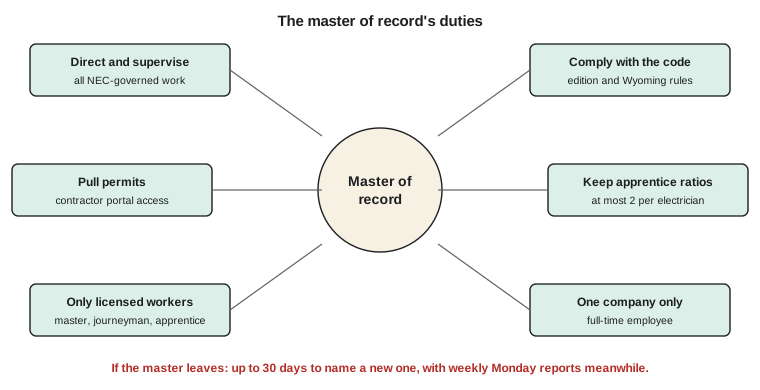
Direction and supervision
The licensing rules require that work by an electrical contractor that is subject to the NEC be done under the direction and supervision of a licensed journeyman or master electrician, and the contractor license rests on a master of record who is a full-time employee of that one company. In practice, the master of record sets the standards for the company's work, assigns qualified people, reviews designs and calculations, answers code questions, and is the person the Department holds accountable when the company's work fails to comply. A master who signs on as master of record but rarely sees the company's jobs is not meeting the duty the rule describes.
Supervision does not mean the master stands over every outlet. On a large company like Sagebrush Line, journeymen run crews, and the master supervises through systems: job reviews, load calculation checks, a review of every correction notice, regular site visits, and a clear rule that unusual installations come to the master before they are built. Dana already does much of this as a lead journeyman. As master of record she will add the formal responsibility.
Full-time and one company
The Department's licensing page states two conditions for the master of record: the master must be a full-time Wyoming-licensed master electrician, and that person may serve as master of record for only one company. The condition protects the public from 'rented' licenses, where a master lends a name to a company he does not work for. It also explains why a master who starts a side business cannot remain master of record for his employer, and why a company cannot share a master with an affiliated company.
The same idea is behind the most serious disciplinary matters. A master who allows another business to pull permits under his license, or who signs off on work he did not supervise, is lending the license. That conduct can lead to discipline against the master's license and to penalties against the business. No fee, favor or friendship is worth it.
Who may do the work
W.S. 35-9-123 requires that licensed electrical contractors employ licensed master or journeyman electricians, or registered apprentice electricians supervised by a licensed master or journeyman, to do the work. Every worker on a Sagebrush Line job who installs wiring governed by the NEC is therefore a licensed master, a licensed journeyman, a holder of a valid temporary journeyman work permit where the Department has issued one, or a registered apprentice. Laborers can carry material and dig trenches; they do not install wiring.
Apprentices must be licensed within ten days of starting employment, according to the Department's licensing page, and the apprentice license runs on a year from July 1 to June 30. The page also lists the supervision level by apprentice year: direct supervision for the full workday in the first two years, at least half the time in the third year, at least a quarter of the time in the fourth and fifth years, and full supervision again for an apprentice who has gone past 10,000 hours without becoming licensed as a journeyman. The supervisor must be a licensed journeyman or master.
| Apprentice year | On-the-job hours | School hours | Supervision |
|---|---|---|---|
| 1 | 0 to 1,999 | 0 to 143 | Full time |
| 2 | 2,000 to 3,999 | 144 to 287 | Full time |
| 3 | 4,000 to 5,999 | 288 to 431 | At least half |
| 4 | 6,000 to 7,999 | 432 to 575 | At least a quarter |
| 5 | 8,000 to 10,000 | 576 or more | At least a quarter |
| 6 | Over 10,000 | 576 or more | Full time |
Apprentice ratios
W.S. 35-9-127(a) sets the ratio: a licensed journeyman or master electrician may supervise no more than two apprentice electricians at a time. For technicians, a licensed technician may supervise no more than one apprentice technician. The ratio applies per supervising electrician on the job, not per company, so a crew of one journeyman and three apprentices violates the rule even if the company has enough licensed electricians elsewhere.
Worked problem
Staffing a crew
Dana is planning a crew for a two-week tenant finish. She has two journeymen and five apprentices available. Three apprentices are in their second year and two are in their fourth year.
Show solution
- Ratio limit: each journeyman may supervise no more than 2 apprentices at a time, so 2 journeymen can supervise at most 4.
- Five apprentices exceed the limit; one must work elsewhere, or a third licensed electrician must join the crew.
- Second-year apprentices need full-time supervision, so they must work alongside a journeyman all day.
- Fourth-year apprentices need supervision at least a quarter of the time, which a journeyman on the same job can provide.
Answer: Assign four apprentices to the crew, keeping the second-year apprentices directly with a journeyman, or add a licensed electrician to take the fifth.
Permits and records
Only the master of record and the company's contractor administrators can reach the permit application on the state portal. That design makes the master accountable for every permit the company pulls. A master should know which permits are open, which inspections are pending and which corrections are outstanding. Ruth runs a weekly open permit report for Carl, and Dana will take it over. Permits that sit open past their useful life are closed or explained.
Records protect the master. For every job, Sagebrush Line keeps the permit, the inspection results, any correction notices and their resolution, the load calculations and design notes, the crew list with license numbers, and the apprentices' hours and supervision. If a question arises years later, such as a fire investigation or a dispute with an owner, the master can show what was done and who did it.
When the master leaves
The rules allow a contractor whose master of record leaves up to 30 days to register a new master of record. During that time, the contractor must submit a list to the Electrical Safety Division every Monday showing the licensed employees who worked the previous week, their projects and hours, and each apprentice's registration year and on-the-job supervisor, including how many hours that supervisor was available. The weekly report shows the Department that the company's work is still being done by licensed people under proper supervision while it finds a new master.
A master who leaves a company should give notice to the employer and to the Department so that the record is accurate. A master who quietly leaves while the company keeps pulling permits under his name is exposed to responsibility for work he no longer supervises.
Grounds for discipline
The statute and rules list grounds on which the Department may refuse, suspend or revoke a license. The common categories are: obtaining a license by fraud or misrepresentation; gross negligence, incompetence or misconduct in electrical work; repeated or willful violations of the code or the licensing rules; allowing the license to be used by another person or business; employing unlicensed people to do licensed work; and failing to obtain required permits. The exact list and the procedures are in the statute and the Board's rules, which give the licensee notice and an opportunity for a hearing before discipline.
Discipline is not the only consequence. Work that fails inspection must be corrected at the contractor's cost. Unpermitted work can lead to stop-work orders and fines. A pattern of violations can affect the company's reputation with inspectors, owners and general contractors, and it can affect the company's insurance.
Common mistakes
MistakeServing as master of record for two companies.
InsteadA master of record may serve only one company, as a full-time employee.
MistakeLetting a crew of one journeyman supervise three apprentices.
InsteadW.S. 35-9-127(a) allows no more than two apprentice electricians per supervising electrician at a time.
MistakeWaiting a month to license a new apprentice.
InsteadApprentices must be licensed within ten days of starting employment.
MistakeLeaving without telling the Department.
InsteadNotify the employer and the Department so permits are not pulled under a master who no longer supervises.
MistakeTreating supervision as a signature.
InsteadDirection and supervision require real involvement in the company's work.
Professional habits
Carl's advice to Dana is practical. Read every correction notice yourself. Check every load calculation on services over 200 amperes before the permit is pulled. Walk every job at least once. Keep a list of the apprentices with their year and supervisor. Never let the office pull a permit for a job you have not seen described. And when a customer or general contractor pushes for a shortcut, remember that your license, not theirs, is on the line.
# Apprentice ratio check per crew (W.S. 35-9-127(a): at most 2 per electrician)
crews = {"tenant finish": (2, 5), "ranch shop": (1, 2), "service upgrade": (1, 3)}
for job, (electricians, apprentices) in crews.items():
    limit = electricians * 2
    status = "OK" if apprentices <= limit else f"over by {apprentices - limit}"
print(f"{job}: {electricians} electricians, {apprentices} apprentices, limit {limit}: {status}")tenant finish: 2 electricians, 5 apprentices, limit 4: over by 1 ranch shop: 1 electricians, 2 apprentices, limit 2: OK service upgrade: 1 electricians, 3 apprentices, limit 2: over by 1
The master and the owner
Owners and general contractors sometimes ask for things the code or the licensing law does not allow: to skip a permit on a small job, to energize before the final inspection, to add circuits to a panel that is already full, or to let the owner's handyman finish some wiring. The master is the person who says no. Carl's approach is to explain the rule, offer a lawful alternative, put it in writing, and walk away from the job if the customer insists. A license is worth more than any single customer.
The master should also be the company's link with the inspectors. When an inspector issues a correction notice or questions a design, the master answers, explains the company's reading of the code if it differs, and makes sure the correction is made. Inspectors remember which contractors argue in good faith and fix their work promptly. That reputation is part of what a master brings to a company.
Worked problem
A request to energize early
A general contractor asks Dana to energize a new building's panels before the final inspection so that the drywall crew can run heaters.
Show solution
- The utility will not connect permanent service without the inspector's release.
- Temporary power for construction needs its own permit and inspection.
- Offer a permitted temporary power installation, with GFCI protection, inspected before use.
- Put the plan and its cost in a written change order.
Answer: Provide permitted, inspected temporary power; do not energize permanent wiring before the release.
Supervision also means training. A master who expects journeymen to supervise apprentices well should teach them how: how to plan a day so that a first-year apprentice is never left alone on a task, how to check an apprentice's work before it is covered, and how to log hours and supervision accurately for the apprentice's license record.
Summary and key terms
- The master of record directs and supervises the contractor's NEC-governed work and is accountable for compliance.
- The master of record must be a full-time Wyoming master and may serve only one company.
- Only licensed masters and journeymen, or registered apprentices under supervision, may install wiring.
- A journeyman or master may supervise no more than two apprentice electricians at a time.
- Apprentices must be licensed within ten days of starting work; supervision levels depend on the apprentice year.
- If the master leaves, the contractor has up to 30 days to name a new one, with weekly Monday reports.
- Direction and supervision
- Real control of how electrical work is planned and installed.
- Rented license
- A license lent to a business the holder does not actually work for; a ground for discipline.
- Apprentice ratio
- The maximum number of apprentices one licensed electrician may supervise at a time.
- Monday report
- The weekly list a contractor without a master of record sends to the Electrical Safety Division.
- Temporary work permit
- A permit the Department may issue allowing interim journeyman work, where available.
Practice problems
Work each problem on paper first, then reveal the answer to check.
Can Carl stay master of record for Sagebrush Line while starting a side business with its own contractor license?
Show answer
No. A master of record may serve only one company.
One journeyman and three apprentices are on a job. Is that allowed?
Show answer
No. The limit is two apprentices per supervising electrician.
How soon must a new apprentice be licensed?
Show answer
Within ten days of starting employment.
What must a contractor send weekly while it has no master of record?
Show answer
A Monday report of licensed employees, projects, hours and apprentice supervision.
Who can apply for permits on the company's portal account?
Show answer
The master of record and the contractor administrators.
Lesson quiz · 5 questions
Score 60% or more to complete this lesson.
Create a free account to save your progress, take quizzes and earn a certificate.