
MBA-699 · Lesson 8 of 12 · 19 min
Developing and evaluating options
A synthesis tells the client what is true; options tell it what it could do. Dr. Mehta warns the team against a common shortcut: moving straight from the synthesis to a single recommendation. Boards do not like being handed one answer, she says. They want to see that you considered the alternatives, including the ones some directors already favor, and that you chose for good reasons. If you show only your preferred option, the first director who asks 'What about selling the stores?' will find you unprepared.
This lesson follows how the Meadowlark team generated options, combined levers into coherent strategies, evaluated them against agreed criteria and tested how robust its ranking was.
Generating options
Options should be genuinely different, realistic and relevant to the problem statement. A useful set usually spans a range: a minimal option that fixes the most urgent problems at low cost and risk; one or more balanced options; an ambitious option; and a radical alternative that challenges the premise. Including the radical alternative is important even if the team expects to reject it, because some stakeholders will raise it and because examining it often clarifies why the other options make sense.
The team begins by listing levers from its issue tree and synthesis: better ordering to reduce shrink; simpler promotions; scheduling to traffic; online ordering with pickup; a digital membership program with regular rewards; closing, converting or protecting each losing store; and changes to support costs. It then holds a workshop with Sunita, Doug, Tyler Okimaw, the vice-president of member relations, and two store managers to add ideas and challenge the list. The managers add two levers the team had missed: sharing staff between grocery stores and fuel sites in the same town, and selling more local products, which members value and which carry good margins.
Levers are not options. An option is a coherent combination of levers that hangs together as a strategy, with a logic the board can understand. The team builds five options.
- A. Fix the core: better ordering, simpler promotions and scheduling to traffic. Low cost and quick, but does nothing for younger members or the losing stores.
- B. Core plus digital: option A, plus a member app with regular rewards and online ordering with pickup at the eight largest stores.
- C. Core plus store portfolio: option A, plus closing Store 7, converting Stores 15, 19 and 21 into a smaller format run with the co-op's fuel sites, and protecting Store 12.
- D. Member First: options A, B and C together, sequenced over three years.
- E. Partner out the grocery stores: lease or sell the stores to a regional grocer or the wholesaler and keep fuel and farm supply, as one director had suggested.
Criteria and weights
Options must be judged against criteria agreed with the client before the scoring, so that the team cannot be accused of choosing criteria to fit its preferred answer. The team proposes five criteria at the second steering meeting, and the client agrees on weights.
- Financial impact, 30 percent: the improvement in grocery operating profit and the net present value.
- Member value, 25 percent: the effect on members' share of spending, satisfaction and younger membership.
- Feasibility, 20 percent: whether Meadowlark has or can build the skills, systems and management time.
- Risk, 15 percent: how much could go wrong and how badly, with higher scores for lower risk.
- Co-op principles, 10 percent: fit with the co-operative principles of member control, member economic participation and concern for community.
The last criterion would not appear in a private retailer's evaluation. The seven co-operative principles adopted by the International Co-operative Alliance in 1995, descended from the rules of the Rochdale Pioneers of 1844, include concern for community. Agnes Wiebe insists on including it because members, not investors, own the co-op, and a strategy that maximized profit by abandoning small towns would breach the purpose for which it was founded.
Scoring
The team scores each option from 1 to 5 on each criterion in a workshop with the client managers, recording the reasons for each score. Scoring together has two benefits. Managers bring knowledge the team lacks, such as how hard it will be to recruit staff for online picking in a small town. And managers who helped score the options are more likely to accept the result.
# Weighted scoring of five strategic options, and how sensitive the ranking is to the weights
options = ["A Fix the core", "B Core plus digital", "C Core plus store portfolio",
           "D Member First: core, digital and portfolio", "E Partner out the grocery stores"]
criteria = {"Financial impact": 0.30, "Member value": 0.25, "Feasibility": 0.20, "Risk": 0.15, "Co-op principles": 0.10}
scores = {  # 1 (poor) to 5 (strong), agreed in the team's scoring workshop with client managers
    "A Fix the core":                               [3, 2, 5, 4, 3],
    "B Core plus digital":                          [3, 4, 4, 3, 4],
    "C Core plus store portfolio":                  [4, 2, 3, 3, 2],
    "D Member First: core, digital and portfolio":  [5, 4, 3, 3, 4],
    "E Partner out the grocery stores":             [3, 1, 3, 2, 1],
}
def rank(w):
    tot = {o: sum(wi * s for wi, s in zip(w.values(), scores[o])) for o in options}
    return sorted(tot.items(), key=lambda kv: -kv[1])
for o, t in rank(criteria):
    print(f"{o:46s}{t:5.2f}")
# Sensitivity: shift 10 points of weight from financial impact to each other criterion in turn
for c in list(criteria)[1:]:
    w = dict(criteria); w["Financial impact"] -= 0.10; w[c] += 0.10
    top = rank(w)[:2]
print(f"weight to {c:16s}: first {top[0][0][:1]} ({top[0][1]:.2f}), second {top[1][0][:1]} ({top[1][1]:.2f})")D Member First: core, digital and portfolio 3.95 B Core plus digital 3.55 A Fix the core 3.30 C Core plus store portfolio 2.95 E Partner out the grocery stores 2.15 weight to Member value : first D (3.85), second B (3.65) weight to Feasibility : first D (3.75), second B (3.65) weight to Risk : first D (3.75), second B (3.55) weight to Co-op principles: first D (3.85), second B (3.65)
Option D, Member First, scores highest at 3.95 out of 5. It is the strongest on financial impact and member value, though it is harder to carry out than option A. Option B is second at 3.55, and option A third at 3.30. Option E, partnering out the stores, scores lowest: it would remove the grocery losses but give up the co-op's main contact with members, conflict with its community purpose and risk a backlash at the annual meeting.
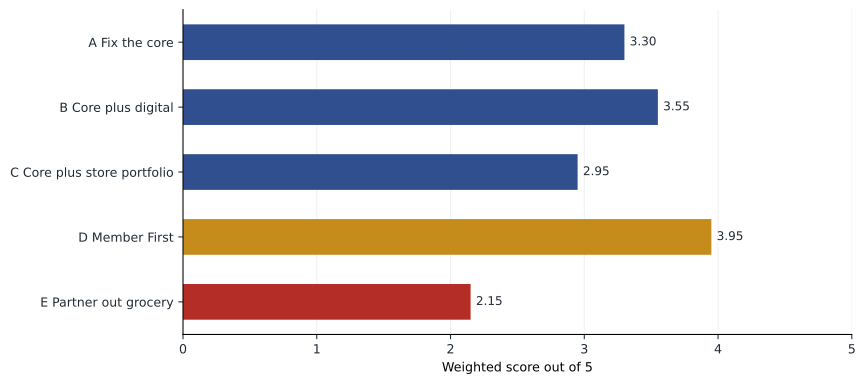
Weighted scoring looks precise but rests on judgment, and Dr. Mehta wants the team to show how much the ranking depends on the weights. The sensitivity test in the code moves 10 points of weight from financial impact to each other criterion in turn. In every case D remains first and B second. The ranking is robust: no reasonable director who weighted the criteria differently would reach a different conclusion. Had the ranking flipped, the team would have presented the trade-off openly and asked the board which criterion mattered more.
Dr. Mehta adds a warning about scoring methods. They are best used to structure a discussion, not to replace judgment. A small difference in scores, such as 3.55 against 3.30, should not decide anything by itself. Scores also hide important differences in kind: option C scores lower than A partly because closing a store carries community risk, which no number fully captures. The team therefore presents the scores with the reasons behind them and a short qualitative description of each option.
Why not simply do everything?
Daniel asks whether option D is simply the sum of the others, and therefore obviously best. Dr. Mehta says no, and the reason is important. Doing everything at once requires more money, management time and change capacity than doing a little. Meadowlark has a small head office, store managers who are already stretched, and a union that must be consulted on scheduling. Option D is best only if it is sequenced so that the organization can absorb it: core fixes first, because they fund later steps and build confidence; the digital program tested before it is rolled out; and store changes after community consultation. Its lower feasibility score reflects that challenge. The implementation plan in lesson 10 must deal with it, or D could fail where the simpler A would have succeeded.
This is a point the cohort has met before. In MBA-514 Dr. Ashford argued that strategy is about choices, and that a plan that tries to do everything is usually a plan that does nothing well. Option D is defensible because each part addresses a separate finding from the synthesis, and because the sequencing limits how much the co-op attempts at once.
Testing the radical option fairly
Option E deserves a fair hearing, Grace insists, because one director favors it and because it has real advantages: it would remove the grocery losses and free the board to focus on fuel and farm supply, which are profitable. The team asks two regional grocers whether they would be interested in taking over the stores. Both say they would want only the four largest, in the growing towns, leaving the co-op with the small, weak stores. That finding changes the debate: partnering out would not remove the problem but would remove the stores most able to solve it. The team presents this evidence rather than simply asserting that E is a bad idea.
The Cedarline contrast
Leo and Owen face a different kind of options problem at Cedarline. Their question is not what to do but in what order to do several things already approved. Their options are sequences: people first, supply chain first, or a parallel approach with a strong transformation office. They score them on cash requirements, management load, risk of disrupting the warehouse while the new union agreement takes effect, and speed of benefit. The scoring favors people first, because supply chain changes depend on a stable warehouse workforce. The method is the same, Dr. Mehta notes; the options reflect the question.
Describing each option fairly
Before scoring, the team writes a one-page profile of each option in the same format: what the co-op would do, what it would cost and return, what it would require of managers and staff, how members would experience it and its main risks. The common format makes the options easy to compare and prevents a familiar trap, the straw-man option, which is described so weakly that it exists only to be rejected. Dr. Mehta tells the team that a board can smell a straw man, and that one weak option makes directors doubt the fairness of the whole evaluation.
Writing the profiles also reveals an option the team had not fully considered. Option B, core plus digital, turns out to be the best choice if the board decides it cannot accept any store changes this year. The team keeps it in the final presentation as the fallback, so that directors who are uneasy about the stores have a clear alternative that still addresses margin and younger members. Offering a credible second choice, Dr. Mehta notes, often makes it easier for a board to agree on the first.
Worked problem
Do the weights change the answer?
A director argues that member value matters more than financial impact and proposes weights of 20 percent financial, 35 percent member value, with the others unchanged. Using the scores in the code, does the leading option change?
Show solution
- New weights: financial 0.20, member value 0.35, feasibility 0.20, risk 0.15, principles 0.10.
- Option D: 0.20 × 5 + 0.35 × 4 + 0.20 × 3 + 0.15 × 3 + 0.10 × 4 = 1.00 + 1.40 + 0.60 + 0.45 + 0.40 = 3.85.
- Option B: 0.20 × 3 + 0.35 × 4 + 0.20 × 4 + 0.15 × 3 + 0.10 × 4 = 0.60 + 1.40 + 0.80 + 0.45 + 0.40 = 3.65.
- Option A: 0.20 × 3 + 0.35 × 2 + 0.20 × 5 + 0.15 × 4 + 0.10 × 3 = 0.60 + 0.70 + 1.00 + 0.60 + 0.30 = 3.20.
Answer: Member First remains first at 3.85, ahead of option B at 3.65, so the director's weights do not change the recommendation.
Common mistakes
MistakePresent only the recommended option.
InsteadShow a range of genuinely different options, including the radical one some stakeholders favor.
MistakeChoose criteria after scoring.
InsteadAgree criteria and weights with the client before scoring.
MistakeLet a small difference in weighted scores decide.
InsteadUse scores to structure discussion, test sensitivity and explain the reasons behind them.
MistakeAssume the option that does the most is best.
InsteadAmbitious options need capacity; sequencing and feasibility can make a simpler option better.
Summary and key terms
- Options are coherent combinations of levers, spanning minimal, balanced, ambitious and radical alternatives.
- Workshops with client managers add levers and build ownership.
- Criteria and weights should be agreed with the client before scoring; for a co-op they include fit with co-operative principles.
- Member First scored 3.95, ahead of core plus digital at 3.55 and fix the core at 3.30; partnering out scored 2.15.
- Sensitivity tests showed the ranking is robust to reasonable changes in weights.
- The radical option was tested with evidence: partners wanted only the strongest stores.
- Option
- A coherent combination of levers forming a strategy the client could choose.
- Lever
- A single action the client can take to affect results.
- Weighted scoring
- Rating options on several criteria and combining the ratings with agreed weights.
- Sensitivity analysis
- Testing whether a result changes when inputs or weights change.
- Co-operative principles
- The seven principles of the International Co-operative Alliance, including member control and concern for community.
- Radical option
- An alternative that challenges the premise of the problem, included to test the others.
Practice problems
Work each problem on paper first, then reveal the answer to check.
Why should criteria be agreed before options are scored?
Show answer
So the team cannot be accused of choosing criteria to favor its preferred option, and so the client owns the basis of the decision.
Calculate option C's weighted score with the original weights: scores 4, 2, 3, 3, 2.
Show answer
0.30 × 4 + 0.25 × 2 + 0.20 × 3 + 0.15 × 3 + 0.10 × 2 = 1.20 + 0.50 + 0.60 + 0.45 + 0.20 = 2.95.
What did the team learn by asking regional grocers about option E?
Show answer
They wanted only the four largest stores in growing towns, so partnering out would leave the co-op with the weakest stores rather than solving the problem.
Why does option D score lower on feasibility than option A?
Show answer
It requires more money, management time and change at once, in a co-op with a small head office and stretched store managers.
Lesson quiz · 5 questions
Score 60% or more to complete this lesson.
Create a free account to save your progress, take quizzes and earn a certificate.