
MBA-699 · Lesson 7 of 12 · 19 min
Synthesis: from findings to insight
At the end of the eighth week the Meadowlark team has a shared folder with 140 charts, 38 interview write-ups, a survey report and a 90-tab spreadsheet. Hana tries to summarize what they know for Dr. Mehta and takes eleven minutes. Dr. Mehta listens, then asks one question: If Colin had thirty seconds in an elevator with Agnes Wiebe tomorrow, what should he tell her? The team cannot answer. They have findings, she says, but not yet a synthesis.
Synthesis is the step in which a team turns many findings into a few insights that answer the client's question. It is the hardest part of consulting to teach, because it requires judgment about what matters, and the most valuable, because clients can rarely do it for themselves. People inside an organization are usually close to the details and divided by their roles; an outside team can step back and see the pattern.
Findings, insights and the so-what test
A finding is a fact the analysis established: shrink is 4.1 percent of sales against 2.7 percent at peers. An insight explains what the finding means for the client's question and what should be done: the co-op's largest margin leak is fixable because it comes mainly from hand ordering in 15 stores, a process problem rather than a structural one. The difference is the so-what. Dr. Mehta asks the team to apply a simple test to every finding by repeatedly asking 'so what?' until the answer says something about what the client should decide.
Daniel tries it on the store data. Five stores lose 1.9 million dollars a year. So what? They explain a large share of the division's weak results. So what? Closing them would raise margin, but the board has limited closures to two. So what? The co-op needs a different answer for each store: one to close, one to protect for its community role, and three to convert into a format that shares costs with the co-op's fuel sites. The last answer is an insight, because it tells the board what to decide. The first is only a finding.
Weighing evidence
Before synthesizing, the team must decide what it believes about each hypothesis. The evidence varies in strength. Store and till data is hard evidence: it records what actually happened. The survey is representative but measures perceptions and estimates. Interviews are rich but few and not random. A useful discipline is to weigh each piece of evidence by its type and record whether it supports or contradicts each hypothesis. Daniel builds a simple scoring to make the team's judgments explicit.
# Weighing the evidence for each hypothesis: +1 supports, -1 contradicts, 0 neutral.
# Weight: 3 for hard data (store or till data), 2 for the survey, 1 for an interview theme.
evidence = {
    "H1 shrink is the largest margin leak": [(+1, 3), (+1, 3), (+1, 1), (0, 2)],
    "H2 members see prices as too high":   [(+1, 2), (+1, 1), (-1, 3), (+1, 1)],
    "H3 a few stores drag down results":    [(+1, 3), (-1, 1), (+1, 3)],
    "H4 younger members want digital ways to shop": [(+1, 2), (+1, 1), (+1, 2), (0, 1)],
    "H5 a bigger private label range would lift margin": [(-1, 3), (+1, 1), (-1, 2)],
}
for h, items in evidence.items():
    score = sum(s * w for s, w in items)
    weight = sum(w for _, w in items)
    verdict = "supported" if score / weight >= 0.5 else "refuted" if score / weight <= -0.3 else "mixed"
print(f"{h:52s} score {score:+3d} of {weight:2d} {verdict}")H1 shrink is the largest margin leak score +7 of 9 supported H2 members see prices as too high score +1 of 7 mixed H3 a few stores drag down results score +5 of 7 supported H4 younger members want digital ways to shop score +5 of 6 supported H5 a bigger private label range would lift margin score -4 of 6 refuted
The scoring is crude, and Dr. Mehta warns against treating it as precise. Its value lies in forcing the team to list the evidence for and against each hypothesis and to agree on how much each piece counts. H1 on shrink and H3 on losing stores are supported by hard data. H4 on younger members is supported by the survey and interviews, though without hard data on behavior that does not yet exist, because the co-op has never offered online ordering. H2 on prices is mixed: members believe prices are high, but the basket comparison shows otherwise. H5 on private label is refuted. These verdicts become the backbone of the synthesis.
The team also notes where evidence is thin. The estimate of online sales rests on another co-op's pilot and on industry ratios, not on Meadowlark's own experience. Rather than hide this, the team will recommend testing online ordering in a few stores before rolling it out. Being honest about uncertainty is part of synthesis: the board needs to know which conclusions are solid and which are bets.
The pyramid principle
Barbara Minto's pyramid principle, developed at McKinsey and published in book form in the 1980s, is the most widely used method for organizing a synthesis. It holds that ideas should be grouped into a pyramid with a single governing thought at the top, supported by a small number of key arguments, each supported by evidence. Communication then runs from the top down: state the answer first, then the reasons, then the evidence.
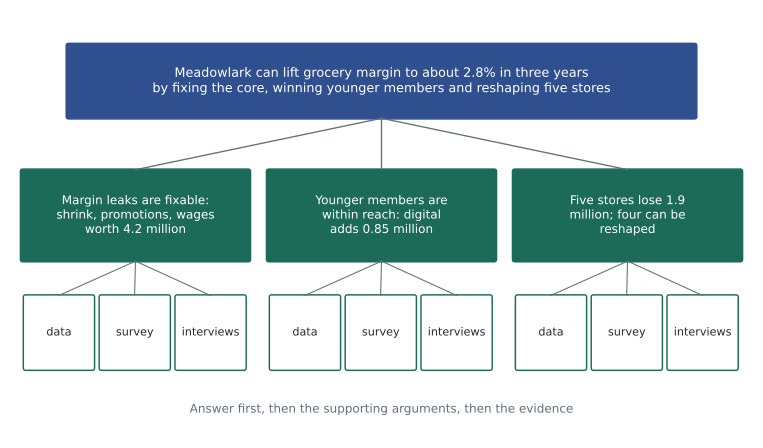
Minto set out rules for the pyramid. Ideas at any level must summarize the ideas grouped below them. Ideas in each group must be of the same kind: all reasons, all steps or all parts. And ideas in each group must be logically ordered, by time, by structure or by importance. The key arguments should together form a MECE set, so that the governing thought is fully supported without overlap.
The pyramid reverses the order in which the team discovered things. The team worked from the bottom up: data, then findings, then insights, then an answer. Busy executives want the opposite. Most people's instinct is to tell the story of the analysis in the order it happened, building to a conclusion, as in a detective story. Minto's advice is to resist that instinct. A board member who hears the answer first can listen to the evidence critically; one who must wait for the answer spends the presentation trying to guess where it is going.
Deductive and inductive reasoning
Minto distinguished two ways of linking ideas. In deductive reasoning, each step follows from the last: shrink is the largest margin leak; shrink comes mainly from hand ordering; therefore the co-op should introduce computer-assisted ordering. Deductive chains are persuasive but fragile: if any step is wrong, the conclusion falls. In inductive reasoning, several independent points support a conclusion: shrink is high, promotions are inefficient and scheduling does not match traffic, so the co-op's core operations can be improved. Inductive groupings are more robust, because the conclusion survives if one point is challenged. Minto recommended inductive structure at the top of a pyramid, where robustness matters most, and the team follows that advice.
Insights that surprise
Dr. Mehta asks the team which of its insights would surprise the client. The question matters because a synthesis that only confirms what managers already believed adds little value. The team identifies three surprises. First, prices are not the main problem; promotions and price communication are. Second, the co-op's largest margin leak is a measurement and ordering problem that costs little to fix. Third, the losing stores do not all need the same answer, which opens a way to improve results without breaking the board's promise on closures.
Surprising insights need extra care. Sunita had believed prices were the main problem, so the team walks her through the basket comparison again and invites her to check the prices herself. She sends two store managers to repeat the comparison in their towns; they find the same result. By the third steering meeting the insight has become hers as well as the team's, and she presents it to the board's grocery committee herself. Dr. Mehta calls this the best possible outcome: an insight is most powerful when the client owns it.
The elevator test and the one-page summary
The team ends the week by writing a one-page summary of its synthesis, using the pyramid. The first sentence states the answer. Three short paragraphs give the key arguments with their most important numbers. A final paragraph states what the board must decide. They also write a thirty-second version for Colin's imaginary elevator ride.
Our grocery stores can earn the margin the board wants within three years without breaking our promise on closures. Most of the gap comes from waste and confusing promotions that we can fix with better ordering and simpler offers. Younger families like us but buy only top-ups; online ordering and a more visible membership reward could win more of their spending. Five stores lose money; we can reshape four and protect the one that serves a community with no other grocery store.
When Hana reads the summary aloud, it takes 28 seconds. Dr. Mehta compares it with the team's day-one answer from week two. The main ideas are similar, but each is now supported by evidence, quantified and refined: the day-one answer did not know that prices were competitive, that hand ordering drove shrink, or that the losing stores needed different answers. The comparison, she says, shows the value of hypothesis-driven work: the team started with a direction, tested it, and ended with a better answer than either guessing or collecting data without a plan would have produced.
When evidence conflicts
Synthesis is hardest when good evidence points in different directions. The price question is the team's clearest example: the survey says members think prices are high, and the basket comparison says they are not. A weak synthesis picks one source and ignores the other. A strong one asks how both can be true. In this case both are true: perceptions and prices differ, and the gap between them is itself the insight, because it points to communication and promotion design rather than price cuts.
Dr. Mehta suggests a team exercise for these moments. Each member writes, separately, the single sentence they believe best explains the evidence. The team then compares the sentences and argues about the differences. The exercise exposes disagreements that polite discussion hides, and it often produces a better explanation than any individual started with. The Meadowlark team uses it three times, and on the third occasion, about the losing stores, it produces the idea that different stores need different answers, which none of them had written down alone.
Worked problem
Turning findings into an insight with the so-what test
Finding: members under 40 rate the co-op's staff friendliness and local products as highly as older members do, but give it only 22 percent of their grocery spending against 41 percent for those 55 and over. Apply the so-what test until it produces an insight.
Show solution
- So what? Younger members are not unhappy with the co-op; they like what it offers but shop mainly elsewhere.
- So what? Their low share reflects how and where they shop, for convenience and perceived value, not dissatisfaction with stores or staff.
- So what? Changing the store experience will not win them; changing how they can shop with the co-op and how they see the value of membership might.
- Insight: the co-op can win more spending from younger members by offering online ordering with pickup and a more visible, regular membership reward, building on the goodwill it already has, rather than redesigning stores or cutting prices across the board.
Answer: The insight shifts the focus from store changes to convenience and membership value, and identifies a strength to build on.
Common mistakes
MistakePresent findings in the order you discovered them.
InsteadPut the answer first, then the key arguments, then the evidence.
MistakeA finding is an insight.
InsteadAn insight explains what a finding means for the decision; apply the so-what test until it does.
MistakeHide uncertainty to sound confident.
InsteadSay which conclusions are solid and which are bets, and recommend tests for the bets.
MistakeBuild the top of the pyramid as a long deductive chain.
InsteadUse inductive groups of independent arguments at the top, so the conclusion survives if one point is challenged.
Summary and key terms
- Synthesis turns many findings into a few insights that answer the client's question.
- The so-what test moves from findings to insights that say what the client should decide.
- Weigh evidence by type and record whether it supports or contradicts each hypothesis; be honest where evidence is thin.
- The pyramid principle puts a governing thought at the top, supported by a MECE set of key arguments and then evidence.
- Inductive groups are more robust than deductive chains at the top of a pyramid.
- Insights that surprise the client add the most value but need extra care so that the client comes to own them.
- Synthesis
- Combining findings into a small number of insights that answer the question.
- Insight
- A statement of what findings mean for the client's decision.
- So-what test
- Repeatedly asking what a finding implies until it points to a decision.
- Pyramid principle
- Minto's method of organizing ideas with the answer at the top and supporting arguments below.
- Governing thought
- The single main message at the top of a pyramid.
- Inductive reasoning
- Supporting a conclusion with several independent points.
Practice problems
Work each problem on paper first, then reveal the answer to check.
Apply the so-what test to: 'About a third of promotions do not increase unit sales.'
Show answer
They give away margin to members who would buy anyway; cutting them and simplifying the rest would add about 1.0 million and make prices clearer, so the co-op should redesign its promotion program.
Why does Minto recommend stating the answer first?
Show answer
Executives can then listen to the evidence critically instead of guessing where the argument is going, and the most important message is not lost if time runs short.
Turn this deductive chain into an inductive group: 'Waste is high; waste comes from hand ordering; so automate ordering.'
Show answer
For example: 'Core operations can be improved: waste is high, promotions are inefficient and scheduling does not match traffic.' Each point independently supports the conclusion.
Why did the team recommend a pilot for online ordering?
Show answer
The evidence for its benefits came from another co-op and industry ratios, not Meadowlark's own experience, so it was a bet to test before a full rollout.
Lesson quiz · 5 questions
Score 60% or more to complete this lesson.
Create a free account to save your progress, take quizzes and earn a certificate.