
MBA-699 · Lesson 10 of 12 · 20 min
Implementation planning and change
At the third steering meeting in week ten, Colin asks the question every chief executive eventually asks: This all makes sense. Who does what on Monday morning? A recommendation that cannot answer it will sit on a shelf. Studies of strategy execution, which the cohort met in MBA-514, suggest that organizations often capture far less of the value their plans promise, and the gap is usually explained by weak implementation: unclear ownership, too many initiatives at once, missing resources and resistance that nobody anticipated.
Implementation planning is therefore part of the consulting work, not an afterthought. The team must turn Member First into a roadmap with sequence and timing, a governance structure, clear roles, measures of progress and a plan for the people who will have to change how they work. This lesson draws on the cohort's governance and change courses, which run alongside the capstone this term.
Sequencing the work
The first question is order. Some activities must finish before others can start; some can run in parallel; some should wait until earlier ones have built confidence and cash. The team lists the main activities of Member First with their durations and dependencies, then finds the critical path: the longest chain of dependent activities, which sets the minimum time to complete the program. Any delay on the critical path delays the whole program; activities off the critical path have slack, time they can slip without affecting the end date.
# Critical path for the Member First roadmap (durations in weeks)
tasks = {  # name: (duration, predecessors)
    "Program office set up":          (4, []),
    "Board approval of store plan":   (6, ["Program office set up"]),
    "Choose ordering system":         (8, ["Program office set up"]),
    "Ordering pilot in 3 stores":     (12, ["Choose ordering system"]),
    "Ordering rollout to 22 stores":  (20, ["Ordering pilot in 3 stores"]),
    "Scheduling tool and training":   (16, ["Program office set up"]),
    "Promotion review and new rules": (10, ["Program office set up"]),
    "Member app build":               (24, ["Program office set up"]),
    "Click-and-collect pilot":        (12, ["Member app build"]),
    "Click-and-collect in 8 stores":  (16, ["Click-and-collect pilot"]),
    "Community meetings":             (8, ["Board approval of store plan"]),
    "Convert 3 stores to express":    (26, ["Community meetings"]),
    "Close one store":                (12, ["Community meetings"]),
}
early = {}
for t in tasks:  # tasks are listed after their predecessors
    d, pre = tasks[t]
    early[t] = max((early[p] for p in pre), default=0) + d
finish = max(early.values())
late = {}
for t in reversed(list(tasks)):
    succ = [s for s in tasks if t in tasks[s][1]]
    late[t] = min((late[s] - tasks[s][0] for s in succ), default=finish)
critical = [t for t in tasks if early[t] == late[t]]
print(f"Program length {finish} weeks")
print("Critical path:", " -> ".join(critical))
for t in tasks:
    slack = late[t] - early[t]
    if slack: print(f"  slack {slack:2d} weeks: {t}")
# RACI check: exactly one A and at least one R for every activity
raci = {
    "Ordering rollout":      {"VP grocery": "A", "Store managers": "R", "IT": "R", "CFO": "C", "Union stewards": "I"},
    "Scheduling tool":       {"VP grocery": "A", "HR": "R", "Store managers": "R", "Union stewards": "C"},
    "Member app":            {"VP members": "A", "IT": "R", "Marketing": "R", "VP grocery": "C"},
    "Store conversions":     {"CEO": "A", "VP grocery": "A", "VP fuel": "R", "Board": "C"},
    "Program reporting":     {"CFO": "C", "Program office": "I"},
}
for act, roles in raci.items():
    a = sum(v == "A" for v in roles.values()); r = sum(v == "R" for v in roles.values())
    issues = ([] if a == 1 else [f"{a} accountable"]) + ([] if r else ["no one responsible"])
print(f"{act:20s}{'ok' if not issues else '; '.join(issues)}")Program length 56 weeks Critical path: Program office set up -> Member app build -> Click-and-collect pilot -> Click-and-collect in 8 stores slack 12 weeks: Board approval of store plan slack 12 weeks: Choose ordering system slack 12 weeks: Ordering pilot in 3 stores slack 12 weeks: Ordering rollout to 22 stores slack 36 weeks: Scheduling tool and training slack 42 weeks: Promotion review and new rules slack 12 weeks: Community meetings slack 12 weeks: Convert 3 stores to express slack 26 weeks: Close one store Ordering rollout ok Scheduling tool ok Member app ok Store conversions 2 accountable Program reporting 0 accountable; no one responsible
The program takes 56 weeks from approval to completion. The critical path runs through the program office, the member app build, the click-and-collect pilot and the rollout to eight stores. This surprises Colin, who had assumed the store conversions would take longest. The digital work has no slack: a delay of a month in building the app delays the whole program by a month. The ordering rollout, which delivers the largest benefit, has 12 weeks of slack, and the scheduling tool and promotion rules have much more.
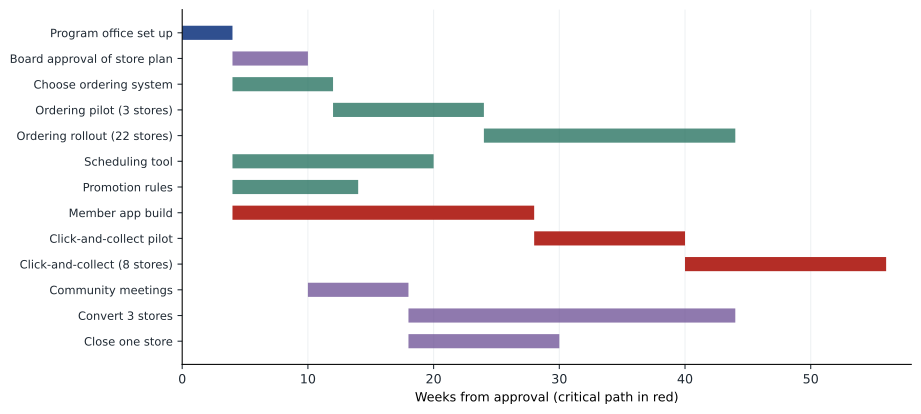
The roadmap shows three overlapping waves. The first wave, starting at once, contains the core fixes: promotion rules, the scheduling tool and the ordering system. They start early because they deliver most of the benefit, cost relatively little, and build confidence among store managers and the board. The second wave, the store portfolio changes, begins after board approval and community consultation. The third wave, the digital program, starts building early because it is on the critical path but goes live only after a pilot proves that members will use it.
Daniel notes that the critical path depends on assumptions about durations, especially the app build, which relies on an outside developer. The team recommends a fixed-scope contract with a date penalty and a simpler first version of the app, ordering and rewards only, with further features later. Shortening the critical path is often a matter of cutting scope rather than working faster.
Governance
Governance answers who decides, who is accountable and how progress is monitored. For a program the size of Member First, the team recommends a light structure suited to a co-op with a small head office.
- The board approves the program, each wave of spending at stage gates, and the store closure and conversions.
- A steering committee chaired by Colin, with Sunita, Doug and Tyler, meets monthly to review progress, resolve conflicts between initiatives and recommend stage-gate decisions to the board.
- A program director, reporting to Colin and working with a small program office, tracks the plan, manages dependencies and reports progress.
- Each initiative has a single executive owner and a project lead who runs it day to day.
The program office is temporary, planned for two years, and its cost is included in the business case. Dr. Mehta warns against two common failures: a program office that becomes a bureaucracy producing reports nobody reads, and one without enough authority to make managers keep their commitments. The program director should be a respected internal manager, not an outsider, because store managers will listen to someone who knows their world.
Roles and RACI
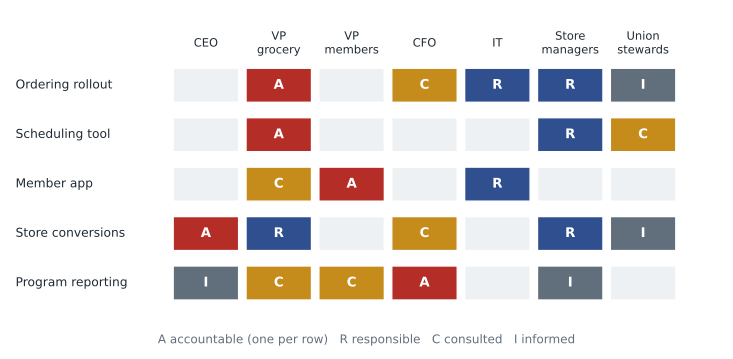
A RACI chart assigns each activity's roles: who is responsible for doing the work, who is accountable for the result, who must be consulted and who must be informed. The key rule is that each activity has exactly one accountable person. When two people are accountable, each assumes the other is in charge; when nobody is, nothing happens. The code includes a simple check of the team's draft chart.
The check finds two problems. Store conversions have two accountable executives, Colin and Sunita, because the team could not decide whether the chief executive or the vice-president of grocery should own a change with community impact. And program reporting has no accountable person and nobody responsible. The team fixes both: Colin becomes accountable for the conversions, given their importance to members, with Sunita and the store managers responsible for the work, working closely with the vice-president of fuel; Doug becomes accountable for program reporting, with the program office responsible.
Measures and the scorecard
A program needs measures that show whether it is working early enough to act. The team distinguishes leading indicators, which move first and predict results, from lagging indicators, which confirm results after the fact. For the ordering initiative, the share of orders placed using the system and the weekly waste recorded in each store are leading indicators; shrink as a share of sales is lagging. For the digital program, app downloads and repeat pickup orders lead; younger members' share of spending lags.
The team proposes a one-page scorecard with twelve measures, reviewed monthly by the steering committee and quarterly by the board. It pairs measures that could be gamed against each other, such as shrink with product availability, and wage hours with checkout waiting times, so that improving one at the expense of members becomes visible. It also includes a member measure the board cares about: active members under 40.
Leading the change
Most of Member First requires people to work differently: store managers ordering with a system, staff working schedules matched to traffic, members trying a new way to shop. Hana, who led a change in clinic scheduling at Lakeview Health, leads this part of the plan. She draws on the change course the cohort is taking this term, and on a lesson from her own experience: people resist changes that are done to them more than changes they help shape.
The team's change plan has several elements. Store managers from the pilot stores will explain the ordering system to their peers, because managers trust each other more than head office. Staff will be told early and honestly what the scheduling changes mean, including that savings will come through turnover and overtime, not layoffs, and the union will be consulted before any change in the eight unionized stores. Members in towns affected by store changes will hear about them at community meetings before decisions are final, with real opportunities to influence how the change happens, such as delivery options or opening hours at converted stores. And quick wins, such as visible reductions in waste in the first pilot stores, will be reported widely to build momentum.
Dr. Mehta adds one point from her experience as a client. Consultants leave; the client stays. The team's plan should build Meadowlark's own capability so that it can run, measure and adjust the program after the students have gone. The analysis files, the scorecard and a short guide to updating the business case are therefore deliverables, and Doug's analyst spends a day with Daniel learning to use them.
The Cedarline contrast
At Cedarline, implementation is the whole engagement. Leo and Owen's recommendation is a sequence, people first, then supply chain and digital in parallel, then international expansion, governed by a transformation office reporting to the chief executive, with a capacity rule that no more than three major initiatives touch the warehouse at once while the first union agreement takes effect. Their roadmap has a critical path through the warehouse stabilization, and their RACI chart had the same problem as Meadowlark's first draft: two accountable executives for the digital inventory view. Leo laughs when he sees it. Every organization thinks shared accountability is collaboration, he says. It is usually confusion.
Worked problem
Using slack to manage a delay
Six weeks into the program, the ordering system vendor announces a four-week delay in delivering the system for the pilot. The ordering pilot has 12 weeks of slack. The app developer warns that the app build may take two weeks longer than planned. Which delay matters more, and what should the program director do?
Show solution
- The ordering delay of four weeks is within its 12 weeks of slack, so it does not delay the program's end date, though it delays the shrink savings, which matter for funding later waves.
- The app is on the critical path with no slack, so a two-week delay there delays the whole program by two weeks.
- The program director should focus first on the app: cut scope from the first version or add developer capacity to protect the date.
- For ordering, she should use the waiting time productively, for example by training pilot store managers to record waste consistently, so the pilot starts fast when the system arrives, and update the business case for the later start of shrink savings.
Answer: The smaller app delay matters more for the end date because it is on the critical path; the ordering delay matters for cash flow but can be absorbed within its slack.
Common mistakes
MistakeTreat implementation as the client's problem after the report.
InsteadPlan sequence, governance, roles, measures and change as part of the recommendation.
MistakeAssume the biggest activity is on the critical path.
InsteadCalculate it; at Meadowlark the digital work, not the store conversions, sets the end date.
MistakeMake two executives jointly accountable to encourage collaboration.
InsteadGive each activity exactly one accountable person; others can be responsible or consulted.
MistakeMeasure only lagging results.
InsteadUse leading indicators that warn early, and pair measures so one cannot be improved at members' expense.
Summary and key terms
- Weak implementation explains much of the gap between planned and realized value.
- The critical path, the longest chain of dependent activities, sets the minimum program length; Member First takes 56 weeks with the digital work on the critical path.
- Waves sequence the work: core fixes first, store changes after consultation, digital after a pilot.
- Light governance suits a small organization: board stage gates, a steering committee, a program director and one owner per initiative.
- A RACI chart needs exactly one accountable person per activity; leading and paired measures make progress visible early.
- Change plans involve people early, use peers as messengers, communicate honestly and build the client's own capability.
- Critical path
- The longest chain of dependent activities, which sets the minimum time to complete a program.
- Slack
- The time an activity can slip without delaying the program's end date.
- RACI
- A chart showing who is responsible, accountable, consulted and informed for each activity.
- Program office
- A small temporary team that tracks a program, manages dependencies and reports progress.
- Leading indicator
- A measure that moves early and predicts later results.
- Quick win
- An early, visible success that builds confidence in a change.
Practice problems
Work each problem on paper first, then reveal the answer to check.
If the member app build took 30 weeks instead of 24, how long would the program take?
Show answer
The app is on the critical path, so the program would take 56 + 6 = 62 weeks.
Why should the program director be a respected internal manager?
Show answer
Store managers are more likely to accept direction from someone who knows their work, and the capability stays with the co-op.
Give a leading and a lagging indicator for the scheduling initiative.
Show answer
Leading: share of stores using the scheduling tool or checkout waiting times at peak; lagging: wages as a share of sales.
What is wrong with a RACI row that has two A's?
Show answer
Each accountable person may assume the other is in charge, so decisions are delayed or nobody acts.
Lesson quiz · 5 questions
Score 60% or more to complete this lesson.
Create a free account to save your progress, take quizzes and earn a certificate.