
MBA-699 · Lesson 12 of 12 · 20 min
Capstone: the final client presentation and reflection
On a cold Thursday evening in the twelfth week, the Meadowlark board meets in the community hall of a small town where the co-op opened its first store in the 1930s. Eleven directors sit at a long table; about thirty members watch from chairs at the back, because Meadowlark's board meetings are open to members. Colin introduces the team, reminds the board of the question it asked in January, and hands over. The team has 40 minutes: 18 for the presentation and the rest for questions.
This final lesson follows the presentation and the board's decision, then turns to what the team, the cohort and the reader can learn from the engagement and from the program as a whole.
The presentation
Grace opens with the executive summary. She states the answer in her first sentence: the co-op can raise grocery operating margin from 1.1 to about 2.8 percent within three years, restore a patronage refund of about 7 million dollars and grow younger membership, without breaking the board's promise on closures, through a program the team calls Member First. She gives the three reasons in one sentence each and says what the board is being asked to decide. It takes ninety seconds. Several directors visibly relax; they know where the presentation is going.
Daniel presents the core fixes. His key slide shows the shrink gap and the 15 stores ordering by hand, and he passes around a photocopy of the handwritten waste clipboard he found in week three. The room laughs in recognition; several members have worked in the stores. Hana presents the member findings, including the surprising news about prices, and the digital pilot. Grace returns for the store portfolio, the business case and the roadmap, ending with the four decisions needed.
The team has rehearsed the timing, and finishes at 17 minutes. Dr. Mehta, watching from the back, later says the most impressive moment was not on any slide: when a member at the back called out that the store in her town had stopped stocking local honey, Hana thanked her, wrote it down and said it was exactly the kind of local product the plan aimed to protect.
Questions
The questions test whether the team understands the co-op, not just the numbers. The director who favored partnering out the stores asks why the co-op should invest in grocery at all. Grace answers with the evidence from the regional grocers: they wanted only the four strongest stores, which would leave the co-op with the weakest ones and no way to fix them. He nods, and says he still has doubts but will support a staged program with clear checkpoints.
A director who farms near Store 12 asks whether its future is safe. Daniel explains that the store loses money but is the only grocery store within 40 minutes, and the plan protects it while improving its ordering and scheduling; it is expected to approach break-even within three years. A younger director, elected last year, asks whether the app will work for members with poor internet service in rural areas. Hana admits that the team has not tested this and adds it to the pilot's design: one of the two pilot stores will be in a town with weak service, and members will be able to order by phone as well as through the app.
Doug asks the hardest question: what happens if the shrink savings come in at half the plan? Daniel answers from the tornado chart and the scenarios. The net present value would fall but stay positive, and the scorecard would show the problem within the first two quarters through the leading indicators, waste recorded and system use, long before the annual results. The board could then pause the second wave of spending at the first stage gate. We designed the plan so that you find out early if we were wrong, he says.
The decision
After the team leaves the room, the board discusses the recommendation for an hour. Colin calls the team the next morning. The board has approved Member First and the first wave of spending, about 4.6 million dollars, and appointed Sunita's regional manager, who had guided Daniel on his store visits, as program director. It has approved community meetings in the towns of Stores 7, 15, 19 and 21, but will make the final decision on the closure and conversions only after hearing members, as the team recommended. And it has asked the team's analysis files to be handed to Doug's analyst, who has already updated the business case with the first month's data.
Before the team hands over, Daniel runs one last check of what the approved program means for the measures the board cares about.
# What the board approved, and what success looks like at the end of year three (millions)
grocery_sales = 318.0
net_benefit = 5.33                      # steady-state, from the business case
margin_y3 = (3.50 + net_benefit) / grocery_sales
savings_y3 = 8.0 + net_benefit
print(f"Grocery operating margin in year three: {margin_y3:.2%} (target 2.50%)")
for payout in (0.50, 0.55):
    print(f"Patronage refund at {payout:.0%} payout: {payout * savings_y3:4.2f} (target 7.0)")
# Member measures in the scorecard
active, under40_share = 86_620, 0.18
target_under40 = 0.24
print(f"Active members under 40 now {active * under40_share:,.0f}; at {target_under40:.0%} of the same base {active * target_under40:,.0f}")
# What if only the core fixes deliver (shrink, promotions, scheduling) and nothing else?
core = 2.23 + 1.00 + 0.95 - 0.45        # less the share of running costs for the core systems
print(f"Core only: margin {(3.50 + core) / grocery_sales:.2%}, refund at 55% {0.55 * (8.0 + core):4.2f}")Grocery operating margin in year three: 2.78% (target 2.50%) Patronage refund at 50% payout: 6.67 (target 7.0) Patronage refund at 55% payout: 7.33 (target 7.0) Active members under 40 now 15,592; at 24% of the same base 20,789 Core only: margin 2.27%, refund at 55% 6.45
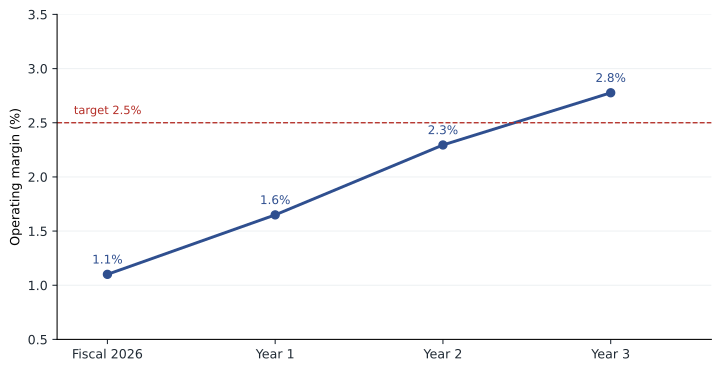
The output confirms the main commitments. With the full program, grocery operating margin should reach about 2.8 percent in year three, above the 2.5 percent target, and a 55 percent payout would restore the refund to about 7.3 million dollars. The board's target for younger members, raising their share of active members from 18 to 24 percent, would mean about 5,200 more active members under 40 on today's base. The last line shows why the team did not recommend the core fixes alone: they would lift margin to about 2.3 percent, below target, and the refund to about 6.5 million. The core is necessary but not sufficient.
The client's evaluation
Colin's written evaluation of the team is short. He praises three things: the team tested his managers' beliefs instead of confirming them, including his own; it found a cheap fix for the biggest problem that nobody inside had noticed; and it treated store managers and members with respect. He criticizes one thing: in the first month the team asked for data in a format that took Doug's staff two days to produce, without asking whether a simpler extract would do. Daniel accepts the point. It is a lesson about the cost to the client of the team's requests, which the team had estimated in lesson 1 but not managed closely enough.
The Cedarline engagement
Leo and Owen present to Cedarline's executive committee in the same week. Their recommendation, a people-first sequence with a transformation office and a rule limiting how many initiatives touch the warehouse at once, is accepted with one change: the chief executive moves the digital inventory view earlier, because the supply chain and stores both depend on it, and accepts the team's warning that this will require extra project staff. Owen says the most useful thing he learned was how to argue for doing less. Leo says it was how to write a title that says something.
Reflection
The final assignment of the program is a personal reflection. Donald Schön, in The Reflective Practitioner, argued that professionals learn most not from applying theories but from reflecting on what happened when they applied them: what surprised them, what they would do differently and why. David Kolb's learning cycle makes a similar point: experience becomes learning only when it is followed by reflection, by drawing general lessons, and by trying them again.
Dr. Mehta asks each student to answer three questions: what did you believe at the start that turned out to be wrong; what will you do differently in your own organization; and what did you learn about yourself as an advisor?
Grace writes that she began the engagement assuming prices were the problem, because in her years at Fairway they usually were, and that her own experience nearly blinded her to the evidence. She will now ask, whenever she is sure of something at Second Ascent, what evidence would change her mind. Hana writes that she learned the power of observation: the best finding of the engagement came from watching a store manager order bread, not from any survey. At Lakeview she plans to spend a day each month watching work rather than reading reports about it. Daniel writes that he learned the difference between being right and being useful: his analysis of the losing stores was correct in week six, but it became useful only when the team turned it into four different answers the board could accept.
What the program adds up to
Dr. Mehta closes the last session of the program by returning to the question she asked in January: what does it mean to use everything at once? The cohort's work on Meadowlark drew on almost every course. The problem statement and synthesis relied on strategy from MBA-514. The profit tree and store contribution came from accounting in MBA-501 and the business case from finance in MBA-511. Segmentation and price perception came from marketing in MBA-512, the ordering and scheduling analysis from operations in MBA-513, the change plan from the people courses, the negotiation of scope from MBA-604, and the attention to governance, members and community from this term's courses. No single framework answered the question; the answer came from combining them with judgment about a particular organization at a particular time.
She ends with the advice she gives every cohort. The tools in this program will change: AI will do more of the analysis, and new frameworks will replace some of the ones they learned. What will not change is the work of understanding a real problem, earning the trust of the people who live with it, testing what everyone believes, and helping a group of people decide and act. That work, she says, is what management is.
Handing over
The engagement does not end with the board's decision. The team's final week is spent on handover, which Dr. Mehta treats as part of the deliverable. The team gives Doug's analyst the cleaned data with its adjustment log, the business case model with a one-page guide to updating it, and the scorecard with definitions of each measure and where its data comes from. It gives the new program director a list of the managers and staff who were most helpful, the questions still open, and the risks the team considers most likely to appear first.
Daniel insists on one more item: a list of the team's assumptions that should be checked with real data in the first six months, starting with the shrink target in the pilot stores and the uptake of online ordering. A good consultant, Dr. Mehta says, leaves the client able to discover when the consultant was wrong. The program director, who walked the stores with Daniel in week three, says the list is the most useful page in the handover.
Worked problem
Answering a board question you did not anticipate
During questions, a director asks whether Member First will affect the co-op's credit union borrowing limits. The team has not analyzed this. How should the presenter respond?
Show solution
- Do not guess or invent a number: an inaccurate answer in front of the board would damage the credibility of everything else.
- Say what you do know: the first wave of spending is about 4.6 million over the first year, and the program's cash flows turn positive in year two as savings build.
- Acknowledge what you do not know: the team has not reviewed the co-op's borrowing covenants.
- Offer a specific follow-up: the team will work with Doug to check the covenants and send the board a short note within a week, before any spending is committed.
Answer: Answer with what you know, admit what you do not, and commit to a specific follow-up; honesty under questioning builds more trust than a confident guess.
Common mistakes
MistakeFill every minute of the presentation slot.
InsteadPresent briefly and leave most of the time for questions, where directors test and own the recommendation.
MistakeGuess when you do not know an answer.
InsteadState what you know, admit what you do not and commit to a specific follow-up.
MistakeConsider the engagement finished when the board decides.
InsteadHand over analysis, measures and capability so the client can carry out and adjust the program.
MistakeTreat reflection as a formality.
InsteadReflection turns experience into learning; ask what you believed that was wrong and what you will do differently.
Summary and key terms
- The final presentation states the answer first, tells the story through a few key arguments and ends with the decisions needed.
- Board questions test understanding of the organization; honest answers, including admitting gaps, build trust.
- Meadowlark's board approved Member First and the first wave of spending, with store decisions after community meetings.
- The program is expected to lift grocery margin to about 2.8 percent and allow a refund of about 7.3 million; the core fixes alone would fall short.
- Client evaluation rewards testing beliefs, finding practical fixes and respecting people; it also notices the burden of the team's requests.
- Reflection, as Schön and Kolb argued, turns experience into learning; the program's tools combine through judgment about a particular organization.
- Executive summary
- The opening statement of the recommendation, its reasons and the decisions needed.
- Handover
- Transferring analysis, tools and knowledge so the client can continue the work.
- Client evaluation
- The client's assessment of the usefulness of the work and the team's conduct.
- Reflective practice
- Learning by examining what happened when theories and skills were applied.
- Learning cycle
- Kolb's cycle of experience, reflection, generalization and experimentation.
- Stage gate
- A checkpoint at which approval is needed before further spending.
Practice problems
Work each problem on paper first, then reveal the answer to check.
Why did the team recommend more than the core fixes, given that they deliver most of the benefit?
Show answer
The core fixes alone would lift margin to only about 2.3 percent and the refund to about 6.5 million, below the board's targets, and would not address younger members or the losing stores.
Active members are 86,620. How many more members under 40 would raise their share from 18 to 24 percent on the same base?
Show answer
0.06 × 86,620 = about 5,200 more members under 40.
What did Colin criticize, and what does it teach?
Show answer
A data request that cost his staff two days; teams should manage the burden of their requests on the client, not just estimate it.
Write one reflection question you would ask yourself after a consulting engagement.
Show answer
For example: what did I believe at the start that turned out to be wrong, and what evidence changed my mind?
Lesson quiz · 5 questions
Score 60% or more to complete this lesson.
Create a free account to save your progress, take quizzes and earn a certificate.