
MBA-604 · Lesson 8 of 12 · 19 min
Multi-party and coalition negotiation
Owen Tremblay's wind project at Prairie Ridge Energy has grown since Lesson 4. The project now needs land from four farm families, not one; a development permit from the rural municipality; a partnership with a nearby Indigenous community whose traditional territory includes the site; and a long-term power purchase agreement with a buyer for the electricity. Each party has its own interests, alternatives and internal politics. Some of them talk to each other without Prairie Ridge in the room. Dr. Fournier tells the cohort that multi-party negotiation is not simply two-party negotiation with more chairs. It changes the problem in at least four ways: more information to manage, more possible coalitions, harder process choices, and more difficult implementation.
For the US version of the case, the community is a tribal nation whose reservation lies eight miles from the site, and parts of the project area include lands of cultural significance to the tribe that federal permits must take into account. For the electricity buyer, Prairie Ridge has been talking to a technology company that is building a large data facility in the state and wants clean power under a twenty-year contract.
What changes when there are more parties
With two parties, each side has one counterpart to understand. With five, each must understand four others and how they view one another. Information becomes complex: interests, priorities and alternatives multiply, and so do possible agreements. Negotiators simplify by focusing on the parties who seem most powerful or vocal, often missing quieter parties whose consent turns out to be essential.
Coalitions become possible. In a two-party negotiation, either both agree or there is no deal. In a multi-party negotiation, subsets of parties can agree among themselves and leave others out, or block agreements they dislike. The rules for deciding, whether unanimity, majority or some other rule, shape which coalitions matter. A party that is weak alone may be pivotal in a coalition: the fourth farm family, whose land includes the only route for the transmission line, can block the project by itself, even though its land holds only one turbine.
Process becomes a negotiation in itself. Who sets the agenda, who chairs the meetings, what is discussed in the full group and what in side meetings, and how decisions are made are all contested, and these choices often decide the outcome. And implementation becomes harder, because an agreement among five parties has five sets of people who must carry it out, with more ways for misunderstandings to arise.
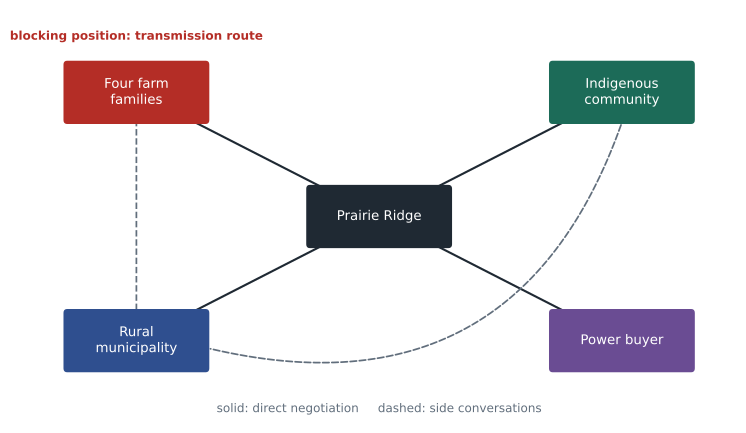
Coalitions
Researchers have studied which coalitions form and how members divide gains. In simple experiments, minimal winning coalitions tend to form: the smallest group that has enough power to decide, because larger groups would have to share the gains among more members. But real coalitions are shaped by relationships, ideology and trust as well as by arithmetic. A party that is trusted by several others is often included even when it is not needed; a party that has broken agreements in the past may be excluded even when its power makes it useful.
How should the gains of a coalition be divided? Lloyd Shapley proposed in 1953 a solution now called the Shapley value. It gives each party the average of its marginal contributions to the coalition across all the orders in which the coalition could be formed. A party that adds a great deal of value in many orders receives a large share; a party that adds little receives little. The Shapley value is used in practice to allocate costs and benefits among partners, and it offers negotiators a principled reference point when they argue about who deserves what.
# Shapley values for the wind project: who contributes what to the total value?
from itertools import permutations

players = ["Prairie Ridge", "landowners", "community", "power buyer"]

def value(coalition):
    s = set(coalition)
    if not {"Prairie Ridge", "landowners"} <= s:
        return 0                       # no project without the developer and the land
    extra = s - {"Prairie Ridge", "landowners"}
    if extra == {"community", "power buyer"}:
        return 80                      # partnership and long-term contract: lowest cost of capital
    if extra == {"power buyer"}:
        return 50                      # contract but slower permits and higher risk
    if extra == {"community"}:
        return 40                      # partnership but merchant power prices
    return 20                          # a smaller project selling power at market prices

shares = {p: 0.0 for p in players}
orders = list(permutations(players))
for order in orders:
    formed = []
    for p in order:
        before = value(formed)
        formed.append(p)
        shares[p] += value(formed) - before
for p in players:
    print(f"{p:14s} Shapley value {shares[p] / len(orders):5.1f} million")
print("total", sum(shares.values()) / len(orders))Prairie Ridge Shapley value 29.2 million landowners Shapley value 29.2 million community Shapley value 9.2 million power buyer Shapley value 12.5 million total 80.0
In the stylized numbers, which measure the present value of the project in millions of dollars under each combination of partners, the full coalition creates 80 million. The Shapley values give Prairie Ridge and the landowners about 29 million each, because without both of them there is no project at all, the power buyer 12.5 million and the community about 9 million. Dr. Fournier stresses that the figures are illustrations, not a recommendation. Real allocations depend on bargaining power, on fairness norms and, in the case of the community, on rights that are not captured in a value function: the community's consent and partnership may be required for the project to proceed regardless of what the arithmetic says. But the exercise is useful because it forces each party to ask what it adds and what the others add, and it shows the landowners why their collective position is strong.
Managing the process
Because process shapes outcomes so strongly, multi-party negotiations benefit from deliberate process design. Dr. Fournier offers several principles. First, map the parties and their relationships before the first meeting, including who influences whom and who can block. Second, agree on the process before the substance: who will attend, how often the group will meet, how decisions will be made, how information will be shared, and how disagreements will be handled. Third, consider using a facilitator or chair who is seen as neutral, particularly when trust is low. Fourth, make sure that each party's representatives have a mandate from their own side and a way to consult back, because multi-party agreements often fail when a constituency rejects what its representative accepted.
Fifth, use a single negotiating text. Rather than each party drafting its own proposals and arguing over them, a facilitator drafts one text that tries to meet everyone's interests, invites criticism, and revises it repeatedly. The technique was used by the United States at the Camp David talks between Egypt and Israel in 1978, where American negotiators produced more than twenty drafts of a single text over thirteen days. A single text focuses the group on improving one document rather than defending competing ones, and it makes it easier to see what each party needs.
Sixth, build agreement in stages. Early agreement on facts, through joint fact-finding with experts all parties trust, reduces later disputes. Agreement on principles, such as how benefits will be shared, can precede agreement on numbers. And agreements in principle can be tested with each constituency before being finalized. Finally, be careful with voting. Majority voting in a group that must implement a decision together can leave a resentful minority that undermines the result; consensus, defined as an agreement that every party can live with, takes longer but usually produces more durable outcomes.
Owen’s process
Owen's first step is to slow down. Prairie Ridge had been negotiating separately with each party, which allowed the farm families to compare notes and conclude that they were being offered different terms. He proposes a joint process with three tracks. The landowner track meets as a group, with a single lease template and a transparent payment formula, so that the families no longer suspect each other of getting better deals; families whose land hosts the access road or the transmission line receive additional payments under the same formula. The community track begins with a meeting at which Prairie Ridge listens to the community's leadership about its priorities, before any proposal is made, and explores an equity partnership in which the community would own a share of the project. The municipality track focuses on road use, setbacks from homes and a community benefit fund.
The US version of the community track recognizes the tribe as a sovereign government. Federal permits for the project trigger consultation obligations under historic preservation law, and the tribe's historic preservation office will review sites of cultural importance. Many tribal nations in the United States have developed or invested in renewable energy projects, sometimes with federal support. Owen's team retains advisers recommended by the tribe, paid for by Prairie Ridge, so that the tribe can evaluate the proposal with independent advice.
A steering group, with one representative from each party and a facilitator from a regional mediation firm, meets monthly to coordinate the tracks and to work on a single text for the project's community benefits agreement. The power buyer is kept informed but negotiates separately, because its contract terms are commercially sensitive and because it does not need to be part of the local agreements.
Agents and teams
Many negotiations involve agents: lawyers, real estate agents, brokers, union representatives or bankers who negotiate on behalf of principals. Agents bring expertise, networks and emotional distance, and they can make tough demands without damaging the principal's relationship. But their interests are not identical to their principals'. A real estate agent paid a commission of a few percent of the sale price gains little from holding out for a higher price and much from closing quickly, a conflict documented in a study by Steven Levitt and Chad Syverson, who found that agents sold their own homes for more and after longer than clients' homes. Principals should align incentives where they can, give clear instructions on reservation values and authority, and stay involved in key decisions.
Teams negotiating on one side face their own internal negotiation. Members from different functions, such as sales, engineering and finance, may have different priorities, and the other side will exploit visible disagreements. Teams should agree on priorities and roles beforehand: who leads, who takes notes, who watches the other side's reactions and who handles which issues. Research suggests that teams often discover integrative trades more readily than individuals, because members bring more knowledge, provided they share information within the team.
Worked problem
The transmission route holdout
One farm family, the Ostrowskis, owns the only practical route for the project's transmission line to the substation. After learning this, the family asks for 700 thousand dollars a year, about seven times the formula payment. Prairie Ridge's alternatives are a route that would add 11 kilometers of line at a cost of about 6 million dollars, or abandoning the project's northern section. How should Owen respond?
Show solution
- Assess the BATNA honestly: the longer route costs about 6 million dollars in present value, so the family's position is strong but not unlimited; above an annual payment of roughly 530 thousand dollars, worth about 6 million over a 30-year lease at an 8 percent discount rate, Prairie Ridge should take the long route.
- Understand the interests behind the demand: the family feels it was undervalued in earlier talks and fears that the line will reduce its land's value and complicate farming near the poles.
- Use the multi-party process: the other families, who benefit from the project going ahead, have an interest in a fair settlement; the transparent formula in the landowner track provides a standard for what is fair.
- Design a package: a higher payment for the route, based on the formula's premium for transmission land plus a share of project revenue; pole placement along field edges chosen by the family; and a purchase option if the family wants to sell land near the line.
- Avoid a deal so generous that it reopens the other families' agreements: make the terms consistent with the formula.
Answer: Owen agrees to a payment of about 160 thousand dollars a year, indexed to inflation, plus pole placement chosen by the family and a small revenue share. The family's position is acknowledged and rewarded, the cost is well below the long-route alternative, and the terms fit the landowner formula, so the other families accept them as fair.
Common mistakes
MistakeMulti-party negotiation is a series of two-party negotiations.
InsteadCoalitions, process and side conversations change the dynamics; manage the whole system.
MistakeThe most powerful party alone decides the outcome.
InsteadWeak parties can block or become pivotal in coalitions; map who can block.
MistakeMajority voting is the fastest fair process.
InsteadIt can leave a minority that undermines implementation; aim for agreements every party can live with.
MistakeAgents always share the principal's interests.
InsteadCommissions and incentives can diverge; align incentives and set clear authority.
Summary and key terms
- Multi-party negotiations add information complexity, coalitions, process choices and implementation challenges.
- Minimal winning coalitions are common in theory, but relationships and trust shape real coalitions.
- The Shapley value allocates gains by average marginal contribution and gives a principled reference point.
- Design the process deliberately: map parties, agree on process first, use neutral facilitation and a single negotiating text, and build agreement in stages.
- Agents and teams bring expertise but create their own internal negotiations and incentive problems.
- Coalition
- A subset of parties acting together to influence the outcome.
- Blocking position
- The ability of one party to prevent an agreement on its own.
- Shapley value
- A party’s average marginal contribution across all orders of coalition formation.
- Single negotiating text
- One draft revised repeatedly with input from all parties.
- Joint fact-finding
- Parties jointly commissioning experts to establish facts.
- Consensus
- An agreement that every party can live with, though not every party’s first choice.
- Principal–agent problem
- A conflict between the interests of a principal and the agent acting for it.
Practice problems
Work each problem on paper first, then reveal the answer to check.
In a three-party game, A and B together create 60, all three create 90, and no other coalition creates value. What is C's Shapley value?
Show answer
C adds 30 only when it joins last after A and B, which happens in 2 of 6 orders, so its value is 10.
Why might a facilitator use a single negotiating text?
Show answer
It focuses parties on improving one document and reveals what each needs, rather than defending competing drafts.
Give one reason an agent's interests might differ from the principal's.
Show answer
A commission agent gains little from a higher price but much from a quick sale.
What is the risk of negotiating separately and privately with each party in a multi-party deal?
Show answer
Parties compare notes, suspect unequal treatment and lose trust in the process.
Lesson quiz · 5 questions
Score 60% or more to complete this lesson.
Create a free account to save your progress, take quizzes and earn a certificate.