
MBA-604 · Lesson 10 of 12 · 21 min
Ethics and trust in negotiation
Dr. Fournier opens the tenth session with a question Leo faced the week before. Near the end of his license negotiation, the retailer's procurement manager asked him directly: do you have other retailers interested in this implementation slot before the holiday season? The truthful answer was that one retailer had expressed vague interest a month earlier and had not followed up. Leo felt that saying so would weaken his position. He was tempted to say that two other retailers were keen to sign. He did not, but he asks the cohort whether doing so would have been wrong, given that everyone knows negotiators exaggerate.
The question divides the cohort. Some think a little exaggeration about competing interest is part of the game; others think it is a lie, plain and simple. Dr. Fournier says the disagreement is itself the point. Negotiation tempts people to deceive because information is power, and because many negotiators believe the other side is doing the same. This lesson examines where the lines lie, ethically and legally, why trust matters so much to negotiated outcomes, and how to protect your interests without lying.
A spectrum of tactics
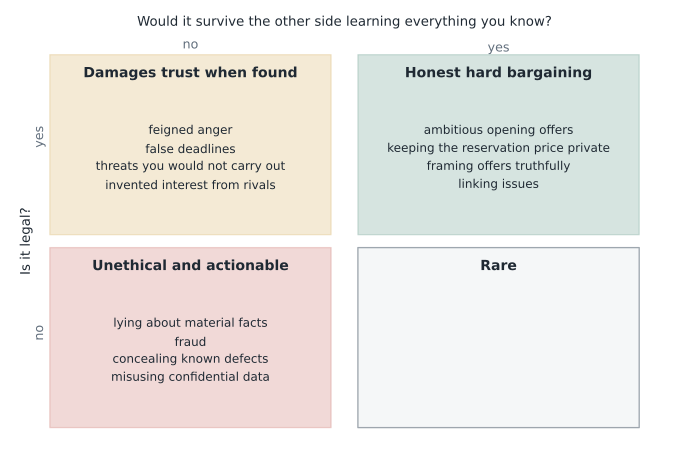
Roy Lewicki and Robert Robinson surveyed managers and students about the acceptability of negotiation tactics and found that they fell into distinct groups. Traditional competitive bargaining, such as making an opening demand far above what one expects or not revealing one's bottom line, was widely seen as acceptable. Emotional manipulation, such as pretending to be angry or disappointed, was seen as more questionable. Bluffing, such as threatening to walk away when one does not intend to, was more questionable still. And misrepresentation, such as lying about facts, misuse of confidential information and building false relationships to extract information, were seen by most as unacceptable. Not revealing information is generally regarded differently from stating something false.
Albert Carr's 1968 article in the Harvard Business Review, Is Business Bluffing Ethical, argued that business is like poker: it has its own rules, and bluffing is part of them, so conventional morality does not apply. Critics replied that, unlike poker players, people in business do not all consent to the rules, that the stakes include the livelihoods of others, and that the poker analogy excuses too much. Dr. Fournier finds the debate useful mainly because it shows that ethical standards in negotiation are contested, which is why every negotiator needs to decide in advance where her own lines are.
Ethical frameworks
Philosophers offer several ways to reason about such choices. Consequentialist reasoning judges an action by its outcomes: a lie is wrong if it causes more harm than good, counting harms to the other side, to oneself and to the trust on which future dealings depend. Duty-based reasoning judges actions by rules: lying is wrong because it treats the other person as a means rather than an end, whatever the consequences. Social contract reasoning asks what rules the community of participants would accept: perhaps that opening demands may be inflated but facts may not be misstated. And personal conscience asks what one can live with. Lewicki and his colleagues suggest that negotiators should use more than one framework: an action that fails every test is clearly wrong; one that passes some and fails others calls for careful thought.
Dr. Fournier offers three practical tests drawn from these frameworks. The disclosure test: would you be comfortable if the other side, your colleagues and your family learned exactly what you did? The reciprocity test: would you accept the same tactic used against you? And the reputation test: would you want to be known for this tactic among the people you will negotiate with over your career? Leo's invented competitors fail all three.
The law of deception in negotiation
The law sets a floor below which deception is not only unethical but actionable. In US common law, a contract induced by a material misrepresentation of fact can be rescinded, and fraudulent misrepresentation, a false statement made knowingly or recklessly that the other side justifiably relied on, can also lead to damages. Statements of opinion, predictions and sales talk, often called puffery, are generally not actionable, but stating as fact something one knows is false is. Silence is usually not misrepresentation, but a half-truth that creates a false impression, active concealment of a defect, or failing to correct a statement that has become false can be. US law generally imposes no duty to negotiate in good faith outside specific contexts, although every contract carries an implied duty of good faith and fair dealing in its performance, and the Uniform Commercial Code requires good faith in transactions for goods. Some courts have also enforced agreements to negotiate in good faith when the parties expressly made them.
Collective bargaining is one context in which the law does require good faith in negotiation itself. The National Labor Relations Act requires employers and unions to bargain in good faith; surface bargaining, refusing to meet, refusing to provide information relevant to bargaining or reneging on agreed items can be found to breach that duty.
The legal floor is lower than the ethical standard most people hold, and it is not where a careful negotiator should aim. Lies about material facts can also unravel deals long after signing, when they are discovered, and they expose individuals and companies to claims.
Detecting deception and protecting yourself
How good are people at detecting lies? Not very. A large review by Charles Bond and Bella DePaulo in 2006, combining studies of many thousands of judgments, found that people correctly distinguished lies from truths only about 54 percent of the time, barely better than chance. Popular cues, such as averted eyes or fidgeting, are unreliable. Negotiators protect themselves better by asking questions that are hard to answer falsely, verifying claims independently, asking for documentation, using contract terms such as representations and warranties that make false statements costly, and structuring deals so that the other side's claims are tested: a contingent contract, as in Lesson 4, puts money behind a forecast.
A practical technique is to ask the same question in different ways at different times, and to ask for specifics. A supplier who claims a rival offered a much lower price can be asked which products, at what volumes, with what delivery terms, and whether the offer can be shown. Genuine offers come with details; invented ones tend to stay vague.
Protecting information without lying
Leo's dilemma has better answers than a lie or a damaging truth. Dr. Fournier suggests several. He could decline to answer, politely: we do not discuss other clients' plans, just as we would not discuss yours. He could answer a different, true question that addresses the underlying concern: our implementation team can start only one new client before the season, and we would like it to be you. He could ask a question in return: what is driving the question, are you concerned about timing? Or he could reveal true information that supports his position: our results at a comparable retailer cut inventory by 12 percent, which is why we expect demand for slots to rise. All of these protect Kestrel's interests without creating a false impression, and none would be embarrassing if disclosed.
The same techniques apply when the other side asks about your BATNA or reservation price. You are not obliged to reveal them, and saying so is honest. Lying about them is risky: if the other side calls the bluff, you must either walk away from a deal you wanted or lose credibility by staying. Bluffs about alternatives are the most common deceptions in negotiation and among the most damaging when discovered, because they destroy the credibility of everything else the bluffer says.
Trust and its value
Trust is the willingness to accept vulnerability based on positive expectations of another party's intentions or behavior. In negotiation it has great economic value: parties who trust each other share information about priorities, which allows integrative trades, they need fewer protective clauses and less monitoring, and they adapt more easily when circumstances change. Roy Lewicki and Barbara Bunker described trust as developing through stages. Calculus-based trust rests on the costs of breaking it: each side keeps its word because cheating would be punished. Knowledge-based trust rests on predictability that comes from experience with the other party. Identification-based trust, the deepest form, rests on shared values and mutual understanding, so that each party can act for the other.
Trust is built slowly and lost quickly. It grows when parties make small commitments and keep them, share information reciprocally, are consistent across settings and acknowledge mistakes. It is damaged by broken promises, discovered deceptions, inconsistency and public humiliation. Research on repairing trust by Peter Kim, Donald Ferrin and colleagues found that after a violation involving competence, such as a mistake, an apology with an admission of fault repaired trust more effectively than a denial. After a violation involving integrity, such as a deliberate deception, the picture was more difficult: an apology confirmed the lack of integrity, and trust was harder to rebuild. The practical lesson is to avoid integrity violations, which are costly to repair, and to apologize promptly and specifically for competence failures.
Reputation and repeated dealings
Most business negotiations are not one-time events. Suppliers, customers, unions, partners and colleagues negotiate with each other repeatedly, and they talk to others. In repeated dealings, honesty and cooperation are not only ethical but rational. Political scientist Robert Axelrod demonstrated the logic in computer tournaments around 1980, in which strategies for playing a repeated prisoner's dilemma competed against each other. The winner was the simplest strategy entered, tit for tat, submitted by Anatol Rapoport: cooperate on the first move, then copy whatever the other player did last. Axelrod attributed its success to four properties: it was nice, never defecting first; retaliatory, punishing defection immediately; forgiving, returning to cooperation as soon as the other did; and clear, so that others quickly learned how it would respond.
# A small repeated prisoner's dilemma tournament in the spirit of Axelrod's
import random
PAYOFF = {("C", "C"): (3, 3), ("C", "D"): (0, 5), ("D", "C"): (5, 0), ("D", "D"): (1, 1)}

def always_cooperate(mine, theirs, rng): return "C"
def always_defect(mine, theirs, rng): return "D"
def tit_for_tat(mine, theirs, rng): return theirs[-1] if theirs else "C"
def grim(mine, theirs, rng): return "D" if "D" in theirs else "C"
def generous_tft(mine, theirs, rng):
    if theirs and theirs[-1] == "D" and rng.random() > 0.1:
        return "D"
    return "C"
def random_player(mine, theirs, rng): return rng.choice("CD")

def play(a, b, rounds=200, seed=1):
    rng = random.Random(seed)
    ha, hb, sa, sb = [], [], 0, 0
    for _ in range(rounds):
        ma, mb = a(ha, hb, rng), b(hb, ha, rng)
        pa, pb = PAYOFF[(ma, mb)]
        sa, sb = sa + pa, sb + pb
        ha.append(ma); hb.append(mb)
    return sa, sb

players = [always_cooperate, always_defect, tit_for_tat, grim, generous_tft, random_player]
totals = {p.__name__: 0 for p in players}
for i, a in enumerate(players):
    for b in players[i:]:
        sa, sb = play(a, b)
        totals[a.__name__] += sa
        if a is not b:
            totals[b.__name__] += sb
for name, score in sorted(totals.items(), key=lambda kv: -kv[1]):
print(f"{name:17s} {score:5d}")grim 3190 tit_for_tat 3053 generous_tft 2999 always_cooperate 2697 always_defect 2500 random_player 2451
In this small tournament, the strategies that never defect first and respond to defection, tit for tat, grim and generous tit for tat, finish at the top, while always defecting, which wins every individual encounter against a cooperator, does poorly overall because it earns low scores against everyone who retaliates. Dr. Fournier draws the lesson for negotiators who deal repeatedly with the same people: start cooperatively, respond firmly to bad faith, forgive quickly when the other side returns to good faith, and be predictable. A reputation for honesty and firmness is worth more over a career than any single deal won by deception.
Worked problem
Grace and the rival's price
A supplier of frozen vegetables tells Grace that a rival chain has been offered a price 8 percent lower than Fairway's for the same products, and that Fairway should match it or risk losing promotional support. Grace suspects the claim is exaggerated. Separately, the supplier asks Grace whether Fairway is talking to other suppliers about its private-label frozen line. Fairway is in early talks with one. How should Grace handle both moments?
Show solution
- Test the claim without accusing: ask which products, at what volumes, with what delivery and payment terms, and over what period. Note how specific the answers are.
- Use objective standards: compare with published wholesale price indexes and with Fairway's own data on the supplier's prices over time.
- Respond to the claim on its merits: if a lower price is real, it may reflect different volumes or terms; ask what Fairway would need to offer to obtain the same price.
- Answer the question about other suppliers honestly without revealing detail: Fairway regularly reviews its private-label sources, as any retailer does, and values the current relationship.
- Avoid inventing a competing offer to match the supplier's claim, which would fail the disclosure, reciprocity and reputation tests.
Answer: Grace's questions reveal that the rival's price applies to a different pack size with longer payment terms, which explains most of the difference. She negotiates a smaller reduction in exchange for larger orders, and answers the supplier's question truthfully without disclosing the early talks. Both moments protect Fairway's interests without a lie that could be exposed later.
Common mistakes
MistakeEveryone lies in negotiation, so I must too.
InsteadMost people regard misrepresenting facts as unacceptable, and discovered lies destroy credibility.
MistakeNot revealing my bottom line is dishonest.
InsteadWithholding information is different from stating falsehoods; you may decline to answer.
MistakeI can usually tell when someone is lying.
InsteadPeople detect lies only slightly better than chance; verify and structure deals instead.
MistakeAn apology always repairs trust.
InsteadIt helps after competence failures; integrity violations are much harder to repair.
Summary and key terms
- Tactics range from accepted competitive bargaining to bluffing, manipulation and misrepresentation; withholding differs from lying.
- Use several ethical frameworks and the disclosure, reciprocity and reputation tests to decide where your lines are.
- US law makes material misrepresentation and fraud actionable, implies good faith in performance and requires good faith in collective bargaining.
- People detect deception poorly; protect yourself with specific questions, verification, warranties and contingent terms.
- Trust has great economic value, develops through stages and is repaired differently after competence and integrity violations; in repeated dealings, cooperative but firm strategies win.
- Bluffing
- Misleading the other side about one’s intentions, such as a threat one would not carry out.
- Misrepresentation
- A false statement of fact that induces another party to contract.
- Puffery
- Exaggerated sales talk or opinion, generally not legally actionable.
- Duty of honest performance
- The obligation not to lie or knowingly mislead about matters linked to performing a contract.
- Calculus-based trust
- Trust that rests on the costs of breaking it.
- Tit for tat
- A strategy that cooperates first and then copies the other side’s previous move.
Practice problems
Work each problem on paper first, then reveal the answer to check.
Give an honest response to the question 'What is the lowest price you will accept?'
Show answer
'We are not going to negotiate against ourselves, but here is why we believe our price is fair.'
What is the difference between withholding information and misrepresentation?
Show answer
Withholding is not revealing; misrepresentation is stating something false or creating a false impression.
Why might apologizing for a deliberate deception fail to repair trust?
Show answer
It confirms the integrity violation, which people see as revealing character.
Name Axelrod's four properties of tit for tat.
Show answer
Nice, retaliatory, forgiving and clear.
Lesson quiz · 5 questions
Score 60% or more to complete this lesson.
Create a free account to save your progress, take quizzes and earn a certificate.