
MBA-604 · Lesson 6 of 12 · 20 min
Communication: questions, listening and persuasion
Dr. Fournier begins the sixth session by playing an audio recording, with permission, of the first twenty minutes of Daniel's meeting with the automaker's purchasing team, re-enacted by two volunteers from the cohort using Daniel's notes. In the recording, the senior buyer, Karen Holloway, sets out the automaker's request for 3 percent reductions. Daniel responds by explaining Northfield's steel costs, its quality record and its concern about margins. Holloway repeats the request. Daniel explains again, in more detail. After twenty minutes, neither side has learned anything new. Dr. Fournier stops the tape and asks how many questions Daniel asked. The answer is two, both of them rhetorical.
The point is not to embarrass Daniel, who in the real meeting recovered well, but to show the most common communication failure in negotiation: treating talk as transmission. Negotiators spend most of their energy explaining their own position and very little discovering the other side's. Research by Neil Rackham on skilled negotiators, based on observations of hundreds of real negotiations in the 1970s, found that the most effective negotiators asked more than twice as many questions as average negotiators, tested their understanding and summarized far more often, and gave fewer reasons for each of their own proposals, because a long list of reasons gives the other side more targets to attack.
Asking questions
Questions serve several purposes in negotiation. They gather information about interests, priorities, constraints and alternatives. They test assumptions. They slow down a conversation that is heating up. They signal respect, because a question shows that the other side's view matters. And they can persuade, because people are more convinced by conclusions they reach themselves than by those they are told.
Open questions, which cannot be answered with a word, are the main tool for discovery: what would an ideal agreement look like for you, how will your managers judge this deal, what concerns you most about our proposal. Diagnostic questions probe the reasons behind positions: why is 3 percent the target, how was it calculated, does it apply to the part price or to the total cost of the part. Closed questions confirm specific facts: so the target applies to annual spend, not to every part. Funnel questioning moves from open to closed, beginning broadly and narrowing as understanding grows.
Dr. Fournier warns about the word why. Asked in a tense moment, why can sound like an accusation: why would you ask for that. Questions beginning with what or how usually obtain the same information with less defensiveness: what makes that important to you, how did you arrive at that figure. She also recommends asking one question at a time and then waiting. Many negotiators ask a question, feel uncomfortable with the silence that follows and fill it themselves, often by answering their own question or by making a concession. Silence is one of the most useful tools in negotiation; a pause of several seconds after an offer or an answer often draws out more information.
Active listening
Listening in negotiation is an active skill, not a passive state. Its techniques are simple to describe and hard to use under pressure. Paraphrasing restates what the other side said in your own words: so the main issue is that your vehicle program's cost target was cut after launch. Summarizing gathers several points: let me check I have this right, you need a reportable reduction this year, you are open to how it is achieved, and quality cannot be compromised. Labeling names the emotion or concern behind a statement: it sounds as though you are under real pressure from your own management. Mirroring repeats the last few words of a statement as a question, which invites the speaker to say more.
These techniques do three things. They show that the listener has understood, which reduces the speaker's need to repeat and escalate. They correct misunderstandings early, before they harden into conflict. And they encourage the speaker to keep talking, which reveals more information. Former FBI hostage negotiator Chris Voss, in a widely read 2016 book, described a similar set of techniques as tactical empathy: understanding and acknowledging the other side's perspective, not because one agrees with it but because acknowledgment opens the way to influence. Empathy in this sense is different from sympathy or concession. A negotiator can fully understand the other side's position and still say no.
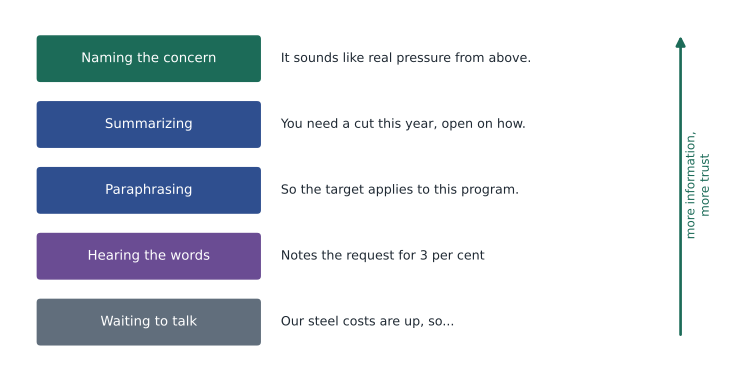
In the real meeting, Daniel changed course after the first break. He asked Holloway how the 3 percent target had been set. She explained that the vehicle's price had been cut by the automaker's marketing team after a competitor's launch, leaving a cost gap that purchasing had to close. Daniel summarized: so the target is about closing a cost gap on this vehicle, not about this bracket specifically. Holloway agreed. Daniel then asked whether a design change that lowered the cost of the assembly would count toward the target. It would, Holloway said, if engineering approved it within the quarter. The conversation had moved from positions to interests, and the design change Daniel had prepared in Lesson 2 now had a place to land.
# Count talk share, questions and summaries in a short negotiation transcript
transcript = [
    ("Buyer", "We need three per cent each year from every supplier on this program."),
    ("Daniel", "Steel has risen and our margins are thin, so three per cent is not possible."),
    ("Buyer", "Other suppliers have agreed. We need it from you too."),
    ("Daniel", "Our quality record is the best you have. We have had no rejects in fourteen months."),
    ("Daniel", "How was the three per cent target set?"),
    ("Buyer", "The vehicle price was cut after a competitor launched, so purchasing has to close the gap."),
    ("Daniel", "So the target is about the cost gap on the vehicle, not this bracket in particular?"),
    ("Buyer", "Yes, that is right."),
    ("Daniel", "Would a design change that lowers the cost of the assembly count as part of it?"),
    ("Buyer", "It would, if engineering approves it this quarter."),
]

stats = {}
for speaker, line in transcript:
    s = stats.setdefault(speaker, {"words": 0, "questions": 0, "summaries": 0})
    s["words"] += len(line.split())
    s["questions"] += line.count("?")
    if line.lower().startswith(("so ", "let me check", "it sounds")):
        s["summaries"] += 1

total = sum(s["words"] for s in stats.values())
for speaker, s in stats.items():
    print(f"{speaker:7s} talk share {s['words'] / total:5.0%}  questions {s['questions']}  summaries {s['summaries']}")

# Compare the first and second halves of the meeting for Daniel
first, second = transcript[:4], transcript[4:]
for name, part in (("first half", first), ("second half", second)):
    q = sum(line.count("?") for who, line in part if who == "Daniel")
print(f"{name}: Daniel asked {q} questions")Buyer talk share 42% questions 0 summaries 0 Daniel talk share 58% questions 3 summaries 1 first half: Daniel asked 0 questions second half: Daniel asked 3 questions
The simple count captures the turn in the meeting. In the first half, Daniel asked no real questions and spent his words on reasons; in the second, he asked three questions, one of them a summary, and learned the fact that unlocked the negotiation. Dr. Fournier suggests that students record practice negotiations, with permission, and run exactly this kind of count. Most are surprised by how little they ask and how much they explain.
Persuasion
Asking and listening reveal interests. Persuasion uses what has been learned to move the other side toward agreement. Robert Cialdini's research identified six principles of influence that apply widely, to which he later added a seventh. Reciprocity: people feel obliged to return favors and concessions. Commitment and consistency: people want to act consistently with what they have already said or done. Social proof: people look to what similar others do. Authority: people defer to credible experts. Liking: people are more easily persuaded by those they like and see as similar. Scarcity: people value what is rare or about to become unavailable. And unity: people are influenced by those they see as part of a shared group or identity.
Each principle can be used honestly or dishonestly. Grace uses social proof honestly when she tells a supplier that three other regional chains have adopted full-truckload deliveries; she would use it dishonestly if the claim were invented. Leo uses scarcity honestly when he tells the retailer that Kestrel's implementation team can start only one new client before the holiday season; a manufactured deadline would be a hardball tactic of the kind described in Lesson 3. Dr. Fournier's test is whether the persuasive statement would survive the other side learning everything you know. If it would, it is persuasion; if not, it is manipulation, and it is likely to damage trust once discovered.
Several findings about arguments are useful. Arguments framed in terms of the other side's interests are more persuasive than arguments about one's own needs: Holloway cares about closing a cost gap, not about Northfield's steel bill. Two-sided arguments, which acknowledge the strongest counterargument and answer it, are more persuasive to informed and doubtful audiences than one-sided ones. Concrete examples and stories are remembered better than statistics alone, although the statistics should be there for those who want them. And fewer, stronger reasons beat many weaker ones, as Rackham found, because a weak reason invites attack and dilutes the strong ones.
Negotiating in writing and on screen
More and more negotiation happens by email, messaging and video. Each channel changes the conversation. Email removes tone of voice and facial expression, so messages are read more negatively than intended, and silence after a message is often read as rejection when it is simply delay. Research by Michael Morris, Janice Nadler, Leigh Thompson and colleagues found that negotiators who had a short telephone conversation, unrelated to the business, before negotiating by email reached agreement far more often than those who went straight to email. Email has advantages too: it gives time to think, creates a record and allows careful wording of complex proposals.
Dr. Fournier's practical advice: build the relationship by phone or video before moving to email; use email to confirm and document, not to resolve disputes; write as if the message will be forwarded, because it may be; read every important message aloud before sending to check its tone; and when an email exchange starts to escalate, pick up the phone. On video, look at the camera when speaking, keep the face well lit, and be aware that delays in transmission can cause people to talk over each other, which feels like interruption. Lesson 9 returns to negotiating at a distance across time zones and cultures.
Communication when stakes are high
The techniques of this lesson matter most when the stakes are high and emotions are running. In those moments, people tend to stop listening, interrupt and restate their positions more forcefully. Dr. Fournier recommends three habits. First, summarize the other side's position to its satisfaction before stating your own, a practice sometimes credited to the psychologist Carl Rogers. Second, separate what you observe from what you infer: you have not responded to our proposal in two weeks is an observation; you are not serious about this deal is an inference that may be wrong. Third, ask permission before giving bad news or a frank view: may I tell you how this looks from our side. These habits slow the conversation down and keep it focused on the problem.
Worked problem
Owen listens to the farm family
In the second meeting with the farm family about the wind lease, the eldest son, Marc, says angrily that Prairie Ridge is like every other energy company: it will promise anything to get its turbines up and then disappear when there is a problem. Owen's instinct is to defend the company. What should he do instead?
Show solution
- Do not argue with the emotion. Label it: it sounds as though the family has had a bad experience with an energy company before.
- Ask an open question and wait: what happened?
- Listen and summarize: Marc explains that a pipeline company damaged drainage tiles on the farm ten years ago and took two years to pay for repairs. Owen summarizes the story and the cost to the family.
- Acknowledge the legitimacy of the concern without blaming the other company or making promises he cannot keep.
- Move to problem solving with a question: what would the family need in the lease to be confident that a problem would be fixed quickly?
- Record the answers, which include a repair deadline, an independent drainage survey before construction and a named contact at Prairie Ridge, as new issues in the negotiation.
Answer: By labeling and exploring Marc's anger rather than arguing with it, Owen learns about a specific past harm and converts it into concrete lease terms. The family's trust grows because Owen has shown that he understands their experience, and the new terms cost Prairie Ridge little because it intends to repair any damage promptly anyway.
Common mistakes
MistakeGood negotiators explain their position thoroughly.
InsteadSkilled negotiators ask more questions, summarize more and give fewer, stronger reasons.
MistakeSilence is awkward and should be filled.
InsteadSilence after a question or an offer often draws out information or concessions.
MistakeEmpathy means agreeing.
InsteadAcknowledging the other side's view shows understanding; you can still say no.
MistakeEmail is efficient for resolving disagreements.
InsteadEmail is read more negatively than intended; build rapport first and move disputes to voice or video.
Summary and key terms
- Skilled negotiators ask more questions, test understanding and summarize more often than average negotiators.
- Use open and diagnostic questions to discover interests, what and how rather than why in tense moments, and silence to draw out information.
- Paraphrasing, summarizing, labeling and mirroring show understanding and encourage the other side to say more.
- Cialdini's principles of influence can be used honestly; persuasion should survive the other side learning what you know.
- Build rapport before email negotiation, use email to document, and move escalating exchanges to voice or video.
- Open question
- A question that cannot be answered with a single word.
- Diagnostic question
- A question that probes the reasons behind a position.
- Paraphrasing
- Restating what the other side said in your own words.
- Labeling
- Naming the emotion or concern behind a statement.
- Tactical empathy
- Understanding and acknowledging the other side’s perspective in order to influence it.
- Social proof
- The tendency to follow what similar others do.
- Two-sided argument
- An argument that acknowledges and answers the strongest counterargument.
Practice problems
Work each problem on paper first, then reveal the answer to check.
Rewrite the question 'Why would you ask for that?' in a less defensive form.
Show answer
'What makes that important to you?' or 'How did you arrive at that figure?'
Give an example of labeling in a supplier negotiation.
Show answer
'It sounds as though the freight increases have hit you harder than you expected.'
Why might a long list of reasons weaken a proposal?
Show answer
Weak reasons invite attack and dilute the strong ones.
What did Morris, Nadler, Thompson and colleagues find about email negotiation?
Show answer
A brief phone conversation before negotiating by email greatly increased the chance of agreement.
Lesson quiz · 5 questions
Score 60% or more to complete this lesson.
Create a free account to save your progress, take quizzes and earn a certificate.