
MBA-604 · Lesson 12 of 12 · 24 min
Capstone: negotiating Cedarline’s supplier and labor agreements
The final session brings the course back to Cedarline Outdoor, the company the cohort has studied since MBA-501. The strategy agreed in MBA-514 commits Cedarline to a focused, durable product range; the supply chain redesign from MBA-513 splits its sourcing into steady replenishment of core products and a staged commitment for fashion products, with an early buy from Asia and a second buy from a nearby partner; and the people strategy from MBA-601 aims to stabilize the distribution warehouse, where turnover was 38 percent a year. Each of these plans now depends on two negotiations. Teresa Lam must agree a new three-year contract with Thien Phuc Garment, the Vietnamese factory that makes a third of Cedarline's outerwear. And Cedarline's chief operating officer must negotiate a first collective agreement with the workers at the distribution warehouse.
The second negotiation follows events over the summer. Despite the improvements launched under the people strategy, the warehouse employees voted in an election supervised by the National Labor Relations Board, and in June a union was certified as the bargaining representative of the 520 workers. Cedarline's managers were disappointed but, on Dr. Rahimi's advice in MBA-601, they did not challenge the result and have committed to bargaining a fair first agreement.
Dr. Fournier divides the cohort into teams. Two teams prepare for Cedarline and two for Thien Phuc; two prepare for Cedarline's warehouse management and two for the union. Each team receives confidential instructions. After the role plays, the teams compare outcomes and analyze what drove the differences. This lesson presents the preparation, the negotiations and the debrief.
Part 1: The Thien Phuc agreement
Thien Phuc has made Cedarline's parkas and shell jackets for nine years. Under the old model, Cedarline placed nearly all its winter orders eight months ahead, and Thien Phuc made about 140 thousand units a year. The new model changes three things. Core products, about two thirds of the volume, move to continuous replenishment, with monthly orders against a rolling forecast. Fashion products move to a smaller early buy, with the rest bought later from a nearby partner after early sales are known. And Cedarline wants stronger social compliance: annual third-party audits with a wage benchmark, because forced labor import rules and reporting laws in North America, and Cedarline's own brand promise of durability and fair production, require it.
Teresa's preparation follows Lesson 2. Cedarline's interests are cost, supply security, flexibility to cancel or change fashion orders, quality and compliance. Its BATNA is to move core production to its factories in Bangladesh and China, which would take a year, cost about 3 percent more per unit after duties and freight, and carry quality risk. Thien Phuc's interests, as Teresa understands them from nine years of dealings and from her first meeting in Lesson 9, are stable volume to keep its 1,800 workers employed, cash flow, because it pays for fabric months before it is paid, and protection against being left with fabric for canceled orders. Its BATNA is to sell the capacity to other brands, which several are seeking in Vietnam, but at lower prices and with the cost of building new relationships.
Five issues are on the table. The price of the core parka, currently 120 dollars, which Thien Phuc wants to raise to 124 because of wage and fabric increases and Cedarline wants to cut to 118. The annual volume Cedarline commits to for core products, which Thien Phuc wants as high as possible. Payment terms, where Thien Phuc wants payment 30 days after shipment and Cedarline wants 60. Responsibility for fabric already bought for fashion orders that Cedarline later cancels. And the compliance program.
| Issue | Options | Cedarline points | Thien Phuc points |
|---|---|---|---|
| Core parka price (US dollars) | 118 / 121 / 124 | 30 / 15 / 0 | 0 / 15 / 30 |
| Annual core volume commitment | 60k / 80k / 100k units | 10 / 7 / 4 | 0 / 12 / 25 |
| Payment terms | 30 / 45 / 60 days | 0 / 3 / 6 | 20 / 10 / 0 |
| Fabric for canceled fashion orders | Factory / shared / Cedarline bears | 24 / 12 / 0 | 0 / 8 / 15 |
| Third-party audits with wage benchmark | No / yes, cost shared | 0 / 30 | 10 / 5 |
The scoring systems reveal the structure. Price is purely distributive. Volume and payment terms matter much more to Thien Phuc than to Cedarline: under the new model Cedarline expects to buy about 95 thousand core units a year anyway, so committing to 100 thousand costs it little, and Cedarline's treasury values 30 extra days of payables less than the factory values 30 days less of financing. Fabric risk matters more to Cedarline, because the new model's purpose is flexibility on fashion products. And compliance is close to essential for Cedarline and only a modest cost to Thien Phuc if Cedarline shares the audit cost.
# Thien Phuc agreement: packages, the efficient frontier and the issue-by-issue compromise
from itertools import product

issues = {
    "price": {"118": (30, 0), "121": (15, 15), "124": (0, 30)},
    "core volume": {"60k": (10, 0), "80k": (7, 12), "100k": (4, 25)},
    "payment": {"30 days": (0, 20), "45 days": (3, 10), "60 days": (6, 0)},
    "fabric risk": {"factory": (24, 0), "shared": (12, 8), "Cedarline": (0, 15)},
    "audit": {"no": (0, 10), "yes": (30, 5)},
}
packages = []
for combo in product(*[list(v.items()) for v in issues.values()]):
    c = sum(score[0] for _, score in combo)
    t = sum(score[1] for _, score in combo)
    packages.append((c, t, [name for name, _ in combo]))

frontier = sorted(p for p in packages
                  if not any(q[0] >= p[0] and q[1] >= p[1] and q[:2] != p[:2] for q in packages))
print(len(packages), "packages,", len(frontier), "efficient")
for c, t, terms in frontier[2:9]:
    print(f"Cedarline {c:3d}  Thien Phuc {t:3d}  {terms}")

def score(terms):
    return next((c, t) for c, t, x in packages if x == terms)

print("compromise on every issue:", score(["121", "80k", "45 days", "shared", "yes"]))
print("logrolled package:        ", score(["121", "100k", "30 days", "factory", "yes"]))
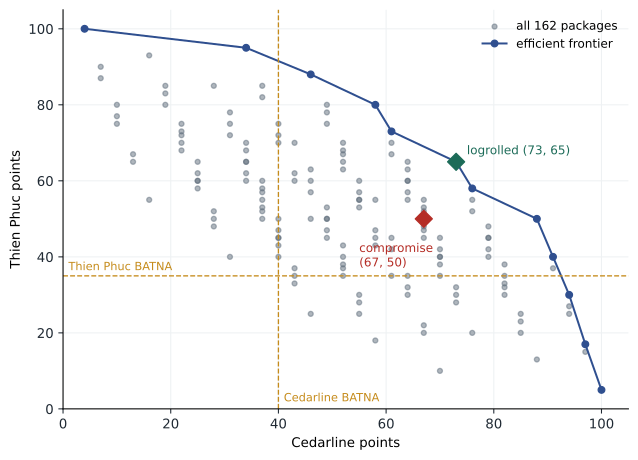
print("BATNA values: Cedarline about 40, Thien Phuc about 35")162 packages, 12 efficient Cedarline 46 Thien Phuc 88 ['124', '100k', '30 days', 'shared', 'yes'] Cedarline 58 Thien Phuc 80 ['124', '100k', '30 days', 'factory', 'yes'] Cedarline 61 Thien Phuc 73 ['121', '100k', '30 days', 'shared', 'yes'] Cedarline 73 Thien Phuc 65 ['121', '100k', '30 days', 'factory', 'yes'] Cedarline 76 Thien Phuc 58 ['118', '100k', '30 days', 'shared', 'yes'] Cedarline 88 Thien Phuc 50 ['118', '100k', '30 days', 'factory', 'yes'] Cedarline 91 Thien Phuc 40 ['118', '100k', '45 days', 'factory', 'yes'] compromise on every issue: (67, 50) logrolled package: (73, 65) BATNA values: Cedarline about 40, Thien Phuc about 35
Of 162 possible packages, only 12 are efficient. The outcome most pairs of negotiators expect to reach, a compromise on every issue, gives Cedarline 67 points and Thien Phuc 50. The logrolled package, with the price split at 121 dollars but Cedarline committing to 100 thousand core units a year and paying in 30 days in exchange for Thien Phuc bearing the fabric risk on canceled fashion orders, gives Cedarline 73 and Thien Phuc 65. Both sides are better off, and both are far above their BATNAs.
How the Thien Phuc negotiations went
The two pairs reached very different outcomes. In the first, the Cedarline team opened with demands on every issue at once, insisted on discussing price first, and spent an hour trading single concessions on it. When they reached 121 dollars, both sides were tired and suspicious, and they split the other issues down the middle, landing on the compromise package. In the second, the Cedarline team began, as Teresa would, by explaining the new supply model and asking about Thien Phuc's concerns. The Thien Phuc team said that cash flow was its biggest worry, because fabric suppliers demanded payment in advance. The Cedarline team then offered two packages of equal value to itself, one with 30-day payment and one with a higher volume commitment, and watched which the factory preferred. Within the second hour they had found the logrolled package, and they spent the remaining time on the details of the audit program and on a clause for reviewing the price if fabric costs moved by more than 8 percent, a contingent term that both sides valued.
Teresa, watching the debrief, says the second pair's agreement is close to the one she hopes to reach in Vietnam, with one addition: she will propose a joint planning meeting each quarter at which Cedarline shares its forecast and Thien Phuc its capacity plan, a commitment that costs little and builds the knowledge-based trust described in Lesson 10.
Part 2: The warehouse collective agreement
The warehouse has 520 employees with average pay of about 46 thousand dollars a year. In MBA-601 the cohort estimated that each departure costs about a quarter of a year's pay to replace, and that turnover of 38 percent was costing Cedarline well over a million dollars a year. The union's bargaining committee, elected by the members, is led by a forklift operator with eleven years at Cedarline and supported by a professional negotiator from the union's regional office. Its survey of members ranked the issues: schedules changed at short notice, pressure from pick-rate targets enforced by handheld scanners, the use of agency temporary workers who are laid off after the holiday peak, and wages.
Cedarline's interests are cost control, the flexibility to handle a holiday peak that triples volume in November and December, productivity, and a stable, skilled workforce, which the supply chain plan relies on for weekly store replenishment and online orders. The union's interests are fair pay, predictable lives, safe and humane work standards, a voice in how the warehouse is run, and, for a first agreement, demonstrating to members that the union was worth having.
Each side's BATNA shapes the negotiation. If talks fail, the union could strike, and a strike in October or November would damage Cedarline's holiday season. Cedarline could legally hire replacement workers during an economic strike, but that would be costly and would poison relations. There is no first-contract arbitration under federal labor law, and first agreements often take more than a year to reach, so both sides face the risk of a long, damaging dispute if they treat the negotiation as a contest of power.
# Costing three wage packages for the warehouse agreement, and the value of lower turnover
employees, pay, rollup = 520, 46_000, 0.22
replacement_cost_share = 0.25                    # cost of replacing one employee, share of pay

def three_year_cost(increases, lump=0.0):
    total, w = 0.0, pay
    for inc in increases:
        w *= 1 + inc
        total += employees * (w - pay) * (1 + rollup)
    return total + lump * employees

packages = {
    "Cedarline opening 2.5 / 2.5 / 2.5": ((0.025, 0.025, 0.025), 0),
    "union opening 5 / 4 / 4": ((0.05, 0.04, 0.04), 0),
    "settlement 3.5 / 3 / 3": ((0.035, 0.03, 0.03), 0),
}
for name, (incs, lump) in packages.items():
    print(f"{name:34s} extra cost over 3 years {three_year_cost(incs, lump) / 1e6:5.2f} million")

# Predictability pay: two hours' pay when a shift is changed with less than 7 days' notice
hourly = pay / 2_000
changes_per_year = 3_000                           # expected late changes after better planning
print(f"predictability pay about {changes_per_year * 2 * hourly / 1e3:5.0f} thousand a year")

# Each point of turnover avoided saves replacement costs
for turnover in (0.38, 0.30, 0.25):
    saving = employees * (0.38 - turnover) * pay * replacement_cost_share
print(f"turnover {turnover:.0%}: saving {saving / 1e3:5.0f} thousand a year")Cedarline opening 2.5 / 2.5 / 2.5 extra cost over 3 years 4.45 million union opening 5 / 4 / 4 extra cost over 3 years 8.10 million settlement 3.5 / 3 / 3 extra cost over 3 years 5.81 million predictability pay about 138 thousand a year turnover 38%: saving 0 thousand a year turnover 30%: saving 478 thousand a year turnover 25%: saving 777 thousand a year
The costing frames the negotiation. Over three years, the union's opening wage proposal would cost about 8.1 million dollars more than current wages, including related costs, and Cedarline's about 4.5 million. A settlement at 3.5, 3 and 3 percent would cost about 5.8 million. Predictability pay, two hours' pay whenever a shift is changed with less than a week's notice, would cost about 138 thousand dollars a year if better planning keeps late changes to about 3,000 a year. And a fall in turnover from 38 to 30 percent would save about 478 thousand dollars a year in replacement costs; a fall to 25 percent would save more than 770 thousand. The non-wage issues the members ranked highest are the ones most likely to reduce turnover, so spending on them may be cheaper than it looks.
How the warehouse negotiations went
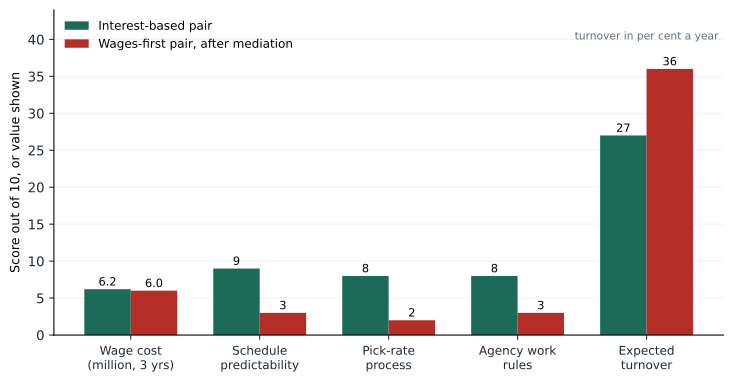
Both pairs began with ground rules: meeting times, the exchange of information, including Cedarline's turnover and overtime data, and an agreement to discuss scheduling, pick rates and agency work in joint subcommittees using interest-based problem solving, while wages would be bargained at the main table. The pair that did better spent the first two sessions on the subcommittees. On scheduling, they agreed that schedules would be posted fourteen days ahead, with predictability pay for late changes and a voluntary list for extra shifts. On pick rates, they agreed that standards would be set by a joint committee based on engineering studies, that scanner data would not be used for discipline without a supervisor's review, and that new employees would have a ramp-up period. On agency workers, they agreed that temporary workers could make up no more than 20 percent of hours outside November and December, and that agency workers with two peak seasons would have the first right to permanent jobs.
With those issues settled in principle, the wage negotiation was easier. The union moved from 5, 4 and 4 percent toward 3.5, 3 and 3 in shrinking steps, labeling each concession; Cedarline moved from 2.5 percent each year, labeling its own. The final agreement, at 3.5, 3 and 3 percent with a 750 dollar signing payment, cost Cedarline about 6.2 million dollars over three years including the signing payments, almost 2 million less than the union's opening, and less than its own estimate of the cost of a peak-season strike. The union could tell its members that it had won predictable schedules, humane pick rates and a path to permanent jobs, which mattered more to them than an extra half point. The other pair, which began with wages and argued for three sessions, reached impasse and was sent to a mediator, which Dr. Fournier played. The mediator's first move was to propose the subcommittee process the first pair had used.
The debrief: what drove the differences
Dr. Fournier asks the teams to identify what made the difference in both negotiations. Their list summarizes the course. Preparation that valued every issue for both sides, so that trades could be recognized. Asking about interests before arguing about positions. Negotiating packages rather than issues one at a time. Ambitious but justified openings, and concessions in shrinking, labeled steps. Attention to the other side's alternatives and constraints, including deadlines such as the holiday peak. Process choices, such as joint subcommittees and information sharing, that made integrative bargaining possible. Contingent terms that bridged disagreements about the future. Respect for cultural norms and for face. And a focus on implementation: the quarterly planning meeting with Thien Phuc, the joint committees at the warehouse, and a commitment from both sides to review how each agreement is working after a year.
She ends with three questions for the cohort to carry into their careers. Before every important negotiation: what do I want, what do they want, and what will each of us do if we do not agree? During it: what am I learning, and what would make this better for both of us? And afterwards: what happened, why, and what will I do differently next time? Negotiators who ask these questions consistently, she says, keep improving long after the course ends.
Worked problem
Writing Cedarline's negotiation plan for Thien Phuc
Teresa asks the cohort to turn the role-play lessons into a one-page plan for the real negotiation in Vietnam next month. What should it contain?
Show solution
- Interests and priorities for both sides, with the scoring system as a private guide; Cedarline's BATNA (move core production, about 3 percent dearer after a year's transition) and estimates of Thien Phuc's.
- Target: price no higher than 121 dollars, 30-day payment and a 100 thousand unit core commitment traded for the factory bearing fabric risk on canceled fashion orders, and the audit program with shared cost.
- Opening: present the new supply model and its benefits for Thien Phuc's core volume; ask about cash flow, capacity and fabric commitments; use equivalent packages to learn priorities.
- Contingent and relationship terms: a price review if fabric costs move by more than 8 percent; a quarterly joint planning meeting; a one-year review of the agreement.
- Process: one day on the relationship before business; written bilingual summaries after each meeting; time for Thien Phuc to consult its owners.
- Walk-away point and authority: Teresa may agree within the target ranges; anything outside them returns to the chief operating officer.
Answer: The plan converts the course's tools into a concrete agenda. It aims for an efficient agreement rather than a compromise, protects Cedarline's flexibility on fashion products, which is the purpose of the new supply model, and gives Thien Phuc the volume and cash flow it needs to commit to Cedarline for three more years.
Common mistakes
MistakeA capstone negotiation is about getting the best price.
InsteadPrice is one issue; most value comes from trades on volume, terms, risk and process.
MistakeFirst agreements with a new union must be won by power.
InsteadInterest-based subcommittees on the issues members care about most can produce better agreements for both sides.
MistakeAgreements end the negotiation.
InsteadImplementation, joint committees and reviews decide whether the agreement delivers its value.
MistakeWhat worked in one negotiation will work in the next.
InsteadDebrief each negotiation: what happened, why, and what to do differently.
Summary and key terms
- Cedarline's strategy, supply chain and people plans all depend on negotiated agreements with a contract factory and a new union.
- In the Thien Phuc agreement, trading volume and payment terms for fabric risk reaches the efficient frontier, while compromising on every issue does not.
- In the warehouse agreement, costing wages, valuing turnover savings and settling non-wage issues through joint problem solving produced a better agreement than starting with wages.
- The pairs that did best prepared both sides, asked about interests, negotiated packages, managed concessions and designed the process deliberately.
- Every negotiation should be followed by implementation planning and a structured debrief.
- Negotiation plan
- A written summary of interests, alternatives, targets, process and authority for a negotiation.
- First collective agreement
- The first contract negotiated after a union is certified.
- Interest-based bargaining
- Collective bargaining that uses joint problem solving on interests.
- Predictability pay
- Extra pay when an employer changes a schedule at short notice.
- Debrief
- A structured review of what happened in a negotiation and why.
Practice problems
Work each problem on paper first, then reveal the answer to check.
In the Thien Phuc case, why is committing to 100 thousand core units cheap for Cedarline but valuable to the factory?
Show answer
Cedarline expects to buy about 95 thousand anyway, so the commitment adds little risk, while the factory gains security for its workforce.
Using the costing code, what is the annual saving if turnover falls from 38 to 33 percent?
Show answer
520 × 0.05 × 46,000 × 0.25 ≈ 299,000 dollars a year.
Why might the union value predictable schedules more than an extra half point of wages?
Show answer
Unpredictable schedules disrupt childcare, second jobs and family life; members ranked them first.
What three questions does Dr. Fournier suggest asking before every important negotiation?
Show answer
What do I want, what do they want, and what will each of us do if we do not agree?
Lesson quiz · 5 questions
Score 60% or more to complete this lesson.
Create a free account to save your progress, take quizzes and earn a certificate.