
MBA-604 · Lesson 2 of 12 · 23 min
Preparing to negotiate: BATNA, reservation price and aspirations
Dr. Fournier opens the second Friday with a claim from her procurement years: in a negotiation that matters, preparation should take at least as long as the meeting, and often several times longer. Her team at the mining company prepared for a large equipment contract for six weeks and negotiated for two days. The preparation was where they discovered that the supplier's factory had idle capacity, that the supplier's rival was keen to enter the region, and that their own maintenance managers cared far more about spare parts availability than about the purchase price. All three discoveries changed the deal. Without preparation, she says, negotiators react to the other side's agenda; with it, they shape the agenda.
This lesson works through a full preparation using Daniel's case. Northfield Components makes the stamped bracket assembly that holds the battery tray in one of a large automaker's vehicles. The automaker's purchasing team has written to all suppliers asking for price reductions of 3 percent in each of the next three years, citing pressure on vehicle margins. The bracket sells for 18.40 dollars, variable cost is 11.90 dollars, and the plan for next year is 310,000 units, as the cohort calculated in MBA-501. A 3 percent cut is 55 cents a unit, about 171 thousand dollars of contribution in the first year, rising as the cuts compound. Daniel's plant manager has asked him to prepare the company's response.
Step 1: Know your interests and priorities
The first step is to list everything Northfield cares about, not only price. Daniel's list, after talking with sales, engineering and the plant manager, includes the bracket margin, stable volume to keep the new line loaded, a commitment that Northfield will be considered for the next vehicle platform, faster payment from the automaker, which currently pays at 75 days, and relief from the cost of an expensive inspection step the automaker requires on every shipment. He then ranks the issues and asks how much each is worth. A day of faster payment on about 5.7 million dollars of annual bracket sales is worth roughly 1,250 dollars a year at Northfield's 8 percent borrowing cost; moving from 75 to 45 days is worth about 37 thousand dollars a year. The inspection step costs about 60 thousand a year. A place on the next platform is worth far more than either, but is uncertain.
Putting values on issues does two things. It shows which concessions are cheap and which are expensive, and it prevents the common error of fighting hard over something that matters little while giving away something that matters a great deal. Dr. Fournier calls the result a priority map: issues listed by value, with a note on each about whether the other side probably values it more, less or about the same.
Step 2: Identify and improve your BATNA
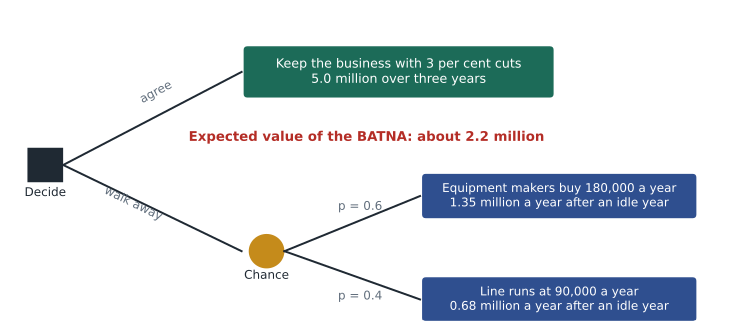
Next, Daniel asks what Northfield will do if it refuses the price reduction and the automaker carries out its threat to re-source the bracket. The alternatives include selling the line's capacity to agricultural and construction equipment makers, which pay higher prices for smaller runs but would need about a year to win; running the line below capacity; or redeploying part of it to another automaker's program for which Northfield has been quoting. The best of these, after honest analysis, is selling capacity to equipment makers. Daniel estimates that within a year Northfield could sell about 180,000 units of similar parts a year at a contribution of about 7.50 dollars a unit, with a probability of about 60 percent; otherwise the line would run at about 90,000 units.
A BATNA is often uncertain, and an uncertain BATNA should be valued by its expected value and its risk, not by its best case. Many negotiators make the mistake of assuming their alternative will turn out well because they would like it to. Others make the opposite mistake of treating their alternative as worthless because it is unpleasant, and then accepting almost anything. Daniel's honest estimate is below the value of keeping the automaker's business even at a reduced price, but it is not zero, and it improves if Northfield begins quoting equipment makers now.
# Northfield: value of keeping the automaker's bracket versus the best alternative (BATNA)
units, price, variable = 310_000, 18.40, 11.90

def contribution_with_cuts(cuts, years=3):
    total, p = 0.0, price
    for c in cuts[:years]:
        p *= 1 - c
        total += units * (p - variable)
    return total

keep_full_cut = contribution_with_cuts([0.03, 0.03, 0.03])
keep_one_cut = contribution_with_cuts([0.03, 0.0, 0.0])

# BATNA: re-sell the capacity to equipment makers after a year of selling
p_success, units_ok, units_low, unit_margin = 0.60, 180_000, 90_000, 7.50
year1 = 0.0                             # the line is mostly idle while new customers qualify
later = p_success * units_ok * unit_margin + (1 - p_success) * units_low * unit_margin
batna = year1 + 2 * later

print(f"keep, 3 per cent cut each year: {keep_full_cut / 1e6:5.2f} million over three years")
print(f"keep, one 3 per cent cut only:  {keep_one_cut / 1e6:5.2f} million")
print(f"BATNA expected value:           {batna / 1e6:5.2f} million")
# Reservation point: the deepest yearly cut Northfield could accept and still beat the BATNA
lo, hi = 0.0, 0.30
for _ in range(50):
    mid = (lo + hi) / 2
    if contribution_with_cuts([mid] * 3) > batna:
        lo = mid
    else:
        hi = mid
print(f"walk-away point: cuts of about {lo * 100:.1f} per cent a year")keep, 3 percent cut each year: 5.04 million over three years keep, one 3 percent cut only: 5.53 million BATNA expected value: 2.16 million walk-away point: cuts of about 12.3 percent a year
The calculation is sobering. Even with the full 3 percent cut in each year, keeping the business is worth about 5.0 million dollars of contribution over three years, compared with an expected value of about 2.2 million for the BATNA. Daniel's walk-away point is cuts of about 12 percent a year, far deeper than anything the automaker has asked for. That means Northfield has a weak BATNA relative to the deal, which is common for suppliers with dedicated equipment. It does not mean Northfield must accept the request as written. It means Daniel's preparation should focus on the automaker's alternatives and interests, on issues other than price, and on improving Northfield's BATNA over time by quoting other customers.
Dr. Fournier adds that the reservation point is a calculation, not a target. A negotiator who knows that she could accept a very bad deal must take care not to drift toward it. The reservation point guards against agreeing to something worse than the alternative; it says nothing about what to aim for.
Step 3: Assess the other side
The same questions must be asked about the other side. What are the automaker's interests? Its purchasing team is measured on annual cost reduction, so a visible percentage cut matters to the buyers personally. Its engineering team cares about quality, launch timing and the cost of qualifying a new supplier. Its plant cares about on-time delivery, because a missing bracket stops a vehicle line that builds a vehicle a minute. What is its BATNA? Re-sourcing the bracket would require a new supplier to build tooling, pass a full production part approval process and run a trial build, which typically takes nine to twelve months and costs several hundred thousand dollars, and it would carry launch risk. The automaker's threat to re-source is real for the next vehicle platform but much weaker for the current one.
Estimating the other side's BATNA and reservation value is the most important analytical task in preparation, and the hardest, because the other side has every reason to disguise them. Sources include public information, industry contacts, the other side's past behavior, and questions asked during the negotiation itself. A useful habit is to write down a range rather than a point estimate, and to update it as information arrives.
Step 4: Set aspirations
With the reservation point and the other side's likely position in view, the negotiator sets a target, or aspiration: the outcome she would be happy to achieve, ambitious but justifiable. Research is consistent that aspirations drive outcomes. Negotiators with specific, challenging goals tend to achieve better outcomes than those told to do their best, and negotiators who focus on their target rather than their reservation point do better than those who focus on the minimum they will accept, as experiments by Adam Galinsky, Thomas Mussweiler and colleagues showed. The cost is that ambitious negotiators feel less satisfied, because they compare the outcome with a high target. Dr. Fournier's advice is to set a high target based on what can be justified with objective standards, then measure the result against the BATNA when deciding whether to accept it.
Daniel proposes a target of a single 1 percent reduction next year, tied to a design change that Northfield's engineers believe can remove one weld and save about 22 cents a unit, together with payment terms of 45 days and removal of the inspection step after six months of perfect quality. That package would cost Northfield almost nothing net, while giving the automaker's buyers a reportable cost reduction. His opening proposal will be a little more ambitious than his target, to leave room for concessions.
Step 5: Plan information, agenda and authority
Preparation includes deciding what to ask, what to share and what to protect. Daniel's information plan lists questions for the automaker: what reduction other suppliers have agreed to, whether the target applies to the part price or to total cost, how the buyers would value faster payment or engineering changes, and when sourcing decisions for the next platform will be made. It also lists what Northfield will share, such as its engineering ideas and its quality record, and what it will not share, such as its variable cost and the weakness of its alternative.
The agenda matters too. Negotiators who discuss issues one at a time, settling each before moving to the next, find it hard to make trades, because each issue becomes a separate distributive contest. Daniel will propose discussing price, design changes, payment terms and inspection together, so that concessions on one can be tied to gains on another. He also needs clarity on his own authority. If the plant manager or the owners must approve the deal, Daniel should know in advance what he can agree to on the spot, and the automaker's buyers should know who will make the final decision. Many deals collapse when a negotiator returns home and is told that what he agreed is unacceptable; Walton and McKersie called the process of aligning one's own side intra-organizational bargaining.
| Preparation item | Northfield | The automaker (estimated) |
|---|---|---|
| Main interests | Margin, stable volume, next platform, cash | Reportable cost cut, quality, on-time launch |
| BATNA | Equipment makers, about 2.2 million expected | Re-source: 9–12 months, several hundred thousand, launch risk |
| Reservation point | Cuts of about 12 percent a year | Unknown; probably accepts much less than 3 percent with other savings |
| Target | One 1 percent cut with a design change, 45-day terms | 3 percent each year |
| Tradeable issues | Design change, payment terms, inspection, volume commitment | Price, quality guarantees, next-platform quotes |
| Standards | Steel index, published cost models, quality record | Industry price-down norms, competing quotes |
Step 6: Choose standards and prepare arguments
Arguments are more persuasive when they rest on standards the other side respects. For Northfield, relevant standards include the steel price index, which rose last year; the published cost models that automakers themselves use to estimate what a part should cost; the price-down rates agreed by other suppliers in the industry; and the value of the quality record, which shows no defective parts in fourteen months. Fisher and Ury call this insisting on objective criteria. It shifts the conversation from a contest of will to a joint search for a fair result, and it gives the other side a way to explain the outcome to its own managers.
Daniel also prepares for the automaker's arguments. The buyers will say that other suppliers have accepted 3 percent; he plans to ask whether those suppliers received design changes or volume increases in return. They will say that the automaker's margins are under pressure; he plans to agree, and to offer the design change as a way to lower the vehicle's cost that does not destroy his own margin. They will say that the bracket could be re-sourced; he plans to acknowledge that this is possible and to point out the timing and cost of qualification, without sounding like a threat.
Common preparation failures
Dr. Fournier lists the failures she sees most often. Negotiators prepare only their own side and treat the other side as an obstacle rather than a party with interests and alternatives of its own. They prepare a single position and no package, so they have nothing to trade. They confuse their target with their reservation point and either give up too much or walk away from good deals. They fail to check their authority. And they assume the other side knows what they know: that their product is better, their record is excellent, or their alternative is strong. Information the other side does not have cannot affect its decisions.
A final element of preparation is a plan for the relationship. Northfield will deal with this automaker for years, through launches, quality problems and recalls. A negotiation that extracts the last cent but leaves the buyers resentful may cost more later. Daniel decides to begin the meeting by recognizing the pressure the automaker faces and by presenting the design change as joint work, so that the relationship is strengthened rather than tested.
Worked problem
Preparing Hana's physician group contract
Lakeview Health contracts with a group of twelve emergency physicians who staff its community hospital's emergency department. The contract expires in four months. The group has told Hana that it wants a 9 percent increase in its hourly rate, citing burnout and competition from hospitals in the city. Lakeview's budget assumes 3 percent. Outline Hana's preparation, including her BATNA and the group's.
Show solution
- Interests of Lakeview: safe, continuous coverage of the emergency department; cost within budget; physician retention; fewer gaps filled by expensive locum physicians.
- Likely interests of the group: income comparable to the city hospitals; manageable night and weekend shifts; less administrative work; a say in how the department runs.
- Lakeview's BATNA: hire a national staffing firm, which would cost about 15 percent more per hour and bring physicians unfamiliar with the community, with a transition of three months. Its value is poor but real.
- The group's BATNA: its members could move to city hospitals, but most live locally, several have children in local schools, and city jobs require long commutes. Their BATNA is weaker than their opening suggests.
- Tradeable issues: rate, a night-shift premium, a scribe program to reduce charting time, scheduling rules, contract length and a joint quality committee.
- Standards: published physician compensation surveys for the region, locum rates, and the rates paid by comparable community hospitals.
- Plan: ask about the causes of burnout before discussing money; propose a package with a moderate rate increase, a night premium and scribes; seek a three-year term.
Answer: Hana's preparation shows that both sides have costly alternatives, so a zone of possible agreement almost certainly exists. The group's real interests seem to be workload and night shifts as much as the rate. A package that spends money where it reduces burnout may cost Lakeview less than 9 percent while meeting the group's needs better than a pure rate increase.
Common mistakes
MistakeMy BATNA is whatever I would like to do if talks fail.
InsteadIt is what you can actually do, valued honestly with its probabilities and costs.
MistakeThe reservation point is my goal.
InsteadIt is the floor; set a separate, ambitious target and aim for it.
MistakePreparation means rehearsing my arguments.
InsteadIt means analyzing both sides' interests, alternatives and priorities, and designing packages.
MistakeI can settle authority questions after the deal.
InsteadKnow in advance what you can agree to, and who on the other side makes the final decision.
Summary and key terms
- Preparation shapes the agenda and usually decides the outcome.
- List and value your interests to build a priority map that shows which issues are cheap or expensive to concede.
- Value an uncertain BATNA by its expected value and risk, improve it before negotiating, and derive the reservation point from it.
- Estimate the other side's interests, BATNA and reservation value as ranges, and update them as information arrives.
- Set ambitious, justifiable targets; plan information, agenda, authority, standards and the relationship.
- Priority map
- A list of issues ranked by their value to each side.
- Aspiration
- The ambitious but justifiable outcome a negotiator aims for.
- Expected value
- The probability-weighted average of possible outcomes.
- Objective criteria
- Standards independent of either side’s will, used to justify proposals.
- Intra-organizational bargaining
- Negotiation within one’s own side to align goals and authority.
- Package
- A proposal that combines several issues so that concessions can be traded.
Practice problems
Work each problem on paper first, then reveal the answer to check.
A job candidate has an offer from another firm at 92,000 dollars that she would accept with 70 percent probability of it still being open after her talks, and otherwise expects to find a job at 80,000. What is the expected value of her BATNA?
Show answer
0.7 × 92,000 + 0.3 × 80,000 = 88,400 dollars.
Why do negotiators who focus on their target tend to do better than those who focus on their reservation point?
Show answer
The target anchors their offers and concessions higher; focusing on the minimum makes them settle near it.
Name two ways Daniel can improve Northfield's BATNA before future negotiations.
Show answer
Quote equipment makers and other automakers for the line's capacity; reduce the line's dependence on one customer through flexible tooling.
What is intra-organizational bargaining, and why does it matter?
Show answer
Aligning goals and authority within your own side; without it, agreements may be rejected at home.
Lesson quiz · 5 questions
Score 60% or more to complete this lesson.
Create a free account to save your progress, take quizzes and earn a certificate.