
MBA-604 · Lesson 5 of 12 · 21 min
Psychology of negotiation: biases, framing and emotion
Dr. Fournier opens the fifth session with a role play called Acquiring a Company, adapted from an exercise designed by William Samuelson and Max Bazerman in the 1980s. Each student plays an executive deciding how much to bid for a small firm. The firm's value under its current owner is somewhere between 0 and 100 million dollars, with every value equally likely; the owner knows the value exactly, the bidder does not. Whatever the value is, it will be 50 percent higher in the bidder's hands because of synergies. The owner will accept any bid at or above the firm's current value and reject anything below it. The bid is a single take-it-or-leave-it offer. How much should the bidder offer?
Most of the cohort bid between 50 and 75 million. The reasoning is almost always the same: the firm is worth 50 on average to the owner and 75 on average to the bidder, so a bid between the two should be profitable. Dr. Fournier then shows why the reasoning is wrong. If the bidder offers 60, the owner will accept only if the firm is worth 60 or less to him. Given acceptance, the firm's expected value to the owner is 30, and to the bidder 45, so the bidder pays 60 for something worth 45 on average. The same logic applies to any positive bid. The best bid is zero. Fewer than one in ten participants in published studies bid zero, including experienced executives and, in one study, participants who had been paid for correct answers and given feedback over many rounds.
# Acquiring a Company: expected profit of a bid when the seller knows the value (millions)
import random

def expected_profit(bid, trials=200_000, seed=7):
    rng = random.Random(seed)
    total = 0.0
    for _ in range(trials):
        value = rng.uniform(0, 100)           # value to the current owner
        if bid >= value:                       # the owner accepts only if the bid covers it
            total += 1.5 * value - bid         # the bidder gains the synergy value minus the price
    return total / trials

for bid in (0, 20, 40, 50, 60, 75, 100):
    exact = (0.75 * bid - bid) * bid / 100    # P(accept) times average profit given acceptance
print(f"bid {bid:3d}: simulated {expected_profit(bid):7.2f}, exact {exact:7.2f}")bid 0: simulated 0.00, exact 0.00 bid 20: simulated -1.00, exact -1.00 bid 40: simulated -4.01, exact -4.00 bid 50: simulated -6.29, exact -6.25 bid 60: simulated -9.04, exact -9.00 bid 75: simulated -14.15, exact -14.06 bid 100: simulated -25.07, exact -25.00
The simulation and the exact calculation agree: every positive bid loses money on average, and larger bids lose more. The exercise shows the winner's curse. A bid is accepted precisely when it is too high, because the seller, who knows more, accepts only offers that favor him. Bidders who focus on their own valuation and ignore what acceptance reveals about the other side's information walk into the trap. The same logic applies when a company wins an auction for a target, a buyer gets a supplier to agree instantly, or a seller's first offer is accepted on the spot. Dr. Fournier asks the cohort to remember the question this lesson is built on: what does the other side's behavior tell me about what it knows?
Bounded rationality in negotiation
Negotiators are not the perfectly rational calculators of economic models. Herbert Simon described human rationality as bounded: people have limited attention, memory and time, and they use rules of thumb that work well most of the time but fail in predictable ways. Daniel Kahneman later distinguished fast, intuitive thinking, which he called System 1, from slow, deliberate thinking, System 2. Negotiation, with its time pressure, emotion and uncertainty, is an environment in which System 1 dominates. Max Bazerman and Margaret Neale's research in the 1980s and 1990s cataloged the biases that matter most in negotiation. Knowing them does not make a negotiator immune, but it helps her design processes, such as preparation checklists and cooling-off periods, that reduce their effects.
Biases about the pie
The fixed-pie assumption, discussed in Lesson 4, leads negotiators to miss integrative trades. A related error is the incompatibility bias: assuming that the other side's interests are opposed to one's own even when they are the same. In Thompson and Hastie's studies, many negotiators failed to notice that the other side wanted the same outcome as they did on some issues, and some even traded away an option both preferred. A third is reactive devaluation: people value a concession less when it comes from an opponent than when the same proposal comes from a neutral party. In a study by Lee Ross and Constance Stillinger, students rated a proposal about university investments in South Africa less favorably when told it was the university's own than when told it was a proposal still under consideration. In negotiation, reactive devaluation means good proposals are rejected because of who made them, which is one reason mediators help: proposals from a neutral party are judged on their merits.
Biases about oneself
Overconfidence is pervasive. In experiments on final-offer arbitration, in which an arbitrator must choose one side's final offer, Bazerman and Neale found that negotiators on average estimated their chance of having their offer chosen at well above 50 percent, which cannot be true for both sides. Overconfident negotiators make fewer concessions and reach impasse more often. Egocentrism, or self-serving fairness, compounds the problem. In experiments by Linda Babcock and George Loewenstein, participants given identical facts about a car accident case, but assigned to the plaintiff or defendant side, reached very different views of a fair settlement, and the greater the gap, the more likely they were to fail to settle. People sincerely believe that what favors them is fair.
Escalation of commitment, studied by Barry Staw, is the tendency to continue investing in a course of action because of what has already been invested. In negotiation it shows up as an inability to walk away after months of talks, or as escalating demands in a dispute, where each side's earlier costs become a reason to keep fighting. Daniel recognizes the pattern in Northfield's last strike: both sides had lost so much in the first two weeks that neither felt able to settle for less than it had demanded at the start, and the strike lasted five weeks. The antidote is to evaluate each decision against the current alternatives, treating past costs as sunk, and to separate the people who made the original commitment from the decision about whether to continue.
Framing and loss aversion
Kahneman and Tversky's prospect theory, published in 1979, showed that people evaluate outcomes as gains or losses relative to a reference point, not in absolute terms, and that losses loom larger than gains of the same size, roughly twice as large in many studies. The value function is concave for gains, so people are risk-averse when choosing among gains, and convex for losses, so people take risks to avoid a sure loss. In negotiation, the reference point determines whether an offer feels like a gain or a loss, and therefore how a negotiator responds.
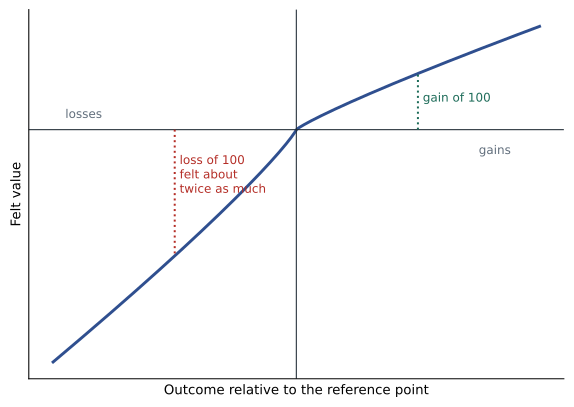
Margaret Neale and Max Bazerman showed that negotiators told to think about what they could gain from a deal made more concessions and reached more agreements than those told to think about what they could lose, even when the offers were identical. A union told that a wage offer is a gain over the current wage behaves differently from one told it is a loss relative to its demand. Grace sees the practical lesson in her supplier talks. When she presents a lower price increase as protecting the supplier's volume at Fairway, a gain, the supplier responds more favorably than when she presents it as a cut from what the supplier asked for, a loss. Framing is not manipulation if it is accurate; every offer can truthfully be described relative to several reference points, and the negotiator chooses which to emphasize.
Loss aversion also produces the endowment effect: people demand more to give up something they own than they would pay to acquire it. In a famous experiment by Kahneman, Jack Knetsch and Richard Thaler, students given a coffee mug asked about twice as much to sell it as other students would pay to buy one. In Owen's land lease, the farm family's attachment to land that has been in the family for generations makes any lease feel like a loss, which partly explains their high demand. Recognizing the effect helps Owen respond with patience and with terms, such as restoration guarantees, that reduce the feeling of loss.
Emotion in negotiation
Emotions are not noise to be eliminated. They carry information about what people care about, and they influence behavior on both sides of the table. Anger is the most studied. Experiments by Gerben van Kleef and colleagues found that negotiators facing an angry counterpart tended to make larger concessions, apparently inferring that the angry party was close to its limit. But anger has costs: it reduces the chance of agreement, harms the relationship and makes the angry party seem less trustworthy. It also backfires when the target has strong alternatives or when the anger seems inappropriate. Research by Victoria Brescoll and Eric Uhlmann found that observers penalized women who expressed anger in a professional setting more than men, which illustrates that the effects of emotion depend on context and on who displays it.
Anxiety, by contrast, tends to hurt the anxious negotiator. Alison Wood Brooks and Maurice Schweitzer found that anxious negotiators made lower first offers, responded more quickly and exited negotiations earlier, all of which led to worse outcomes. One simple technique helped: reappraising anxiety as excitement, for example by saying to oneself that one is excited rather than trying to calm down, improved performance in later studies by Brooks. Preparation helps too, because anxiety feeds on uncertainty, and a clear plan with a known BATNA reduces it. Positive emotions tend to increase creativity and the search for integrative options, which is one reason experienced negotiators invest in the opening phase of a negotiation, building rapport before the hard issues.
Dr. Fournier distinguishes between experiencing an emotion and choosing how to express it. A negotiator who feels angry can name the feeling, explain what caused it and say what would address it, without shouting. A negotiator facing an angry counterpart can acknowledge the emotion, slow down, ask questions about the cause and avoid matching it. Taking a break is often the single most useful response to a heated moment, because physiological arousal fades within minutes, while words said in anger can damage a relationship for years.
Debiasing
What can negotiators do about these biases? Training helps when it is specific. The most effective methods, according to research summarized by Bazerman and Don Moore, include analogical training, in which people compare several cases that share a principle; considering the opposite, deliberately listing reasons the other side's view might be right or one's own estimate wrong; taking the other side's perspective in writing during preparation; using a checklist that forces attention to alternatives, interests and information; and building in time between receiving an offer and responding, so that System 2 has a chance to engage. In teams, appointing a member to argue against the team's assumptions reduces overconfidence.
| Bias | What it does in negotiation | Countermeasure |
|---|---|---|
| Fixed-pie assumption | Misses trades that create value | Ask about priorities; negotiate packages |
| Anchoring | Pulls estimates toward early numbers | Prepare your own anchor; question theirs |
| Overconfidence | Fewer concessions, more impasse | Estimate ranges; consider the opposite |
| Self-serving fairness | Each side sees its own view as fair | Use objective standards and neutral experts |
| Escalation of commitment | Keeps fighting because of sunk costs | Evaluate against current alternatives |
| Reactive devaluation | Rejects good proposals from opponents | Use a mediator or a joint working group |
| Winner’s curse | Overpays when the other side knows more | Ask what acceptance would reveal |
Worked problem
Breaking an escalation at Lakeview
Lakeview Health has been in a dispute with a software vendor for eight months over a scheduling system that never worked properly. Lakeview has spent 1.4 million dollars on licenses and consultants and has withheld the last payment of 300 thousand. The vendor has threatened to sue. Lakeview's project sponsor wants to continue fighting until the vendor fixes the system. Hana is asked to advise. How should she apply the ideas of this lesson?
Show solution
- Treat the 1.4 million already spent as sunk: it should not affect the decision except as information about the vendor's capability.
- Compare the current alternatives: continue the dispute, with legal costs and an uncertain outcome; settle and replace the system; or negotiate a fix with specific milestones and penalties.
- Check for self-serving fairness: ask a neutral expert, such as an independent consultant, to assess what share of the problems lies with Lakeview's own data and processes.
- Watch for reactive devaluation: if the vendor proposes a reasonable fix, consider whether it would be acceptable if it came from a neutral party.
- Separate the decision from the people who made the original commitment, by asking a different executive to chair the decision.
Answer: Hana recommends evaluating a negotiated exit, with a partial refund and a transition period, against the cost of continuing the dispute, judged on future costs and benefits only. The analysis shows that a settlement and a new system would cost less over three years than continuing, and the independent review finds that about a third of the problems arose from Lakeview's own configuration choices, which softens the sense of grievance on both sides.
Common mistakes
MistakeExperienced executives are immune to biases.
InsteadBiases affect experts too; processes such as checklists and cooling-off periods reduce them.
MistakeAn instantly accepted offer is a success.
InsteadIt may signal that the offer was too generous; ask what acceptance reveals.
MistakeShowing anger always gets concessions.
InsteadIt sometimes does, but it raises the risk of impasse and harms the relationship; effects depend on context.
MistakeFraming is manipulation.
InsteadEvery offer can be described truthfully against several reference points; choose the one that helps agreement.
Summary and key terms
- Negotiators are boundedly rational and fall into predictable traps, especially under time pressure.
- The winner's curse arises when the other side knows more and accepts only offers that favor it.
- Fixed-pie thinking, incompatibility bias and reactive devaluation hide joint gains; overconfidence, self-serving fairness and escalation cause impasse.
- Prospect theory shows that framing and reference points shape responses, because losses loom larger than gains.
- Emotions carry information; manage their expression, reappraise anxiety, take breaks, and use structured debiasing methods.
- Winner’s curse
- Overpaying because an offer is accepted only when it is too generous.
- Reactive devaluation
- Valuing a proposal less because an opponent made it.
- Self-serving fairness
- The tendency to see outcomes that favor oneself as fair.
- Escalation of commitment
- Continuing a course of action because of past investment.
- Loss aversion
- The tendency for losses to weigh more than equal gains.
- Endowment effect
- Demanding more to give something up than one would pay to acquire it.
- Reappraisal
- Reinterpreting an emotion, such as anxiety, to change its effect on behavior.
Practice problems
Work each problem on paper first, then reveal the answer to check.
In Acquiring a Company, why does a bid of 50 lose money on average?
Show answer
It is accepted only if the firm is worth 50 or less to the owner, averaging 25, which is 37.5 to the bidder; paying 50 loses 12.5 when accepted.
Give an example of how the same offer can be framed as a gain or a loss.
Show answer
A 2 percent raise is a gain over the current wage but a loss relative to a demand for 4 percent.
What is one technique for reducing anxiety's harm to negotiation outcomes?
Show answer
Reappraise it as excitement, and prepare thoroughly so that the BATNA and plan are clear.
Why can a mediator reduce reactive devaluation?
Show answer
Proposals from a neutral party are judged on their merits rather than discounted because of their source.
Lesson quiz · 5 questions
Score 60% or more to complete this lesson.
Create a free account to save your progress, take quizzes and earn a certificate.