
MBA-602 · Lesson 7 of 12 · 22 min
Building the founding team and equity splits
Investors often say they back people before ideas, and Dr. Marchetti begins the seventh session by explaining why. Early-stage ventures change constantly: the product, customers and business model at the seed stage are frequently different from those that eventually succeed. What persists is the team. A team that learns quickly, works well under pressure and stays together through setbacks can find its way to a good business; a weak or divided team can ruin a good idea. Her own company survived its two near-death experiences, she says, because the three founders trusted each other enough to make hard decisions quickly, and nearly died a third time when one of them wanted to sell and the others did not.
The founder's dilemmas
Noam Wasserman's 2012 book The Founder's Dilemmas, based on data from about ten thousand founders, organized the early decisions about a team into three sets. Relationship dilemmas concern whether to found alone or with others, and whether to work with friends, family or strangers. Role dilemmas concern who does what and who makes final decisions. Reward dilemmas concern how to split equity and salary. Wasserman found that founders often make these decisions quickly, early and informally, based on what feels fair or comfortable at the time, and that the decisions are hard to change later. Many of the conflicts that break up founding teams can be traced to choices made in the first few weeks.
One of Wasserman's central findings concerns a trade-off he called rich versus king. Founders who give up more control, by bringing in co-founders, investors and professional managers, tend to build more valuable companies; founders who keep control tend to build less valuable ones, but keep their position as chief executive. Neither choice is wrong, but it should be deliberate. Wasserman also found that many founders are replaced as chief executive within a few years of raising outside capital, often as the company moves from the search for a business model to the execution of one, which demands different skills.
Solo founders and teams
Most high-growth ventures are started by teams, and investors often prefer them, because a team brings more skills, more energy and a check on any one person's blind spots. A solo founder carries every decision and every setback alone. But teams create their own risks: conflict over direction, unequal effort and difficult departures. Research on founding teams suggests that teams with complementary skills and shared prior experience, such as having worked together before, tend to perform better than teams of friends or teams assembled quickly for a pitch competition. Teams of close friends and family members are common because trust is high, but they often avoid the frank conversations about roles and rewards that strangers would insist on.
Second Ascent's founders have complementary skills but no history of working together. Marta is a master technician who has run Cedarline's workshop for six years; she knows repair methods, materials and how to train technicians. Grace has fifteen years of retail and category management experience, knows how to negotiate with suppliers and partners, and has the financial training of the MBA. Both recognize a gap: the venture will need software for bookings, repair tracking and, eventually, a portal for brands to submit warranty claims. Leo introduces them to Tariq Haddad, a software engineer who built much of Kestrel's early product and is looking for a smaller venture with a physical side. After several long conversations and a trial weekend building a booking prototype together, Tariq agrees to join as the third founder.
Roles and decision rights
Founders need to agree early on who does what and how decisions are made. Titles matter less than decision rights. Who has the final say on product, hiring, spending and fundraising? What happens if the founders disagree? In a three-founder team, a majority can decide routine matters, but the most important decisions, such as raising money, selling the company or removing a founder, usually require unanimity or a defined supermajority. Many teams designate one founder as chief executive with the authority to break deadlocks on operating matters, while reserving strategic decisions for the group.
The Second Ascent founders agree that Grace will be chief executive, responsible for partnerships, brand contracts, finance and fundraising; Marta will be chief operating officer, responsible for the workshop, quality and training; and Tariq will be chief technology officer, responsible for the booking system, repair tracking and data. They write down a short list of decisions that require all three to agree. Dr. Marchetti says the exercise matters less for the answers than for the conversation, which often reveals assumptions that would otherwise surface only in a crisis. In this case it revealed that Marta assumed she would have a veto over any change to repair methods, which the others accepted.
Splitting equity
Equity splits are the most emotional of the early decisions. Wasserman found that about a third of teams split equity equally, and that equal splits were most common among teams that decided quickly. Equal splits are simple and signal partnership, but they can be unfair if founders contribute very differently, and his data suggested that teams that split equally without discussion were associated with lower valuations in later financings, perhaps because the quick split signaled a reluctance to have difficult conversations. Unequal splits reflect differences in contribution but can breed resentment if they seem arbitrary.
A more deliberate approach weighs each founder's expected contributions. Common factors include the original idea and early work, time commitment, relevant skills and experience, capital contributed, the opportunity cost of joining, such as salary given up, and the importance of each role to the venture's success. The factors are weighted by the team's view of what matters most, each founder is scored on each factor, and the scores give a split. The method is not precise, but it makes the reasoning explicit. Some teams prefer a dynamic split, such as the approach Mike Moyer called the slicing pie, in which equity is allocated in proportion to the market value of what each founder contributes over time until a defined milestone.
# Second Ascent: a weighted-contribution approach to the founders' equity split
factors = {               # weight of each factor, agreed by the team
    "idea and early work":    0.10,
    "time commitment":        0.25,
    "skills for the role":    0.25,
    "capital contributed":    0.10,
    "opportunity cost":       0.10,
    "importance of the role": 0.20,
}
scores = {                # each founder scored 0 to 10 on each factor, in the order above
    "Grace": [9, 9, 7, 10, 8, 8],
    "Marta": [7, 10, 9, 2, 6, 9],
    "Tariq": [2, 10, 8, 2, 7, 6],
}
weights = list(factors.values())
points = {name: sum(w * s for w, s in zip(weights, sc)) for name, sc in scores.items()}
total = sum(points.values())
for name, p in points.items():
    print(f"{name}: {p:.2f} points, {p / total:.1%} of founder equity")

# Round to an agreed split and issue 10 million founder shares
agreed = {"Grace": 0.40, "Marta": 0.35, "Tariq": 0.25}
for name, share in agreed.items():
print(f" {name}: {share:.0%} = {share * 10_000_000:,.0f} shares")Grace: 8.30 points, 35.9% of founder equity Marta: 8.05 points, 34.8% of founder equity Tariq: 6.80 points, 29.4% of founder equity Grace: 40% = 4,000,000 shares Marta: 35% = 3,500,000 shares Tariq: 25% = 2,500,000 shares
The weighted method gives Grace about 36 percent, Marta about 35 and Tariq about 29. The founders discuss the result and agree on 40, 35 and 25 percent. Grace receives slightly more than the formula suggests because she is putting in 60,000 dollars of her own money and has done most of the work so far; Tariq, who joins later and with less at stake, accepts slightly less, with the understanding that his share will be protected by vesting and that he will receive additional options if the software side grows as planned. Dr. Marchetti says the final split should be one that every founder can defend to the others a year from now, when someone is working harder than someone else.
Vesting
Vesting protects founders from each other. Under a vesting arrangement, a founder's shares are earned over time; if a founder leaves before the shares are fully vested, the company can buy back the unvested portion, usually at the original price, which is often a fraction of a cent per share. The standard arrangement for founders and employees in North American startups is four-year vesting with a one-year cliff: nothing vests for the first year, a quarter vests at the first anniversary, and the rest vests monthly over the following three years. The cliff protects the team from a founder who leaves after a few months, and investors generally insist on founder vesting before they invest, because they are investing in the team staying together.
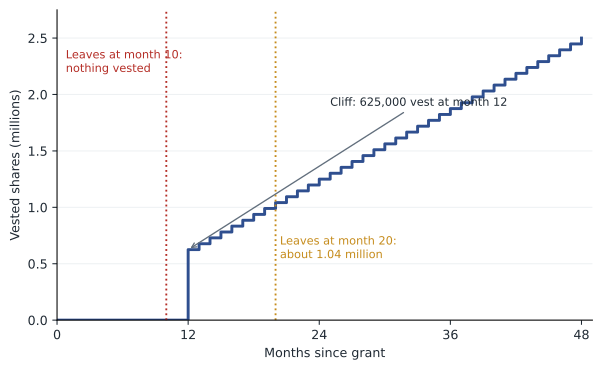
Vesting usually applies to founders who already own their shares, through a reverse vesting or repurchase arrangement: the founder holds the shares from the start, with voting and economic rights, but the company has the right to repurchase the unvested portion on departure. Founders should negotiate acceleration terms, which vest some or all unvested shares on certain events. Single-trigger acceleration vests shares on a sale of the company; double-trigger acceleration vests them only if the company is sold and the founder is then dismissed or their role is substantially reduced. Investors and acquirers generally prefer double-trigger, because single-trigger acceleration can leave a buyer with founders who have no reason to stay.
# Vesting schedule: four years, one-year cliff, monthly thereafter
def vested(shares, months, cliff=12, total=48):
    if months < cliff:
        return 0
    return shares * min(months, total) / total

tariq = 2_500_000
for m in (6, 10, 12, 13, 20, 36, 48):
    v = vested(tariq, m)
    print(f"month {m:2d}: vested {v:>9,.0f} ({v / tariq:5.1%}), unvested {tariq - v:>9,.0f}")

# Departure at month 20: the company repurchases unvested shares at the issue price
issue_price = 0.0001
unvested = tariq - vested(tariq, 20)
print(f"Leaving at month 20: repurchase {unvested:,.0f} shares for {unvested * issue_price:,.2f} dollars")month 6: vested 0 ( 0.0%), unvested 2,500,000 month 10: vested 0 ( 0.0%), unvested 2,500,000 month 12: vested 625,000 (25.0%), unvested 1,875,000 month 13: vested 677,083 (27.1%), unvested 1,822,917 month 20: vested 1,041,667 (41.7%), unvested 1,458,333 month 36: vested 1,875,000 (75.0%), unvested 625,000 month 48: vested 2,500,000 (100.0%), unvested 0 Leaving at month 20: repurchase 1,458,333 shares for 145.83 dollars
Leaving and conflict
Founder departures are common, and the terms of departure should be agreed before anyone wants to leave. Many shareholder agreements distinguish good leavers, such as a founder who leaves because of illness or is dismissed without cause, from bad leavers, such as a founder who leaves to join a competitor or is dismissed for misconduct. Good leavers may keep their vested shares and sometimes receive fair value for them; bad leavers may be forced to sell even vested shares at a low price. The definitions need care, because they become contentious exactly when relations are worst.
Disagreements short of departure need a process too. Dr. Marchetti recommends that founders agree in writing how they will handle a deadlock: who decides which questions, when to bring in an adviser or a board member, and when a buy-sell mechanism applies. A shotgun clause, for example, allows one founder to offer to buy the other's shares at a stated price, and the other must either sell at that price or buy the offering founder's shares at the same price, which encourages fair offers. Such clauses are blunt and are best kept as a last resort, but having one in place often encourages founders to settle disagreements before they reach that point.
Salaries and early hires
Founders usually pay themselves well below market at first, and investors expect it, but not so far below that the founders cannot concentrate on the business. Wasserman found that founders who invest in their own venture, or accept lower salaries, are seen by investors as more committed. Second Ascent's plan pays Marta 70,000 dollars a year from launch, close to her current salary, because she has fewer savings and the workshop cannot run without her, and pays Grace and Tariq nothing until the seed round closes and 90,000 dollars a year each after that. The founders agree that the differences are temporary and will be reviewed at each financing.
The first employees shape the culture of a venture as much as the founders do. Early hires in a startup are usually paid partly in stock options, which give the right to buy shares at a fixed price in future, so that they share in the upside. Ventures typically set aside an employee option pool of 10 to 20 percent of the shares for this purpose, and investors in the first priced round usually require that the pool be created or enlarged before they invest, so that the dilution falls on the founders rather than on the new investors. Lesson 10 will work through the arithmetic. For Second Ascent the first hires will be two senior technicians, recruited from tailoring and sail-making, and Dr. Marchetti suggests they receive options as well as wages, since their skill is the product.
Advisers and boards
Advisers can supply expertise and introductions that the founders lack, often in exchange for a small equity grant, typically a fraction of one percent, vesting over one or two years. Advisers are most valuable when their role is specific: an expert on brand partnerships, a retired repair executive from a large outdoor company, an accountant who knows startups. Founders should avoid collecting advisers for their names, since each takes equity and attention. A formal board of directors becomes important when outside investors join; in the earliest stage, the founders are often the only directors. Lesson 10 discusses how boards change with each financing.
Worked problem
A founder departure
Eighteen months after closing a seed round, Tariq tells his co-founders that he wants to leave Second Ascent to join a large technology company. He holds 2.5 million shares under four-year vesting with a one-year cliff, starting on the day the company was incorporated, nineteen months ago. The shareholder agreement treats a voluntary resignation as a good-leaver event, with the right of the company to repurchase unvested shares at the issue price. What happens to Tariq's shares, and what should the remaining founders consider?
Show solution
- Months vested: 19, past the cliff. Vested shares = 2,500,000 × 19 / 48 ≈ 989,600; unvested ≈ 1,510,400.
- The company can repurchase the 1,510,400 unvested shares at the issue price of 0.0001 dollars, about 151 dollars in total. Tariq keeps 989,600 shares, about 40 percent of his original holding.
- The repurchased shares can be retired or added to the option pool to hire a replacement chief technology officer, who will need a meaningful equity grant.
- The founders should also check that the software Tariq wrote belongs to the company under the IP assignment he signed at incorporation, and agree a transition period for handover.
Answer: Vesting works as intended: Tariq keeps the equity he has earned, the company recovers the unearned shares cheaply, and those shares fund his replacement. Without vesting, he would have walked away with a quarter of the company after nineteen months, leaving the remaining founders to build value for an absent shareholder.
Common mistakes
MistakeSplit equity equally to avoid conflict.
InsteadEqual splits can be fine, but a quick split without discussion avoids conflict only until contributions diverge; discuss contributions and use vesting.
MistakeFounders who own their shares do not need vesting.
InsteadReverse vesting protects each founder from a co-founder who leaves early, and investors expect it.
MistakeDecide roles and decision rights later, once the business is working.
InsteadAgree roles, decision rights and deadlock procedures early, while relations are good.
MistakeCollect well-known advisers to impress investors.
InsteadChoose advisers for specific expertise and introductions; each takes equity and attention.
Summary and key terms
- Investors back teams because the product and model change; teams persist.
- Wasserman's relationship, role and reward dilemmas shape founding teams; early informal choices are hard to undo.
- Teams with complementary skills and prior shared experience tend to do better than quickly assembled teams.
- Agree roles, decision rights and deadlock procedures in writing.
- Equity splits can be equal, contribution-weighted or dynamic; whatever the method, discuss it openly.
- Four-year vesting with a one-year cliff, leaver terms and double-trigger acceleration protect founders and investors.
- Rich versus king
- Wasserman's trade-off between building a more valuable company and keeping control of it.
- Vesting
- Earning ownership of shares over time, so that unvested shares can be repurchased on departure.
- Cliff
- The initial period, often one year, before any shares vest.
- Double-trigger acceleration
- Vesting of unvested shares only on both a sale of the company and the founder's dismissal.
- Good and bad leaver
- Categories in a shareholder agreement that set what a departing founder keeps.
- Option pool
- Shares reserved for future grants of stock options to employees.
- Shotgun clause
- A buy-sell provision under which one shareholder names a price and the other must buy or sell at it.
Practice problems
Work each problem on paper first, then reveal the answer to check.
A founder with 3 million shares on four-year vesting with a one-year cliff leaves after 30 months. How many shares has she vested?
Show answer
3,000,000 × 30 / 48 = 1,875,000 shares.
Why do investors generally prefer double-trigger over single-trigger acceleration?
Show answer
Single-trigger vests founders on a sale, removing their incentive to stay with the buyer; double-trigger requires both a sale and the founder's dismissal or demotion.
Name two factors other than the original idea that a contribution-weighted equity split should consider.
Show answer
For example, time commitment, relevant skills, capital contributed, opportunity cost and the importance of the role.
What is the purpose of a one-year cliff?
Show answer
To ensure that a founder or employee who leaves within the first year receives no shares, protecting those who stay.
Lesson quiz · 5 questions
Score 60% or more to complete this lesson.
Create a free account to save your progress, take quizzes and earn a certificate.