
MBA-602 · Lesson 12 of 12 · 24 min
Capstone: launching a venture from Cedarline's repair service
The final session of the term takes place in the Lakeshore School's venture lab in Chicago. Each manager presents a launch plan to a panel, and the first plan is Second Ascent's. The panel has three members: Cedarline's chief executive, who must decide whether to support the spin-off; an angel investor from a Chicago angel group who has backed several consumer-services companies; and a commercial banker who lends to small businesses. Dr. Marchetti has asked the founders to present the plan as they would to people who could actually commit money and resources, with a recommendation, the evidence for it, the numbers, the risks and the decisions they need from each member of the panel.
Grace opens with the recommendation. Cedarline should support Second Ascent as an independent company in which it holds a minority stake, rather than running multi-brand repair itself; the founders will launch in the first city within four months on the lean plan, financed by their own money, a government-backed equipment loan, customer funding and a 250,000-dollar SAFE; and they will seek a seed round of about 1.5 million dollars after twelve months only if the first city meets defined milestones. The rest of the presentation, she says, explains why.
The opportunity and the evidence
The first part of the plan summarizes what the founders know and how they know it, drawing on lessons 2 to 4. Owners of premium outdoor gear frequently have items fail, and many do not repair them because repair is slow, unavailable or untrusted. In thirty interviews, 21 owners had an item fail in the past two years and 13 had not repaired it. Small and mid-sized brands spend heavily replacing items under warranty because they have no fast, skilled repair option; six of ten interviewed described this as a significant cost, and two paid for test batches. The experiments showed that consumers could be reached cheaply through clubs and Cedarline referrals but not through search advertising, that labor per repair averaged under an hour, and that brand work required tiered pricing by repair type.
Grace is careful to distinguish evidence from assumption. The serviceable market of about 14 million dollars a year in the first city rests on household and repair-rate assumptions that the pilot supports but does not prove. Retention beyond eight weeks is unknown. Brand contracts have been tested only at small scale. The plan is built so that the first city tests these assumptions before Second Ascent commits to a second. The angel says this is the part of the presentation she found most convincing: the founders know which of their numbers are facts and which are hopes.
Why a spin-off
The panel's first question comes from Cedarline's chief executive: why should Cedarline not simply expand its own repair workshop to serve every brand? The founders have prepared for it. Their answer has three parts. First, brands will not send warranty items, product data and customer details to a competitor's workshop; three of the ten brands interviewed said so explicitly. An independent Second Ascent can serve them; a Cedarline unit cannot. Second, multi-brand repair is a different business from Cedarline's, with different economics, skills and pace, and running it inside Cedarline would compete for management attention at a time when Cedarline is carrying out the working-capital and marketing plans from earlier courses. Third, a spin-off gives the founders ownership and Cedarline an equity stake whose value grows with the venture, aligning everyone's interests.
Research on corporate ventures supports the founders' argument in part. Joseph Bower and Clayton Christensen argued in the 1990s that established firms often struggle to nurture new businesses whose economics and customers differ from the core, because resource-allocation processes favor the existing business. Charles O'Reilly and Michael Tushman described the ambidextrous organization, which keeps new ventures structurally separate while linking them to the parent's resources at the top. A minority stake with a commercial agreement is a lighter form of the same idea: separation where it matters, for brand neutrality and focus, and links where they help, for space, referrals and overflow work.
Business model and unit economics
The second part of the plan sets out the business model from lesson 5 and the unit economics from lesson 6. Second Ascent will earn revenue from consumer repairs with tiered prices and an express option, from brand contracts with tiered prices by repair type and monthly minimums, and from refurbished resale, with an annual repair plan to be piloted in the first year. Contribution averages about 24 dollars per consumer repair, 14.50 per brand repair and 51 per refurbished item. Customer acquisition through clubs, shops and Cedarline referrals pays back in about three to six months. Brand work and refurbishment can be scheduled into slow months, which raises utilization and contribution. Breakeven requires about 1,270 jobs a month at second-year fixed costs, against a capacity of about 2,000 with ten technicians.
The launch plan
The operating plan divides the first eighteen months into stages, each with a milestone that decides whether to proceed. In months one to four, the founders incorporate, sign the Cedarline agreement and the equipment loan, fit out the workshop, hire four technicians and open with two brand contracts in place. In months five to twelve, they build to about 900 jobs a month, add three more brand contracts, pilot the repair plan and measure retention by monthly cohort. At month twelve, the go or no-go decision on a seed round depends on four milestones agreed with the angels: at least 800 jobs a month, five brand contracts, a 12-month repeat rate of at least 45 percent and contribution of at least 21 dollars per job. In months thirteen to eighteen, if the seed round closes, they prepare the second city and begin building the brand portal.
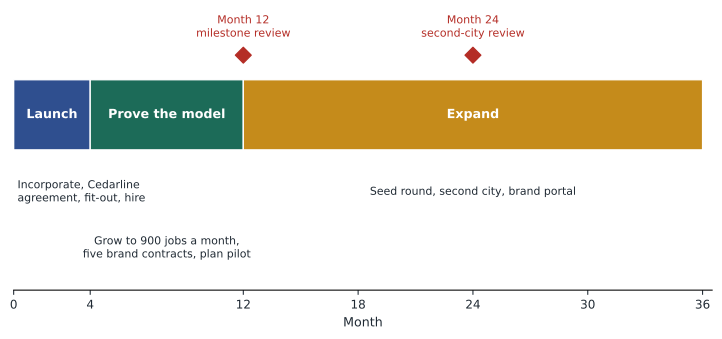
Dr. Marchetti points out that the plan uses the same logic as Cedarline's own staged store rollout in MBA-511: commit capital in tranches, each conditional on evidence from the previous one, so that the option to stop or change course has value. The banker likes the staging for a different reason. His loan is for equipment that keeps its value if the venture fails, and the milestones give him early warning if repayment is at risk.
The financial model
The founders' model extends the cash model from lesson 6 to three scenarios. The base case follows the lean plan. The slow case assumes that volume ramps at two-thirds of the base rate and that contribution per job is 10 percent lower because the repair mix is more complex. The fast case assumes the ramp is a third faster and contribution 5 percent higher. All three assume the same fixed costs and equipment. The model asks three questions for each scenario: how deep the cash low point is, when the venture first makes a monthly profit and how much cash it has at the end of three years.
# Second Ascent capstone: three scenarios for the first city over 36 months (dollars)
def run(ramp_factor, contribution, capex=85_000, months=36):
    cash, low, low_m, first = -capex, -capex, 0, None
    for m in range(1, months + 1):
        jobs = min(2000, 250 + 1750 * ramp_factor * (m - 1) / 29)
        fixed = 16_000 if m <= 6 else (23_500 if m <= 18 else 28_000)
        net = jobs * contribution - fixed
        cash += net
        if cash < low: low, low_m = cash, m
        if first is None and net > 0: first = m
    return low, low_m, first, cash

scenarios = {"Slow": (2 / 3, 22.0 * 0.90), "Base": (1.0, 22.0), "Fast": (4 / 3, 22.0 * 1.05)}
funding = 60_000 + 85_000 + 40_000 + 250_000      # Grace, equipment loan, customer funding, SAFE
for name, (ramp, contrib) in scenarios.items():
    low, low_m, first, end = run(ramp, contrib)
    print(f"{name:<5} low point {low:>9,.0f} (month {low_m:2d})  first profitable month {first}  "
f"cash after 36 months {end:>9,.0f} headroom at low point {funding + low:>8,.0f}")Slow low point -304,050 (month 29) first profitable month 30 cash after 36 months -286,972 headroom at low point 130,950 Base low point -171,190 (month 14) first profitable month 15 cash after 36 months 39,500 headroom at low point 263,810 Fast low point -133,612 (month 10) first profitable month 11 cash after 36 months 236,191 headroom at low point 301,388
The base case reproduces lesson 6: a low point of about 171,000 dollars in month 14, a first monthly profit in month 15 and positive cumulative cash by month 34. The slow case is much worse. The low point deepens to about 304,000 dollars in month 29, leaving about 131,000 dollars of the 435,000 dollars of planned funding, and the venture does not make a monthly profit until month 30. The fast case reaches its low point of about 134,000 dollars in month 10, makes its first monthly profit in month 11 and ends the three years with about 236,000 dollars of cumulative cash. The founders draw two conclusions. The lean funding plan covers the base case comfortably and the slow case with a much thinner cushion after two and a half years of losses, so the month-twelve milestone review is essential: if the slow case is unfolding, they must cut costs or raise more long before the cushion runs out. And the upside of the fast case is large enough that the seed round, if the milestones are met, should be raised promptly rather than delayed.
Financing and ownership
The financing plan follows lessons 9 and 10. At launch, Grace invests 60,000 dollars for her founder shares and as a shareholder loan, the equipment is financed by an 85,000-dollar government-backed term loan, customer deposits and plan fees provide about 40,000 dollars, and a group of angels invests 250,000 dollars through a post-money SAFE with a 3.6-million-dollar cap. Cedarline receives 1.5 million shares, vesting over three years as it delivers space, the brand license and referrals. If the seed round of about 1.5 million dollars at a pre-money valuation of about 4.5 million closes after twelve months, the founders will own a little over half the company, Cedarline about 8 percent, the angels about 4.5 percent, the seed investors 25 percent and the option pool 10 percent, or a little less if the founders win the argument over pool size.
Cedarline's chief executive asks what Cedarline gets. The founders' answer is quantified. Cedarline's stake would be worth about 470,000 dollars at the seed post-money valuation, for contributions whose cash cost to Cedarline is mainly the below-market portion of the rent, about 30,000 dollars a year. Cedarline would pay Second Ascent for overflow repairs at less than the cost of handling them in its own workshop at peak times, which the operations team estimates saves about 60,000 dollars a year. And Cedarline's lifetime repair promise, which the marketing course identified as a major source of brand value, would be stronger with a fast multi-brand partner behind it. The founders also offer Cedarline a right to participate in future rounds to maintain its percentage, but not a veto over financings or a sale.
Risks and mitigations
The plan's risk section lists the five most serious risks, their likelihood and impact, the early indicators the founders will watch and the actions they will take. Dependence on Cedarline is managed by the commercial agreement, with a five-year lease, an eighteen-month notice period and a change-of-control clause. Shortage of skilled technicians, which could cap growth, is managed by a training program led by Marta and partnerships with a sail-making shop and a college sewing program. Brand-contract concentration is managed by limiting any one brand to a quarter of volume. A large brand copying the model is the risk the founders can do least about directly; their response is to move quickly in the first city and to build the repair data and portal that a single-brand program would lack. And a slow ramp, the risk the scenario analysis highlights, is managed by the milestone review and by keeping fixed costs low until volume arrives.
| Risk | Early indicator | Response |
|---|---|---|
| Slow ramp | Jobs per month below 600 by month 9 | Delay hires, cut fixed costs, raise a bridge from the angels |
| Technician shortage | Open positions unfilled for 60 days | Expand training, raise wages, partner with sail-making shop |
| Brand concentration | Any brand above 25 percent of volume | Prioritize new brand sales, cap the large brand |
| Cedarline dependence | Change in Cedarline strategy or ownership | Exercise notice period, locate alternative space |
| Copying by a large brand | Announcement of multi-brand service | Accelerate brand portal and second-city plan |
The panel's decisions
After forty minutes of questions, the panel gives its responses. Cedarline's chief executive agrees in principle to the spin-off, subject to board approval and to negotiating the commercial agreement, and asks for Cedarline's stake to vest over three years rather than all at once, which the founders had proposed. The angel says she would invest 50,000 dollars of the SAFE herself and introduce the founders to her group, provided they reduce the cap slightly or add a 10 percent discount. The banker says he would lend against the equipment with a personal guarantee from Grace limited to a quarter of the loan, and would want monthly financial reports. Grace says she will take all three back to her co-founders, and that the decision on the angel's terms will depend on how many other angels join.
The other managers' plans show the range of what entrepreneurship can be. Hana presents the mobile clinic as a not-for-profit pilot with two rural municipalities, funded by a health foundation grant and the municipalities' in-kind support, with a decision after six months on whether to expand or hand the model to the regional health authority. Daniel presents an offer to buy the fabricating shop for about 3.5 times its normal annual cash flow, financed by a bank loan, a seller note and his own savings, conditional on a quality audit and on keeping the two senior machinists. Owen presents Prairie Ridge's investment in the battery-storage startup, structured as a minority stake alongside a paid pilot at one wind farm. Leo presents the lessons of Kestrel's cap table, including a participating preference from its first round that he would never accept again.
What the course has taught
Dr. Marchetti closes the term with the questions she asked in the first session: why this, why now and why you. The cohort can now answer them with evidence rather than enthusiasm. The course has treated entrepreneurship as a method for acting under uncertainty: starting from the means at hand, choosing opportunities where the founders have an edge, testing the riskiest assumptions cheaply, designing a business model whose unit economics can work, assembling the team, legal structure and capital the venture needs on terms that keep the founders able to continue, and telling the story in a way investors can believe. The same method applies inside large companies, in social ventures and in acquisitions, and it applies to investors deciding which ventures to back.
She ends with a reminder that most ventures fail, and that a well-run failure, one that tests its assumptions cheaply, stops when the evidence says so and treats investors and employees honestly, is not a disgrace but a normal part of a career in which the next venture benefits from what the last one taught. Grace says she has never been more aware of what could go wrong, and never more confident that she knows what to do about it.
Worked problem
Should Cedarline accept the spin-off structure?
Cedarline's board must choose between (a) supporting Second Ascent as an independent company, receiving 1.5 million shares, about 13 percent before outside financing, and an overflow repair agreement; and (b) expanding its own repair workshop into multi-brand repair, at an estimated cost of 300,000 dollars in the first two years. The board's analysts estimate that an internal unit would win only about 40 percent of the brand contracts an independent company could win, because of competitive concerns. Using the founders' figures, evaluate the choice.
Show solution
- Option (a): Cedarline commits little cash, mainly about 30,000 dollars a year in below-market rent. It gains an equity stake worth about 470,000 dollars at the seed post-money valuation, overflow savings of about 60,000 dollars a year and a stronger lifetime repair promise.
- Option (b): Cedarline commits about 300,000 dollars and management attention, keeps all the profit of the unit but wins far fewer brand contracts, which the founders' business model analysis showed are essential to keep the workshop busy in slow months.
- With only 40 percent of the brand volume, the internal unit's utilization and contribution would be closer to the consumer-only case from lesson 5, with large seasonal idle time, making it unlikely to earn back 300,000 dollars quickly.
- Risks: in (a), Cedarline depends on an outside partner and owns only a minority; in (b), Cedarline bears all the venture's risk inside a business that is still repairing its own working capital.
Answer: Option (a) is the better choice. It costs Cedarline less cash, gives it a growing equity stake, keeps the venture neutral for other brands and lets Cedarline's management focus on its core plans. Cedarline should protect itself through the commercial agreement and its right to participate in future rounds rather than through control.
Common mistakes
MistakeA launch plan should commit the full budget at once to move fast.
InsteadStage commitments with milestones, so that evidence from each stage decides the next, preserving the option to stop or change course.
MistakePresent only the base case to investors.
InsteadShow base, slow and fast scenarios with the funding headroom in each, and the actions that milestones will trigger.
MistakeA corporate parent should keep a promising new business inside the company.
InsteadSeparation can be essential when the venture serves the parent's competitors or needs different economics and pace.
MistakeA failed venture is a wasted effort.
InsteadA well-run failure that tests assumptions cheaply and stops on evidence is a normal part of entrepreneurship.
Summary and key terms
- A launch plan leads with a recommendation, separates evidence from assumption and asks each stakeholder for specific decisions.
- Spin-offs suit ventures that need brand neutrality, different economics or focus, linked to the parent through equity and contracts.
- Stage resources with milestones agreed in advance, as with Cedarline's staged store rollout.
- Test the financial plan under slow and fast scenarios and check funding headroom at the cash low point.
- Quantify what each partner gets, and protect partners through contracts and participation rights rather than control.
- Entrepreneurship is a learnable method for acting under uncertainty, applicable in new firms, large companies, social ventures and acquisitions.
- Spin-off
- A new company created from part of an existing firm, often with the parent as a shareholder.
- Ambidextrous organization
- A firm that runs new ventures separately from its core while linking them at the top.
- Milestone review
- A scheduled decision point at which evidence against agreed targets decides the next commitment.
- Scenario analysis
- Testing a plan under alternative assumptions, such as slow, base and fast cases.
- Funding headroom
- The cash remaining at the low point of the J-curve after all planned funding.
Practice problems
Work each problem on paper first, then reveal the answer to check.
In the slow scenario, why is the month-twelve milestone review especially important?
Show answer
Because in the slow case losses continue for two and a half years and the cushion shrinks to about 131,000 dollars; the review gives time to cut costs or raise more before it runs out.
Give two reasons other brands might refuse to use a repair unit owned by Cedarline.
Show answer
They would be sending product data, warranty volumes and customer details to a competitor, and they might fear the unit would favor Cedarline's own repairs.
Cedarline's stake is 1.5 million of about 19 million fully diluted shares after the seed round, priced at about 32 cents. What is it worth?
Show answer
About 1.5 million × 0.3156 ≈ 473,000 dollars.
Name one early indicator and one response for the risk of a technician shortage.
Show answer
Indicator: positions open for more than 60 days; response: expand the training program or partner with a sail-making shop.
Lesson quiz · 5 questions
Score 60% or more to complete this lesson.
Create a free account to save your progress, take quizzes and earn a certificate.