
MBA-602 · Lesson 2 of 12 · 24 min
Opportunity recognition and idea generation
Dr. Marchetti begins the second session by asking each manager to write down three business ideas in five minutes. Most of the cohort produce something quickly, and most of the ideas are apps. She then asks a harder question: for each idea, what do you know that most people do not, and what has changed in the world that makes the idea possible now and not five years ago? Most of the apps fail the test. Grace's repair idea passes it. She knows from Marta that Cedarline's workshop turns away dozens of other-brand items each month, and she knows from MBA-512 that customers rated lifetime repair as one of the most valuable features of the Cedarline brand. What has changed is the combination of rising prices for technical outdoor gear, new right-to-repair rules and a growing market in used goods.
Opportunity recognition is the process by which a person comes to see a possibility for a new venture that others have missed or cannot pursue. Research on how founders find opportunities, such as work by Scott Shane published in 2000, suggests that prior knowledge is the strongest predictor. People notice opportunities related to what they already know about markets, ways of serving them and customer problems. That is why many successful founders start companies in industries where they have worked, and why the bird-in-hand principle from lesson 1 is a good starting point. Alertness and networks matter too: people with diverse contacts hear about problems and trends earlier.
Ideas are not opportunities
An idea is a possible product or service; an opportunity is an idea that can create enough value for customers, and capture enough of it, to justify the effort and capital it needs, given the founders' means. The distinction matters because ideas are cheap and abundant. Dr. Marchetti says that every serious investor sees hundreds of ideas a year and that most investors could list several in any market they follow. What makes a venture worth backing is evidence that the idea solves an important problem for a reachable group of customers, that those customers will pay enough, and that this team has a reason to win.
A good opportunity usually has several features. The customer problem is real, frequent or costly, and the customer knows it. The market is large enough, or growing fast enough, to support the venture's ambitions. The venture can reach customers at a reasonable cost. Its economics allow a healthy margin once it reaches scale. And there is something that will make the venture hard to copy, at least for a while: a capability, a relationship, a cost advantage, network effects or intellectual property. Jeffry Timmons, whose book New Venture Creation was a standard text for decades, organized these features into a screening checklist covering industry and market, economics, harvest potential, competitive advantage, management team and fatal flaws. The course uses a shorter version.
Sources of opportunity
Peter Drucker's 1985 book Innovation and Entrepreneurship identified seven sources of innovative opportunity. Four arise within an industry: the unexpected, such as an unexpected success or failure; incongruities between what is and what ought to be; process needs, where a step in a process is weak or missing; and changes in industry or market structure. Three arise outside: demographic change, changes in perception or meaning, and new knowledge, scientific or otherwise. Drucker argued that the first sources are the most reliable and that new knowledge, though glamorous, is the slowest and riskiest. Most successful ventures, he observed, exploit a change that has already happened rather than one that is predicted.
Second Ascent illustrates several of Drucker's sources at once. The unexpected: Cedarline's repair service attracted more other-brand items than anyone predicted. An incongruity: owners of a 600-dollar shell jacket throw it away when a zipper fails, because there is nowhere convenient to fix it, while the jacket's fabric would last for years. A process need: brands that promise repairs often send items across the country to a single workshop and take weeks to return them. A change in perception: many buyers of outdoor gear now prefer brands that support repair and resale, and some deliberately buy used. Grace says the opportunity did not come from a brainstorm. It came from noticing what was already happening at the edge of Cedarline's business.
Trends and timing
Timing is one of the strongest determinants of venture success and one of the hardest to judge. Too early, and the founder must educate the market and wait for enabling conditions, often running out of cash first. Too late, and incumbents or better-funded rivals have the market. Bill Gross, who founded the incubator Idealab, analyzed about two hundred companies and concluded that timing explained more of the difference between successes and failures than the idea, team, business model or funding. His analysis was informal, but many investors share the intuition. The useful question is not whether a trend is real but whether it has reached the point where customers will change their behavior now.
Several trends support repair and resale of outdoor gear. Prices of technical apparel have risen faster than general inflation for years. Resale has moved into the mainstream through online marketplaces and brand programs such as Patagonia's Worn Wear and Arc'teryx's ReBird, which buy back, repair and resell their own products. Regulation is moving toward repair. Several states, including New York, Minnesota, California and Colorado, have passed right-to-repair laws since 2022, mostly for electronics and equipment, and the European Union adopted a right-to-repair directive in 2024 that its member states must apply. None of these directly requires anyone to repair a jacket, but together they shift what customers and brands expect.
Dr. Marchetti warns against the opposite mistake: confusing a trend with a market. Many people say they care about sustainability, but far fewer will change what they do or pay more for it. Lesson 3 will show how to test whether stated preferences turn into behavior. For now, she asks the founders to separate three things in their pitch: the trend, the specific customer behavior that the trend changes, and the evidence that the change is already happening among the venture's first customers.
Generating and refining ideas
Some founders start with a problem they have experienced; others start with a capability and look for problems it can solve. Both can work, but problem-first ideas tend to be easier to test, because the founder can find others who have the same problem. Useful techniques include listing frustrations in one's own work and life, studying workarounds that people build for themselves, such as spreadsheets and informal services, looking at what is unusually expensive or slow, and asking what becomes possible when a cost falls sharply. Leo says Kestrel began when he and his co-founder, both analysts at a retailer, noticed that store managers kept a second inventory forecast in a spreadsheet because they did not trust the official one.
Ideas usually improve through recombination and narrowing. A broad idea, such as fixing everything people own, is hard to test and easy to dismiss. A narrow one, such as repairing technical outerwear, tents and packs for outdoor enthusiasts in one city, can be tested quickly and becomes a beachhead from which to expand. Geoffrey Moore's idea of a beachhead market, from his book on crossing the chasm, applies: dominate a small segment whose members talk to one another, then use that position to move to adjacent segments. Second Ascent's beachhead is owners of premium outdoor gear in a single metropolitan area, reached through outdoor clubs, gear shops and Cedarline's own customers.
Sizing the market
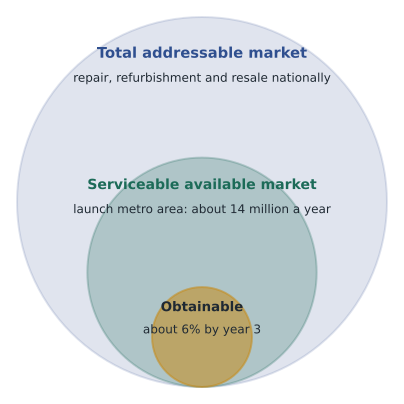
Investors ask about market size because a venture's potential is bounded by it. Three nested measures are common. The total addressable market, or TAM, is the total annual revenue available if every potential customer bought the product. The serviceable available market, or SAM, is the part of the TAM that the venture's business model and geography can actually serve. The serviceable obtainable market, or SOM, is the share of the SAM the venture can realistically win in a stated period, given competition and its own capacity. The numbers are estimates, and investors know it; what they look for is the reasoning.
There are two approaches. A top-down estimate starts from a published figure, such as the size of the outdoor apparel market, and takes a share. It is quick but often inflated, because it assumes that a share of an industry's sales is available to a new venture. A bottom-up estimate starts from units: the number of potential customers the venture can reach, how often they buy and what they pay. It is slower, but it rests on assumptions that can be tested and it connects directly to the sales plan. Dr. Marchetti says that founders who present only a top-down figure, such as one percent of a multibillion-dollar market, signal that they have not yet thought about how they will sell.
# Second Ascent: bottom-up market sizing for the launch metro area (annual, dollars)
households = 1_500_000           # households in the city and inner suburbs
own_gear = 0.28                  # share owning premium technical outdoor gear
items_per_household = 4.2        # premium jackets, tents, packs and sleeping bags owned
repair_rate = 0.11               # share of items needing a repair each year
avg_repair = 58                  # average repair ticket
resale_rate = 0.035              # share of items resold each year
resale_value = 140               # average resale price of a refurbished item
take_rate_resale = 0.35          # Second Ascent's gross revenue share on items it refurbishes and sells

items = households * own_gear * items_per_household
repair_market = items * repair_rate * avg_repair
resale_market = items * resale_rate * resale_value * take_rate_resale
sam = repair_market + resale_market
print(f"Premium items in the area: {items:,.0f}")
print(f"Repair demand: {repair_market / 1e6:.1f} million; resale revenue pool: {resale_market / 1e6:.1f} million")
print(f"Serviceable available market (launch area): {sam / 1e6:.1f} million a year")

# Obtainable share in year 3, limited by competition and workshop capacity
for share in (0.03, 0.06, 0.10):
    print(f"  SOM at {share:.0%} share: {sam * share / 1e6:.2f} million a year")
technicians, repairs_per_tech = 6, 2_300   # capacity in year 3
print(f"Capacity check: {technicians * repairs_per_tech:,} repairs, worth {technicians * repairs_per_tech * avg_repair / 1e6:.2f} million")Premium items in the area: 1,764,000 Repair demand: 11.3 million; resale revenue pool: 3.0 million Serviceable available market (launch area): 14.3 million a year SOM at 3% share: 0.43 million a year SOM at 6% share: 0.86 million a year SOM at 10% share: 1.43 million a year Capacity check: 13,800 repairs, worth 0.80 million
Every input in the code is an assumption to be tested. The share of households owning premium gear comes from an outdoor-recreation survey; the number of items per household and the annual repair rate come from Cedarline's own customer data and from Marta's experience, and they are the least certain. The result is a serviceable market of roughly 14 million dollars a year in the launch area, about four-fifths of it repairs. A year-three share of about six percent, a little under 0.9 million dollars, is close to what a workshop of six technicians could handle, about 0.8 million dollars of repairs. Grace notes that capacity, not demand, is likely to bind first, which tells her where the business will need investment. Dr. Marchetti adds that the national market, the TAM, matters mainly to show investors that the model can be repeated in other cities.
Screening opportunities
Once several ideas have been sized, founders need a way to compare them. The course uses a simple screen with six criteria, each scored from 1 to 5: pain, meaning how important and frequent the problem is for the customer; market, meaning size and growth; reach, meaning the cost and speed of finding customers; economics, meaning the likely margin and capital needed; edge, meaning the founders' advantage and the difficulty of copying them; and fit, meaning the match with the founders' goals, skills and affordable loss. The scores are subjective, but making them explicit forces a conversation about why one idea is better than another, and the weakest score usually identifies the first thing to test.
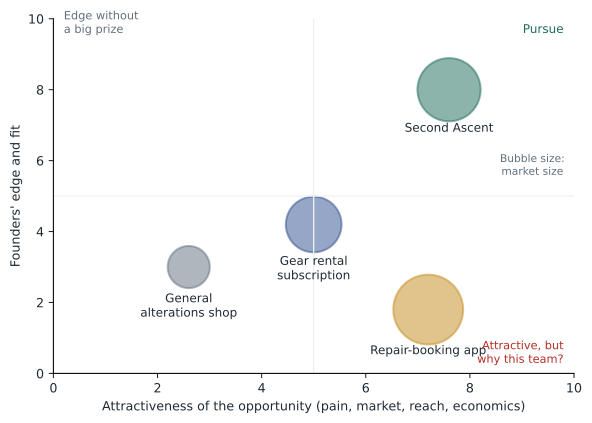
| Criterion | Second Ascent | Gear rental subscription | Repair-booking app |
|---|---|---|---|
| Pain | 4 | 3 | 3 |
| Market | 3 | 3 | 4 |
| Reach | 4 | 3 | 2 |
| Economics | 3 | 2 | 3 |
| Edge | 4 | 2 | 1 |
| Fit | 5 | 3 | 2 |
| Total (out of 30) | 23 | 16 | 15 |
The screen also reveals fatal flaws, problems serious enough to stop an idea regardless of its other scores. Typical fatal flaws are a dependence on a single customer or supplier who could cut the venture off, a regulatory barrier the founders cannot clear, a market that is shrinking, or a requirement for capital far beyond what the founders could raise. Second Ascent's most serious candidate is its dependence on Cedarline. If Cedarline later decided to run multi-brand repair itself, it could take the workshop space and the customer relationships with it. Lesson 8 will show how a founders' agreement and a commercial contract can manage that risk.
Opportunity cost and the founders
An opportunity must be good for the founders as well as for customers and investors. Starting a venture has a large opportunity cost: salary given up, career risk and years of time. Noam Wasserman of Harvard found that founders' motives differ: some want wealth and are willing to give up control to get it; others want control and will accept a smaller outcome to keep it. Neither is wrong, but the choice should shape the opportunity. A founder who wants to keep control should favor opportunities that can grow on customer revenue; one who wants to build something very large must usually accept outside investors and their influence.
Grace is honest about her position. She earns about 145,000 dollars a year at Fairway, has two children and a mortgage, and is not willing to risk her family's savings beyond the 60,000 dollars she has set aside. Marta earns much less but would be giving up a secure job she likes. Dr. Marchetti says that is exactly the information the founders need: it tells them how much evidence they need before Grace leaves Fairway, and how much salary the venture must eventually be able to pay. Many good ventures start part-time, with one founder committing full-time only after an early milestone has been reached.
Worked problem
Bottom-up versus top-down
A competing founder pitches a repair startup to the same angel group: the outdoor apparel and equipment market in the country is worth about 10 billion dollars a year, so capturing just one percent would make a 100-million-dollar business. Second Ascent's bottom-up estimate gives a serviceable market of about 14 million dollars a year in its launch area. Explain which figure an investor should find more persuasive and why.
Show solution
- The top-down figure measures sales of new products, not spending on repair and resale; it is the wrong market. Repair spending is a small fraction of new-product sales.
- Even within the right market, one percent of a national total says nothing about how the venture will reach customers or how much capacity it needs. It is a share of everything rather than a sum of specific sales.
- The bottom-up figure starts from households, items, repair rates and prices that can each be checked through surveys, Cedarline data and the venture's own pilot. It also links directly to capacity: six technicians, about 2,300 repairs each.
- The bottom-up figure is smaller, but it is credible, and it can be multiplied across cities to show how the national opportunity is built.
Answer: The investor should prefer the bottom-up estimate. It uses the right market definition, rests on testable assumptions and connects to the operating plan. A small, well-reasoned serviceable market with a path to repeat in other cities is more persuasive than a large, unexplained share of the wrong market.
Common mistakes
MistakeA good idea is the most important part of a venture.
InsteadIdeas are abundant; what matters is evidence of customer pain, a reachable market, workable economics and a reason this team can win.
MistakeA big top-down market figure impresses investors.
InsteadInvestors trust bottom-up estimates built from customers, frequency and price, because they connect to the sales plan.
MistakeA real trend guarantees demand.
InsteadA trend matters only when it changes specific customer behavior now; test that the change is happening among first customers.
MistakeStart with the broadest possible market so the venture can grow.
InsteadStart with a narrow beachhead that can be served well, then expand to adjacent segments.
Summary and key terms
- Prior knowledge, alertness and networks are the main sources of opportunity recognition.
- An opportunity is an idea that can create and capture enough value to justify its cost, given the founders' means.
- Drucker's sources of innovation include the unexpected, incongruities, process needs, structural, demographic and perception changes, and new knowledge.
- Timing is critical: the question is whether customers will change behavior now.
- TAM, SAM and SOM size the market; bottom-up estimates are more credible than top-down ones.
- A simple screen of pain, market, reach, economics, edge and fit compares ideas and identifies what to test first.
- Opportunity
- An idea that can create and capture enough value to justify the effort and capital it needs.
- Beachhead market
- A narrow initial segment that a venture can dominate before expanding.
- Total addressable market
- Total annual revenue available if every potential customer bought.
- Serviceable available market
- The part of the total market the business model and geography can serve.
- Serviceable obtainable market
- The share of the serviceable market the venture can realistically win in a stated period.
- Deal-breaking flaw
- A problem serious enough to stop an idea regardless of its other strengths, also called a fatal flaw.
Practice problems
Work each problem on paper first, then reveal the answer to check.
A city has 900,000 households; 20 percent own premium bicycles, averaging 1.5 bicycles each, and each bicycle needs a 90-dollar service once a year. What is the serviceable available market for bicycle servicing?
Show answer
900,000 × 0.20 × 1.5 × 90 = 24.3 million dollars a year.
Which of Drucker's sources of opportunity does a long wait for brand-run warranty repairs represent?
Show answer
A process need: a weak step in an existing process that a new venture can fix.
Why might a founder who wants to keep control prefer an opportunity that grows on customer revenue?
Show answer
Because it reduces the need for outside equity investors, who take ownership and influence in exchange for capital.
In the Second Ascent screen, which score suggests the first thing to test, and why?
Show answer
Economics, the lowest score: if margins or capital needs are wrong, the venture fails regardless of demand, so the unit economics should be tested early.
Lesson quiz · 5 questions
Score 60% or more to complete this lesson.
Create a free account to save your progress, take quizzes and earn a certificate.