
MBA-602 · Lesson 11 of 12 · 22 min
Pitching and the investor story
Before the seed term sheet in lesson 10 arrived, Grace pitched Second Ascent to twenty-three investors. The first five meetings went badly. She began with the history of repair, spent ten minutes on the business model canvas and reached the numbers that investors cared about, the unit economics and the brand contracts, just as time ran out. Dr. Marchetti's feedback was blunt: the pitch was organized the way Grace had learned about the business, not the way an investor needs to hear it. The eleventh session is about turning the work of the previous ten lessons into a story that an investor can understand, believe and act on in twenty minutes.
What a pitch is for
A pitch has a narrow purpose: to get to the next step. A first meeting with an angel or venture firm rarely ends with a commitment; its goal is a second meeting, an introduction to a partner or a request for more information. Investors see many pitches and make quick early judgments. Research by Laura Huang of Harvard and Jone Pearce, published in 2015, found that experienced angels relied heavily on gut feel about the founders, formed early in the pitch, alongside their analysis of the business, especially for very early ventures with little data. The founders' job is therefore to communicate quickly why the opportunity is large, why it is real and why this team will win, and to make the investor curious enough to spend more time.
Good pitches answer the questions investors will ask anyway, in roughly the order they will ask them. What is the problem, and who has it? What is the solution, and why is it better? Why now? How big can this be? How will you make money? What evidence do you have that it works? Who else is trying to do this? How will you reach customers? Why is this the right team? How much money do you need, what will you do with it and what will it achieve? A pitch that leaves one of these unanswered invites the investor to fill the gap with an assumption, usually an unfavorable one.
The structure of a deck
Investor decks follow a fairly standard structure, and departing from it usually costs more than it gains. Sequoia Capital's widely copied outline runs through company purpose, problem, solution, why now, market size, competition, product, business model, team and financials. Guy Kawasaki, an early Apple employee turned investor, proposed the 10/20/30 rule: ten slides, twenty minutes, no font smaller than thirty points, the last to force founders to show only what matters. Most experienced investors say that the best decks are short, clear and specific, with one idea per slide and real numbers rather than adjectives.
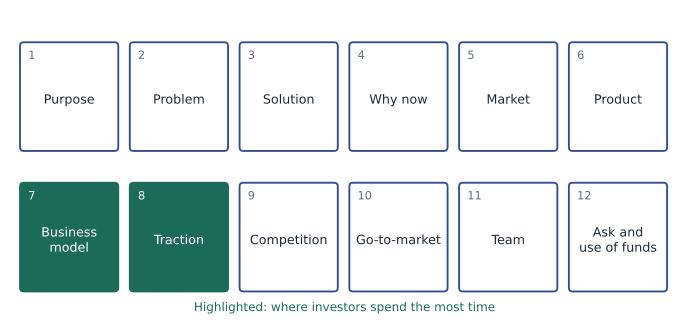
| Slide | What Second Ascent's slide says |
|---|---|
| Purpose | Keep good outdoor gear in use: fast, skilled repair for every brand. |
| Problem | Owners discard repairable gear because repair is slow or unavailable; brands spend about three times as much replacing items as a repair would cost. |
| Solution | A multi-brand repair workshop serving owners and brands, with tiered turnaround and refurbished resale. |
| Why now | Rising gear prices, mainstream resale, right-to-repair rules and brand sustainability commitments. |
| Market | About 14 million dollars a year of serviceable repair and resale demand in the first city; a repeatable model for other cities. |
| Business model | Consumer repairs, brand contracts and resale; brand work fills slow months. |
| Traction | Twelve months: 7,000 jobs, five brand contracts, 52 percent repeat customers, monthly losses down to a few thousand dollars. |
| Competition | Local tailors, single-brand programs, mail-in contractors; none combines speed, skill and every brand. |
| Team | Workshop leader with six years running a brand repair center; retail and partnership executive; software lead. |
| Ask | 1.5 million dollars to open a second city and build the brand portal; target profitability in both cities within 24 months. |
Leading with the story
Facts persuade more when they are arranged as a story. A good pitch has a protagonist, usually a customer, a problem that matters to that person, an insight that the founders have and others have missed, and a resolution in which the venture makes things better. Grace's revised pitch opens with a customer from the Saturday repair days: a climbing guide whose eight-hundred-dollar jacket failed two weeks before a season of work, who had been told by the brand that a repair would take six weeks, and who had it back from Second Ascent in four days. The story takes thirty seconds, shows the problem and the solution together and leads naturally to the insight: there are thousands of such customers, and the brands themselves would rather pay for a fast repair than a replacement.
The story should be true and representative, not a rare best case. Investors will check, often by calling customers, and a pitch built on an exceptional anecdote damages trust when the numbers do not match. Dr. Marchetti also warns against two common styles. One is the grand vision with no specifics, which sounds inspiring but leaves the investor unsure what the company actually does. The other is the data dump, which shows every chart the founders have made and leaves the investor unsure which numbers matter. The best pitches state the vision in one sentence and then prove it with a few well-chosen numbers.
Traction and metrics
For a venture with customers, traction is usually the most persuasive part of the pitch. Investors want to see metrics that show the business model working: revenue and its growth, contribution margin, customer acquisition cost and payback by channel, retention by cohort and, for business customers, contract value and renewal. They want honest definitions, since many decks inflate traction by counting pilots as customers or bookings as revenue. Second Ascent's traction slide shows monthly jobs, contribution margin by revenue stream, repeat rates for the first six monthly cohorts and the five signed brand contracts with their monthly minimums. It also shows one weakness openly: consumer demand fell by almost half in the winter months, which the brand contracts only partly offset.
Showing a weakness, and what the founders are doing about it, usually builds credibility rather than destroying it. Investors know that every early venture has problems, and founders who appear to have none either do not understand their business or are hiding something. Grace's slide notes that two of the five brand contracts are on trial terms and that winter consumer demand remains the main risk, and presents the annual repair plan as the response, with its early sign-ups.
Competition
Founders often weaken their pitch by claiming to have no competition. To an investor, that suggests either that there is no market or that the founders have not looked. Every venture competes with something, even if it is the customer's current workaround or doing nothing. A good competition slide shows the main alternatives customers use today, compares them on the two or three dimensions customers care most about, and explains why the venture's position is defensible. A common format is a two-by-two chart; a table can be more honest when there are more than two important dimensions. Second Ascent's slide compares local tailors, single-brand programs, mail-in contractors and buying new, on turnaround, skill with technical fabrics and coverage of brands.
Team
At the seed stage, investors often decide mainly on the team. The team slide should show why these people are the right ones for this venture, not list every job they have held. The most persuasive evidence is relevant experience, such as Marta's six years running a brand repair center; complementary skills; evidence of past achievement; and signs of commitment, such as founders investing their own money or leaving good jobs. Grace's slide notes that she has left Fairway to work full-time on Second Ascent, that she invested 60,000 dollars of her own savings, and that the three founders have worked together for a year through the pre-seed stage.
Research suggests that the questions founders are asked can differ systematically by gender. A study by Dana Kanze and colleagues, published in 2018 and based on recordings of question-and-answer sessions at a startup competition, found that investors tended to ask male founders promotion-focused questions about gains and growth and female founders prevention-focused questions about risks and losses, and that founders who answered in the frame of the question raised less money when the questions were prevention-focused. The researchers found that founders who answered prevention questions by reframing toward growth did better. Dr. Marchetti tells the cohort that every founder should prepare to turn questions about risk into answers about the plan to grow.
The ask and use of funds
The pitch should end with a clear ask: how much money, on what kind of instrument, to achieve what milestones by when. Investors want to see that the amount is tied to a plan, not chosen because it is a round number. A use-of-funds slide shows how the money will be spent, usually in a few categories, and a milestones slide shows what the venture will have achieved when the money is spent, which should be enough to justify the next round or to reach profitability. Second Ascent's ask is 1.5 million dollars to open a second city, build the brand portal and reach combined profitability within 24 months, with roughly 18 months of runway and a six-month cushion.
Running a fundraising process
Fundraising is a sales process, and the same disciplines apply. Founders should build a target list of investors who invest at their stage, in their sector and in their region; rank them; and seek warm introductions, ideally from founders the investors have backed. They should run meetings in a compressed period, so that interest in one investor can create urgency in others, rather than spreading meetings over months. They should track every conversation, follow up promptly and prepare a data room with the documents investors will request in due diligence: financial statements and model, cap table, incorporation documents, IP assignments, material contracts and customer references. Dr. Marchetti says the most common mistake is starting too late, when runway is short and the founders cannot walk away from bad terms.
# Second Ascent seed process: pipeline conversion and timing
stages = [("Target investors", 60), ("First meeting", 23), ("Second meeting", 9),
          ("Partner meeting or diligence", 4), ("Term sheet", 2)]
prev = None
for name, n in stages:
    rate = f"{n / prev:5.0%} of previous" if prev else ""
    print(f"{name:<30} {n:>3}  {rate}")
    prev = n

weeks = {"Preparation and target list": 3, "First meetings": 5, "Follow-ups and second meetings": 4,
         "Diligence and term sheet": 3, "Legal documents and closing": 5}
total = sum(weeks.values())
print(f"Total elapsed: {total} weeks, about {total / 4.33:.1f} months")
runway_months = 9
print(f"With {runway_months} months of runway at the start, months left at closing: {runway_months - total / 4.33:.1f}")

use = {"Second-city workshop fit-out and equipment": 220_000, "Second-city operating losses": 380_000,
       "Brand portal and software": 300_000, "Partnerships and marketing": 210_000,
       "Working capital for resale inventory": 90_000, "Cushion": 300_000}
ask = sum(use.values())
for k, v in use.items():
    print(f"  {k:<44} {v:>9,.0f}  {v / ask:4.0%}")
print(f" {'Total ask':<44} {ask:>9,.0f}")Target investors 60 First meeting 23 38% of previous Second meeting 9 39% of previous Partner meeting or diligence 4 44% of previous Term sheet 2 50% of previous Total elapsed: 20 weeks, about 4.6 months With 9 months of runway at the start, months left at closing: 4.4 Second-city workshop fit-out and equipment 220,000 15% Second-city operating losses 380,000 25% Brand portal and software 300,000 20% Partnerships and marketing 210,000 14% Working capital for resale inventory 90,000 6% Cushion 300,000 20% Total ask 1,500,000
The pipeline shows typical early-stage conversion: about four in ten targets agreed to a first meeting, fewer than half of those led to a second, and two produced term sheets. The whole process took about twenty weeks, close to five months, which is why Dr. Marchetti insists that founders start raising with at least nine months of runway. Grace started with nine and closed with about four to spare, which gave her enough room to negotiate the option pool and the sale veto from lesson 10. The use-of-funds table ties the 1.5-million-dollar ask to specific spending, with a fifth held back as a cushion.
Questions and due diligence
The question-and-answer part of a pitch often matters more than the presentation. Investors use questions to test whether the founders understand their business, how they respond under pressure and whether they are candid about what they do not know. Founders should prepare by listing the ten hardest questions they could be asked and rehearsing honest, concise answers; by knowing their numbers without looking them up; and by being willing to say they do not know and will follow up. For Second Ascent the hardest questions concern the dependence on Cedarline, whether a large brand could copy the model, how fast a second city can reach breakeven and whether skilled technicians can be hired.
Due diligence follows a successful pitch. Investors check the claims in the deck: they call customers and brand partners, review financial records, examine the legal documents and IP assignments, check the founders' references and sometimes their backgrounds. Diligence goes faster when the data room is complete and the cap table is clean, and it is where the legal work described in lesson 8 pays off. Founders should also do diligence on their investors, as lesson 9 suggested, by talking to other founders the investors have backed.
Worked problem
Fixing a weak pitch
Grace's first version of the pitch spent the first ten minutes on the history of repair and the business model canvas, mentioned the brand contracts only on slide 14 and ended without a clear ask. Investors' questions focused on whether consumers would really pay, which the traction data answered, but Grace had not reached it. Redesign the order of the first five minutes.
Show solution
- Open with the customer story: the climbing guide's jacket fixed in four days instead of six weeks, about thirty seconds.
- State the problem and insight in one slide: owners discard repairable gear and brands overpay for replacements; Second Ascent fixes both.
- Move traction forward to slide three or four: 7,000 jobs, five brand contracts, repeat rates and contribution margins, since the investors' main doubt is answered by data.
- Then show the business model, briefly, explaining how brand work fills slow months, and the market, and leave history and the full canvas for an appendix.
Answer: Lead with a representative customer story, state the problem and insight crisply, show traction early because it answers the investors' central doubt, and finish with a clear ask tied to milestones. The content is the same; the order now follows the questions investors ask.
Common mistakes
MistakeThe goal of a first pitch is to close the round.
InsteadThe goal is the next step: a second meeting, a partner introduction or a request for diligence materials.
MistakeClaim there is no competition.
InsteadShow the alternatives customers use today and why the venture's position is defensible.
MistakeHide weaknesses so investors stay enthusiastic.
InsteadName the main risks and the plan to address them; candour builds credibility.
MistakeStart fundraising when the money is nearly gone.
InsteadStart with at least nine months of runway, run a compressed process and keep the option to walk away.
Summary and key terms
- A pitch aims to win the next step by showing why the opportunity is large, real and right for this team.
- Follow the standard deck structure; one idea and real numbers per slide.
- Lead with a true, representative customer story and reach traction early.
- Present competition honestly, a team suited to the venture and a clear ask tied to milestones and use of funds.
- Prepare for hard questions, including reframing risk questions toward growth.
- Run fundraising as a compressed, tracked sales process with a complete data room, starting with ample runway.
- Pitch deck
- A short slide presentation that explains a venture to investors.
- Traction
- Evidence that the business model works, such as revenue, retention and contracts.
- Use of funds
- How the money raised will be spent, by category.
- Data room
- An organized collection of documents for investors' due diligence.
- Due diligence
- Investors' checks of a venture's claims, records and legal position before investing.
- Warm introduction
- An introduction to an investor from someone the investor knows and trusts.
Practice problems
Work each problem on paper first, then reveal the answer to check.
Why should a founder avoid saying that the venture has no competitors?
Show answer
It suggests either no market or poor research; every venture competes with alternatives, including doing nothing.
A pipeline of 80 targets converts to first meetings at 35 percent, second meetings at 40 percent, diligence at 45 percent and term sheets at 50 percent. How many term sheets would be expected?
Show answer
80 × 0.35 × 0.40 × 0.45 × 0.50 ≈ 2.5, so about two or three.
An investor asks how the founder will avoid losing money in a second city. Give a growth-framed answer.
Show answer
For example: by entering with two brand contracts already signed to fill the workshop from month one, so that consumer growth adds profit from the start.
List four documents a seed-stage data room should contain.
Show answer
For example: financial statements and model, cap table, incorporation and shareholder documents, IP assignments, material contracts and customer references.
Lesson quiz · 5 questions
Score 60% or more to complete this lesson.
Create a free account to save your progress, take quizzes and earn a certificate.