
MBA-602 · Lesson 5 of 12 · 22 min
Business models and the business model canvas
By the fifth session Second Ascent has evidence that customers want what it offers. Dr. Marchetti now asks a different question: how will the venture make money, and could the same service be organized in a better way? She points out that two companies can offer almost the same product to the same customers and end up with very different results because of how they are paid, what they own and whom they partner with. A repair workshop can charge per job, sell annual repair plans, take a share of resale value, license its methods to brands or run a marketplace of independent tailors. Those choices make up its business model, and for many ventures the business model, not the product, is the main innovation.
What a business model is
David Teece, writing in 2010, described a business model as the design of the mechanisms by which a firm creates value for customers, delivers it, and captures a share of it as profit. The definition separates three questions. Value creation asks what customer problem is solved and how well. Value delivery asks how the product reaches the customer, through which channels and with which partners. Value capture asks how the firm is paid and what stops others from taking the value it creates. A venture can fail on any of the three. Many ventures create real value for customers but capture little of it, because competitors copy them quickly or because a partner controls access to the customer.
The business model is different from strategy, although the two interact. Strategy concerns how a firm positions itself against competitors and which choices make it distinctive, which the cohort will study in more depth in its strategy course. The business model is the logic of the business itself. Joan Magretta put it simply in a 2002 article: a business model is a story that explains how an enterprise works, answering who the customer is, what the customer values and how the firm makes money by delivering that value at an appropriate cost. A good business model story is coherent: every part supports the others.
The business model canvas
Alexander Osterwalder and Yves Pigneur's 2010 book Business Model Generation introduced the business model canvas, a one-page template with nine building blocks. On the right side, facing the customer, are customer segments, value propositions, channels, customer relationships and revenue streams. On the left side, facing the operation, are key resources, key activities, key partners and the cost structure. The canvas is popular because it is simple and visual, and because it makes the connections among the blocks easy to see and discuss. Founders typically fill it in with sticky notes, keeping it rough so that it can be changed as they learn.
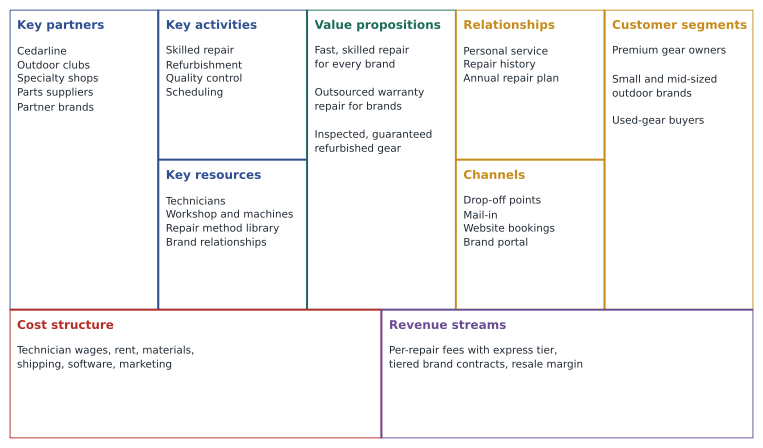
Ash Maurya adapted the canvas for early-stage ventures as the Lean Canvas, replacing partners, activities, resources and relationships with problem, solution, key metrics and unfair advantage. The change reflects his view that a new venture's biggest uncertainties are about the problem and the customer rather than about operations. Dr. Marchetti uses both: the Lean Canvas early, when the founders are still testing the problem, and the full canvas once they need to think about operations, partners and costs, which is where Second Ascent now is.
Value propositions
Osterwalder later added the value proposition canvas, which zooms in on the fit between one customer segment and one value proposition. For the customer, it lists jobs to be done, pains, meaning what annoys or blocks the customer in doing those jobs, and gains, meaning the outcomes they want. For the product, it lists the products and services offered, pain relievers and gain creators. Fit exists when the product addresses the jobs, pains and gains that matter most. For premium gear owners, the strongest pains from interviews were long waits, uncertainty about whether an item could be fixed and fear that a tailor would damage waterproof fabric; the main gain sought was having the item back before a trip. The value proposition therefore leads with speed and skill rather than price.
Different segments need different propositions, which is why one venture may have several. For small brands, the jobs are keeping warranty promises at low cost and protecting the brand's reputation; the pains are the cost of replacing items, slow contractors and customer complaints. Second Ascent's proposition to brands is outsourced warranty repair with a guaranteed turnaround, quality reporting and pricing below the cost of replacement. For buyers of used gear, the proposition is refurbished items inspected and guaranteed by skilled technicians, which addresses their main fear: buying something that fails on the first trip.
Revenue models
The revenue stream block describes how a venture is paid, and there are many choices. A transaction model charges per sale or per job. A subscription model charges a recurring fee for ongoing access, which smooths revenue but requires continuing value. A usage model charges by how much is consumed. A licensing model charges others for the right to use intellectual property. A marketplace model takes a commission on transactions between other parties. A freemium model gives a basic version away and charges for premium features. The razor-and-blades model sells one item cheaply and profits on consumables or service. Each has different implications for cash flow, customer behavior and how much capital the venture needs.
Second Ascent is considering three revenue streams with very different characteristics. Consumer repairs are transactions, with tiered prices by repair type and an express option; demand is strongly seasonal. Brand contracts are a business-to-business service, priced per repair by type with a monthly minimum, which gives predictable volume. Resale of refurbished items is a merchant model: Second Ascent would buy or accept items, refurbish them and sell them, earning the margin, but tying up cash in inventory. The founders also discussed an annual repair plan, a subscription giving members discounted repairs and priority booking, which could smooth demand and build loyalty.
Operations and partners
The left side of the canvas determines whether the right side can be delivered at an acceptable cost. Key resources for Second Ascent are skilled technicians, who are scarce and take months to train; a workshop with specialized machines; repair methods and specifications for many brands' products; and relationships with brands that allow it to buy genuine parts. Key activities are diagnosis, repair, quality control, refurbishment and scheduling. The cohort's operations course is directly relevant: repair is a job shop with highly variable task times, and the lessons on queues and utilization predict that turnaround times will rise sharply once technicians are more than about 80 percent busy.
Partners can provide resources the venture cannot afford to own. Cedarline would supply workshop space in its distribution center at below-market rent, refer customers whose items are not covered by its lifetime repair promise and give Second Ascent its own overflow repairs. Outdoor clubs and specialty shops could act as drop-off points, extending reach without retail leases. Parts suppliers, such as zipper manufacturers, could offer trade accounts. Each partnership creates value but also dependence. Dr. Marchetti asks the founders to write down, for each key partner, what it gets from the relationship, what Second Ascent would do if the partner withdrew, and what written agreement will protect both sides.
Platforms and network effects
Some of the most valuable business models of recent decades are platforms, which create value by connecting two or more groups of users, such as buyers and sellers or drivers and riders. Platforms benefit from network effects: each additional user on one side makes the platform more valuable to users on the other side. The cohort studied platforms briefly in MBA-512; they matter here because Leo suggested that Second Ascent could become a marketplace connecting gear owners with independent repair technicians and tailors across the country, rather than running its own workshops. A marketplace would need far less capital and could grow faster.
Dr. Marchetti points out the trade-offs. A marketplace captures only a commission, often 10 to 30 percent of each transaction, and must attract both sides at once, the chicken-and-egg problem that makes launching platforms hard. Quality control is harder when the work is done by independent technicians, and Second Ascent's interviews showed that fear of damage was one of customers' strongest pains. A marketplace also needs software and marketing skills that the founders do not have. The founders decide to start with their own workshop, where they control quality, and to keep the marketplace idea as a possible expansion path once they understand repair quality well enough to certify others.
Comparing business model options
The founders compared four configurations using the data from their experiments. Each uses the same workshop and staff but a different mix of revenue streams. The comparison asks how much contribution each mix produces, how evenly it keeps technicians busy through the year and how much cash it ties up in inventory. Seasonality matters because a workshop staffed for the peak months is idle in the slow months, while one staffed for the average turns customers away at the peak.
# Second Ascent: four business model mixes on one workshop (annual, dollars)
season = [3, 4, 6, 9, 12, 13, 10, 7, 6, 8, 12, 10]   # consumer repairs by month, share of annual (sums to 100)
capacity = 1250                                       # repair-hours of work a month, roughly one repair each

mixes = {
    # name: (consumer repairs, brand repairs, resale items) a year
    "Consumer only":        (12_000, 0, 0),
    "Brand contracts only": (0, 12_000, 0),
    "Consumer plus brands": (12_000, 2_400, 0),
    "Hybrid with resale":   (12_000, 1_800, 700),
}
margin = {"consumer": 24.3, "brand": 14.5, "resale": 51.0}   # contribution per unit
resale_cost, resale_days = 58.0, 75                          # cash tied up per refurbished item, days to sell

for name, (c, b, r) in mixes.items():
    served_c = lost = 0.0
    slack = []
    for share in season:
        demand = c * share / 100
        done = min(demand, capacity)          # consumers cannot wait for a slow month
        served_c += done; lost += demand - done
        slack.append(capacity - done)
    flexible = b + r                          # brand work and refurbishing are scheduled into slack
    fill = min(flexible, sum(slack))
    served_b = min(b, fill); served_r = min(r, fill - served_b)
    util = (served_c + served_b + served_r) / (capacity * 12)
    contribution = served_c * margin["consumer"] + served_b * margin["brand"] + served_r * margin["resale"]
    inventory = served_r * resale_cost * resale_days / 365
    print(f"{name:<21} contribution {contribution:>8,.0f}  utilization {util:4.0%}  "
f"consumer repairs turned away {lost:5,.0f} resale inventory {inventory:6,.0f}")Consumer only contribution 274,833 utilization 75% consumer repairs turned away 690 resale inventory 0 Brand contracts only contribution 174,000 utilization 80% consumer repairs turned away 0 resale inventory 0 Consumer plus brands contribution 309,633 utilization 91% consumer repairs turned away 690 resale inventory 0 Hybrid with resale contribution 336,633 utilization 92% consumer repairs turned away 690 resale inventory 8,342
The output makes the trade-offs concrete. Relying only on consumers leaves technicians underused for much of the year, because demand peaks before summer trips and the ski season, and even with the workshop sized at 1,250 jobs a month about 700 repairs a year are turned away in the peak months of May, June and November. Brand contracts alone fill the workshop evenly, but at a much lower margin per repair. The combination works because brand repairs, unlike consumer ones, can be scheduled into slow months: the contracts promise a turnaround of ten working days, not same-week service. Adding brand work raises both utilization and contribution, and adding refurbishment, which earns the highest margin and can also wait for slack, raises contribution further at the cost of some cash tied up in inventory. Grace says the comparison convinced her that brand contracts are not a side line; they are what makes the consumer business workable. Marta adds a warning from the operations course: at utilization near 90 percent, turnaround times become very sensitive to surges, so the slack-filling plan needs a buffer.
Testing the business model as a whole
A business model is a set of linked hypotheses, and testing them one at a time can miss how they interact. Dr. Marchetti suggests a few consistency checks. Does the customer segment value what the value proposition emphasizes? Can the channels reach that segment at a cost the revenue model supports? Do the key resources and activities deliver the proposition at the cost the structure assumes? Do the partners have reasons to keep cooperating as the venture grows? Is there anything that would stop a larger competitor from copying the whole model once it is proven?
Second Ascent's answer to the last question is its most important weakness. Large outdoor brands already run repair programs for their own products, and one of them could open a multi-brand service. The founders' best defenses are speed, quality and relationships: a reputation for skilled repairs built in the beachhead city, contracts with brands that would rather not depend on a competitor's workshop, and data on repair methods and costs across many brands that a single-brand program would not have. Dr. Marchetti says that is a reasonable start, but the venture should keep asking what it is building that would be hard for others to copy.
Worked problem
Should Second Ascent offer an annual repair plan?
Grace proposes a plan at 89 dollars a year that gives members two standard repairs, 20 percent off other repairs and priority booking. Experiments suggest members would use an average of 1.3 standard repairs a year (cost about 25 dollars each), and that 40 percent of members would otherwise have bought 1.6 repairs a year at an average price of 58 dollars and contribution of 24.30. Evaluate the plan for a member who would have been a customer anyway and for a new customer attracted by the plan.
Show solution
- Existing customer: without the plan, contribution is 1.6 × 24.30 ≈ 38.90. With the plan, revenue is 89 and the cost of 1.3 standard repairs is about 32.50, giving 56.50, plus any discounted extra repairs. The plan earns about 17.60 more.
- New customer: without the plan, contribution is zero. With the plan, contribution is about 56.50 a year, plus discounted extras, before acquisition cost.
- Demand smoothing: members book early to use their repairs, and priority booking can be managed with off-peak incentives, but priority customers in peak months may displace others when capacity binds.
- Risk: if members use more repairs than the 1.3 assumed, or bring mainly complex repairs, the plan's margin falls; usage must be monitored by cohort.
Answer: The plan looks attractive: it raises contribution from existing customers, attracts new ones and creates recurring revenue. The founders should pilot it with a capped number of members, track usage and repair mix by cohort, and limit priority booking in peak weeks so that capacity is not overwhelmed.
Common mistakes
MistakeThe product is the business model.
InsteadThe business model also covers how value is delivered and captured; the same product can succeed or fail under different models.
MistakeFill in the canvas once and treat it as the plan.
InsteadThe canvas is a set of hypotheses; keep it rough and update it as experiments produce evidence.
MistakeA platform model is always better because it needs less capital.
InsteadPlatforms capture only a commission, must attract both sides at once and make quality harder to control.
MistakeThe highest-margin revenue stream should dominate.
InsteadLook at the whole system: utilization, seasonality and working capital can make a lower-margin stream essential.
Summary and key terms
- A business model describes how a firm creates, delivers and captures value.
- The business model canvas has nine blocks linking customer-facing elements to operations; the Lean Canvas suits very early ventures.
- The value proposition canvas tests fit between a segment's jobs, pains and gains and the offering.
- Revenue models include transaction, subscription, usage, licensing, marketplace, freemium and razor-and-blades; each affects cash flow and capital needs.
- Partners supply resources the venture cannot afford to own but create dependence that needs written agreements.
- Compare model options on contribution, utilization, seasonality and working capital, and ask what would stop competitors copying the model.
- Business model
- The design of how a firm creates value for customers, delivers it and captures part of it as profit.
- Business model canvas
- A one-page template of nine building blocks describing a business model.
- Value proposition
- The bundle of products and services that creates value for a specific customer segment.
- Revenue model
- The way a venture is paid, such as per transaction, by subscription or by commission.
- Network effect
- The increase in a product's value to each user as more users join.
- Platform
- A business that creates value by connecting two or more groups of users.
Practice problems
Work each problem on paper first, then reveal the answer to check.
Classify these revenue models: a 12 percent commission on used-gear sales between owners; an 89-dollar annual repair plan; a fee per warranty repair for a brand.
Show answer
Marketplace commission; subscription; business-to-business transaction (per-unit service fee).
A workshop can do 1,000 repairs a month. Consumer demand is 600 in January and 1,400 in June; a brand contract adds 300 a month. In which month is demand turned away, and how much?
Show answer
June: 1,400 + 300 = 1,700, so 700 repairs are turned away; January's 900 fits within capacity.
Why might a large outdoor brand prefer to outsource warranty repairs to Second Ascent rather than to a competitor's repair program?
Show answer
It would not want to depend on a competitor or share customer and product data with it; an independent service is neutral.
Name one consistency check between the channels and revenue blocks of the canvas.
Show answer
Can the channels reach the customer segment at a cost that the revenue per customer can support?
Lesson quiz · 5 questions
Score 60% or more to complete this lesson.
Create a free account to save your progress, take quizzes and earn a certificate.