
MATH-430 · Lesson 7 of 12 · 27 min
The Gauss map and the second fundamental form
The first fundamental form measures a surface from the inside. To see how a surface bends in space we watch its unit normal. On a plane the normal never changes; on a sphere it turns as fast as we move; on a cylinder it turns in one direction and not in the other. This lesson packages the turning of the normal as the Gauss map, a map from the surface to the unit sphere, and its derivative as the shape operator, a self-adjoint linear map on each tangent plane. Its quadratic form is the second fundamental form, which measures how fast the surface curves away from its tangent plane in each direction and controls the curvature of every curve drawn on the surface.
The Gauss map
Let \(S\) be an oriented regular surface with unit normal field \(N\). Since \(|N(p)| = 1\), we may view \(N\) as a map
the Gauss map, sending each point to its normal direction on the unit sphere. Gauss introduced it in his 1827 memoir, transferring the normals to a sphere much as astronomers transfer directions to the celestial sphere. For a plane the image is a single point. For the unit sphere with outward normal, \(N(p) = p\) and the Gauss map is the identity. For a cylinder \(x^2 + y^2 = 1\) with outward normal \(N(x, y, z) = (x, y, 0)\), the image is the equator: the Gauss map squashes the whole cylinder onto a circle. For the saddle \(z = x^2 - y^2\), the image near the origin covers a neighborhood of the north pole, but as the figure shows it reverses orientation.
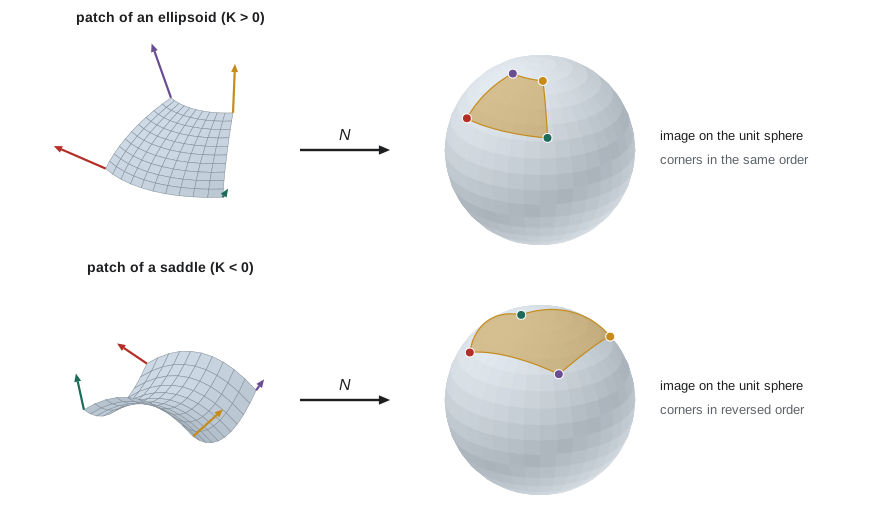
The Gauss map is smooth, since in a patch it is \(\mathbf{x}_u \times \mathbf{x}_v/|\mathbf{x}_u \times \mathbf{x}_v|\), a smooth function of \((u, v)\). Its differential at \(p\) maps \(T_pS\) to \(T_{N(p)}S^2\). But the tangent plane of the unit sphere at the point \(N(p)\) is the set of vectors perpendicular to \(N(p)\), which is exactly \(T_pS\). So \(dN_p\) is a linear map from \(T_pS\) to itself. Concretely, if \(\alpha(t)\) is a curve on \(S\) with \(\alpha(0) = p\) and \(\alpha'(0) = w\), then \(dN_p(w) = \frac{d}{dt}N(\alpha(t))\big|_{t=0}\), the rate at which the normal turns as we move in the direction \(w\). In coordinates, \(dN(\mathbf{x}_u) = N_u\) and \(dN(\mathbf{x}_v) = N_v\).
The shape operator is self-adjoint
The shape operator, or Weingarten map, is \(S_p = -dN_p : T_pS \to T_pS\). The minus sign is chosen so that a sphere with inward normal has positive curvature, but conventions vary.
Theorem. The shape operator is self-adjoint with respect to the first fundamental form: \(\langle S_p(w_1), w_2 \rangle = \langle w_1, S_p(w_2) \rangle\) for all \(w_1, w_2 \in T_pS\).
Proof. By linearity it suffices to check the basis \(\mathbf{x}_u, \mathbf{x}_v\), and the only nontrivial case is \(\langle N_u, \mathbf{x}_v \rangle = \langle \mathbf{x}_u, N_v \rangle\). Since \(N\) is perpendicular to the tangent plane, \(\langle N, \mathbf{x}_v \rangle = 0\) and \(\langle N, \mathbf{x}_u \rangle = 0\) everywhere. Differentiating the first with respect to \(u\) and the second with respect to \(v\),
Mixed partial derivatives of a smooth map commute, \(\mathbf{x}_{uv} = \mathbf{x}_{vu}\), so both expressions give \(\langle N_u, \mathbf{x}_v \rangle = \langle N_v, \mathbf{x}_u \rangle = -\langle N, \mathbf{x}_{uv} \rangle\). \(\blacksquare\)
By the spectral theorem, a self-adjoint operator on the two-dimensional inner product space \(T_pS\) has an orthonormal basis of eigenvectors with real eigenvalues. Lesson 8 names them: the eigenvalues are the principal curvatures and the eigenvectors the principal directions.
The second fundamental form
The quadratic form associated with the shape operator is the second fundamental form,
In a patch, write \(w = a\mathbf{x}_u + b\mathbf{x}_v\). Then \(II_p(w) = e a^2 + 2f ab + g b^2\), where, using the identities from the proof above,
The second expressions are the practical ones: compute the second partial derivatives of \(\mathbf{x}\) and take their components along the normal. (Some books write \(L, M, N\) for \(e, f, g\); we keep \(N\) for the normal.) Classical notation writes \(II = e\,du^2 + 2f\,du\,dv + g\,dv^2\).
The second fundamental form has a direct geometric meaning: it is the second-order term of the height of the surface above its tangent plane. Indeed, by Taylor's theorem,
because the first-order term \(a\mathbf{x}_u + b\mathbf{x}_v\) is tangent. For a graph \(z = h(x, y)\) with \(h(0) = 0\) and \(\nabla h(0) = 0\), so that the tangent plane at the origin is horizontal and \(N(0) = (0, 0, 1)\), this says \(e = h_{xx}\), \(f = h_{xy}\), \(g = h_{yy}\) at the origin: the second fundamental form is the Hessian of the height function. The surface lies locally on one side of the tangent plane when the Hessian is definite and crosses it when the Hessian is indefinite.
Worked problem
Fundamental forms of a surface of revolution
Find \(e, f, g\) for \(\mathbf{x}(u, v) = (f(v)\cos u, f(v)\sin u, g(v))\) when the profile \((f, g)\) has unit speed, \(f'^2 + g'^2 = 1\). (Here \(f, g\) denote the profile functions; we write \(\ell, m, n\) for the coefficients to avoid a clash.)
Show solution
- \(\mathbf{x}_u = (-f\sin u, f\cos u, 0)\), \(\mathbf{x}_v = (f'\cos u, f'\sin u, g')\), and \(\mathbf{x}_u \times \mathbf{x}_v = f\,(g'\cos u, g'\sin u, -f')\), so \(N = (g'\cos u, g'\sin u, -f')\).
- \(\mathbf{x}_{uu} = (-f\cos u, -f\sin u, 0)\), \(\mathbf{x}_{uv} = (-f'\sin u, f'\cos u, 0)\), \(\mathbf{x}_{vv} = (f''\cos u, f''\sin u, g'')\).
- Dotting with \(N\): \(\ell = -fg'\), \(m = 0\), \(n = f''g' - f'g''\).
Answer: \(\ell = -fg'\), \(m = 0\), \(n = f''g' - f'g''\), which is minus the signed curvature of the profile. Both fundamental forms are diagonal in meridian-parallel coordinates, so meridians and parallels are the principal directions of lesson 8. For the torus with profile \((R + r\cos v, r\sin v)\) rescaled to unit speed, these give \(\ell = -(R + r\cos v)\cos v\) and \(n = -r\) in the original coordinates. Here the normal points away from the core circle, and the negative signs say that on the outer equator the surface bends away from its normal in both directions.
Normal curvature and Meusnier's theorem
How does the second fundamental form relate to the curvature of curves on the surface? Let \(\alpha(s)\) be a unit-speed curve on \(S\) through \(p\), with curvature \(\kappa\) and principal normal \(n\). Since \(\alpha' \perp N\) along the curve, differentiating \(\langle \alpha'(s), N(\alpha(s)) \rangle = 0\) gives
The left side is \(\kappa\langle n, N \rangle\), the component of the curve's curvature vector normal to the surface, called the normal curvature \(\kappa_n\) of the curve. So
Theorem (Meusnier, 1776). All curves on a surface through \(p\) with the same tangent line have the same normal curvature, equal to \(II_p(T)\) for the unit tangent \(T\).
The proof is the computation above: the right side depends only on \(T\). Jean-Baptiste Meusnier's statement was that the osculating circles of all such curves lie on a sphere. So the second fundamental form, evaluated on unit vectors, is the normal curvature function. For each unit tangent \(w\), the plane through \(p\) spanned by \(w\) and \(N\) cuts the surface in a normal section, a plane curve with \(\vartheta = 0\) or \(\pi\), whose signed curvature is \(II_p(w)\). On the unit sphere with inward normal every normal section is a great circle and \(II_p(w) = 1\) for all unit \(w\); a small circle of latitude \(\varphi\) has curvature \(1/\cos\varphi\) but makes angle \(\vartheta = \varphi\) with the normal, and indeed \(\frac{1}{\cos\varphi}\cos\varphi = 1\).
The matrix of the shape operator
In a patch, the shape operator is represented by a \(2 \times 2\) matrix \(A\) in the basis \(\mathbf{x}_u, \mathbf{x}_v\): \(-N_u = a_{11}\mathbf{x}_u + a_{21}\mathbf{x}_v\) and \(-N_v = a_{12}\mathbf{x}_u + a_{22}\mathbf{x}_v\). Dotting with \(\mathbf{x}_u\) and \(\mathbf{x}_v\) and using the definitions,
These are the Weingarten equations, found by Julius Weingarten in 1861. Note that \(A\) itself need not be symmetric unless the parametrization is orthonormal at \(p\); self-adjointness is with respect to the first fundamental form, and it is the product with the Gram matrix that is symmetric. The determinant and trace of \(A\) are independent of the basis, and lesson 8 defines the Gaussian curvature \(K = \det A = \frac{eg - f^2}{EG - F^2}\) and the mean curvature \(H = \frac12\operatorname{tr}A\).
Gauss's definition of curvature
Gauss originally defined the curvature at \(p\) through the Gauss map: the ratio of the area of the image \(N(\Omega)\) on the sphere to the area of a small region \(\Omega\) around \(p\), in the limit as \(\Omega\) shrinks, with a sign recording whether \(N\) preserves or reverses orientation. Since \(dN_p = -A\), the change of variables theorem gives
For a plane the image is a point, ratio 0. For a sphere of radius \(R\), a region of area \(A\) has normals filling a region of area \(A/R^2\) on the unit sphere, ratio \(1/R^2\). A cylinder has ratio 0 because its image is a curve. The program checks the formula on an ellipsoid.
Computing the second fundamental form
The program computes \(e, f, g\) numerically for the torus with \(R = 2\), \(r = 1\) and compares them with the exact formulas, verifies Meusnier's theorem by taking two different curves through the same point of the torus with the same tangent direction, and measures the area of the Gauss image of a small square on the ellipsoid \(x^2/4 + y^2 + z^2/0.25 = 1\) against \(\det A\).
import math

def sub(a, b): return [x - y for x, y in zip(a, b)]
def dot(a, b): return sum(x*y for x, y in zip(a, b))
def cross(a, b): return [a[1]*b[2] - a[2]*b[1], a[2]*b[0] - a[0]*b[2], a[0]*b[1] - a[1]*b[0]]
def unit(a):
    n = math.sqrt(dot(a, a)); return [x / n for x in a]

def forms(X, u, v, h=1e-4):
    P = lambda du, dv: X(u + du*h, v + dv*h)
    xu = [(a - b)/(2*h) for a, b in zip(P(1, 0), P(-1, 0))]
    xv = [(a - b)/(2*h) for a, b in zip(P(0, 1), P(0, -1))]
    c = P(0, 0)
    xuu = [(a - 2*m + b)/h**2 for a, m, b in zip(P(1, 0), c, P(-1, 0))]
    xvv = [(a - 2*m + b)/h**2 for a, m, b in zip(P(0, 1), c, P(0, -1))]
    xuv = [(a - b - cc + d)/(4*h*h) for a, b, cc, d in zip(P(1, 1), P(1, -1), P(-1, 1), P(-1, -1))]
    N = unit(cross(xu, xv))
    return (dot(xu, xu), dot(xu, xv), dot(xv, xv)), (dot(N, xuu), dot(N, xuv), dot(N, xvv)), N

R, r = 2.0, 1.0
torus = lambda u, v: [(R + r*math.cos(v))*math.cos(u), (R + r*math.cos(v))*math.sin(u), r*math.sin(v)]
for v in (0.0, math.pi/2, math.pi):
    (E, F, G), (e, f, g), N = forms(torus, 0.4, v)
    print(f"torus v={v:.3f}: e={e:+.5f} f={f:+.5f} g={g:+.5f}   exact e={-(R + r*math.cos(v))*math.cos(v):+.5f} g={-r:+.5f}"
          f"   K=(eg-f^2)/(EG-F^2)={(e*g - f*f)/(E*G - F*F):+.5f}  exact {math.cos(v)/(r*(R + r*math.cos(v))):+.5f}")

# Meusnier: two curves through torus(0.4, 0.5) with tangent direction x_u + x_v
u0, v0 = 0.4, 0.5
c1 = lambda t: torus(u0 + t, v0 + t)                 # straight line in (u, v)
c2 = lambda t: torus(u0 + t + 3*t*t, v0 + t - 2*t*t)  # same tangent, different second derivative
def curvature_data(c, h=1e-4):
    d1 = [(a - b)/(2*h) for a, b in zip(c(h), c(-h))]
    d2 = [(a - 2*m + b)/h**2 for a, m, b in zip(c(h), c(0), c(-h))]
    k = math.sqrt(dot(cross(d1, d2), cross(d1, d2))) / dot(d1, d1)**1.5
    # normal component of the curvature vector: (d2 . N) / |d1|^2
    return k, d1, d2
(E, F, G), (e, f, g), N = forms(torus, u0, v0)
II = (e + 2*f + g) / (E + 2*F + G)
for name, c in (("straight in (u,v)", c1), ("bent in (u,v)", c2)):
    k, d1, d2 = curvature_data(c)
    kn = dot(d2, N) / dot(d1, d1)
    print(f"{name:18s} curvature {k:.5f}   normal curvature {kn:+.5f}   II(T) = {II:+.5f}")

# Gauss image of a small square on an ellipsoid versus det A
a, b, cc = 2.0, 1.0, 0.5
ell = lambda u, v: [a*math.cos(v)*math.cos(u), b*math.cos(v)*math.sin(u), cc*math.sin(v)]
u0, v0, d = 0.7, 0.4, 0.01
def nrm(u, v): return forms(ell, u, v)[2]
def tri_area(p, q, s): return 0.5*math.sqrt(dot(cross(sub(q, p), sub(s, p)), cross(sub(q, p), sub(s, p))))
corners = [(u0, v0), (u0 + d, v0), (u0 + d, v0 + d), (u0, v0 + d)]
Pn = [nrm(*q) for q in corners]; Ps = [ell(*q) for q in corners]
ratio = (tri_area(Pn[0], Pn[1], Pn[2]) + tri_area(Pn[0], Pn[2], Pn[3])) / (tri_area(Ps[0], Ps[1], Ps[2]) + tri_area(Ps[0], Ps[2], Ps[3]))
(E, F, G), (e, f, g), N = forms(ell, u0 + d/2, v0 + d/2)
print(f"ellipsoid: area(N(patch))/area(patch) = {ratio:.5f} K = det A = {(e*g - f*f)/(E*G - F*F):.5f}")torus v=0.000: e=-3.00000 f=+0.00000 g=-1.00000 exact e=-3.00000 g=-1.00000 K=(eg-f^2)/(EG-F^2)=+0.33333 exact +0.33333 torus v=1.571: e=+0.00000 f=+0.00000 g=-1.00000 exact e=-0.00000 g=-1.00000 K=(eg-f^2)/(EG-F^2)=-0.00000 exact +0.00000 torus v=3.142: e=+1.00000 f=+0.00000 g=-1.00000 exact e=+1.00000 g=-1.00000 K=(eg-f^2)/(EG-F^2)=-1.00000 exact -1.00000 straight in (u,v) curvature 0.41796 normal curvature -0.37986 II(T) = -0.37986 bent in (u,v) curvature 0.92508 normal curvature -0.37986 II(T) = -0.37986 ellipsoid: area(N(patch))/area(patch) = 0.82913 K = det A = 0.82908
The numerical coefficients match the exact values \(e = -(R + r\cos v)\cos v\), \(f = 0\), \(g = -r\) for the outward normal \(\mathbf{x}_u \times \mathbf{x}_v\). On the outer equator \(v = 0\) both are negative, the surface bending away from its normal in every direction, and \(K = \cos v/(r(R + r\cos v))\) is positive. On the top circle \(v = \pi/2\) the coefficient \(e\) vanishes and \(K = 0\); on the inner equator \(v = \pi\) the coefficients have opposite signs and \(K\) is negative, the saddle-shaped part of the doughnut. The two curves through the same point with the same tangent have different curvatures but identical normal curvature, equal to \(II(T)\), as Meusnier's theorem requires. And the Gauss image of a small square on the ellipsoid has area equal to \(K\) times the area of the square, to within the discretization error, confirming Gauss's original definition of curvature.
Common mistakes
MistakeThinking \(dN_p\) maps into a different plane than \(T_pS\).
Instead\(T_{N(p)}S^2\) is the plane perpendicular to \(N(p)\), which is \(T_pS\); the shape operator is an endomorphism of the tangent plane.
MistakeComputing \(e = \langle \mathbf{x}_{uu}, \mathbf{x}_u \rangle\) or forgetting to normalize the normal.
Instead\(e = \langle N, \mathbf{x}_{uu} \rangle\) with \(N\) a unit vector.
MistakeExpecting the matrix \(A\) of the shape operator to be symmetric in every basis.
InsteadIt is self-adjoint for the first fundamental form; its matrix is symmetric only in an orthonormal basis.
MistakeConfusing the curvature of a curve with its normal curvature.
Instead\(\kappa_n = \kappa\cos\vartheta\); a curve can be very curved while having zero normal curvature if it bends within the tangent plane.
MistakeIgnoring sign conventions for \(N\).
InsteadReversing the normal changes the sign of \(II\), of the normal curvatures and of \(H\), but not of \(K\).
Summary and key terms
- The Gauss map \(N : S \to S^2\) records normal directions; its differential \(dN_p\) is a linear map of \(T_pS\) to itself.
- The shape operator \(-dN_p\) is self-adjoint, by equality of mixed partials, so it has real eigenvalues and orthogonal eigenvectors.
- The second fundamental form \(II = e\,du^2 + 2f\,du\,dv + g\,dv^2\) has \(e = \langle N, \mathbf{x}_{uu} \rangle\), \(f = \langle N, \mathbf{x}_{uv} \rangle\), \(g = \langle N, \mathbf{x}_{vv} \rangle\), and is half the Hessian of the height above the tangent plane.
- Meusnier's theorem: the normal curvature of a curve depends only on its tangent, \(\kappa_n = \kappa\cos\vartheta = II(T)\).
- The Weingarten equations give the shape operator matrix \(A = I^{-1}II\); Gauss's curvature is \(\det A\), the limiting area ratio of the Gauss map.
- Gauss map
- The map sending each point of an oriented surface to its unit normal, viewed as a point of the unit sphere.
- shape operator
- Minus the differential of the Gauss map, a self-adjoint linear map of the tangent plane.
- second fundamental form
- The quadratic form of the shape operator, measuring how the surface bends away from its tangent plane.
- normal curvature
- The component of the curvature vector of a curve along the surface normal.
- normal section
- The curve cut from a surface by a plane containing the normal line.
- Weingarten equations
- The expressions of the derivatives of the normal in terms of the tangent basis.
Practice problems
Work each problem on paper first, then reveal the answer to check.
Find the second fundamental form of the plane, the unit sphere with outward normal and the cylinder \(x^2 + y^2 = 1\) with outward normal.
Show answer
Plane: \(II = 0\). Sphere: \(dN = \text{id}\), so \(II(w) = -|w|^2\). Cylinder: in coordinates \((\cos u, \sin u, v)\), \(e = -1\), \(f = g = 0\).
For the saddle \(z = xy\), compute \(II\) at the origin and describe the surface near there.
Show answer
The Hessian of \(xy\) is \(\begin{pmatrix} 0 & 1 \\ 1 & 0 \end{pmatrix}\), so \(II = 2\,dx\,dy\). It is indefinite: the surface rises above the tangent plane in the first and third quadrants and falls below in the others.
A curve on the unit sphere has curvature 2 at a point. What angle does its principal normal make with the inward sphere normal?
Show answer
\(\kappa_n = 1\) for every direction, so \(\cos\vartheta = 1/2\) and \(\vartheta = 60^\circ\).
Prove that if every point of a connected surface has \(dN_p = 0\), the surface is part of a plane.
Show answer
Then \(N\) is constant, \(N_0\), and \(\langle \mathbf{x}, N_0 \rangle\) has derivatives \(\langle \mathbf{x}_u, N_0 \rangle = \langle \mathbf{x}_v, N_0 \rangle = 0\), so it is constant: the surface lies in a plane.
Show that a curve on a surface whose principal normal is everywhere tangent to the surface has zero normal curvature. Give an example.
Show answer
\(\kappa_n = \kappa\langle n, N \rangle = 0\) because \(n \perp N\). Example: any circle drawn in a plane, regarded as a curve on that plane, has curvature \(1/r\) but zero normal curvature; it bends entirely within the tangent plane.
Use the Weingarten equations to find the matrix \(A\) for the unit sphere in latitude-longitude coordinates with outward normal.
Show answer
\(N = \mathbf{x}\), so \(N_\varphi = \mathbf{x}_\varphi\), \(N_\theta = \mathbf{x}_\theta\) and \(A = -I_2\). Then \(e = -1\), \(f = 0\), \(g = -\cos^2\varphi\), and \(I^{-1}II = -I_2\).
Lesson quiz · 5 questions
Score 60% or more to complete this lesson.
Create a free account to save your progress, take quizzes and earn a certificate.