
MATH-430 · Lesson 2 of 12 · 28 min
Parametrized curves, arc length and reparametrization
A curve is the path of a moving point. To do calculus on it we describe it by a map from an interval of times to space, but the same path can be traced quickly or slowly, forward or backward, so we must separate the geometry of the path from the accident of how it is traced. This lesson defines parametrized curves and regular curves, proves that arc length does not depend on the parametrization, and shows that every regular curve can be reparametrized to have unit speed. Arc length will be the natural parameter for everything that follows: curvature and torsion in lesson 3 are defined as rates of change with respect to arc length.
Parametrized curves
A parametrized differentiable curve is a smooth map \(\alpha : I \to \mathbb{R}^3\), where \(I\) is an open interval \((a, b)\) of real numbers (we allow \(a = -\infty\) or \(b = \infty\)). Writing \(\alpha(t) = (x(t), y(t), z(t))\), smoothness means each coordinate function has derivatives of all orders. The variable \(t\) is the parameter, the vector \(\alpha'(t) = (x'(t), y'(t), z'(t))\) is the velocity or tangent vector at \(t\), and its length \(|\alpha'(t)|\) is the speed. The image \(\alpha(I)\) is the trace of the curve. A plane curve is one whose trace lies in a plane, which we usually take to be the \(xy\)-plane.
Some examples fix ideas. The circle \(\alpha(t) = (r\cos t, r\sin t)\) has velocity \((-r\sin t, r\cos t)\) and constant speed \(r\). The helix \(\alpha(t) = (a\cos t, a\sin t, bt)\) with \(a > 0\) winds around the cylinder \(x^2 + y^2 = a^2\), rising \(2\pi b\) per turn; its speed is \(\sqrt{a^2 + b^2}\). The cycloid \(\alpha(t) = (t - \sin t, 1 - \cos t)\) is traced by a point on the rim of a rolling wheel of radius 1; its velocity \((1 - \cos t, \sin t)\) vanishes at \(t = 2\pi k\), the moments when the point touches the ground and momentarily stops.
Different maps can have the same trace. The maps \(t \mapsto (\cos t, \sin t)\) and \(t \mapsto (\cos 2t, \sin 2t)\) on \((0, \pi)\) trace the upper half circle and the whole circle minus a point respectively, so even the trace can depend on the interval. And the smooth map \(\beta(t) = (t^3, t^2)\) has a trace with a sharp corner, a cusp at the origin: the semicubical parabola \(y = |x|^{2/3}\). Smoothness of the map does not guarantee smoothness of the trace. What goes wrong at \(t = 0\) is that \(\beta'(0) = (0, 0)\): the point stops, turns around and leaves in a different direction.
Regular curves
A parametrized curve \(\alpha\) is regular if \(\alpha'(t) \ne 0\) for every \(t \in I\). At a regular point the curve has a well-defined tangent line, the line through \(\alpha(t)\) in the direction \(\alpha'(t)\), and near that point the trace is the graph of a smooth function over the tangent line. To see the last claim in the plane, suppose \(x'(t_0) \ne 0\). By the inverse function theorem of MATH-341, \(x(t)\) has a smooth inverse \(t = t(x)\) near \(x(t_0)\), and the trace near \(\alpha(t_0)\) is the graph \(y = y(t(x))\), a smooth function of \(x\). If instead \(y'(t_0) \ne 0\), the trace is locally a graph over the \(y\)-axis. Either way it has no corners. From now on all curves are regular unless we say otherwise.
The cycloid fails to be regular at its cusps, and the semicubical parabola fails at the origin. The parametrization \(\gamma(t) = (t, |t|)\) is not even differentiable at 0. These examples show why regularity is part of the definition: differential geometry describes the smooth part of a curve, and singular points need separate treatment.
Arc length
The length of a curve should be the limit of the lengths of inscribed polygons. Let \(\alpha : [a, b] \to \mathbb{R}^3\) be a curve defined on a closed interval (smooth on a slightly larger open interval). For a partition \(P : a = t_0 < t_1 < \dots < t_n = b\), the inscribed polygon has length
Refining a partition can only increase \(\ell(\alpha, P)\), by the triangle inequality. We define the length of \(\alpha\) as the supremum of \(\ell(\alpha, P)\) over all partitions. For smooth curves this supremum is given by the familiar integral.
Theorem. If \(\alpha\) is continuously differentiable on \([a, b]\), then its length is \(L = \int_a^b |\alpha'(t)|\,dt\).
Proof. First, every polygon is no longer than the integral. For each \(i\), the fundamental theorem of calculus applied to each coordinate gives \(\alpha(t_i) - \alpha(t_{i-1}) = \int_{t_{i-1}}^{t_i} \alpha'(t)\,dt\), and the length of an integral of a vector function is at most the integral of its length. (To prove the last fact, let \(v\) be the integral; if \(v \ne 0\) then \(|v|^2 = v \cdot \int \alpha' = \int v \cdot \alpha' \le |v| \int |\alpha'|\) by Cauchy–Schwarz, and divide by \(|v|\).) Summing over \(i\) gives \(\ell(\alpha, P) \le \int_a^b |\alpha'|\).
Second, polygons come arbitrarily close to the integral. Let \(\varepsilon > 0\). Since \(\alpha'\) is continuous on the compact interval \([a, b]\), it is uniformly continuous, so there is \(\delta > 0\) with \(|\alpha'(s) - \alpha'(t)| < \varepsilon\) whenever \(|s - t| < \delta\). Take any partition with mesh less than \(\delta\). On \([t_{i-1}, t_i]\), write \(\alpha'(t) = \alpha'(t_i) + (\alpha'(t) - \alpha'(t_i))\). Integrating,
where the second inequality uses \(|\alpha'(t)| \le |\alpha'(t_i)| + \varepsilon\) on the subinterval. Summing, \(\ell(\alpha, P) \ge \int_a^b |\alpha'| - 2\varepsilon(b - a)\). Since \(\varepsilon\) is arbitrary, the supremum of polygon lengths is at least the integral, and combined with the first part it equals the integral. \(\blacksquare\)
The theorem says that length is the integral of speed: distance traveled equals the time integral of how fast you go. For the helix over one turn, \(L = \int_0^{2\pi} \sqrt{a^2 + b^2}\,dt = 2\pi\sqrt{a^2 + b^2}\), which also follows by unrolling the cylinder: one turn becomes the hypotenuse of a right triangle with legs \(2\pi a\) and \(2\pi b\). For one arch of the cycloid, \(|\alpha'(t)|^2 = (1 - \cos t)^2 + \sin^2 t = 2 - 2\cos t = 4\sin^2(t/2)\), so \(L = \int_0^{2\pi} 2\sin(t/2)\,dt = 8\). Christopher Wren found this in 1658: the arch is exactly four times the diameter of the rolling wheel.
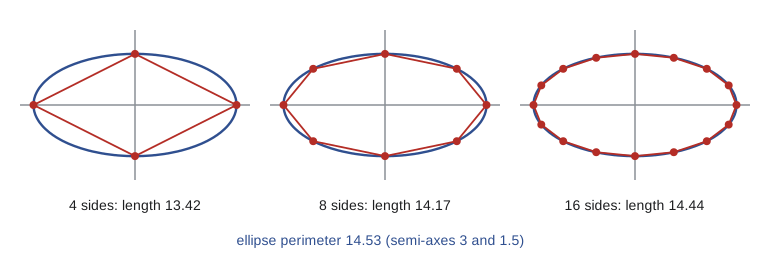
The ellipse \(\alpha(t) = (a\cos t, b\sin t)\) has speed \(\sqrt{a^2\sin^2 t + b^2\cos^2 t}\), and its perimeter \(\int_0^{2\pi} \sqrt{a^2\sin^2 t + b^2\cos^2 t}\,dt\) is an elliptic integral, not expressible by elementary functions. Ramanujan gave the remarkably accurate approximation \(\pi\big(3(a + b) - \sqrt{(3a + b)(a + 3b)}\big)\). The program below compares polygons, a numerical integral and Ramanujan's formula.
Reparametrization
A reparametrization of \(\alpha : I \to \mathbb{R}^3\) is a curve \(\beta = \alpha \circ h : J \to \mathbb{R}^3\), where \(h : J \to I\) is a smooth bijection with smooth inverse (a diffeomorphism of intervals). Because \(h\) is a bijection of intervals with \(h' \ne 0\) (differentiate \(h^{-1}(h(s)) = s\)), either \(h' > 0\) everywhere, and \(h\) preserves orientation, or \(h' < 0\) everywhere and it reverses orientation. By the chain rule \(\beta'(s) = \alpha'(h(s))\,h'(s)\): the velocity is rescaled by the factor \(h'(s)\), so \(\beta\) is regular when \(\alpha\) is, and the tangent lines agree.
Theorem. Arc length is invariant under reparametrization. If \(h : [c, d] \to [a, b]\) is a diffeomorphism and \(\beta = \alpha \circ h\), then \(\int_c^d |\beta'(s)|\,ds = \int_a^b |\alpha'(t)|\,dt\).
Proof. Suppose \(h' > 0\). Then \(|\beta'(s)| = |\alpha'(h(s))|\,h'(s)\), and the substitution \(t = h(s)\) gives \(\int_c^d |\alpha'(h(s))|\,h'(s)\,ds = \int_a^b |\alpha'(t)|\,dt\). If \(h' < 0\), then \(|\beta'(s)| = -|\alpha'(h(s))|\,h'(s)\), and the substitution reverses the limits, which cancels the minus sign. \(\blacksquare\)
So length is a property of the geometric curve, not of the parametrization. The same is true of everything we compute in this course: curvature, torsion and their analogues for surfaces are defined so as not to depend on parameters (up to a sign when orientation is reversed).
The arc length parameter
Fix a regular curve \(\alpha : I \to \mathbb{R}^3\) and a base point \(t_0 \in I\). The arc length function
measures signed distance along the curve from \(\alpha(t_0)\). By the fundamental theorem of calculus \(s'(t) = |\alpha'(t)| > 0\), so \(s\) is a smooth strictly increasing function onto some interval \(J\), with a smooth inverse \(t(s)\) by the inverse function theorem. The reparametrized curve \(\beta(s) = \alpha(t(s))\) has velocity
a unit vector. Thus every regular curve can be reparametrized by arc length, and a curve parametrized by arc length is the same thing as a unit-speed curve: if \(|\beta'(s)| = 1\) for all \(s\), then the arc length from \(s_0\) to \(s\) is \(\int_{s_0}^s 1\,du = s - s_0\). The arc length parameter is unique up to the choice of starting point and direction, that is, up to \(s \mapsto \pm s + c\).
Conversely, regularity is exactly what is needed. If \(\alpha'(t_0) = 0\), the arc length function has \(s'(t_0) = 0\) and its inverse is not differentiable there, so the unit-speed reparametrization may fail to be smooth; the semicubical parabola shows that it can genuinely have a corner.
Worked problem
Arc length parameter of a helix
Reparametrize the helix \(\alpha(t) = (a\cos t, a\sin t, bt)\) by arc length from \(t = 0\).
Show solution
- The speed is constant: \(|\alpha'(t)| = \sqrt{a^2 + b^2}\). Write \(c = \sqrt{a^2 + b^2}\).
- Then \(s(t) = \int_0^t c\,du = ct\), so \(t = s/c\).
- Substituting, \(\beta(s) = \big(a\cos(s/c), a\sin(s/c), bs/c\big)\).
- Check: \(\beta'(s) = \big(-\frac{a}{c}\sin(s/c), \frac{a}{c}\cos(s/c), \frac{b}{c}\big)\), whose length squared is \((a^2 + b^2)/c^2 = 1\).
Answer: The unit-speed helix is \(\beta(s) = (a\cos(s/c), a\sin(s/c), bs/c)\) with \(c = \sqrt{a^2 + b^2}\). For constant-speed curves the arc length parameter is just a rescaling of time.
Worked problem
Arc length of a catenary
Find the arc length parametrization of the catenary \(\alpha(t) = (t, \cosh t)\) measured from its lowest point.
Show solution
- \(\alpha'(t) = (1, \sinh t)\) and \(|\alpha'(t)| = \sqrt{1 + \sinh^2 t} = \cosh t\).
- So \(s(t) = \int_0^t \cosh u\,du = \sinh t\), and \(t = \operatorname{arsinh} s = \ln(s + \sqrt{1 + s^2})\).
- Since \(\cosh(\operatorname{arsinh} s) = \sqrt{1 + s^2}\), the reparametrization is \(\beta(s) = \big(\operatorname{arsinh} s, \sqrt{1 + s^2}\big)\).
Answer: \(\beta(s) = (\operatorname{arsinh} s, \sqrt{1 + s^2})\). The height above the lowest point grows like the arc length for large \(s\), which is why a hanging chain looks nearly straight far from its low point.
For most curves the integral defining \(s(t)\) cannot be done in closed form, and even when it can, inverting \(s(t)\) may be impossible. This is not a practical problem. Theorems are proved using a unit-speed parametrization, which exists, while computations are done in whatever parameter is convenient, using formulas that lesson 3 derives for arbitrary regular parametrizations. Numerically, one tabulates \(s(t)\) by quadrature and inverts it by interpolation or Newton's method, as the program does.
Computing arc length
The program computes the perimeter of the ellipse with semi-axes 3 and 1.5 three ways: inscribed polygons with more and more sides, Simpson's rule for the integral, and Ramanujan's approximation. It then reparametrizes the ellipse by arc length numerically, placing ten points at equal arc-length spacing by solving \(s(t) = k L/10\) with Newton's method, whose derivative \(s'(t) = |\alpha'(t)|\) is known exactly. Equal steps in \(t\) bunch points near the ends of the major axis; equal steps in arc length space them evenly.
import math

a, b = 3.0, 1.5
def pt(t):    return (a * math.cos(t), b * math.sin(t))
def speed(t): return math.hypot(a * math.sin(t), b * math.cos(t))

# 1. inscribed polygons
for n in (4, 8, 16, 64, 256):
    P = [pt(2 * math.pi * k / n) for k in range(n + 1)]
    poly = sum(math.dist(P[k], P[k + 1]) for k in range(n))
    print(f"polygon with {n:3d} sides: {poly:.6f}")

# 2. Simpson's rule for the integral of the speed
def simpson(f, lo, hi, n=200):
    h = (hi - lo) / n
    s = f(lo) + f(hi) + sum((4 if k % 2 else 2) * f(lo + k * h) for k in range(1, n))
    return s * h / 3
L = simpson(speed, 0, 2 * math.pi)
print(f"integral (Simpson, 200 steps): {L:.10f}")
ram = math.pi * (3 * (a + b) - math.sqrt((3 * a + b) * (a + 3 * b)))
print(f"Ramanujan's approximation:     {ram:.10f}   difference {L - ram:.2e}")

# 3. reparametrize by arc length: solve s(t) = target by Newton's method
def s_of(t): return simpson(speed, 0, t, 100)
t, ts = 0.0, []
for k in range(10):
    target = k * L / 10
    for _ in range(8):
        t -= (s_of(t) - target) / speed(t)
    ts.append(t)
gaps = [math.dist(pt(ts[k]), pt(ts[(k + 1) % 10])) for k in range(10)]
print("parameters t_k:", " ".join(f"{x:.3f}" for x in ts))
print("chords between equally spaced points:", " ".join(f"{g:.3f}" for g in gaps))
naive = [math.dist(pt(2 * math.pi * k / 10), pt(2 * math.pi * (k + 1) / 10)) for k in range(10)]
print("chords for equal steps in t: ", " ".join(f"{g:.3f}" for g in naive))polygon with 4 sides: 13.416408 polygon with 8 sides: 14.174729 polygon with 16 sides: 14.439526 polygon with 64 sides: 14.526837 polygon with 256 sides: 14.532308 integral (Simpson, 200 steps): 14.5326723308 Ramanujan's approximation: 14.5326316465 difference 4.07e-05 parameters t_k: 0.000 0.787 1.327 1.815 2.354 3.142 3.929 4.468 4.956 5.496 chords between equally spaced points: 1.382 1.447 1.450 1.447 1.382 1.382 1.447 1.450 1.447 1.382 chords for equal steps in t: 1.051 1.596 1.854 1.596 1.051 1.051 1.596 1.854 1.596 1.051
The polygons converge to the integral from below, as the proof predicts, and the error falls by a factor of about four each time the number of sides doubles. Simpson's rule on a smooth periodic integrand converges very quickly; Ramanujan's formula is off by only about \(4 \times 10^{-5}\) for this moderately eccentric ellipse, and its error shrinks rapidly as the ellipse becomes rounder. The chords between arc-length-spaced points are nearly equal (they are not exactly equal because chords are shorter than arcs by an amount that depends on the curvature), while equal steps in \(t\) give chords that vary by a factor of about two.
Curves defined implicitly
Plane curves often come as level sets \(F(x, y) = c\) rather than as maps. If \(\nabla F \ne 0\) at a point of the level set, the implicit function theorem gives a regular parametrization near that point, and the tangent line is perpendicular to \(\nabla F\). The ellipse \(x^2/9 + 4y^2/9 = 1\) is the level set of \(F = x^2/9 + 4y^2/9\) and is parametrized by \((3\cos t, 1.5\sin t)\). The lemniscate of Bernoulli \((x^2 + y^2)^2 = 2(x^2 - y^2)\) has \(\nabla F = 0\) at the origin, where two branches cross; there the level set is not a regular curve, though each branch separately is. Lesson 5 uses the same idea to produce surfaces as level sets of functions of three variables.
Common mistakes
MistakeAssuming a smooth parametrization has a smooth trace.
Instead\((t^3, t^2)\) is smooth but its trace has a cusp at the origin, where the velocity vanishes. Regularity, not smoothness alone, rules out corners.
MistakeComputing arc length as \(\int |\alpha(t)|\,dt\).
InsteadLength is the integral of the speed \(|\alpha'(t)|\), not of the position.
MistakeThinking the arc length parameter must be found in closed form before anything can be done.
InsteadIts existence is what matters for theory; computations can use any regular parameter and the chain rule \(d/ds = (1/|\alpha'|)\,d/dt\).
MistakeForgetting that orientation-reversing reparametrizations flip the tangent vector.
InsteadIf \(h' < 0\) then \(\beta' = \alpha' h'\) points the other way; lengths agree but signed quantities may change sign.
MistakeTreating a cycloid as a regular curve at its cusps.
InsteadIts velocity \((1 - \cos t, \sin t)\) vanishes at \(t = 2\pi k\).
Summary and key terms
- A parametrized curve is a smooth map \(\alpha : I \to \mathbb{R}^3\); it is regular if its velocity never vanishes, which guarantees a tangent line and no corners.
- The length of a curve is the supremum of inscribed polygon lengths and equals \(\int |\alpha'(t)|\,dt\) for continuously differentiable curves.
- Arc length is unchanged by reparametrization, in either orientation.
- Every regular curve has a unit-speed reparametrization \(\beta(s)\) by arc length, unique up to \(s \mapsto \pm s + c\).
- Classic lengths: one turn of a helix \(2\pi\sqrt{a^2 + b^2}\), one cycloid arch 8, the catenary \(s = \sinh t\); the ellipse needs an elliptic integral.
- parametrized curve
- A smooth map from an interval into the plane or space.
- trace
- The set of points a parametrized curve passes through.
- regular curve
- A parametrized curve whose velocity is never the zero vector.
- arc length
- The length of a curve, the integral of its speed.
- reparametrization
- A new parametrization obtained by composing with a diffeomorphism of intervals.
- unit-speed curve
- A curve parametrized by arc length, so that its velocity always has length one.
Practice problems
Work each problem on paper first, then reveal the answer to check.
Find the length of the curve \(\alpha(t) = (t^2, t^3)\) for \(0 \le t \le 1\).
Show answer
\(|\alpha'| = \sqrt{4t^2 + 9t^4} = t\sqrt{4 + 9t^2}\). With \(u = 4 + 9t^2\), \(L = \frac{1}{18}\int_4^{13} \sqrt{u}\,du = \frac{1}{27}(13^{3/2} - 8) \approx 1.4397\).
Is \(\alpha(t) = (t^3, t^3)\) regular? Is its trace a regular curve?
Show answer
No: \(\alpha'(0) = 0\). But the trace is the line \(y = x\), which has the regular parametrization \((t, t)\). Regularity is a property of the parametrization.
Reparametrize the circle \((r\cos t, r\sin t)\) by arc length.
Show answer
Speed is \(r\), so \(s = rt\) and \(\beta(s) = (r\cos(s/r), r\sin(s/r))\).
Show that the logarithmic spiral \(\alpha(t) = (e^{-t}\cos t, e^{-t}\sin t)\), \(t \ge 0\), has finite length although it winds infinitely often around the origin.
Show answer
\(|\alpha'(t)| = \sqrt{2}\,e^{-t}\), so \(L = \int_0^\infty \sqrt{2}e^{-t}\,dt = \sqrt{2}\).
Prove that among all curves from \(p\) to \(q\), the segment is shortest.
Show answer
Let \(u = (q - p)/|q - p|\). For any curve, \(|q - p| = u \cdot (\alpha(b) - \alpha(a)) = \int_a^b u \cdot \alpha'\,dt \le \int_a^b |\alpha'|\,dt\).
For a plane graph \(y = f(x)\), \(a \le x \le b\), derive the length formula.
Show answer
Parametrize by \(\alpha(x) = (x, f(x))\); then \(|\alpha'| = \sqrt{1 + f'(x)^2}\) and \(L = \int_a^b \sqrt{1 + f'(x)^2}\,dx\).
Lesson quiz · 5 questions
Score 60% or more to complete this lesson.
Create a free account to save your progress, take quizzes and earn a certificate.