
MATH-430 · Lesson 6 of 12 · 26 min
The first fundamental form: lengths, angles and area
The ant of lesson 1 measures lengths, angles and areas without leaving its surface. This lesson gives it the formulas. The inner product of \(\mathbb{R}^3\), restricted to each tangent plane, is a quadratic form called the first fundamental form, and in a local parametrization it is recorded by three functions \(E\), \(F\), \(G\). Everything metric about the surface, from the length of a path to the area of a region, can be computed from these functions alone. Two surfaces whose first fundamental forms agree in suitable coordinates are indistinguishable to their inhabitants, which is the precise meaning of isometry.
Definition
Let \(S\) be a regular surface and \(p \in S\). The first fundamental form at \(p\) is the quadratic form on the tangent plane
In a local parametrization \(\mathbf{x}(u, v)\), a tangent vector is \(w = a\mathbf{x}_u + b\mathbf{x}_v\), and expanding the dot product gives
The coefficients \(E, F, G\) are smooth functions on the parameter domain. Their matrix \(\begin{pmatrix} E & F \\ F & G \end{pmatrix}\) is the Gram matrix of the basis \(\mathbf{x}_u, \mathbf{x}_v\), positive definite because the basis is independent; in particular \(E > 0\), \(G > 0\) and \(EG - F^2 > 0\). Classical notation writes the first fundamental form as \(ds^2 = E\,du^2 + 2F\,du\,dv + G\,dv^2\), recording the length of an infinitesimal displacement \((du, dv)\). The polarized form gives the inner product of two tangent vectors: if \(w_1 = a_1\mathbf{x}_u + b_1\mathbf{x}_v\) and \(w_2 = a_2\mathbf{x}_u + b_2\mathbf{x}_v\), then \(w_1 \cdot w_2 = Ea_1a_2 + F(a_1b_2 + a_2b_1) + Gb_1b_2\).
Examples
The plane \(\mathbf{x}(u, v) = p + u e_1 + v e_2\) with orthonormal \(e_1, e_2\) has \(E = 1\), \(F = 0\), \(G = 1\). The same plane in polar coordinates, \(\mathbf{x}(r, \theta) = (r\cos\theta, r\sin\theta, 0)\), has \(\mathbf{x}_r = (\cos\theta, \sin\theta, 0)\) and \(\mathbf{x}_\theta = (-r\sin\theta, r\cos\theta, 0)\), so \(E = 1\), \(F = 0\), \(G = r^2\): \(ds^2 = dr^2 + r^2\,d\theta^2\). The coefficients depend on the coordinates, not just on the surface.
The cylinder \(\mathbf{x}(u, v) = (\cos u, \sin u, v)\) has \(\mathbf{x}_u = (-\sin u, \cos u, 0)\) and \(\mathbf{x}_v = (0, 0, 1)\), so again \(E = 1\), \(F = 0\), \(G = 1\). This is the computational content of the observation that a cylinder can be unrolled: in these coordinates it has exactly the first fundamental form of the plane.
The unit sphere in latitude-longitude coordinates, \(\mathbf{x}(\varphi, \theta) = (\cos\varphi\cos\theta, \cos\varphi\sin\theta, \sin\varphi)\) with \(-\pi/2 < \varphi < \pi/2\), has
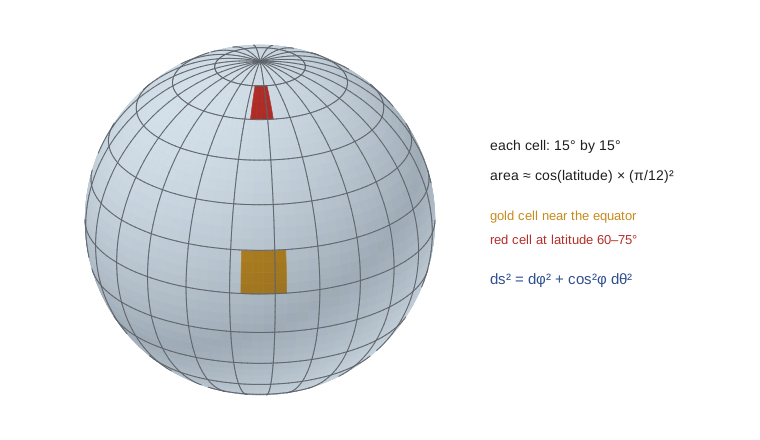
so \(E = 1\), \(F = 0\), \(G = \cos^2\varphi\), that is \(ds^2 = d\varphi^2 + \cos^2\varphi\,d\theta^2\). Moving one radian north always covers distance 1, but moving one radian east covers \(\cos\varphi\), which shrinks to zero at the poles: the parallels are circles of radius \(\cos\varphi\).
More generally a surface of revolution \(\mathbf{x}(u, v) = (f(v)\cos u, f(v)\sin u, g(v))\) has \(E = f^2\), \(F = 0\), \(G = f'^2 + g'^2\). If the profile curve is parametrized by arc length then \(G = 1\) and \(ds^2 = f(v)^2\,du^2 + dv^2\). Meridians and parallels always meet at right angles. For the torus with profile \((R + r\cos v, r\sin v)\), \(E = (R + r\cos v)^2\), \(F = 0\), \(G = r^2\). A graph \(z = f(x, y)\) has \(E = 1 + f_x^2\), \(F = f_xf_y\), \(G = 1 + f_y^2\), and \(EG - F^2 = 1 + f_x^2 + f_y^2\).
Lengths of curves
A curve on the surface given in coordinates as \(\alpha(t) = \mathbf{x}(u(t), v(t))\) has velocity \(\alpha' = u'\mathbf{x}_u + v'\mathbf{x}_v\), so its length is
with \(E, F, G\) evaluated at \((u(t), v(t))\). This is the formula the ant uses: it needs only the coordinates of its path and the three coefficients. On the unit sphere, the parallel at latitude \(\varphi_0\) has \(\varphi' = 0\), \(\theta' = 1\) and length \(\int_0^{2\pi}\cos\varphi_0\,dt = 2\pi\cos\varphi_0\). A meridian from the equator to the north pole has length \(\int_0^{\pi/2} 1\,d\varphi = \pi/2\).
Worked problem
A loxodrome on the sphere
A ship sails on a constant compass bearing, crossing every meridian at the angle \(\beta\) with \(0 < \beta < \pi/2\), from the equator toward the north pole. Find the length of its path.
Show solution
- Parametrize the path as \((\varphi(t), \theta(t))\) with \(\varphi\) increasing. The northward component of velocity is \(\varphi'\mathbf{x}_\varphi\), of length \(\varphi'\); the eastward component is \(\theta'\mathbf{x}_\theta\), of length \(\cos\varphi\,\theta'\).
- Crossing meridians at angle \(\beta\) means \(\tan\beta = \cos\varphi\,\theta'/\varphi'\), so the speed satisfies \(\sqrt{\varphi'^2 + \cos^2\varphi\,\theta'^2} = \varphi'/\cos\beta\).
- Using \(\varphi\) as parameter, the length is \(\int_0^{\pi/2} \frac{d\varphi}{\cos\beta} = \frac{\pi}{2\cos\beta}\).
- The longitude satisfies \(d\theta/d\varphi = \tan\beta/\cos\varphi\), whose integral \(\tan\beta\,\ln\tan(\frac{\pi}{4} + \frac{\varphi}{2})\) diverges as \(\varphi \to \pi/2\).
Answer: The loxodrome has finite length \(\frac{\pi}{2\cos\beta}\), yet winds around the pole infinitely many times. For \(\beta = 60^\circ\) it is exactly twice as long as the meridian. The same divergent integral reappears in Mercator's projection below.
Angles
Two curves on the surface crossing at \(p\) meet at the angle \(\vartheta\) between their velocity vectors, \(\cos\vartheta = \frac{w_1 \cdot w_2}{|w_1||w_2|}\), computed with the polarized first fundamental form. The coordinate curves themselves, with velocities \(\mathbf{x}_u\) and \(\mathbf{x}_v\), meet at the angle with \(\cos\vartheta = F/\sqrt{EG}\). So a parametrization is orthogonal, meaning its coordinate curves cross at right angles, exactly when \(F = 0\). Latitude-longitude coordinates, polar coordinates and all surfaces of revolution with meridian-parallel coordinates are orthogonal.
Area
The area of the parallelogram spanned by \(\mathbf{x}_u\,\Delta u\) and \(\mathbf{x}_v\,\Delta v\) is \(|\mathbf{x}_u \times \mathbf{x}_v|\,\Delta u\,\Delta v\), and Lagrange's identity from lesson 1 gives \(|\mathbf{x}_u \times \mathbf{x}_v|^2 = EG - F^2\). So for a region \(\Omega = \mathbf{x}(Q)\) inside one coordinate neighborhood we define
Theorem. The area does not depend on the parametrization.
Proof. Let \(\mathbf{y} = \mathbf{x} \circ h\) be another parametrization of \(\Omega\), with \(h(\bar u, \bar v) = (u, v)\) a diffeomorphism from \(\bar Q\) onto \(Q\). By the chain rule, \(\mathbf{y}_{\bar u} = \mathbf{x}_u\frac{\partial u}{\partial \bar u} + \mathbf{x}_v\frac{\partial v}{\partial \bar u}\) and \(\mathbf{y}_{\bar v} = \mathbf{x}_u\frac{\partial u}{\partial \bar v} + \mathbf{x}_v\frac{\partial v}{\partial \bar v}\). The cross product of two such combinations is \(\mathbf{y}_{\bar u} \times \mathbf{y}_{\bar v} = J\,\mathbf{x}_u \times \mathbf{x}_v\), where \(J\) is the Jacobian determinant of \(h\). By the change of variables theorem for double integrals,
The quantity \(dA = \sqrt{EG - F^2}\,du\,dv\) is the area element. For the unit sphere it is \(\cos\varphi\,d\varphi\,d\theta\), and the whole sphere (minus a meridian and the poles, which have zero area) has area \(\int_0^{2\pi}\int_{-\pi/2}^{\pi/2} \cos\varphi\,d\varphi\,d\theta = 4\pi\). For the torus \(dA = r(R + r\cos v)\,du\,dv\), and the total area is \(\int_0^{2\pi}\int_0^{2\pi} r(R + r\cos v)\,du\,dv = 4\pi^2 Rr\): the length \(2\pi R\) of the core circle times the circumference \(2\pi r\) of the tube, as Pappus's theorem predicts.
Archimedes discovered that the area of a band of a sphere between two parallel planes depends only on the distance between the planes. In our coordinates, the band between heights \(z_1 = \sin\varphi_1\) and \(z_2 = \sin\varphi_2\) has area \(\int_0^{2\pi}\int_{\varphi_1}^{\varphi_2}\cos\varphi\,d\varphi\,d\theta = 2\pi(z_2 - z_1)\), exactly the area of the corresponding band of the circumscribed cylinder. So the horizontal radial projection from the sphere to the cylinder, \((\varphi, \theta) \mapsto (\theta, \sin\varphi)\), preserves area. It is the basis of the Lambert cylindrical equal-area map projection, published in 1772.
Isometries and conformal maps
A diffeomorphism \(\phi : S \to \bar S\) between surfaces is an isometry if it preserves the first fundamental form, \(|d\phi_p(w)| = |w|\) for all tangent vectors \(w\). Then it preserves lengths of curves, angles between curves and areas of regions. It is a local isometry if every point has a neighborhood on which \(\phi\) restricts to an isometry onto its image. The criterion used in practice is the following.
Theorem. Suppose \(\mathbf{x} : U \to S\) and \(\bar{\mathbf{x}} : U \to \bar S\) are parametrizations on the same domain with \(E = \bar E\), \(F = \bar F\), \(G = \bar G\). Then \(\phi = \bar{\mathbf{x}} \circ \mathbf{x}^{-1}\) is an isometry from \(\mathbf{x}(U)\) onto \(\bar{\mathbf{x}}(U)\).
Proof. A tangent vector \(w = a\mathbf{x}_u + b\mathbf{x}_v\) is the velocity of the curve \(\mathbf{x}(q + t(a, b))\), which \(\phi\) maps to \(\bar{\mathbf{x}}(q + t(a, b))\), with velocity \(d\phi(w) = a\bar{\mathbf{x}}_u + b\bar{\mathbf{x}}_v\). Hence \(|d\phi(w)|^2 = \bar Ea^2 + 2\bar Fab + \bar Gb^2 = Ea^2 + 2Fab + Gb^2 = |w|^2\). \(\blacksquare\)
So the plane and the cylinder are locally isometric, via \((u, v) \mapsto (\cos u, \sin u, v)\), though not globally isometric, since one is simply connected and the other is not. A cone minus its tip is locally isometric to the plane too, as practice problem 3 of lesson 1 suggested. A diffeomorphism is conformal if it preserves angles, which happens exactly when it multiplies the first fundamental form by a positive function, \(|d\phi(w)|^2 = \lambda(p)|w|^2\). A parametrization is conformal, or isothermal, when \(E = G\) and \(F = 0\).
Gerardus Mercator's 1569 world map is a conformal parametrization of the sphere. Set \(y = \ln\tan(\frac{\pi}{4} + \frac{\varphi}{2})\), so that \(dy/d\varphi = 1/\cos\varphi\). In the coordinates \((\theta, y)\) the first fundamental form becomes \(\cos^2\varphi\,(d\theta^2 + dy^2)\), a multiple of the flat form. Angles on the map equal angles on the globe, which is why navigators liked it: a loxodrome is a straight line on a Mercator map. The price is the scale factor \(1/\cos\varphi\), which inflates Greenland to the apparent size of Africa although Africa is about fourteen times larger. By the Theorema Egregium no map can be both conformal and area-preserving: such a map would be an isometry onto a plane region, which the sphere does not have.
Computing metric quantities
The program computes the first fundamental form of the torus numerically and integrates it to get the total area, compares it with \(4\pi^2Rr\), integrates the length of a loxodrome and of a torus knot, and checks numerically that the Mercator coordinates are conformal and that the Lambert projection preserves area.
import math

def ff(X, u, v, h=1e-5):
    """First fundamental form E, F, G of a parametrization X at (u, v) by central differences."""
    xu = [(a - b) / (2*h) for a, b in zip(X(u + h, v), X(u - h, v))]
    xv = [(a - b) / (2*h) for a, b in zip(X(u, v + h), X(u, v - h))]
    dot = lambda p, q: sum(x*y for x, y in zip(p, q))
    return dot(xu, xu), dot(xu, xv), dot(xv, xv)

R, r = 2.0, 1.0
torus = lambda u, v: [(R + r*math.cos(v))*math.cos(u), (R + r*math.cos(v))*math.sin(u), r*math.sin(v)]
n = 60
area = 0.0
for i in range(n):
    for j in range(n):
        u, v = 2*math.pi*(i + 0.5)/n, 2*math.pi*(j + 0.5)/n
        E, F, G = ff(torus, u, v)
        area += math.sqrt(E*G - F*F) * (2*math.pi/n)**2
print(f"torus area (midpoint rule, {n}x{n}): {area:.8f}   4 pi^2 R r = {4*math.pi**2*R*r:.8f}")

def length(X, path, a, b, m=4000):
    """Length of t -> X(path(t)) using the first fundamental form."""
    L, h = 0.0, (b - a) / m
    for k in range(m):
        t = a + (k + 0.5)*h
        (u0, v0), (u1, v1) = path(t - 1e-6), path(t + 1e-6)
        du, dv = (u1 - u0)/2e-6, (v1 - v0)/2e-6
        u, v = path(t)
        E, F, G = ff(X, u, v)
        L += math.sqrt(E*du*du + 2*F*du*dv + G*dv*dv) * h
    return L

sphere = lambda phi, th: [math.cos(phi)*math.cos(th), math.cos(phi)*math.sin(th), math.sin(phi)]
beta = math.radians(60)
lox = lambda p: (p, math.tan(beta)*math.log(math.tan(math.pi/4 + p/2)))
Lx = length(sphere, lox, 0, math.pi/2 - 1e-4)
print(f"loxodrome at 60 degrees, equator to latitude 89.994: {Lx:.6f}   pi/(2 cos beta) = {math.pi/(2*math.cos(beta)):.6f}")
knot = lambda t: (2*t, 3*t)
print(f"(2,3) torus knot length: {length(torus, knot, 0, 2*math.pi):.6f}")

# Mercator: (theta, y) with phi = 2 atan(e^y) - pi/2 ; check E = G and F = 0
merc = lambda th, y: sphere(2*math.atan(math.exp(y)) - math.pi/2, th)
for y in (0.0, 1.0, 2.0):
    E, F, G = ff(merc, 0.3, y)
    phi = 2*math.atan(math.exp(y)) - math.pi/2
    print(f"Mercator y={y}: E={E:.6f} F={F:+.1e} G={G:.6f}  cos^2(lat)={math.cos(phi)**2:.6f}  latitude {math.degrees(phi):.2f} deg")
# Lambert: (theta, z) -> point at height z; area element should be 1
lam = lambda th, z: [math.sqrt(1 - z*z)*math.cos(th), math.sqrt(1 - z*z)*math.sin(th), z]
for z in (0.0, 0.5, 0.9):
    E, F, G = ff(lam, 1.0, z)
print(f"Lambert z={z}: sqrt(EG - F^2) = {math.sqrt(E*G - F*F):.8f}")torus area (midpoint rule, 60x60): 78.95683520 4 pi^2 R r = 78.95683521 loxodrome at 60 degrees, equator to latitude 89.994: 3.141393 pi/(2 cos beta) = 3.141593 (2,3) torus knot length: 31.898601 Mercator y=0.0: E=1.000000 F=+0.0e+00 G=1.000000 cos^2(lat)=1.000000 latitude 0.00 deg Mercator y=1.0: E=0.419974 F=+1.2e-12 G=0.419974 cos^2(lat)=0.419974 latitude 49.60 deg Mercator y=2.0: E=0.070651 F=+1.0e-14 G=0.070651 cos^2(lat)=0.070651 latitude 74.59 deg Lambert z=0.0: sqrt(EG - F^2) = 1.00000000 Lambert z=0.5: sqrt(EG - F^2) = 1.00000000 Lambert z=0.9: sqrt(EG - F^2) = 1.00000000
The midpoint rule gets the torus area to many digits because the integrand is smooth and periodic. The loxodrome length agrees with \(\pi/(2\cos\beta) = \pi\), up to the tiny piece near the pole that the integral omits. In Mercator coordinates \(E = G = \cos^2\varphi\) and \(F = 0\), confirming conformality, and the scale factor at \(y = 2\) corresponds to a latitude of about 74.6 degrees, where areas on the map are inflated by \(1/\cos^2\varphi \approx 14\). In Lambert's coordinates the area element is identically 1, so equal areas on the map are equal areas on the globe.
Common mistakes
MistakeTreating \(E, F, G\) as properties of the surface alone.
InsteadThey depend on the parametrization: the plane has \(E = G = 1\) in Cartesian coordinates and \(G = r^2\) in polar coordinates. Only the form itself is intrinsic.
MistakeComputing area as \(\iint (E + G)\,du\,dv\) or \(\iint \sqrt{EG}\,du\,dv\).
InsteadThe area element is \(\sqrt{EG - F^2}\,du\,dv\); the \(F^2\) term matters for non-orthogonal coordinates.
MistakeConcluding two surfaces are globally isometric because some patches have the same \(E, F, G\).
InsteadThat gives a local isometry; the plane and the cylinder are locally but not globally isometric.
MistakeAssuming a map projection can preserve both angles and areas.
InsteadA map that preserves both is an isometry, and the Theorema Egregium rules out an isometry between a piece of sphere and a piece of plane.
MistakeForgetting the factor \(\cos\varphi\) when measuring east-west distances on a sphere.
Instead\(ds^2 = d\varphi^2 + \cos^2\varphi\,d\theta^2\): one degree of longitude shrinks toward the poles.
Summary and key terms
- The first fundamental form is the dot product restricted to tangent planes: \(ds^2 = E\,du^2 + 2F\,du\,dv + G\,dv^2\).
- Lengths of curves on a surface are \(\int\sqrt{Eu'^2 + 2Fu'v' + Gv'^2}\,dt\); coordinate curves are orthogonal when \(F = 0\).
- The area element is \(\sqrt{EG - F^2}\,du\,dv\), independent of the parametrization; the torus has area \(4\pi^2Rr\).
- Surfaces of revolution have \(E = f^2\), \(F = 0\), \(G = f'^2 + g'^2\); the sphere has \(ds^2 = d\varphi^2 + \cos^2\varphi\,d\theta^2\).
- Patches with equal \(E, F, G\) define an isometry; the plane, cylinder and cone are locally isometric.
- Mercator coordinates are conformal and Lambert's are equal-area; no map of the sphere is both.
- first fundamental form
- The quadratic form giving squared lengths of tangent vectors to a surface.
- orthogonal parametrization
- A parametrization whose coordinate curves meet at right angles, so that F is zero.
- area element
- The expression square root of EG minus F squared, times du dv.
- isometry
- A diffeomorphism between surfaces preserving the first fundamental form.
- conformal map
- A map preserving angles, multiplying the first fundamental form by a positive function.
- loxodrome
- A curve on the sphere crossing all meridians at the same angle.
Practice problems
Work each problem on paper first, then reveal the answer to check.
Find \(E, F, G\) for the helicoid \(\mathbf{x}(u, v) = (v\cos u, v\sin u, u)\).
Show answer
\(\mathbf{x}_u = (-v\sin u, v\cos u, 1)\), \(\mathbf{x}_v = (\cos u, \sin u, 0)\), so \(E = 1 + v^2\), \(F = 0\), \(G = 1\).
Find the area of the part of the paraboloid \(z = x^2 + y^2\) with \(z \le 1\).
Show answer
\(EG - F^2 = 1 + 4x^2 + 4y^2\). In polar coordinates the area is \(\int_0^{2\pi}\int_0^1 \sqrt{1 + 4\rho^2}\,\rho\,d\rho\,d\theta = \frac{\pi}{6}(5\sqrt5 - 1) \approx 5.330\).
Find the angle between the coordinate curves of \(\mathbf{x}(u, v) = (u, v, uv)\) at \((1, 1)\).
Show answer
\(\mathbf{x}_u = (1, 0, v)\), \(\mathbf{x}_v = (0, 1, u)\); at \((1, 1)\), \(E = G = 2\), \(F = 1\), so \(\cos\vartheta = 1/2\) and \(\vartheta = 60^\circ\).
Show that the area of the polar cap above latitude \(\varphi_0\) on the unit sphere is \(2\pi(1 - \sin\varphi_0)\).
Show answer
\(\int_0^{2\pi}\int_{\varphi_0}^{\pi/2}\cos\varphi\,d\varphi\,d\theta = 2\pi(1 - \sin\varphi_0)\), the height of the cap times \(2\pi\), as Archimedes said.
Show that the cone \(\mathbf{x}(\rho, \theta) = (\rho\sin\gamma\cos\theta, \rho\sin\gamma\sin\theta, \rho\cos\gamma)\), \(\rho > 0\), is locally isometric to the plane.
Show answer
\(E = 1\), \(F = 0\), \(G = \rho^2\sin^2\gamma\). The plane in polar coordinates \((\rho, \psi)\) with \(\psi = \theta\sin\gamma\) has the same form, so the map \((\rho, \theta) \mapsto (\rho, \theta\sin\gamma)\) is a local isometry.
Stereographic coordinates on the unit sphere have \(E = G = \frac{4}{(1 + u^2 + v^2)^2}\), \(F = 0\). What does this say about stereographic projection?
Show answer
It is conformal: it preserves angles, though not lengths or areas.
Lesson quiz · 5 questions
Score 60% or more to complete this lesson.
Create a free account to save your progress, take quizzes and earn a certificate.