
LVT-320 · Lesson 8 of 12 · 20 min
Cellular coverage and distributed antenna systems
Patients and visitors at St. Brendan's judge the hospital partly by whether their phones work. Staff use phones too, for secure messaging and two-factor sign-in, and some clinical apps run on cellular. The east wing's thick walls and coated glass will block much of the outside cellular signal, so the owner has asked for a cellular DAS. Cellular is different from Wi-Fi in one fundamental way: the building owner does not own the spectrum or the network. Every design decision must be accepted by the carriers, and the installer's work will be inspected against carrier standards. This lesson covers how cellular networks reach buildings, the bands and technologies, the types of DAS and their signal sources, small cells, neutral-host arrangements, consumer and industrial signal boosters, private networks, and the carrier approval process.
How cellular networks work
A cellular network divides an area into cells, each served by a base station with antennas on a tower or rooftop. Phones connect to the base station with the best signal and hand over to neighboring cells as they move, under the network's control, unlike Wi-Fi, where the client decides. Each carrier operates its own network on its own licensed spectrum, and most use several bands at once: a low band, below 1 GHz, for wide coverage and building penetration; mid bands, from 1.7 to 2.7 GHz, for capacity; and newer upper mid bands around 3.5 GHz for 5G capacity. LTE, the fourth-generation technology, and 5G New Radio both use OFDM-based signals similar in principle to Wi-Fi's, with modulation and data rates that adapt to signal quality.
In the United States the national carriers hold spectrum in the 600, 700, 850, PCS (1900), AWS (1.7/2.1 GHz), 2.5 GHz and C-band (3.7 GHz) bands, among others; the FCC auctions and licenses the spectrum. FirstNet, the nationwide public safety broadband network, uses 700 MHz Band 14 and is built and operated by a carrier partner. Each carrier's holdings differ by market, so a DAS in Austin must carry the specific bands each carrier uses there.
Cellular measurements use their own terms. For LTE and 5G, reference signal received power, RSRP, measures the strength of the cell's reference signals in dBm; −100 dBm or better is usually considered good indoors, and carriers often design DAS coverage to −85 to −95 dBm. Signal-to-interference-plus-noise ratio, SINR, measures quality; values above 10 dB support good data rates. A phone's bars are a rough, maker-specific display of these values, never a measurement.
Why buildings need DAS
Outside signals weaken through building walls, as lessons 1 and 4 described, and the upper bands that carry most capacity weaken most. Even where outside signal reaches inside, a large building can hold thousands of phones, more than the outside cell can serve well, and phones deep inside a building must transmit at full power to reach the tower, draining batteries and raising interference. An in-building system solves all three problems: it brings strong signal inside, adds capacity dedicated to the building, and lets phones transmit at low power to nearby antennas.
Signal sources
A DAS distributes a signal; something must provide it. There are two main sources. An off-air source uses a donor antenna on the roof aimed at a carrier's cell site and a bi-directional amplifier, a carrier-grade repeater, to bring that signal into the DAS. It adds coverage but not capacity, because the building's phones still share the outside cell. A base station source puts carrier equipment, baseband and radio units, in the building, connected to the carrier's network by fiber, so the building has its own cells and capacity. Base station sources are used in large or busy venues: hospitals, stadiums, airports, large office towers. The carriers decide which source they will provide for a site, based on their own traffic and coverage needs.
Passive, active and hybrid DAS
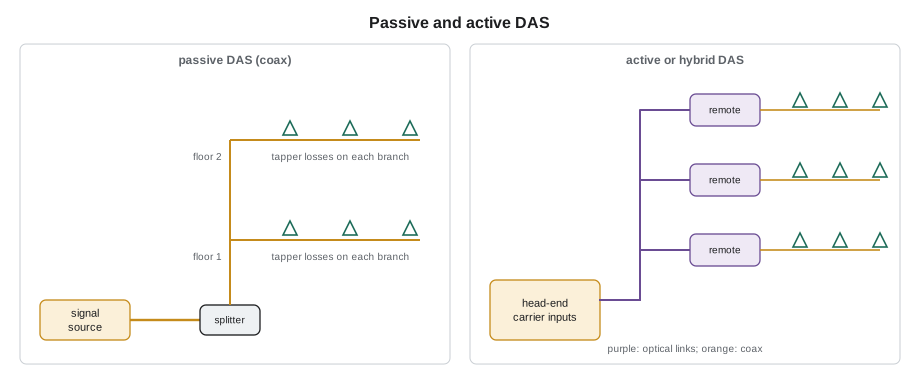
A passive DAS distributes signals from the head-end over coax, using splitters and directional couplers, also called tappers, to feed many antennas. It has no amplifiers in the distribution, so it is simple, reliable and wide-band, but coax losses limit its size: at higher frequencies, a long coax run loses most of the signal, so passive systems suit small to medium buildings.
An active DAS converts the signals to optical or digital form at the head-end and sends them over fiber to remote units throughout the building, which convert them back to radio and drive nearby antennas over short coax runs. Fiber has very low loss, so active systems can cover large buildings and campuses, and each remote can be monitored. A hybrid DAS combines the two: fiber to remotes on each floor or zone, then passive coax from each remote to several antennas. Most large buildings, including St. Brendan's east wing, use a hybrid design. Lesson 10 covers the installation of each part.
# Passive DAS branch: power at each antenna and its coverage at the design RSRP
import math
SOURCE_DBM = 30.0                 # composite at the head-end output for one band, 1900 MHz (illustrative)
COAX_LOSS = 0.034               # dB per ft at 1900 MHz, 1/2 in plenum coax (illustrative)
def fspl(d_m, f_mhz): return 20 * math.log10(d_m) + 20 * math.log10(f_mhz) - 27.55
branch = [  # element, coax length before it (ft), element loss dB, antenna gain dBi (0 if not an antenna)
    ("2-way splitter", 50, 3.5, 0), ("tapper 10 dB tap -> ANT-1", 65, 10.4, 3), ("through 0.5 dB", 0, 0.5, 0),
    ("tapper 7 dB tap -> ANT-2", 80, 7.2, 3), ("through 1.2 dB", 0, 1.2, 0), ("end antenna ANT-3", 100, 0, 3),
]
level = SOURCE_DBM
for name, run, loss, gain in branch:
    level -= run * COAX_LOSS
    if gain:
        eirp = level - loss + gain
        print(f"{name:30s} antenna input {level - loss:5.1f} dBm, EIRP {eirp:5.1f} dBm")
    else:
        level -= loss
print(f"{name:30s} level after {level:5.1f} dBm")2-way splitter level after 24.8 dBm tapper 10 dB tap -> ANT-1 antenna input 12.2 dBm, EIRP 15.2 dBm through 0.5 dB level after 22.1 dBm tapper 7 dB tap -> ANT-2 antenna input 12.2 dBm, EIRP 15.2 dBm through 1.2 dB level after 18.2 dBm end antenna ANT-3 antenna input 14.8 dBm, EIRP 17.8 dBm
The tappers are chosen so that each antenna gets about the same power: the first antenna, close to the source, gets a large tap value, and later antennas, after more coax, get smaller taps. Balancing the antenna powers is what makes the coverage even. A substituted tapper value, like the substituted splitter in lesson 3, unbalances the whole branch.
Small cells and neutral hosts
Small cells are compact base stations, sometimes looking much like Wi-Fi access points, mounted in ceilings and connected to the carrier over the building's network or fiber. They give coverage and capacity for one carrier in an area and are common in offices and retail. For multiple carriers, an owner might need several small cells per location, one per carrier, so in larger buildings a multi-carrier DAS is often more practical.
Who pays for and owns a DAS varies. Carriers sometimes fund systems in buildings they consider important; otherwise the owner pays. A neutral-host provider is a company that builds and operates a DAS shared by all carriers, under agreements with each. In every arrangement, the carriers retain control of their signals: they approve the design, specify equipment, set power levels and must accept the system before it goes on air. St. Brendan's east wing DAS is owner-funded, built by Cobalt Line under the hospital's contract, with carrier-provided base station equipment in a dedicated head-end room.
Signal boosters
Smaller buildings sometimes use signal boosters instead of a full DAS. These are certified repeaters with a donor antenna and one or a few indoor antennas. Consumer boosters for homes and small offices are sold to the public; their rules require the carrier's consent, which the regulators have simplified for consumer devices that meet strict technical limits, such as automatic gain control and shutdown if they oscillate. Industrial boosters, for larger buildings, have higher gain and stricter conditions.
In the United States, the FCC's rules for consumer signal boosters require certified devices that meet network-protection standards, registration with the carrier and the carrier's consent, which the major carriers have given generally for compliant consumer boosters. Industrial boosters require the licensee's express consent and must be operated by or with the agreement of a licensee.
An installer must never install a booster, even a certified one, without confirming the carrier's consent. An oscillating or overdriven booster can interfere with a whole cell site, and carriers can locate the source and require it to be shut down.
Private networks
Some large sites now run private LTE or 5G networks for their own devices, alongside Wi-Fi. In the United States, the Citizens Broadband Radio Service, CBRS, around 3.55 to 3.7 GHz, lets enterprises run private networks on lightly licensed or shared spectrum coordinated by spectrum access systems. They suit warehouses, ports and campuses; Hartwell's parent company is trialling one at another distribution center.
Carrier approval and acceptance
A carrier-connected DAS goes through each carrier's approval process. The designer submits a design package: floor plans with antenna locations, predicted RSRP and SINR heatmaps for each carrier's bands, equipment lists, a riser diagram, a link budget and the head-end layout. The carrier reviews it against its standards, which often specify minimum signal levels, maximum signal leaking outside the building (so the DAS does not interfere with the outside network), equipment models, PIM limits and test methods. After installation, the installer performs and documents tests, typically sweep tests of coax for return loss and distance to faults, PIM tests at set power levels, fiber tests, and a walk test of coverage for each carrier. The carrier then integrates its equipment, tests, and accepts the system.
Carrier standards are strict about workmanship. Connectors must be the specified type, cleaned, torqued to the maker's value with a torque wrench, and weatherproofed where exposed. Coax bends must respect the minimum bend radius. Every antenna, coax run and component is labeled to the as-built drawings. A DAS that fails PIM testing because of a single loose connector delays acceptance for every carrier.
Worked problem
Leakage outside the building
During the east wing DAS walk test, one carrier's engineer notes that the DAS signal is strong on the street outside the north entrance, about −75 dBm RSRP, and asks for it to be reduced. Why does the carrier care, and what can be done?
Show solution
- Phones on the street could connect to the DAS instead of the outside cell, then hand over badly as they walk away, causing dropped calls.
- The DAS signal can also interfere with the carrier's outside network on the same channels.
- The north entrance lobby antenna is a ceiling omni close to the glass doors.
- Options include replacing it with a directional antenna aimed into the building, moving it farther from the entrance, or reducing its tap value, then re-testing both inside coverage and outside leakage.
Answer: Carriers limit leakage to protect their outside network; antenna choice, placement and power control it.
Maintaining a DAS after acceptance
A DAS is not finished when the carriers accept it. Carriers add bands, change frequencies and retire old technologies, and each change can mean new head-end modules, new remote units or a retuned system. The building changes too: tenants build new walls, add shelving or install glass with metal coatings, and coverage that passed at acceptance fades in the areas they change. A good operations plan names who monitors the system's alarms, who has keys to the head-end room, how fast a failed remote unit must be replaced, and how often the coverage is walked again. Most active DAS equipment reports its own faults, such as a remote unit offline, a fiber link with high loss, a power supply on battery or an amplifier running hot, to a management system that the integrator or neutral host watches.
Frank tells Maya that the most common DAS failures he sees years after installation are not electronic at all. They are a ceiling contractor who moved an antenna to make room for a light fixture and left its coax kinked, a jumper unplugged in the head-end room during an unrelated job, a remote unit's breaker switched off by an electrician tracing a circuit, and a donor antenna knocked off its aim by a rooftop equipment crew. Each is found the same way: compare the system's alarms and a quick walk test with the acceptance records, and look first at whatever changed most recently. That is why the as-built drawings, test records and labels from the installation matter long after the crew has left the site.
Common mistakes
MistakeInstalling a signal booster without the carrier's consent.
InsteadConfirm consent for every booster; certification alone is not enough.
MistakeReading phone bars as a measurement.
InsteadMeasure RSRP and SINR with a scanner or test phone.
MistakeSubstituting tapper or splitter values.
InsteadInstall the specified values; they balance antenna power.
MistakeLeaving DAS coverage spilling outside the building.
InsteadControl leakage with antenna choice, placement and power.
MistakeHand-tightening DAS connectors.
InsteadClean and torque every connector to the maker's value; PIM tests will find loose ones.
Summary and key terms
- Carriers own their spectrum and networks and must approve any in-building system that carries their signals.
- Cellular uses low bands for coverage and mid and upper mid bands for capacity; RSRP and SINR measure strength and quality.
- DAS signal sources are off-air donor antennas with BDAs, or base station equipment in the building.
- Passive DAS uses coax with splitters and tappers; active and hybrid DAS use fiber to remote units.
- Small cells serve one carrier each; neutral hosts operate shared DAS under carrier agreements.
- Signal boosters need certification and the carrier's consent.
- Carriers accept a DAS after design review, sweep, PIM and coverage tests and their own integration.
- RSRP
- Reference signal received power: LTE and 5G signal strength in dBm.
- SINR
- Signal-to-interference-plus-noise ratio.
- Off-air source
- A DAS fed from a donor antenna and repeater that capture an outside cell.
- Base station source
- Carrier base station equipment installed in the building to feed a DAS.
- Tapper
- A directional coupler that sends a set fraction of signal to an antenna and passes the rest on.
- Neutral host
- A company that builds and operates a DAS shared by several carriers.
- Leakage
- DAS signal escaping outside the building.
Practice problems
Work each problem on paper first, then reveal the answer to check.
What does RSRP measure?
Show answer
The strength of LTE or 5G reference signals in dBm.
Which DAS source adds capacity to a building?
Show answer
A base station source.
Why does a hybrid DAS use fiber?
Show answer
Fiber has very low loss, so it can reach remote units throughout a large building.
What must be confirmed before installing a signal booster?
Show answer
The carrier's consent, and that the booster is certified.
Lesson quiz · 5 questions
Score 60% or more to complete this lesson.
Create a free account to save your progress, take quizzes and earn a certificate.