
LSAT-120 · Lesson 9 of 12 · 23 min
Inference questions
▶ Video coming soon A video version of this lesson is on the way.
Marcus was absent from the reading lab on Wednesday, November 11, the night before his LSAT, on Harriet's orders. 'Sleep, eat, and do not read a single passage,' she had told him. The rest of the group spent the evening on inference questions, which Harriet called the hardest of the core families and the one that rewards the habits from LSAT-112 most directly.
She started with a question about the defaults passage: "The author of the passage would be most likely to agree with which one of the following?" Dani chose an answer saying that automatic enrollment was good policy. Élodie chose an answer saying that the effect of defaults could not be explained by standard theory. Thomas and Ji-won chose an answer saying that the design of a choice can affect the decisions people make. Harriet asked each of them to point to the sentence that supported their answer.
Dani could not; the author never says the policy is good. Élodie pointed to "Standard economic theory has difficulty with this result," and Harriet noted that "has difficulty" is weaker than "cannot." Thomas and Ji-won pointed to the first paragraph's finding and the second paragraph's explanation, which together guarantee their answer without going further.
What inference questions ask
Inference questions ask what the passage supports without stating it outright. Their stems use words like "infer," "suggests," "implies," "most strongly supported," and "the author would most likely agree." Some ask about the author; others ask about a group in the passage ("the critics would most likely agree") or about a particular part ("it can be inferred from the third paragraph that").
The standard is the one you learned for most-strongly-supported questions in LSAT-112. The passage is treated as true, and the credited answer must be well supported by it. Usually that means the answer is a small step from what the passage says: a combination of two statements, a consequence that clearly follows, or a modest restatement of something implied.
Harriet put it in a sentence she had written on a card for the Sunday clinic: "The right answer to an inference question needs no help from me." If you find yourself adding an assumption to make an answer work, it is probably wrong.
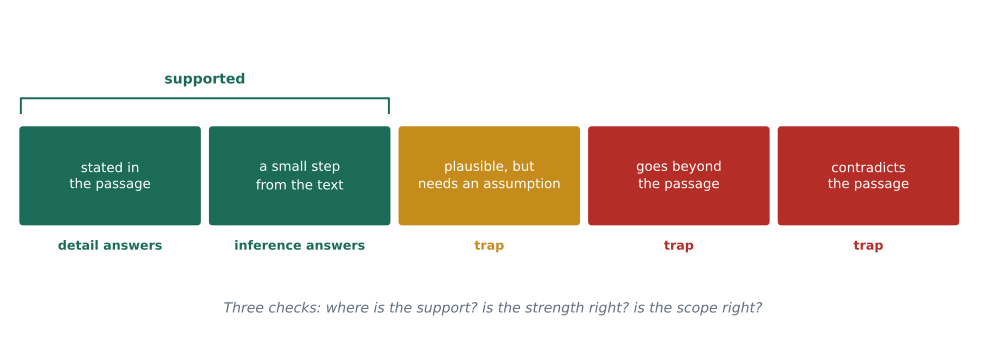
How inference differs from detail
A detail answer is stated in the passage, usually in one place. An inference answer is not stated but is supported. In practice, many credited inference answers are close paraphrases of a single sentence, with a small logical step: "Standard economic theory has difficulty with this result" supports "The finding was not what standard theory would have predicted." Others combine information from two places in the passage.
Because of this, the detail method still applies: locate the relevant part of the passage, reread it, and test each answer against it. The difference is in the final step. Instead of matching a paraphrase, you ask whether the passage guarantees the answer, or at least strongly supports it without extra assumptions.
Practice passage
Here is the defaults passage again, from lessons 3 and 6.
Passage B (social science): defaults and retirement saving (written for this course)
When employers began offering retirement savings plans to which workers could contribute part of their wages, economists expected participation to depend on the plans' terms: the higher the employer's matching contribution and the greater the tax advantage, the more workers would join. Yet studies of individual firms in the late 1990s revealed something the standard account could not easily explain. When a company changed nothing about its plan except the default, enrolling new employees automatically unless they chose to opt out rather than requiring them to opt in, participation among new hires rose dramatically, in some studies from well under half to more than four in five.
Standard economic theory has difficulty with this result. If a worker's decision to save reflects a careful weighing of present and future consumption, the effort required to tick a box on a form should be trivial by comparison, and the default should make little difference. That it makes a large difference suggests that many decisions are shaped by forces the theory had treated as negligible: inertia, procrastination, and a tendency to treat the default as an implicit recommendation from the employer.
These findings helped launch a policy movement. Advocates argued that if defaults influence behavior so strongly, policymakers and employers should choose defaults deliberately, steering people toward choices they would likely endorse on reflection while leaving them free to choose otherwise. Several countries have since built automatic enrollment into national pension policy, and many employers have adopted it voluntarily.
The approach has not escaped criticism. Some critics object on grounds of principle, arguing that designing choices to exploit predictable lapses in attention is manipulative even when the goal is benign. Others raise practical concerns. The same inertia that keeps workers in a plan may also keep them at the default contribution rate, which designers often set low to discourage opting out; a worker who would have chosen a higher rate under an opt-in system may end up saving less. Still others note that automatic enrollment raises participation most among workers least able to afford reduced take-home pay, for whom saving may not be the wisest use of scarce income.
Defenders reply that these objections argue for better defaults rather than none. Every plan must have some default; even requiring an active choice is a design decision. The question, then, is not whether to influence choices but how. A low default rate can be paired with automatic annual increases, and workers with pressing needs can opt out at any time. The deeper lesson of the research, on this view, is not that people are irrational but that context matters more than the older models assumed, and that those who design institutions bear responsibility for the contexts they create.
Wrong-answer patterns
Inference questions share traps with must-be-true and most-strongly-supported questions from Logical Reasoning, plus some that are specific to passages.
- Too strong. The passage says theory "has difficulty"; the answer says theory "cannot explain" or "has been abandoned."
- Plausible but unsupported. The answer is reasonable, and you might believe it, but the passage does not support it: "Workers in automatic plans are happier with their retirement savings."
- Wrong voice. The answer states a view of one group as the author's: "The author believes automatic enrollment is manipulative" (that is one group of critics' view).
- Reversal. The answer flips a relationship: "Automatic enrollment raises participation least among low-income workers."
- Scope shift. The answer moves from the passage's subject to a broader or different one: from retirement plans to "all financial decisions" or to "health insurance."
- Prediction or recommendation. The answer predicts the future ("will become universal") or recommends action ("governments should require") when the passage only reports.
Élodie said the scope shift was the one that caught her most. 'I read "defaults shape decisions" and I think, of course, everywhere,' she said. Harriet reminded her of the word she had added to her bilingual glossary in the Sunday clinic: "surinterprétation," over-reading. 'Inference questions are the place where that word earns its keep,' Harriet said.
Inferences about groups
When a question asks what a particular group would agree with, first find the group's sentences and read only those. Then test each answer against what that group is committed to. In Passage B, the critics "on grounds of principle" are committed to the view that designing choices to exploit lapses in attention is manipulative even when the goal is benign. They would therefore likely agree that a good purpose does not by itself justify a method of influencing choices. They are not committed to any view about contribution rates; that is a different group of critics.
This is the same discipline as the point-at-issue questions from LSAT-112: distinguish what a speaker is committed to from what the speaker merely might also believe. Ji-won said it reminded her of the two-yes test, and Harriet said that was exactly the right connection.
Inferences about the author
Questions about what the author would agree with are among the most common inference questions. In a passage like Passage B, where the author stays balanced, credited answers tend to be statements that the passage presents as fact rather than as one side's view: that defaults affected participation in the studies described, that the finding prompted policy changes, that there are criticisms of the approach. Answers that take a side in the debate are wrong for a balanced author, however reasonable they sound.
In a passage with a clear authorial view, such as Passage A, the credited answer will be consistent with the author's position at the author's level of certainty. "The author would agree that public registers have reduced the need for adverse possession in some places" fits. "The author would agree that adverse possession has no remaining justification" does not.
Testing an answer
Harriet gave the group three questions to ask of every inference answer:
- Where is the support? Point to a sentence or two in the passage.
- Is the strength right? Compare qualifiers: some, many, most, often, may, can, all, always, never.
- Is the scope right? Same subject, same group, same time, same kind of claim (fact, cause, value, prediction).
If an answer passes all three, it is very likely the credited answer. If it fails any, eliminate it.
Worked problem
Sample question (written for this course)
Question: "Which one of the following can most reasonably be inferred from Passage B?" (A) Automatic enrollment has been adopted by every country that offers retirement savings plans. (B) Standard economic theory has been abandoned by most economists. (C) Workers with low incomes should not save for retirement. (D) Under an opt-in system, some workers might choose a higher contribution rate than the default rate they would keep under automatic enrollment. (E) Employers set low default contribution rates in order to reduce their own costs.
Show solution
- Locate: contribution rates appear in the fourth paragraph: "a worker who would have chosen a higher rate under an opt-in system may end up saving less."
- (D) is correct. It restates the critics' practical concern at the same strength ("might," matching "may").
- (A) is too strong: the passage says "several countries."
- (B) is too strong and a scope shift: the passage says theory "has difficulty with this result," not that it has been abandoned.
- (C) turns a critic's observation ("saving may not be the wisest use of scarce income") into a recommendation the passage never makes.
- (E) gives a motive the passage does not state; it says designers set low rates "to discourage opting out."
Answer: (D). It needs no help: the support is one sentence, with matching strength and scope.
Worked problem
Sample question (written for this course)
Question: "The critics described in Passage B who object on grounds of principle would be most likely to agree with which one of the following?" (A) Automatic enrollment produces lower contribution rates than opt-in plans. (B) Automatic enrollment raises participation most among workers who can least afford to save. (C) The fact that a choice design has a good aim does not by itself make the design acceptable. (D) Defaults have little effect on workers' decisions. (E) Every retirement plan must have some default.
Show solution
- Locate: "Some critics object on grounds of principle, arguing that designing choices to exploit predictable lapses in attention is manipulative even when the goal is benign."
- (C) is correct: "manipulative even when the goal is benign" commits them to the view that a good aim does not justify the design.
- (A) and (B) are concerns of the other critics, the practical critics, a wrong-voice error.
- (D) contradicts the premise of their objection: they object because defaults are effective.
- (E) is the defenders' reply, not the critics' view.
Answer: (C). Read only the group's sentences, then ask what they are committed to.
The November 11 set
The four students present answered eight inference questions across Passages A to D. Ji-won answered all eight correctly. Thomas answered seven, missing a scope-shift answer on the heat island passage. Élodie answered six; she caught herself over-reading twice in blind review. Dani answered five, missing two wrong-voice answers and a too-strong answer, and said that she was going to start every inference question by asking whose view it was about. Marcus did the set the following week, after his test, and answered seven.
Common mistakes
MistakeChoosing a reasonable answer the passage does not support.
InsteadPoint to the sentence that supports the answer; if you need an extra assumption, eliminate it.
MistakeAccepting an answer stronger than the passage.
InsteadCompare qualifiers and verbs: "has difficulty" is not "cannot."
MistakeTreating a group's view as the author's.
InsteadIdentify whose view the question asks about, and test against only that voice.
MistakeMoving from the passage's subject to a broader one.
InsteadCheck that the answer keeps the same subject, group, time and kind of claim.
MistakeChoosing a recommendation or prediction from a passage that only reports.
InsteadMatch the kind of claim the passage makes.
Summary and key terms
- Inference questions ask what the passage supports without stating it; the credited answer is a small, well-supported step from the text.
- Use the detail method to locate support, then test whether the passage guarantees or strongly supports the answer.
- Ask three questions: where is the support, is the strength right, is the scope right?
- Traps include too strong, plausible but unsupported, wrong voice, reversal, scope shift and predictions or recommendations.
- For questions about a group, read only that group's sentences and test what they are committed to.
- A balanced author supports factual statements from the passage, not one side of the debate.
- Inference
- A conclusion supported by the passage but not stated in it.
- Scope shift
- A wrong answer that moves to a broader or different subject than the passage discusses.
- Commitment
- A view a speaker or group is logically bound to by what they say.
- Plausible but unsupported
- An answer that is reasonable in itself but not supported by the passage.
- Qualifier
- A word that sets the strength of a claim, such as some, most, may or always.
Practice problems
Work each problem on paper first, then reveal the answer to check.
Why is "Standard economic theory cannot explain the effect of defaults" too strong for Passage B?
Show answer
The passage says theory "has difficulty with this result," which is weaker than "cannot explain."
Would the author of Passage A agree that "public registers have reduced the need for adverse possession in some places"?
Show answer
Yes; the author reports the critics' reliance argument and the reforms without disputing them, and the hedge "in some places" matches the author's caution.
Name the three questions to ask of every inference answer.
Show answer
Where is the support? Is the strength right? Is the scope right?
Classify: "Automatic enrollment will soon be required everywhere" for Passage B.
Show answer
A prediction the passage does not support (also too strong).
Which group in Passage B would agree that "every plan must have some default"?
Show answer
The defenders, in the fifth paragraph.
Lesson quiz · 5 questions
Score 60% or more to complete this lesson.
Create a free account to save your progress, take quizzes and earn a certificate.