
LSAT-120 · Lesson 11 of 12 · 33 min
Working a full passage: strategy and timing
▶ Video coming soon A video version of this lesson is on the way.
The last regular reading lab, on Wednesday, November 18, was about putting everything together under the clock. Marcus was back, six days after his test and two weeks before his score release. He said he had decided not to think about his score until December 2, and that the best way to not think about it was to read about translation theory.
Harriet had planned the session around Élodie's goal from the first lab: finishing four sets without guessing. Élodie's practice sections still showed the same pattern. She understood the passages, answered the first three sets accurately, and then ran out of time on the fourth. 'Your problem is not reading,' Harriet told her. 'It is a pacing plan you have not yet built. Tonight everyone builds one.'
The process for one set
Harriet summarized the whole course as a process for working one set.
- Read actively, building a roadmap and marking viewpoints, the author's voice, turns, claims and the location of lists. Aim for about three to four minutes in the current format.
- Before reading the questions, say the main point and the author's position to yourself in a sentence each.
- Work the questions in order, identifying the family of each: main point, purpose, organization, detail, inference, function, meaning in context, or one of the families covered in LSAT-121.
- For big-picture questions, predict from your roadmap and answer quickly. For detail, inference and function questions, return to the passage: locate, read, predict and match.
- Flag any question you cannot settle in about a minute, choose your best answer, and move on. Return to flagged questions only if time remains.
Thomas said the process felt obvious written down. Harriet said that was the point: every step had been practiced separately, and the only new skill tonight was doing them in sequence without wasting time between them.
Should you read the questions first?
Some test takers read the question stems before the passage, hoping to know what to look for. Harriet explained why she did not recommend it for most students. Most sets include big-picture questions that require understanding the whole passage anyway, the stems often refer to parts of the passage that make sense only after reading, and holding five to eight stems in mind while reading divides attention. Some test takers do benefit from glancing at the first stem to confirm the passage's topic, and a few strong readers prefer to preview all stems. Her advice was to try both approaches on timed practice and keep whichever produces better accuracy at the same speed, rather than following a rule.
Ji-won tried previewing the stems on a practice set the previous week and found that it slowed her down. Dani found that glancing at the first stem helped her stay focused on the main point. Both kept their own habit.
Pacing in the current format
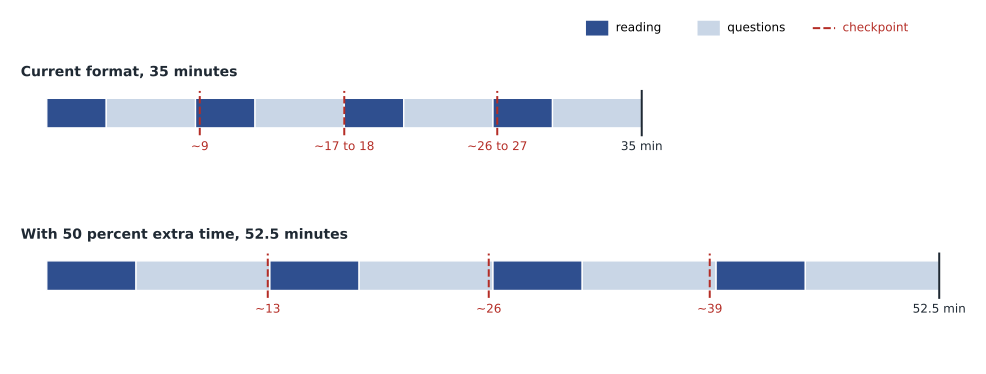
In the current format, the section lasts 35 minutes for four sets, an average of about 8 minutes 45 seconds per set. Harriet gave the group checkpoints rather than per-set limits, because passages vary in difficulty and length:
- After the first set: about 9 minutes.
- After the second set: about 17 to 18 minutes.
- After the third set: about 26 to 27 minutes.
A test taker behind a checkpoint should speed up on the questions, not on the reading, by flagging and moving on sooner. Cutting reading time usually backfires, because a poorly understood passage makes every question slower.
For Ji-won's 50 percent extra time, the checkpoints scale to about 13, 26 and 39 minutes in a 52.5-minute section.
Choosing the order of passages
In the digital test you can move between questions within a section, so you are not required to work the sets in the order presented. Some test takers start with the passage on the subject they find easiest, or leave a passage that looks especially dense for last. Harriet said this can help, but the time spent deciding must be small: glance at the first lines of each passage, choose, and start. Marcus planned to start with the science passage on every section and leave humanities for third, not last, so that a hard humanities passage would never be the one he guessed on. Élodie decided to work the sets in order, because deciding cost her more than it saved.
Guessing well
There is no penalty for wrong answers, so every question should be answered. If time runs short, the order of priorities is: answer every remaining question with a quick best guess, then use any remaining seconds on the questions you can answer fastest, usually detail questions with clear line references. A guess after eliminating two answers is worth much more than a blind guess, so a quick elimination is often the best use of the last minute.
The August 2027 format
From August 2027, Reading Comprehension will come first and last 52 minutes, with 40 questions of which 27 are scored and 13 are unscored questions embedded among them. LSAC's figures work out to about 78 seconds per question on average, compared with roughly 75 to 80 seconds in the current format. Because you cannot tell scored questions from unscored ones, the right approach is the same: treat every question as if it counts and build checkpoints for the new section length. LSAC has said it will release practice material for the new format in February 2027; anyone testing from August 2027 should build their checkpoints on that material.
A timed walkthrough
Harriet gave the group a new passage, about translation, and six questions, with nine minutes on the clock (thirteen and a half for Ji-won). Try it yourself under the same conditions before reading the explanations.
Passage G (humanities): two ways to translate (written for this course)
In an 1813 lecture, the German theologian Friedrich Schleiermacher argued that a translator has only two genuine choices: either leave the author in peace as much as possible and move the reader toward the author, or leave the reader in peace as much as possible and move the author toward the reader. Any attempt to mix the two methods, he warned, risks losing both writer and reader.
For much of the following two centuries, translators writing in English largely chose the second path. The prevailing standard held that a good translation reads as though it had been written in English: fluent, idiomatic and free of the oddities that betray a foreign origin. Reviewers praised translations as "transparent," and the translator's highest achievement was to become invisible.
In the 1990s the translation scholar Lawrence Venuti challenged this standard, adapting Schleiermacher's distinction into the terms "domesticating" and "foreignizing" translation. Fluency, Venuti argued, is not neutral. A translation that smooths away every unfamiliar turn of phrase assimilates the foreign text to the values of the receiving culture, flattering readers' expectations instead of challenging them. It also conceals the translator's labor, which in turn helps explain why translators have often been poorly paid and seldom credited. Venuti urged translators to resist fluency in selected ways, by preserving unusual syntax, retaining foreign terms or drawing on archaic or regional English, so that readers would remain aware that they were reading a translation and encountering a different culture.
Venuti's critique proved influential, but it has drawn objections of its own. Some critics argue that the foreignizing approach presumes readers who are both sophisticated and patient; for general readers, a translation that feels strange may simply be abandoned. Others note that "foreign" effects in English are themselves an English invention: archaic diction or awkward syntax may signal foreignness to an English reader without corresponding to anything in the original, so that the translation substitutes one kind of distortion for another. Still others point out that the dichotomy can obscure the countless small decisions, sentence by sentence, through which working translators balance competing goals.
These objections need not be read as a rejection of Venuti's central insight. Few scholars now accept that any translation can be transparent, and the recognition that every translation embodies choices about how much strangeness to keep has changed how translations are reviewed and taught. Rather than settling the question in favor of one method, the debate has made it harder for either translators or readers to pretend that no question exists.
Worked problem
Sample question (written for this course)
Question 1: "Which one of the following most accurately expresses the main point of the passage?" (A) Translations into English should preserve the unusual syntax of their originals. (B) Schleiermacher's distinction between two methods of translation was rejected by later scholars. (C) Translators have been poorly paid because their work is invisible. (D) A critique of fluent translation, though it has drawn reasonable objections, has made it difficult to regard any translation as transparent or free of choices. (E) Foreignizing translations are rarely read by the general public.
Show solution
- (D) is correct. It covers the old standard, Venuti's critique, the objections and the author's concluding judgment, at the author's level of certainty.
- (A) is Venuti's recommendation, not the author's main point (wrong voice, and too strong).
- (B) contradicts the passage: Venuti adapted Schleiermacher's distinction.
- (C) is too narrow: one consequence Venuti identifies in the third paragraph.
- (E) is too narrow and too strong: one group of critics says such translations "may" be abandoned by general readers.
Answer: (D). Predict from the last paragraph: the debate has made it harder to pretend no question exists.
Worked problem
Sample question (written for this course)
Question 2: "According to the passage, Venuti argued that fluent translation" (A) conceals the work of the translator. (B) is impossible to achieve in English. (C) should be abandoned in favor of word-for-word translation. (D) was first recommended by Schleiermacher. (E) is preferred by sophisticated readers.
Show solution
- Locate: the third paragraph. "It also conceals the translator's labor."
- (A) is correct.
- (B) is never stated; fluent translation was the prevailing standard.
- (C) overstates: Venuti urged resisting fluency "in selected ways," and word-for-word translation is never mentioned.
- (D) is wrong: Schleiermacher described two methods; the passage does not say he recommended fluency.
- (E) is unsupported; sophistication is mentioned only in a criticism of foreignizing.
Answer: (A). A detail question: locate, read, predict, match.
Worked problem
Sample question (written for this course)
Question 3: "The passage suggests that, in the period described in the second paragraph, a reviewer would most likely have praised a translation that" (A) retained many words from the original language. (B) used archaic English to signal its foreign origin. (C) read smoothly, as if it had been written in English. (D) included an essay by the translator explaining their choices. (E) closely reproduced the syntax of the original.
Show solution
- Locate: the second paragraph. "A good translation reads as though it had been written in English... Reviewers praised translations as 'transparent.'"
- (C) is correct: a small step from the stated standard.
- (A), (B) and (E) describe the foreignizing techniques Venuti later recommended, which the old standard opposed.
- (D) is never mentioned and conflicts with the ideal of the invisible translator.
Answer: (C). An inference that needs no help: the passage nearly states it.
Worked problem
Sample question (written for this course)
Question 4: "The author mentions archaic diction and awkward syntax in the fourth paragraph primarily in order to" (A) recommend techniques that translators should adopt. (B) describe the style of Schleiermacher's lecture. (C) show that general readers dislike difficult prose. (D) explain why translators are poorly paid. (E) illustrate how effects intended to signal foreignness may not correspond to anything in the original.
Show solution
- Find the part: the second group of critics. Find the point: "foreign" effects in English are themselves an English invention. Name the relationship: examples illustrating that claim.
- (E) is correct.
- (A) reverses the function: in this paragraph the techniques are criticized, not recommended.
- (B) and (D) tie the examples to unrelated parts of the passage.
- (C) belongs to the first group of critics, not this example.
Answer: (E). Function, not content: the examples serve the critics' point.
Worked problem
Sample question (written for this course)
Question 5: "Which one of the following most accurately describes the organization of the passage?" (A) A theory is proposed, tested and rejected. (B) A distinction is introduced; a standard based on one side of it is described; a challenge to that standard is presented; objections to the challenge are raised; and the author assesses the debate. (C) Two translation methods are compared and the author recommends one. (D) A historical lecture is summarized and its influence on publishing is traced. (E) A problem in translation is described and a single solution is proposed and defended.
Show solution
- Abstract roadmap: P1 distinction introduced; P2 prevailing standard (one side); P3 challenge; P4 objections to the challenge; P5 author's assessment.
- (B) matches move for move.
- (A) has wrong moves: nothing is tested or rejected.
- (C) is wrong on the last move: the author does not recommend a method.
- (D) omits Venuti, the objections and the assessment.
- (E) has a wrong move: Venuti's proposal is criticized, and the author does not defend a single solution.
Answer: (B). Check every move in order.
Worked problem
Sample question (written for this course)
Question 6: "The author's attitude toward Venuti's critique is best described as" (A) enthusiastic endorsement of all its recommendations (B) dismissive rejection of its central claim (C) appreciation of its central insight, combined with recognition of valid objections (D) indifference to the debate it provoked (E) confusion about what it claims
Show solution
- Author's voice: "These objections need not be read as a rejection of Venuti's central insight." "Few scholars now accept that any translation can be transparent."
- (C) is correct: the author treats the objections as reasonable but endorses the central insight.
- (A) is too strong: the author does not endorse every recommendation.
- (B) is the wrong direction.
- (D) and (E) do not fit an author who assesses the debate clearly.
Answer: (C). Moderate, qualified attitudes are the usual credited answer.
How the group did
Thomas finished in 7 minutes 40 seconds and answered all six correctly. Ji-won finished in 12 minutes 10 seconds (under her 13.5) with six correct. Marcus, working on a humanities passage first on purpose, took 8 minutes 50 and answered five; he chose the main point answer about poorly paid translators, a too-narrow answer, and said he had been drawn to it because it was the most concrete. Dani took 9 minutes 20 and answered five, missing the function question by choosing the critics' point from the first group. Élodie finished in 8 minutes 30 seconds with five correct, her fastest time on a full set, missing question 6 by choosing enthusiastic endorsement. 'I agree with Venuti,' she said, 'so I gave the author my opinion.' Harriet said that was a familiar trap and an easy one to fix now that she had named it.
Building your plan
Harriet ended the lab by asking each student to write a one-paragraph pacing plan for test day. Élodie's read: "Read every passage actively in about three and a half minutes. Checkpoints at 9, 18 and 27 minutes. If behind, flag sooner, never read faster. Last 90 seconds: answer every remaining question." Marcus added "science first, humanities third." Dani added "glance at the first stem." Ji-won wrote her scaled checkpoints. Thomas wrote one line: "Keep doing what works, a minute faster."
Common mistakes
MistakeSpeeding up the reading when behind schedule.
InsteadKeep reading actively; speed up on the questions by flagging and moving on sooner.
MistakeSpending a long time choosing the order of passages.
InsteadGlance, choose and start; if deciding costs time, work in order.
MistakeLeaving questions blank at the end of the section.
InsteadAnswer every question; eliminate quickly if you can before guessing.
MistakeAdopting a strategy (such as previewing questions) because someone else uses it.
InsteadTest it on timed practice and keep what improves your accuracy at the same speed.
MistakeUsing per-set time limits that ignore differences between passages.
InsteadUse checkpoints across the section.
Summary and key terms
- Work each set by reading actively, stating the main point and author's view, then answering in order with prediction or passage checks.
- Flag questions you cannot settle in about a minute and return only if time remains.
- Use checkpoints (about 9, 17 to 18 and 26 to 27 minutes in the current format), scaled for any accommodation.
- When behind, speed up on the questions, not the reading.
- Answer every question; there is no penalty for wrong answers.
- In the August 2027 format the section lasts 52 minutes for 40 questions; build checkpoints on LSAC's new-format practice material.
- Checkpoint
- A target time for reaching a point in the section, used to manage pacing.
- Flagging
- Marking a question to return to later after choosing a best answer.
- Pacing plan
- A written set of checkpoints and rules for managing time on a section.
- Previewing stems
- Reading the question stems before the passage; helpful for some test takers, not most.
- Elimination
- Ruling out wrong answers to improve the odds of a guess.
Practice problems
Work each problem on paper first, then reveal the answer to check.
In the current format, what are approximate checkpoints after one, two and three sets?
Show answer
About 9, 17 to 18, and 26 to 27 minutes.
If you are two minutes behind at the second checkpoint, what should you change?
Show answer
Flag and move on sooner on the questions; keep reading actively.
Why does Harriet not recommend previewing all question stems for most students?
Show answer
Big-picture questions need full understanding anyway, many stems make sense only after reading, and holding stems in mind divides attention.
What is the first priority when time is almost up?
Show answer
Answer every remaining question with a quick best guess.
In Passage G, why is "Translators have been poorly paid" a poor main point?
Show answer
It is too narrow: it is one consequence Venuti identifies in the third paragraph.
Lesson quiz · 5 questions
Score 60% or more to complete this lesson.
Create a free account to save your progress, take quizzes and earn a certificate.