
LSAT-120 · Lesson 10 of 12 · 23 min
Function and meaning-in-context questions
▶ Video coming soon A video version of this lesson is on the way.
In the second half of the November 11 lab, Harriet turned to two question families that ask about small pieces of a passage: function questions, which ask why the author included something, and meaning-in-context questions, which ask what a word or phrase means where it appears. She began with the word "ripens."
In the adverse possession passage, the occupant's possession "ripens into title." Harriet asked the group what "ripens" meant. Dani said it meant becomes ready to eat, then laughed. Thomas said it meant develops over time into something complete. Élodie said that in French legal writing the equivalent idea would be expressed differently, so she had stopped to think about it and decided it meant "turns into, after enough time." Ji-won said "matures," which Harriet said was close to the answer a test would credit.
'The dictionary meaning is almost never the point,' Harriet said. 'The question is what the word is doing in this sentence, in this passage. And the same is true of every function question: not what a sentence says, but why it is there.'
Function questions
Function questions ask about the role of a word, phrase, sentence, example or paragraph within the passage. Typical stems:
- "The author mentions absentee owners and corporations primarily in order to..."
- "The reference to the statute of limitations serves primarily to..."
- "Which one of the following most accurately describes the function of the last sentence of the third paragraph?"
The answers describe purposes: to illustrate a claim, to provide evidence, to introduce a view, to raise an objection, to qualify a conclusion, to contrast two positions, to concede a point, to explain a term. They resemble the role questions from LSAT-110, applied to a passage rather than an argument.
The method
Harriet's method has three steps.
- Find the part. Locate the word, phrase or sentence the question names, using your roadmap.
- Find the point it serves. Ask what claim or move the part supports. Usually that is the main claim of its paragraph, but sometimes it is a claim in the previous or next sentence.
- Name the relationship. Is the part an example of the point, evidence for it, a reason against it, a concession, a definition, a contrast? Predict the purpose before reading the answers.
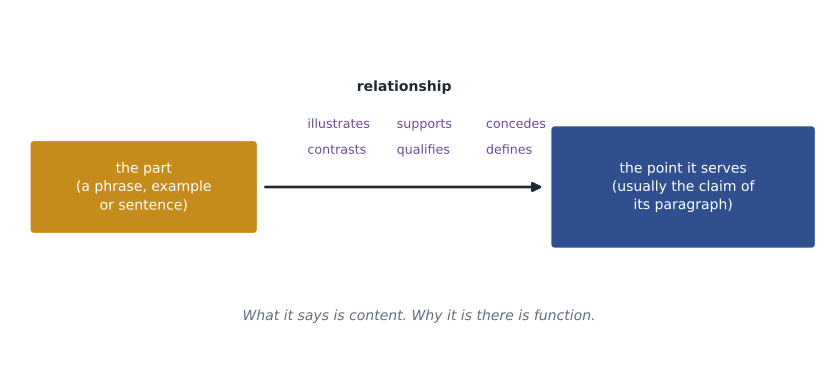
The most common mistake is to answer with what the part says rather than what it does. If a question asks why the author mentions absentee owners, an answer that summarizes absentee ownership ("absentee owners rarely inspect their land") states content. The function is to support the critics' claim that the neglect rationale fits poorly with modern conditions.
Practice passage
Here is Passage A again, from lessons 2 and 6. As you read, mark two or three phrases whose function you could describe.
Passage A (law): adverse possession (written for this course)
For centuries, the common law has allowed a person who occupies another's land openly and without permission for a long enough period to become its owner. The doctrine of adverse possession, as it is called, strikes many people on first encounter as a reward for trespass. Why, they ask, should the law transfer property from an owner who has done nothing wrong to an intruder who has?
Defenders of the doctrine usually begin with the statute of limitations. An owner who fails to bring an action to recover land within the period the law allows loses the right to do so, and the occupant's possession, once beyond challenge, ripens into title. On this view, adverse possession is less a reward for the possessor than a penalty for the owner's neglect: the law protects owners who watch over their land and declines to protect those who do not. The requirements that courts traditionally impose, namely possession that is actual, open, continuous, exclusive and hostile to the owner's claim, are designed to ensure that a reasonably attentive owner would have noticed the intrusion in time to act.
A second justification looks forward rather than backward. Land that has been used by one person for decades, the argument runs, should not be thrown into dispute by stale claims whose evidence has faded, whose witnesses have died and whose documents have been lost. Settling title in the long-term occupant protects not only that occupant but also the buyers, lenders and neighbors who have relied on the apparent state of affairs.
Critics respond that both justifications fit poorly with modern conditions. The neglect rationale assumed an owner who lived on or near the land and could easily observe it; today, land is often held by absentee owners, estates and corporations for whom constant inspection is impractical. And the reliance rationale has lost much of its force where governments maintain public registers of title. If a register accurately records who owns each parcel, a buyer need not rely on appearances at all; the register itself supplies the certainty that adverse possession was once needed to provide.
Partly for these reasons, several jurisdictions with registered title systems have restricted the doctrine. Some have abolished it for registered land altogether; others require a possessor to apply for registration and give the registered owner notice and an opportunity to object before the possessor's claim can succeed. These reforms preserve a role for long possession in resolving genuine boundary mistakes while removing the doctrine's capacity to surprise an owner who has relied on the register.
Whether such reforms represent the doctrine's future is not yet clear. Where registers are incomplete or inaccurate, the older rationales retain real force, and courts continue to treat long, open possession as strong evidence of where boundaries actually lie. What has changed is the burden of justification: once taken for granted, adverse possession must now explain why it is needed in a world of registered title.
Function examples from Passage A
Harriet walked through several parts of the passage.
- The question at the end of the first paragraph ("Why, they ask, should the law transfer property...") poses the issue the passage addresses. It also introduces a common objection, attributed to "many people," that the rest of the passage tests.
- The list of requirements in the second paragraph (actual, open, continuous, exclusive, hostile) supports the defenders' neglect rationale: the requirements ensure that an attentive owner would have noticed. Its function is to show how the law puts the rationale into practice.
- "stale claims whose evidence has faded, whose witnesses have died and whose documents have been lost" in the third paragraph illustrates the problem that the reliance justification solves.
- "absentee owners, estates and corporations" in the fourth paragraph provides examples supporting the critics' claim that constant inspection is impractical today.
- "Partly" in "Partly for these reasons" qualifies the causal link between the critics' arguments and the reforms: the arguments are one reason among others.
- "Where registers are incomplete or inaccurate" in the last paragraph limits the scope of the critics' argument and explains why the older rationales still have force in some places.
Marcus, reading the notes the following week, said the "partly" example was the one that had cost him a question on the diagnostic. Harriet said small qualifying words are a favorite target of function questions precisely because readers skim them.
Examples, concessions and contrasts
Three kinds of parts appear in function questions again and again.
- Examples. The credited answer almost always says the example illustrates or supports a more general claim, and names that claim correctly. A wrong answer may say the example is the main point, or tie it to the wrong claim.
- Concessions. A sentence beginning "Admittedly," "To be sure," or "It is true that" usually acknowledges a point on the other side before the author continues. The function is to concede, not to endorse. In Passage D, "The revisionist account has its own limits" concedes weaknesses in a view the author ultimately endorses.
- Contrasts. A detail introduced to contrast with something else ("much as a long-running television drama does today" in Passage D) functions as a comparison that clarifies the revisionists' view of serial novels.
Meaning-in-context questions
Meaning-in-context questions ask what a word or phrase means as it is used in the passage. Typical stems:
- "As used in the passage, the word 'ripens' most nearly means..."
- "The phrase 'burden of justification' in the last paragraph refers to..."
- "By 'a unit of composition with its own logic' the author most likely means..."
These questions are about context, not vocabulary. Test writers often choose words with several meanings and include the most common dictionary meaning as a wrong answer. Others ask about phrases whose meaning depends on what came before: "this judgment," "such responsiveness," "the older rationales."
The method: reread the sentence and the one before it, then substitute each answer for the word or phrase. The credited answer fits the sentence and preserves the author's meaning. For "ripens into title," substituting "matures into" works; "becomes edible as" obviously does not, and a subtler wrong answer such as "is converted immediately into" fails because ripening takes time.
Ji-won said she liked the substitution test because it turned a fuzzy question into a concrete check. Thomas said he had been choosing answers that matched his own understanding of a word rather than the author's use of it, which Harriet said was the reader's version of an outside-knowledge error.
Referring phrases
Some meaning-in-context questions ask what a pronoun or general phrase refers to: "this view," "such reforms," "these patterns." The answer is almost always in the sentence or two before. In Passage A, "such reforms" in the last paragraph refers to the restrictions on adverse possession in registered-title jurisdictions described in the fifth paragraph. "The older rationales" refers to the defenders' two justifications, the neglect rationale and the reliance rationale.
Dani said that at work she spent a lot of time figuring out what "the aforementioned" referred to in long immigration decisions. Harriet said the skill was identical, and that law school would ask it of her daily.
Worked problem
Sample question (written for this course)
Question: "The author of Passage A mentions 'absentee owners, estates and corporations' primarily in order to" (A) identify the groups that most often lose land through adverse possession. (B) support the claim that the assumption underlying the neglect rationale fits poorly with modern patterns of ownership. (C) suggest that such owners should be exempt from adverse possession. (D) illustrate the kinds of possessors who most often acquire title by adverse possession. (E) explain why public registers of title were first created.
Show solution
- Find the part: the fourth paragraph. Find the point: the critics' claim that the neglect rationale assumed an owner who could easily observe the land. Name the relationship: the examples support that claim.
- (B) is correct.
- (A) states something the passage never claims; the examples show who finds inspection impractical, not who loses land most often.
- (C) is a recommendation the passage never makes.
- (D) confuses owners with possessors.
- (E) connects the examples to registers, which belong to the critics' second argument, and the passage never explains why registers were created.
Answer: (B). Predict the function (support for the critics' first reply) before reading the choices.
Worked problem
Sample question (written for this course)
Question: "As used in the last paragraph of Passage A, the phrase 'burden of justification' refers to" (A) the requirement that possessors prove each element of adverse possession in court. (B) the costs that owners bear in inspecting their land. (C) the obligation of governments to maintain accurate registers. (D) the duty of buyers to rely on the register rather than on appearances. (E) the need for the doctrine to be defended with reasons rather than accepted without question.
Show solution
- Reread: "What has changed is the burden of justification: once taken for granted, adverse possession must now explain why it is needed in a world of registered title." The colon explains the phrase.
- (E) is correct: the doctrine, once taken for granted, must now be defended.
- (A) reads "burden" in its courtroom sense (burden of proof), which is not how the author uses it.
- (B), (C) and (D) borrow ideas from earlier paragraphs that the phrase does not refer to.
Answer: (E). The sentence itself defines the phrase; substitution confirms it.
The November 11 set, part two
Harriet ended the lab with six function and meaning-in-context questions. Ji-won and Thomas answered all six correctly, Élodie five and Dani five. Élodie's miss was a dictionary-meaning trap on the word "tags" in Passage D ("verbal tags"), which she chose as "labels attached to objects." Dani's was a content answer to a function question. Both said the substitution test and the "why, not what" question would have caught them.
Common mistakes
MistakeAnswering a function question with what the part says.
InsteadName why it is there: illustrate, support, concede, contrast, qualify or define, and name the point it serves.
MistakeChoosing the most common dictionary meaning of a word.
InsteadSubstitute each answer into the sentence and keep the author's meaning.
MistakeTying an example to the wrong claim.
InsteadFind the claim in the same paragraph, or the adjacent sentence, that the example serves.
MistakeTreating a concession as the author's endorsement.
InsteadConcessions acknowledge a point before the author continues in another direction.
MistakeLooking far afield for what a referring phrase means.
InsteadThe referent is almost always in the sentence or two before.
Summary and key terms
- Function questions ask why a part of a passage is there; meaning-in-context questions ask what a word or phrase means where it appears.
- For function: find the part, find the point it serves, name the relationship, and predict before reading the answers.
- Examples usually illustrate or support a more general claim; concessions acknowledge, not endorse; contrasts clarify.
- For meaning in context: reread the sentence and the one before, then substitute each answer.
- Dictionary meanings and courtroom senses of words are frequent traps.
- Referring phrases point to something in the sentence or two before.
- Function question
- A question about the role a word, phrase, sentence or paragraph plays in the passage.
- Meaning in context
- What a word or phrase means as the author uses it, which may differ from its usual meaning.
- Substitution test
- Replacing a word with each answer to see which preserves the author's meaning.
- Referring phrase
- A phrase such as "this view" or "such reforms" that points back to something earlier.
- Illustration
- An example that makes a general claim concrete.
Practice problems
Work each problem on paper first, then reveal the answer to check.
What is the function of "stale claims whose evidence has faded" in Passage A?
Show answer
It illustrates the problem that the reliance (certainty) justification addresses.
In Passage A, what does "such reforms" in the last paragraph refer to?
Show answer
The restrictions on adverse possession adopted by jurisdictions with registered title, described in the fifth paragraph.
Why is "burden of proof in court" a trap for "burden of justification"?
Show answer
It uses the courtroom sense of "burden"; the author means the need to justify the doctrine at all.
What is the function of "Partly" in "Partly for these reasons"?
Show answer
It qualifies the causal link, showing the critics' arguments were one reason among others for the reforms.
In Passage D, what is the function of the comparison to "a long-running television drama"?
Show answer
It clarifies the revisionist view of serial novels as developing in dialogue with their audience.
Lesson quiz · 5 questions
Score 60% or more to complete this lesson.
Create a free account to save your progress, take quizzes and earn a certificate.