
LSAT-120 · Lesson 1 of 12 · 19 min
How the Reading Comprehension section works
▶ Video coming soon A video version of this lesson is on the way.
On Wednesday evening, September 30, 2026, Harriet Nakamura-Fox opened a new series for the Thursday Circle: a Wednesday reading lab, separate from the Thursday sessions, devoted entirely to Reading Comprehension. She began by putting the group's diagnostic results from September 10 on the screen, but only the Reading Comprehension section. Out of 27 questions, Ji-won had answered 23 correctly under her accommodated timing, Thomas 22, Marcus 19, Élodie 18 and Dani 17.
The numbers told only part of the story, and Harriet asked each student to describe the section in one sentence. Thomas, the history graduate, said it felt "like a seminar reading list with a stopwatch." Élodie said she had understood every passage but had run out of time on the last one and guessed on five questions. Marcus, the civil engineer, said the science passage was the easiest twelve minutes of his week and the passage about art history was the hardest. Dani said she kept rereading paragraphs because she was afraid of missing something. Ji-won said she had finished, but only because she had skimmed the last passage, and that her correct answers there felt like luck.
'Every one of those sentences describes a habit, not a talent,' Harriet said. 'This course is about replacing the habits that cost you points with habits that earn them. Before we read anything, though, you need to know exactly what the section is, how it is built and what it asks you to do.'
What the section measures
The Law School Admission Council (LSAC), which writes the LSAT, describes Reading Comprehension as a test of the ability to read lengthy, complex material with understanding and insight, the kind of reading law students do every week. The passages are dense, use advanced vocabulary and often present sophisticated arguments or complex structures, such as several viewpoints in conversation with each other.
That description is worth taking literally. The section does not test how much you know about the subject of a passage, and it does not reward speed reading. It tests whether you can follow an author's reasoning through difficult prose, keep track of who believes what, and then answer precise questions about what the text says, implies and is doing. Law school asks the same of you: a judgment may run to forty pages, contain three dissenting opinions and turn on a single qualifying phrase.
Harriet's favorite line applies here more than anywhere else on the test: "The test rewards reading what is there, not what you expected to be there." Thomas laughed and said that as a history student he had spent four years being rewarded for reading what was not there. 'Interpretation is a fine skill,' Harriet said, 'but on this section it is a trap. Your job is to understand the author, not to improve on them.'
How the section is built
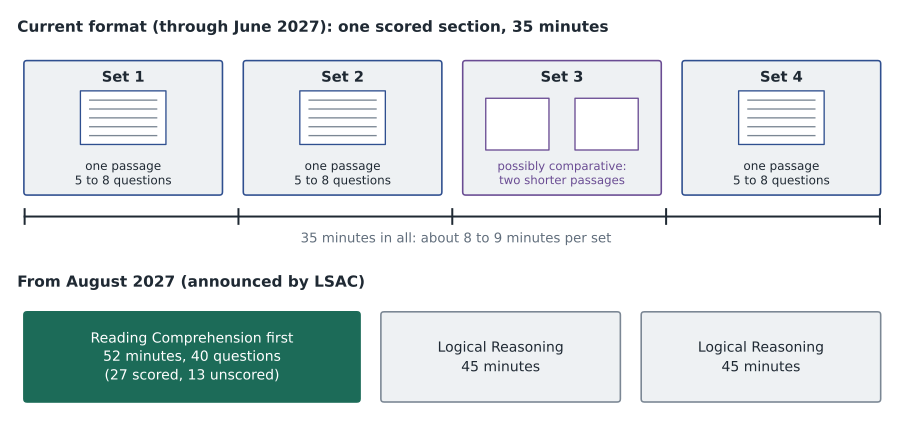
Reading Comprehension consists of four sets of questions. Each set begins with a reading selection, followed by five to eight questions about it. LSAC states that a selection is either a single passage or a pair of shorter related passages, which it calls comparative reading. A section contains three or four single passages and either one comparative set or none.
Passages are drawn from four broad areas: the humanities, the social sciences, the biological and physical sciences, and law-related fields. A typical single passage runs to roughly 450 to 500 words, usually in three to five paragraphs. Across the section there are typically 26 to 28 questions, though LSAC does not publish a fixed number for every form of the test.
Under the format in use through June 2027, the multiple-choice test has four 35-minute sections: two scored Logical Reasoning sections, one scored Reading Comprehension section and one unscored section that could be either type. You will not know which section is unscored, so you must treat every Reading Comprehension section as if it counts.
The August 2027 change
LSAC has announced that, starting with the August 2027 administration, the test will be organized differently. The multiple-choice portion will have three sections instead of four, and Reading Comprehension will come first. That section will last 52 minutes and contain 40 questions, of which 27 are scored and 13 are unscored questions embedded among them. The two Logical Reasoning sections will each last 45 minutes. LSAC has said that the new format tests the same skills with the same question types, and that the 120 to 180 score scale stays the same.
Members of the Thursday Circle who test in January, April or June 2027 will take the current format. A student who postpones to the fall of 2027 or later will take the new one. Harriet told the group that nothing in this course depends on which format you take: the reading method, the question types and the traps are identical. What changes is pacing, which the course returns to in lesson 11 and in LSAT-140.
The question types
LSAC lists the skills that Reading Comprehension questions test. Prep books give these question families names, but the names are conventions, not official labels, and different books group them slightly differently. The table below uses the families this course follows, with the lesson that covers each one.
| Question family | What it asks | Where it is covered |
|---|---|---|
| Main point | The central idea of the whole passage | Lesson 6 |
| Primary purpose | What the author is trying to do in the passage | Lesson 6 |
| Organization and structure | How the passage or a paragraph is put together | Lesson 7 |
| Detail (stated information) | What the passage explicitly says | Lesson 8 |
| Inference | What the passage supports without stating it | Lesson 9 |
| Function and meaning in context | Why a word, phrase or sentence is there, and what it means here | Lesson 10 |
| Author's attitude | The author's view, shown by tone and word choice | Lesson 5 (introduced) and LSAT-121 |
| Application, principle and analogy | Applying the passage to a new case, or finding a parallel situation | LSAT-121 |
| Effect of new information | Which new fact would strengthen, weaken or bear on a claim in the passage | LSAT-121 |
| Comparative reading | How two related passages relate to each other | LSAT-121 |
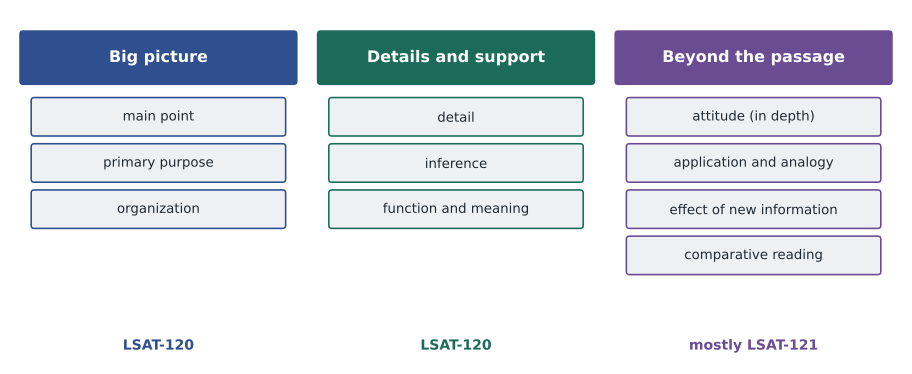
Several families have close cousins in Logical Reasoning. Inference questions in Reading Comprehension work much like the must-be-true and most-strongly-supported questions from LSAT-112. Function questions resemble the role questions from LSAT-110. Strengthen and weaken questions reappear as effect-of-new-information questions. The skills transfer, which is one reason Harriet sequenced the Logical Reasoning courses first.
The arithmetic of time
In the current format you have 35 minutes for four sets, or about 8 minutes and 45 seconds per set. A common plan divides each set into roughly three to four minutes of reading and about five minutes for the questions, which is about forty to fifty seconds per question. Some passages and questions take longer than others, so these figures are averages, not rules.
Ji-won worked out her own numbers on the spot. With 50 percent extra time, her section lasts 52.5 minutes, or a little over 13 minutes per set. 'So my reading budget is about five and a half minutes,' she said. 'I have been spending eight on the first passage and then panicking.'
Harriet pointed out the most important consequence of the arithmetic. Because every question in the set depends on the same passage, the reading time is an investment that pays off across five to eight questions. Spending an extra minute to understand a passage well can save more than a minute on the questions, because you stop rereading to find answers. Spending that minute rereading a sentence you already understood is pure loss. The goal is efficient understanding, not speed.
How much the section is worth
Reading Comprehension is one of three scored multiple-choice sections in the current format, so it contributes roughly a third of the questions that count toward your score. LSAC converts your raw score (the number of questions answered correctly, with no penalty for wrong answers) to the 120 to 180 scale. Because there is no penalty for guessing, you should answer every question, even if you run out of time.
Marcus asked whether it was worth studying Reading Comprehension at all, given that Logical Reasoning makes up twice as many scored questions. Harriet answered with his own numbers. His diagnostic showed eight wrong answers in Reading Comprehension, five of them on the humanities passage. 'If this course turns five of those eight into correct answers, that is worth about as much as five Logical Reasoning questions, and Reading Comprehension habits are often faster to fix,' she said. 'Also, the reading you do in your first year of law school will look a lot more like this section than like a Logical Reasoning question.'
What does not help
Three popular strategies do more harm than good.
- Speed reading. Skimming techniques that skip words or read only first sentences lose exactly the qualifiers, contrasts and attributions that the questions test. The fastest reliable readers on this section read every word once, actively.
- Outside knowledge. A passage about a topic you know well can be more dangerous than one you know nothing about, because you may answer from memory rather than from the text. Every answer must be supported by the passage. Marcus admitted that on his diagnostic he had answered a science question from what he knew about soil mechanics, and the passage had said something narrower.
- Memorizing the passage. You can return to the passage at any time, and you should, for most detail questions. What you need from your first reading is a map: what each paragraph does, who holds which view and where the author stands. Lessons 2 to 4 teach how to build that map.
How this course works
The course follows the order in which you meet the task. Lessons 2 to 5 cover reading: active reading, annotation, passage structure and the different voices in a passage. Lessons 6 to 10 cover the main question families, one or two per lesson. Lesson 11 puts the pieces together into a method for working a whole passage under time pressure. Lesson 12 is a timed capstone set of two full passages.
Every passage in the course was written for it. None comes from an LSAT, and none is a close version of a published article. They are written to resemble the length, density and structure of real Reading Comprehension passages, and they cover law, science, the social sciences and the humanities. Several passages return across lessons, so that you can practice different question types on a passage you already know.
Harriet ended the first lab by asking everyone to set a single measurable goal. Élodie's was to finish all four sets on her next practice section without guessing. Dani's was to read each paragraph once and only return to the passage when a question sent her there. Marcus's was to get the humanities passage to no more than two wrong answers. Thomas, whose reading was already strong, chose to cut his average time per set by a minute without losing accuracy. Ji-won's was to read the last passage as carefully as the first.
Reading on a screen
The test is taken on a computer, with the passage displayed beside the questions. Many students do most of their reading on paper or on phones, and reading dense prose on a screen for half an hour is a skill of its own. Practice with LSAC's official practice tests on LawHub, which use the same kind of interface, so that scrolling, highlighting and moving between questions feel automatic. Pay attention to when your focus drops: for many readers it happens in the third set, which is exactly where a pacing plan matters most.
Dani said she had done her first practice tests on a small laptop and found it tiring. Harriet suggested practicing on a screen of about the size she expected at the test center, and taking every timed section in one sitting, without pausing the timer, so that the practice conditions matched the real ones as closely as possible.
Common mistakes
MistakeTreating Reading Comprehension as a test of reading speed.
InsteadRead every word once, actively; efficient understanding saves more time on the questions than skimming saves on the passage.
MistakeAnswering from what you already know about the topic.
InsteadEvery answer must be supported by the passage itself, even when you know more than the author says.
MistakeTrying to memorize the passage before reading the questions.
InsteadBuild a map of what each paragraph does and who holds which view; return to the text for details.
MistakeLeaving questions blank when time runs out.
InsteadThere is no penalty for wrong answers, so answer every question.
MistakeAssuming the August 2027 format requires a different method.
InsteadLSAC says the new format tests the same skills with the same question types; mainly the pacing changes.
Summary and key terms
- Reading Comprehension has four sets, each with a passage or a pair of passages and five to eight questions; a section has three or four single passages and at most one comparative set.
- Passages come from the humanities, social sciences, sciences and law, and typically run to about 450 to 500 words.
- In the current format the section lasts 35 minutes, or about 8 minutes 45 seconds per set; from August 2027 it comes first and lasts 52 minutes for 40 questions, 27 of them scored.
- Question families include main point, purpose, organization, detail, inference, function, attitude, application, new information and comparative reading.
- Reading time is an investment shared by every question in the set; efficient understanding beats speed.
- Outside knowledge, speed reading and memorization all cost points.
- Set
- A reading selection (one passage or a comparative pair) and the five to eight questions about it.
- Comparative reading
- A set built on two shorter related passages, with questions about how they relate.
- Raw score
- The number of scored questions answered correctly, before conversion to the 120 to 180 scale.
- Question family
- A group of questions that test the same skill; names are prep conventions, not official LSAC labels.
- Reading budget
- The time you plan to spend reading a passage before turning to its questions.
Practice problems
Work each problem on paper first, then reveal the answer to check.
How many sets does a Reading Comprehension section contain, and how many questions does each set have?
Show answer
Four sets, each with five to eight questions.
In the current format, about how long do you have per set?
Show answer
About 8 minutes 45 seconds (35 minutes divided by four).
With 50 percent extra time, about how long per set would a test taker have in the current format?
Show answer
About 13 minutes (52.5 minutes divided by four).
Name three things that will change in August 2027 and one that will not.
Show answer
Changes: Reading Comprehension comes first; it lasts 52 minutes; it has 40 questions (27 scored, 13 unscored). Unchanged: the skills and question types (and the 120 to 180 scale).
Why can outside knowledge hurt you on this section?
Show answer
You may answer from memory instead of the text, choosing a statement that is true in the world but not supported by the passage.
Lesson quiz · 5 questions
Score 60% or more to complete this lesson.
Create a free account to save your progress, take quizzes and earn a certificate.