
LSAT-120 · Lesson 4 of 12 · 21 min
Passage structure
▶ Video coming soon A video version of this lesson is on the way.
At the third reading lab, on Wednesday, October 14, Harriet put two lists of paragraph notes side by side. They were the function notes the group had written for the defaults passage the week before. Thomas's list read: "surprise, theory fails, policy, critics, defenders." Dani's read: "default study, 401k stuff, countries adopted, problems, defenders say it's fine."
'Both of these are correct,' Harriet said, 'but only one of them tells you the shape of the passage at a glance. Thomas has written the passage's skeleton. Tonight we learn the skeletons that come up again and again, so that you can recognize them by the second paragraph.'
Why structure matters
Most Reading Comprehension passages are built from a small number of recurring structures. Recognizing the structure early has three benefits. It tells you what to expect next, which keeps you engaged and helps you read faster. It tells you where the author's view is likely to appear. And it answers several question families directly: organization questions ask about structure, primary purpose questions ask what the structure is for, and function questions ask about the role of a part within it.
Marcus compared it to recognizing a building type. 'If I know it's a truss bridge, I know where the loads go before I see the drawings,' he said. Harriet said that was exactly the point: once you know the type, the details have a place to go.
Six common structures
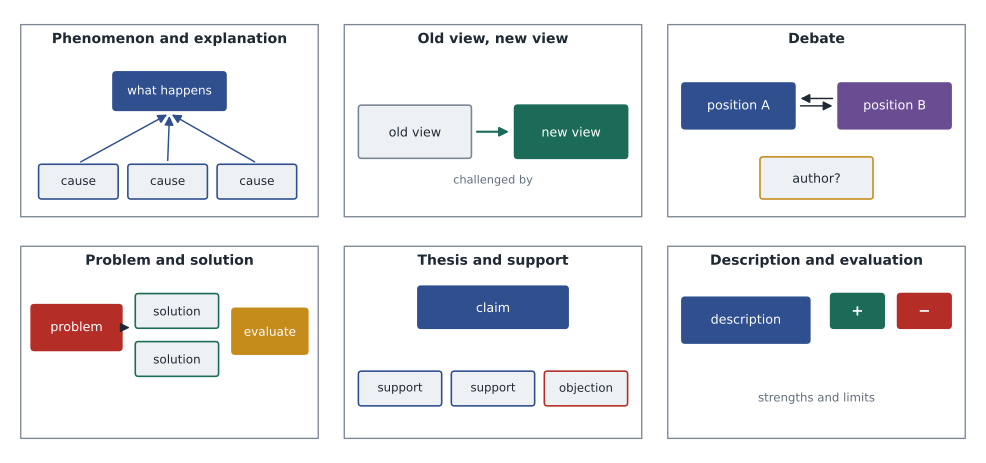
Harriet presented six structures that cover most passages. Many real passages combine two of them.
- Phenomenon and explanation. The passage describes something puzzling or interesting (a natural process, a historical event, a behavior) and then explains its causes. Science passages often use this shape.
- Old view, new view. The passage describes how something was traditionally understood, then presents a newer view that challenges it, often with the evidence that prompted the change. The author frequently sides with the new view but may qualify it.
- Debate. The passage presents two or more positions on a question, usually with their arguments, and may end with the author's assessment. Law and social science passages often take this shape.
- Problem and solution. The passage describes a problem, proposes or reports solutions, and often evaluates them.
- Thesis and support. The author states a claim early and spends the rest of the passage supporting it, sometimes acknowledging and answering an objection.
- Description and evaluation. The passage describes a work, a theory, a person's achievement or a practice, then evaluates its strengths and limits.
Recognizing the structure early
The first paragraph usually reveals the structure, or at least narrows the possibilities. Signals to watch for:
- "Traditionally," "long held," "for much of the twentieth century," "until recently": expect an old view followed by a new one.
- "Defenders argue," "critics contend," "proponents," "opponents": expect a debate.
- "Why does," "a puzzle," "one of the striking features of": expect a phenomenon and explanation.
- "The problem," "challenge," "strategies to address": expect a problem and solution.
- A strong claim in the author's voice in the first paragraph ("I will argue," "this view is mistaken"): expect thesis and support.
Dani asked what to do when the first paragraph gave no signal. Harriet said that happens with purely descriptive openings, and the second paragraph almost always settles it. 'Hold the question open for one paragraph,' she said. 'Do not force a skeleton onto a passage that has not shown you one yet.'
Roadmapping
A roadmap is the list of your function notes, one per paragraph, read together. It is a picture of the passage's structure in a few lines. Writing or holding a roadmap takes only seconds per paragraph and pays off in two ways. During reading, it forces you to classify each paragraph. During the questions, it lets you go straight to the right paragraph instead of scanning the whole passage.
Good roadmap entries are short (three to six words), describe what the paragraph does, and identify whose view it presents when that matters. Here is the roadmap for Passage A, from lesson 2:
- P1: doctrine looks like rewarding trespass (question posed)
- P2: defenders' justification one: neglect
- P3: defenders' justification two: certainty and reliance
- P4: critics answer both (modern conditions)
- P5: reforms in registered-title systems
- P6: author: future unclear; burden of justification shifted
Read together, the roadmap reveals a debate structure (defenders against critics) followed by real-world consequences and a measured judgment from the author.
Practice passage
Read Passage C below. Before reading the walkthrough, write a roadmap and decide which structure, or combination of structures, the passage uses.
Passage C (science): urban heat islands (written for this course)
Cities are often warmer than the countryside around them, a phenomenon known as the urban heat island. The difference is usually modest by day and greatest on calm, clear nights, when rural areas cool quickly while city centers release stored heat for hours after sunset. In large cities the night-time difference can reach several degrees Celsius.
The causes are well understood in outline. Asphalt, concrete and brick absorb more of the sun's energy than vegetation and soil do, and they store it, releasing it slowly as the air cools. Tall buildings trap some of the radiation reflected from streets and walls and block the winds that would otherwise carry warm air away. Cities also replace evaporating surfaces with impervious ones: where plants and moist soil would use part of the incoming energy to evaporate water, a process that cools the surface, pavement simply grows hotter. Finally, vehicles, air conditioners and industry release waste heat directly into the urban air.
For much of the twentieth century, the heat island was treated mainly as a curiosity or as a problem for climate scientists, who had to correct temperature records from weather stations that cities had grown up around. That view has changed. Researchers now emphasize the heat island's consequences for health, since extreme heat is among the deadliest weather hazards, and urban residents, especially older people, those living alone and those without air conditioning, bear much of the risk during heat waves. Higher temperatures also raise electricity demand for cooling, which can strain power grids at the moment they are most needed.
Not all parts of a city are equally affected. Neighborhoods with little tree cover and large paved areas are often markedly hotter than leafy districts a short distance away, and in many cities these hotter neighborhoods are also poorer. Some researchers have traced these patterns to past decisions about where to build highways, industry and dense housing, and where to plant parks.
Strategies to reduce urban heat target the same mechanisms that produce it. Reflective roofs and pavements absorb less energy; trees shade surfaces and cool the air through evaporation from their leaves; green roofs combine both effects. The benefits of such measures depend heavily on local conditions, however. A reflective roof that lowers indoor temperatures in summer may raise heating costs in a cold winter, and trees require water that may be scarce in dry climates. For this reason, many researchers caution against treating any single measure as a universal remedy, urging instead that cities measure temperatures block by block and match each intervention to the places and people most at risk.
Walking through the structure
Harriet asked each student for their roadmap, then built a shared version:
- P1: phenomenon defined (cities warmer, especially at night)
- P2: causes (four mechanisms)
- P3: old view (curiosity, data problem) vs. new view (health, energy)
- P4: unequal distribution within cities
- P5: solutions; caution: depends on local conditions
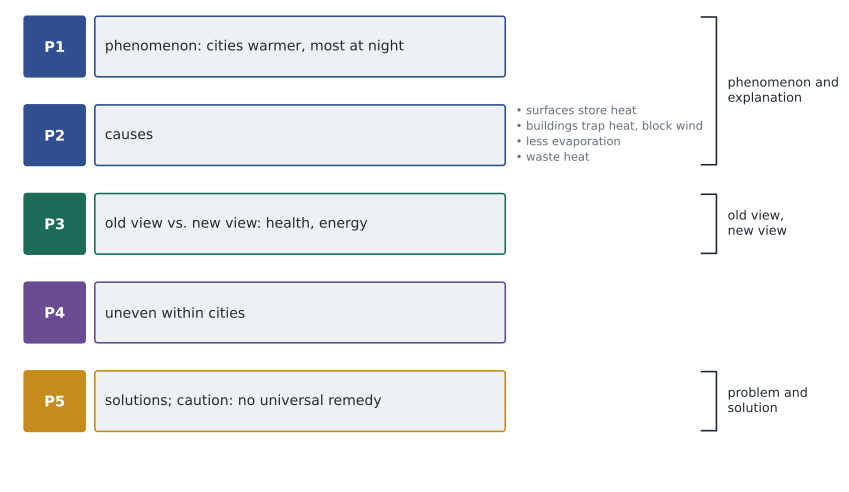
The passage combines structures. The first two paragraphs are a phenomenon and its explanation. The third paragraph is a small old-view, new-view unit ("For much of the twentieth century" against "That view has changed"). The last paragraph turns to solutions and evaluates them. The fourth paragraph extends the problem by showing that it falls unevenly.
Marcus noticed something about the last paragraph: the solutions "target the same mechanisms that produce it," so the fifth paragraph mirrors the second. Reflective surfaces answer absorption; trees answer lost evaporation and add shade. Harriet said that kind of internal echo is common and is exactly what organization questions like to test.
Where the author is
Élodie asked where the author's voice was in Passage C. The group found that most of the passage is explanatory and attributes newer concerns to "researchers." The author's own judgment is muted but present in the final paragraph, where "however" introduces a qualification and the passage closes by endorsing a cautious, local approach through the researchers it cites. A primary purpose answer for this passage would describe explaining a phenomenon and its significance and discussing responses to it, not arguing for a particular policy.
Thomas pointed out that the structure predicts this. Phenomenon-and-explanation passages are usually descriptive, while debate passages are more likely to end with an author's verdict. Harriet agreed, with a warning: the prediction is a tendency, not a rule, and the text always decides.
Structure and the question families
Harriet closed with a table that she said was the reason for the whole lesson.
| If you know... | You can answer... |
|---|---|
| The overall skeleton | Primary purpose and organization questions (lessons 6 and 7) |
| What each paragraph does | Function questions about a paragraph or sentence (lesson 10) |
| Where each viewpoint appears | Questions about what critics, defenders or researchers believe (lessons 5 and 8) |
| Where the author speaks | Main point and attitude questions (lessons 5 and 6) |
| Where each list or example is | Detail questions, quickly (lesson 8) |
Ji-won said that she now understood why her first-sentence highlighting had failed her: the first sentence of Passage C's third paragraph gives the old view, and the important sentence is the short one that follows it, "That view has changed." Harriet said that was one of the most useful observations anyone had made in the lab.
Worked problem
Sample question (written for this course)
Question: "Which one of the following most accurately describes the organization of Passage C?" (A) A theory is proposed, evidence against it is reviewed, and the theory is rejected. (B) Two competing explanations of a phenomenon are presented and the author argues for one of them. (C) A phenomenon is described and explained, a change in how it is regarded is noted, its uneven effects are discussed, and responses to it are evaluated. (D) A problem is described, a single solution is recommended, and objections to that solution are answered. (E) A historical development is traced and its causes are identified.
Show solution
- (C) is correct. It matches the roadmap: phenomenon and causes (P1 and P2), changed view (P3), uneven effects (P4), responses evaluated with a caution (P5).
- (A) is wrong: no theory is rejected; the causes are described as well understood.
- (B) is wrong: the passage presents several complementary causes, not competing explanations.
- (D) is wrong: several strategies are discussed, and the passage cautions against treating any single measure as a universal remedy.
- (E) is too narrow: only the third paragraph traces a change in how the phenomenon is regarded.
Answer: (C). Organization answers that list every major move, in order, are usually right; those that misdescribe even one move are wrong.
Practice: classify three openings
Harriet gave the group three opening sentences, each written for the course, and asked them to predict the structure of the passage that would follow.
- Opening 1: "For most of the twentieth century, historians described the medieval guilds chiefly as monopolies that stifled innovation; a growing body of research now presents a more complicated picture." Prediction: old view, new view. "For most of the twentieth century" and "now presents" set up a challenge, and "more complicated" suggests the author will favor the new view, perhaps with qualifications.
- Opening 2: "Why do some species of fish change sex during their lifetimes, while closely related species never do?" Prediction: phenomenon and explanation. The question signals a puzzle that the passage will try to explain, possibly by comparing competing hypotheses.
- Opening 3: "Proponents of mandatory arbitration clauses in consumer contracts argue that they lower costs for everyone; critics contend that they deprive consumers of meaningful remedies." Prediction: debate. Two named positions face each other; the passage may end with the author's assessment.
Marcus pointed out that the second opening could also become a debate if the passage presented two explanations and chose between them. Harriet agreed and said that was why the second paragraph matters: it confirms or revises the prediction. 'A prediction is a hypothesis,' she said. 'You are an engineer. You know what to do with a hypothesis.'
Thomas added that the first opening's phrase "a more complicated picture" was itself an authorial signal. Harriet said that was exactly the kind of quiet evaluative wording lesson 5 would train the group to hear.
Common mistakes
MistakeWriting roadmap entries that summarize facts.
InsteadDescribe what each paragraph does and whose view it presents.
MistakeForcing a structure onto the passage after one sentence.
InsteadUse the first paragraph's signals, and let the second paragraph confirm or revise your guess.
MistakeAssuming the first sentence of each paragraph is the important one.
InsteadTurns often come in the second or third sentence ("That view has changed").
MistakeTreating every passage as a single skeleton.
InsteadMany passages combine structures; note each unit.
MistakeUsing a structural tendency as a rule.
InsteadDescriptive passages usually lack a strong verdict, but the text always decides.
Summary and key terms
- Most passages use one or more of six structures: phenomenon and explanation, old view and new view, debate, problem and solution, thesis and support, and description and evaluation.
- Signals in the first paragraph often reveal the structure; the second paragraph usually confirms it.
- A roadmap is a list of short function notes, one per paragraph, that shows the passage's shape.
- Knowing the structure answers organization and purpose questions and speeds up detail and function questions.
- Structure predicts where the author's view is likely to appear, but the text decides.
- Structure
- The way a passage's paragraphs are arranged to serve its purpose.
- Roadmap
- A short list of what each paragraph does.
- Old view, new view
- A structure that presents a traditional understanding and then a challenge to it.
- Phenomenon and explanation
- A structure that describes something and then explains its causes.
- Debate structure
- A structure that presents competing positions, sometimes with the author's assessment.
Practice problems
Work each problem on paper first, then reveal the answer to check.
Which structure does the phrase "For much of the twentieth century" usually signal?
Show answer
Old view, new view.
Write a roadmap entry for the fourth paragraph of Passage C.
Show answer
Unequal effects within cities. (Any close function note.)
Which two structures does Passage A combine?
Show answer
Debate (defenders against critics) followed by consequences and an author's assessment; arguably also old view, new view in the shifted burden.
In Passage C, which paragraph mirrors the second paragraph, and how?
Show answer
The fifth: its solutions target the same mechanisms (absorption, lost evaporation, shade) that the second paragraph lists as causes.
Why is Ji-won's first-sentence method unreliable for Passage C's third paragraph?
Show answer
The first sentence gives the old view; the key turn comes in the next sentence, "That view has changed."
Lesson quiz · 5 questions
Score 60% or more to complete this lesson.
Create a free account to save your progress, take quizzes and earn a certificate.