
LSAT-120 · Lesson 8 of 12 · 25 min
Detail questions
▶ Video coming soon A video version of this lesson is on the way.
The lab on Wednesday, November 4 was about detail questions, and Harriet opened with a confession from Marcus. On a recent practice section, he had answered a question about a geology passage from his own knowledge of soil compaction. His answer was true about soil. It was not what the passage said.
'Detail questions look like the easiest questions on the section,' Harriet said, 'and they are, if you go back to the passage. Most errors on them come from answering from memory: your memory of the passage, or your memory of the world. Tonight we learn to go back efficiently, every time.'
What detail questions ask
Detail questions, sometimes called stated-information questions, ask about something the passage says explicitly. Their stems usually include phrases like "according to the passage," "the passage states," "the author mentions," or "the passage indicates." Some variations:
- Direct: "According to the passage, which one of the following contributes to the urban heat island?"
- About a viewpoint: "According to the passage, researchers now emphasize which one of the following?"
- EXCEPT: "The passage mentions each of the following as a cause of the heat island EXCEPT:"
- Answerable question: "The passage provides information that answers which one of the following questions?"
Because the answer is stated, there is no reason to guess. The passage contains proof for the credited answer, usually in one or two sentences.
The method: locate, read, predict, match
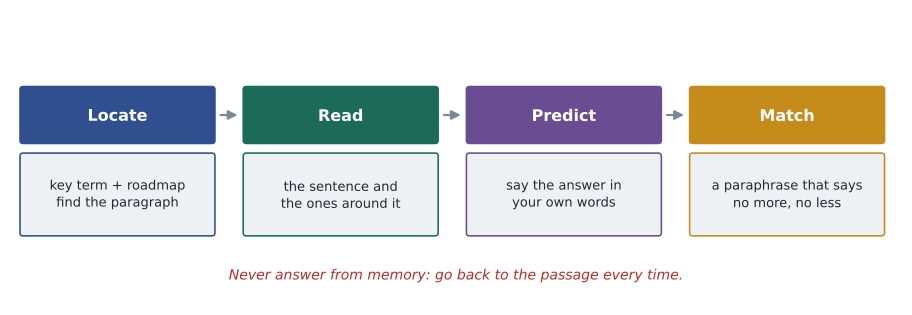
- Locate. Identify the key term in the stem (waste heat, researchers, reflective roofs) and use your roadmap to go to the right paragraph. With a good roadmap this takes a few seconds.
- Read. Reread the relevant sentence and the sentences immediately before and after it. Context matters: a detail may be qualified in the next sentence.
- Predict. Put the answer in your own words before reading the choices.
- Match. Choose the answer that paraphrases your prediction. The credited answer usually does not repeat the passage word for word; it restates it. Check that it says no more and no less than the passage.
Dani asked whether going back to the passage for every detail question would take too long. Harriet said that with a roadmap, locating takes five to ten seconds, and rereading two or three sentences takes another fifteen. 'Thirty seconds of checking beats forty seconds of agonizing between two answers you half remember,' she said.
Practice passage
Here is the urban heat island passage from lesson 4. If you built a roadmap then, use it now.
Passage C (science): urban heat islands (written for this course)
Cities are often warmer than the countryside around them, a phenomenon known as the urban heat island. The difference is usually modest by day and greatest on calm, clear nights, when rural areas cool quickly while city centers release stored heat for hours after sunset. In large cities the night-time difference can reach several degrees Celsius.
The causes are well understood in outline. Asphalt, concrete and brick absorb more of the sun's energy than vegetation and soil do, and they store it, releasing it slowly as the air cools. Tall buildings trap some of the radiation reflected from streets and walls and block the winds that would otherwise carry warm air away. Cities also replace evaporating surfaces with impervious ones: where plants and moist soil would use part of the incoming energy to evaporate water, a process that cools the surface, pavement simply grows hotter. Finally, vehicles, air conditioners and industry release waste heat directly into the urban air.
For much of the twentieth century, the heat island was treated mainly as a curiosity or as a problem for climate scientists, who had to correct temperature records from weather stations that cities had grown up around. That view has changed. Researchers now emphasize the heat island's consequences for health, since extreme heat is among the deadliest weather hazards, and urban residents, especially older people, those living alone and those without air conditioning, bear much of the risk during heat waves. Higher temperatures also raise electricity demand for cooling, which can strain power grids at the moment they are most needed.
Not all parts of a city are equally affected. Neighborhoods with little tree cover and large paved areas are often markedly hotter than leafy districts a short distance away, and in many cities these hotter neighborhoods are also poorer. Some researchers have traced these patterns to past decisions about where to build highways, industry and dense housing, and where to plant parks.
Strategies to reduce urban heat target the same mechanisms that produce it. Reflective roofs and pavements absorb less energy; trees shade surfaces and cool the air through evaporation from their leaves; green roofs combine both effects. The benefits of such measures depend heavily on local conditions, however. A reflective roof that lowers indoor temperatures in summer may raise heating costs in a cold winter, and trees require water that may be scarce in dry climates. For this reason, many researchers caution against treating any single measure as a universal remedy, urging instead that cities measure temperatures block by block and match each intervention to the places and people most at risk.
Wrong-answer patterns
Detail questions have their own family of traps.
- True but elsewhere. The answer accurately states something from a different part of the passage, not the part the question asks about. If the question asks what researchers now emphasize, an accurate statement about the causes of the heat island is wrong.
- Distorted detail. The answer uses the passage's words but changes the relationship: "pavement absorbs less energy than vegetation" reverses the passage's comparison.
- Half right. The answer starts accurately and then adds something unsupported: "Trees cool the air through evaporation and are the most effective strategy in every climate."
- Extreme wording. The passage says hotter neighborhoods are "in many cities" also poorer; an answer saying "in all cities" overstates it.
- Outside knowledge. The answer is true in the world but not stated in the passage. Marcus's soil answer was this kind.
- Right words, wrong voice. The answer states something the passage attributes to one group as though it were established fact or the author's view.
| Pattern | Example for Passage C | Why it fails |
|---|---|---|
| True but elsewhere | Asphalt stores heat (answering a question about health effects) | Accurate, but not about what the question asks |
| Distorted | Night-time differences are smaller than daytime differences | The passage says the difference is greatest at night |
| Half right | Reflective roofs lower summer temperatures and reduce heating costs in winter | The passage says they may raise winter heating costs |
| Extreme | Hotter neighborhoods are always poorer | The passage says "in many cities" |
| Outside knowledge | Heat islands increase ground-level ozone | May be true, but the passage does not say it |
Paraphrase, not echo
Credited answers usually paraphrase. Wrong answers often echo the passage's exact words, attached to the wrong idea. Harriet called these "echo traps." On a question about why the heat island was once considered mainly a data problem, an echo trap might say "because vehicles and air conditioners release waste heat," using real phrases from the passage that have nothing to do with the data problem. The credited answer would say something like "because cities grew up around weather stations, affecting their temperature records," which paraphrases the third paragraph.
Thomas said he had a habit of choosing answers that sounded like the passage, which worked well on main point questions and badly on detail questions. Harriet said echo traps are aimed precisely at readers who match words instead of meaning.
EXCEPT and answerable-question variations
EXCEPT detail questions list four things the passage mentions and one it does not. The efficient approach is to go through the choices and confirm each in the passage, rather than trying to recall them. With a location marker on the list of causes in the second paragraph, an EXCEPT question about causes takes very little time: check each choice against the list.
Answerable-question variations ask which question the passage answers. Four choices are questions the passage does not answer, often because they ask for more precision ("By how many degrees...") or for information on a related topic the passage does not cover. The credited choice is a question whose answer is stated. For Passage C, "What is one reason the heat island effect is often greatest at night?" is answerable: rural areas cool quickly while city surfaces release stored heat. "Which city has the strongest heat island?" is not.
Ji-won said the answerable-question form was her favorite, because it was so clear-cut once she went back to the passage. Élodie said it was her least favorite, because she tended to choose questions the passage "almost" answered. Harriet's advice was to say the answer aloud: if you cannot say it from the text, the passage does not answer the question.
Worked problem
Sample question (written for this course)
Question: "According to Passage C, which one of the following is a reason that some strategies for reducing urban heat may not suit every city?" (A) Reflective surfaces absorb more energy than conventional surfaces. (B) Green roofs have not been tested in large cities. (C) Weather stations in cities record inaccurate temperatures. (D) Poorer neighborhoods have more trees than wealthier ones. (E) Trees require water that may be scarce in dry climates.
Show solution
- Locate: strategies are in the fifth paragraph. Read: "The benefits of such measures depend heavily on local conditions... trees require water that may be scarce in dry climates." Predict: local limits such as winter heating costs or water scarcity.
- (E) is correct: it paraphrases the passage's example.
- (A) reverses the passage: reflective surfaces absorb less energy.
- (B) is not stated anywhere in the passage.
- (C) echoes the third paragraph's point about temperature records, which has nothing to do with strategies.
- (D) reverses the fourth paragraph, which links little tree cover with hotter, often poorer neighborhoods.
Answer: (E). Locate, read, predict, match: the answer was in one sentence of the fifth paragraph.
Worked problem
Sample question (written for this course)
Question: "Passage C mentions each of the following as contributing to the urban heat island EXCEPT:" (A) the storage of heat by building materials (B) the reflection of sunlight by light-colored pavements (C) the blocking of winds by tall buildings (D) the replacement of evaporating surfaces with impervious ones (E) the release of waste heat by vehicles and industry
Show solution
- Locate: the causes are listed in the second paragraph.
- (A), (C), (D) and (E) are each stated there: storage of heat by asphalt, concrete and brick; tall buildings blocking winds; impervious surfaces replacing evaporating ones; waste heat from vehicles, air conditioners and industry.
- (B) is correct: reflective pavements appear in the fifth paragraph as a strategy to reduce heat, not as a cause of it.
Answer: (B). On EXCEPT questions, confirm each choice in the passage rather than relying on memory.
The November 4 set
The session ended with eight detail questions across Passages A to D. Thomas and Ji-won answered all eight correctly. Marcus answered seven; his miss was an outside-knowledge answer on the heat island passage, about ozone, which he recognized immediately in review. Élodie answered seven and finished faster than she ever had on detail questions, because she went straight to the paragraph instead of rereading from the top. Dani answered six, missing one half-right answer and one echo trap. She wrote "say it from the text" on a card and propped it against her laptop.
Detail questions about viewpoints
Many detail questions are also questions about a particular voice: "According to the passage, critics of the doctrine argue that..." These combine the detail method with the viewpoint discipline from lesson 5. Locate the group's sentences first, then read only those, and reject any answer that states a view from elsewhere in the passage, however accurate.
Worked problem
Sample question (written for this course)
Question: "In Passage A (lesson 2), according to the critics, which one of the following has weakened the rationale based on reliance?" (A) The maintenance of public registers of title. (B) The difficulty absentee owners face in inspecting their land. (C) The requirement that possession be open and continuous. (D) The loss of documents and the deaths of witnesses over time. (E) The reforms adopted by several jurisdictions.
Show solution
- Locate: the critics' paragraph (the fourth). "The reliance rationale has lost much of its force where governments maintain public registers of title."
- (A) is correct.
- (B) is the critics' reply to the other rationale, the one based on neglect, a true-but-elsewhere answer.
- (C) is part of the defenders' first justification.
- (D) is the defenders' description of the problem the reliance rationale solves, not something that weakens it.
- (E) is a consequence of the critics' arguments (fifth paragraph), not the cause of the weakened rationale.
Answer: (A). Two of the wrong answers are accurate statements from the critics' own paragraph or nearby; only one answers the question asked.
Common mistakes
MistakeAnswering detail questions from memory.
InsteadLocate the relevant sentences and reread them, every time.
MistakeChoosing an answer because it repeats the passage's words.
InsteadMatch meaning; credited answers usually paraphrase, while echo traps reuse words in the wrong context.
MistakeAccepting an answer that is accurate about a different part of the passage.
InsteadCheck that the answer addresses what the question asks.
MistakeOverlooking a small change in strength or direction.
InsteadCompare quantity words (many, some, all) and relationships (more, less, causes) with the passage.
MistakeChoosing a statement that is true in the world but not in the passage.
InsteadIf you cannot point to the sentence that supports it, it is not a detail answer.
Summary and key terms
- Detail questions ask about what the passage states explicitly; the answer is always provable from the text.
- Locate the relevant sentences with your roadmap, reread them with their context, predict and then match.
- Credited answers usually paraphrase; echo traps reuse the passage's words for the wrong idea.
- Common traps: true but elsewhere, distorted, half right, extreme, outside knowledge and wrong voice.
- For EXCEPT and answerable-question variations, confirm each choice against the text.
- Detail question
- A question about information the passage states explicitly.
- Echo trap
- A wrong answer that repeats the passage's words but attaches them to the wrong idea.
- Half-right answer
- An answer that begins accurately and then adds something unsupported.
- Answerable question
- A question variation asking which question the passage provides information to answer.
- Paraphrase
- A restatement of the passage's meaning in different words.
Practice problems
Work each problem on paper first, then reveal the answer to check.
According to Passage C, when is the heat island difference usually greatest?
Show answer
On calm, clear nights.
Classify the answer "Trees are the only effective strategy against urban heat" for a Passage C detail question.
Show answer
Extreme (and unsupported); the passage warns against treating any single measure as a universal remedy.
Is "Why did climate scientists once have to correct some temperature records?" answerable from Passage C?
Show answer
Yes: cities grew up around weather stations, affecting their records.
What are the four steps of the detail method?
Show answer
Locate, read, predict, match.
Why are echo traps effective?
Show answer
They reuse the passage's exact words, which attracts readers who match words rather than meaning.
Lesson quiz · 5 questions
Score 60% or more to complete this lesson.
Create a free account to save your progress, take quizzes and earn a certificate.