
LSAT-112 · Lesson 7 of 12 · 22 min
Principle questions
▶ Video coming soon A video version of this lesson is on the way.
On Sunday, November 1, 2026, Harriet opened the clinic by reading out a rule from her own tutoring contract: "A student who cancels a session with less than twenty-four hours' notice will be charged for the session, unless the cancellation is due to illness." Then she asked: 'Last month, Thomas canceled a session nineteen hours ahead because his manager called him in for an emergency shift. Should he have been charged?'
Thomas winced. Élodie answered first. 'Under the rule, yes. Less than twenty-four hours, and not illness.' Harriet nodded. 'And I did not charge him, because I am a soft touch. But on the LSAT, you are not allowed to be a soft touch. You apply the rule as written.'
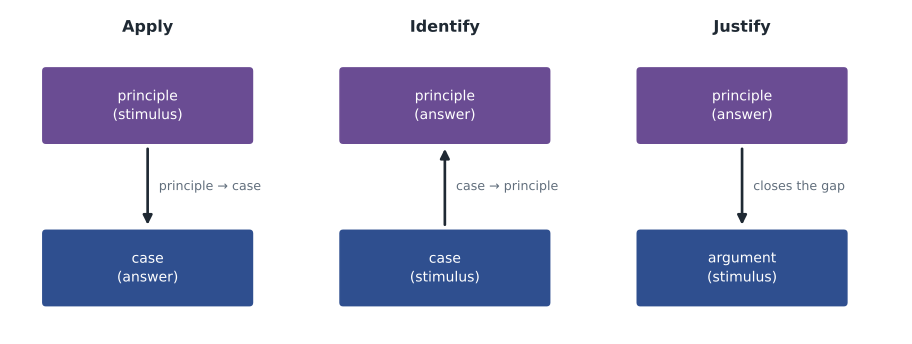
Principle questions come in several forms, but they all involve a general rule and a specific case. This lesson covers the two inference-style forms, applying a principle and identifying a principle, and briefly revisits the principle-justify form you met in LSAT-111. It ends with the reading habits that keep you from importing your own sense of fairness into a principle.
What a principle is
In LSAT terms, a principle is a general rule that covers a range of cases. It may be ethical ("People should keep their promises unless keeping them would cause serious harm"), legal ("A landlord who fails to make urgent repairs within seven days owes the tenant a rent reduction"), practical ("A business should expand only when its existing customers are satisfied") or scientific ("Species with short life cycles adapt to environmental change more quickly than species with long ones").
Most principles on the test can be translated into conditionals. "People should keep their promises unless keeping them would cause serious harm" becomes: not Serious harm → Should keep promise. Once translated, a principle question is often a conditional inference question in disguise.
Three forms of principle question
- Apply the principle (sometimes called "conform"): the stimulus states a principle; the answer choices describe cases, and you pick the one that conforms to it. Stem: "Which one of the following judgments conforms most closely to the principle stated above?"
- Identify the principle (sometimes called "illustrate"): the stimulus describes a case or a judgment; you pick the principle that the case illustrates or that underlies the judgment. Stem: "Which one of the following principles is best illustrated by the situation described above?"
- Principle-justify: the stimulus contains an argument; you pick the principle that, if valid, would most help to justify the conclusion. This is a strengthen question (LSAT-111, lesson 11), and the credited answer works like a sufficient assumption.
The first two forms are inference-style: support flows from the stimulus to the answer, or the answer must match the stimulus exactly. The third is argument-style: the answer supports the stimulus. Read the stem carefully to tell which you are facing.
Applying a principle
Applying a principle is like running a rule against a set of facts. The method:
- Translate the principle into a conditional, noting every condition carefully. Principles often have two or three conditions joined by "and," plus exceptions introduced by "unless" or "except."
- For each answer choice, check whether the case meets the sufficient condition (all parts of it) and then whether the judgment in the choice matches the necessary condition.
- Alternatively, check whether the case fails the necessary condition, in which case the contrapositive tells you the sufficient condition must fail too.
The credited answer is a case where the facts trigger the principle and the judgment follows from it, or a case where the judgment follows from the contrapositive. Wrong answers usually fail in one of these ways: the case does not meet every condition of the principle; the judgment reverses the principle; the case falls under an exception; or the judgment goes beyond what the principle says.
Harriet's contract rule illustrates the method. Translated: Cancels with less than 24 hours and not illness → Charged. A judgment that "a student who canceled with two hours' notice because of a family wedding should be charged" conforms. A judgment that "a student who canceled with three days' notice should not be charged" does not conform, because the principle says nothing about cancellations with more than twenty-four hours' notice (it neither requires nor forbids a charge). That is the classic trap: denying the sufficient condition and concluding the opposite result.
Worked problem
Sample question (written for this course)
Stimulus: "A city should fund a public art project only if the project has been reviewed by a panel that includes local artists and the project's budget has been made available for public comment." Stem: "Which one of the following judgments conforms most closely to the principle above?" (A) Lindale should fund the riverside mural, since its budget was posted for public comment and residents praised it. (B) Corrin should not fund the plaza sculpture, since its budget was never made available for public comment. (C) Ashmere should fund the library mosaic, since it was reviewed by a panel that included local artists and its budget was posted for comment. (D) Tarnwick should fund any project that local artists have reviewed. (E) Fenwick should not fund the park installation, since most residents oppose it.
Show solution
- Translate: Fund → (Panel with local artists AND Budget open for comment). Both are necessary; together they are not stated to be sufficient.
- (B) The plaza sculpture fails a necessary condition (no public comment on the budget), so by the contrapositive the city should not fund it. This conforms.
- (C) is the trap: it meets both necessary conditions and concludes the project should be funded. But the principle never says those conditions are enough. Necessary treated as sufficient.
- (A) concludes funding without the panel review, and treats public praise as relevant when the principle does not mention it. (D) makes panel review sufficient, which the principle does not say.
- (E) bases the judgment on resident opposition, a factor the principle does not mention.
Answer: (B). With an "only if" principle, the only guaranteed judgments are refusals based on a missing requirement.
Marcus noticed the pattern immediately. 'When the principle says "only if," it can only tell you when not to do something.' Harriet agreed and added the mirror image: when a principle says "if" (a sufficient condition), it can only tell you when to do something, and when its result fails, the contrapositive tells you a condition must have failed.
Identifying a principle
In the second form, the stimulus gives you a case, often a decision someone made and the reason they gave. You choose the principle that the case illustrates, or that the decision-maker seems to be following.
The method runs in reverse:
- Identify the key facts of the case and the judgment reached.
- Predict a general rule: "When [these kinds of facts], [this kind of judgment] follows."
- Look for the choice whose conditions match the case's facts and whose result matches the judgment.
The credited principle must fit the case, but it need not mention the case's specific details. It will be stated in general terms: not "Ji-won should get extra time" but "Test takers with documented disabilities should receive accommodations that let them demonstrate their abilities."
Wrong answers on identify questions tend to be too narrow (they fit only part of the case), too broad in a way that conflicts with the case, about a different factor than the one the case turned on, or reversed (they make the case's fact necessary when the case treats it as sufficient).
| Wrong answer | What it does | Example (case: a library waives a late fee because the borrower was in hospital) |
|---|---|---|
| Wrong factor | Turns on something the case did not | Fees should be waived for long-time borrowers |
| Reversed | Swaps condition and result | Anyone whose fee is waived must have been in hospital |
| Too narrow | Covers only part of the case | Fees should be waived for books returned within a week of discharge |
| Conflicts with case | Would require a different judgment | Late fees should never be waived |
Principle-justify, briefly
You studied principle-justify questions in LSAT-111 as a form of strengthen question. A quick reminder of how they differ: the stimulus contains an argument with a gap, and the credited principle bridges it. The best way to find it is to predict a rule connecting the premises to the conclusion, in the form "If [premise], then [conclusion]."
The key difference from apply and identify questions is the direction of support. On apply and identify questions, the principle and case must match. On justify questions, the principle must be strong enough to make the argument work, and it may be broader than the case.
Do not bring your own principles
The biggest danger on principle questions is substituting your own sense of what is fair or sensible. Principles on the LSAT are often reasonable but sometimes odd, and the test does not care whether you agree with them. Harriet's refusal to charge Thomas was humane, but it did not conform to her rule.
Dani said this was the hardest part for her, because her work as an immigration paralegal involved arguing constantly for exceptions. 'Every day I tell someone that the rule should bend for my client. On the LSAT I have to be the person who says "the rule is the rule."' Harriet said that was exactly the right mindset, and that it would serve her well in law school too, where you have to know the rule cold before you can argue for an exception.
Two specific habits help:
- Read every condition, including exceptions. A principle with "unless," "except when" or "provided that" has more than one condition, and wrong answers often ignore one.
- Do not reward a choice for reaching the "right" outcome. A choice that reaches a sensible judgment for a reason the principle does not mention does not conform.
Long principles
Some principle stimuli are long, with multiple conditions and exceptions: "An employer may require employees to work on a statutory holiday only if the employer pays at least one and a half times the regular rate, the employee has been given at least a week's notice, and the work is necessary for the safety of the public or the continued operation of essential equipment." Translate these into a checklist, then go through each choice like an inspector with a clipboard. Choices that fail any item can be ruled out quickly.
Ji-won, who wrote test checklists for software at work, said this felt more natural than anything else in the course. 'It is literally acceptance criteria.'
The November 1 set
The session closed with eight principle questions (four apply, three identify, one justify) in eleven minutes (Ji-won had sixteen and a half). Ji-won and Élodie got eight. Marcus got seven; he missed the justify question by choosing a principle that matched the case but was too weak to close the argument's gap. Thomas got six. Dani got seven and said, with some satisfaction, that she had not bent a single rule.
Practice: an identify-the-principle question
Worked problem
Sample question (written for this course)
Stimulus: "The Corwin Gazette retracted its story about a councillor's expenses once it learned that the documents it relied on had been altered, even though the councillor had not complained and most readers had already forgotten the story." Stem: "Which one of the following principles is best illustrated by the Gazette's decision?" (A) A newspaper should retract a story whenever the subject of the story complains. (B) Newspapers should never report on the expenses of elected officials. (C) A newspaper should retract only stories that readers still remember. (D) Any story that is retracted must have relied on altered documents. (E) A newspaper should correct a published story once it learns that the story rests on unreliable evidence, whether or not anyone objects.
Show solution
- Case: the story rested on altered documents; the paper retracted it despite no complaint and little attention.
- (E) fits: unreliable evidence leads to correction regardless of objection.
- (A) turns on complaints, which the case explicitly lacked. (B) is unrelated to the case's reasoning.
- (C) would have required the opposite decision, since readers had forgotten the story. (D) reverses condition and result.
Answer: (E). The credited principle matches the factor the decision turned on and accommodates the details that did not matter.
Élodie noted that the details "the councillor had not complained" and "readers had forgotten" were there to eliminate wrong answers. Harriet agreed: in identify questions, details that seem incidental often exist to rule out principles that depend on them.
Principles with exceptions
A final practice idea from Harriet: when a principle contains "unless" or "except," write it as two lines. "Employees must give two weeks' notice before resigning unless they are leaving for medical reasons" becomes: not Medical → Two weeks' notice required; and a note that the principle says nothing about what is required when the reason is medical. Wrong answers on apply questions often treat the exception as if it created a rule of its own ("employees leaving for medical reasons need give no notice at all"). The principle does not say that. It simply stops applying, and leaves the medical case open.
Common mistakes
MistakeTreating the necessary conditions of an "only if" principle as sufficient.
InsteadAn "only if" principle can only justify a refusal when a requirement is missing.
MistakeConcluding the opposite result when a case does not meet a principle's sufficient condition.
InsteadIf the sufficient condition fails, the principle says nothing.
MistakeIgnoring an exception introduced by "unless" or "except."
InsteadTranslate every condition, including exceptions, before testing choices.
MistakeChoosing the answer with the fairest outcome.
InsteadApply the principle as written; your own sense of fairness is irrelevant.
Summary and key terms
- A principle is a general rule, usually translatable into a conditional.
- Apply questions give the principle and ask for a conforming case; identify questions give the case and ask for the principle.
- Principle-justify questions are strengthen questions: the principle must close the argument's gap.
- An "only if" principle can justify only refusals; an "if" principle can justify only actions (or, by contrapositive, missing conditions).
- Read every condition and exception, and never substitute your own principles.
- Principle
- A general rule covering a range of cases.
- Conform
- To be consistent with a principle's conditions and result.
- Illustrate
- To be an instance of a general principle.
- Exception clause
- Part of a principle, often introduced by "unless" or "except," that removes some cases from its scope.
Practice problems
Work each problem on paper first, then reveal the answer to check.
Principle: "A school should cancel classes if the temperature falls below minus thirty or the buses cannot run." The temperature is minus twenty and the buses are running. What does the principle say?
Show answer
Nothing. Neither sufficient condition is met, so the principle neither requires nor forbids cancellation.
Same principle. Classes were not canceled today. What follows?
Show answer
By the contrapositive, the temperature was not below minus thirty and the buses could run (assuming the school followed the principle).
Case: "Okafor returned the wallet he found, even though no one would have known if he had kept it." Give a principle it illustrates.
Show answer
For example: "People should return lost property to its owner whether or not anyone would discover that they kept it."
Lesson quiz · 5 questions
Score 60% or more to complete this lesson.
Create a free account to save your progress, take quizzes and earn a certificate.