
LSAT-112 · Lesson 6 of 12 · 23 min
Cannot-be-true questions and EXCEPT forms
▶ Video coming soon A video version of this lesson is on the way.
The Sunday clinic on October 25, 2026 began with an apology from Marcus, who had been up late reviewing the Tuesday flaw set and admitted he had read the first practice stem as "must be true." He had found a choice that the stimulus guaranteed, picked it, and been confidently wrong. The stem had asked which choice CANNOT be true.
Harriet did not laugh. 'That is the single most common way people lose points on this question type,' she said. 'Not by misunderstanding the logic, but by reading the stem on autopilot. Today is about questions that flip what you are looking for: cannot-be-true questions, and the EXCEPT forms of every question type in this course.'
What cannot-be-true questions ask
A cannot-be-true question asks you to find the one answer choice that is inconsistent with the stimulus. If every statement in the stimulus is true, the credited answer must be false.
The stems include:
- "If the statements above are true, which one of the following CANNOT be true?"
- "The statements above, if true, most seriously undermine which one of the following?"
- "Which one of the following is inconsistent with the information above?"
- "If the statements above are true, each of the following could be true EXCEPT:"
The last stem deserves a second look. "Each could be true EXCEPT" means four choices could be true and one cannot. It is a cannot-be-true question in disguise.
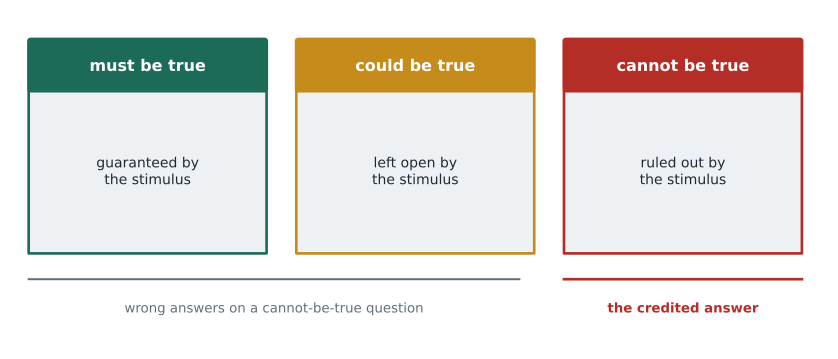
The other four choices, the wrong answers, are not necessarily true. They are simply possible: consistent with the stimulus. Some may even be guaranteed; others may be unaddressed. What they share is that the stimulus does not rule them out.
Thinking in three bins
Harriet asked the group to think of every inference answer choice as belonging in one of three bins: must be true, could be true (but not must), and cannot be true. Each question type rewards a different bin:
- Must-be-true questions credit the first bin.
- Cannot-be-true questions credit the third bin.
- "Could be true" questions, which are rare, credit any choice not in the third bin. Their EXCEPT form, "each must be true EXCEPT," credits a choice that is not guaranteed.
This framework turns confusing stems into a simple sorting task. For each choice, ask which bin it belongs in, then pick the bin the stem asks for.
| Stem | Credited answer | Bin |
|---|---|---|
| Must be true | Guaranteed by the stimulus | Must |
| Cannot be true | Ruled out by the stimulus | Cannot |
| Could be true EXCEPT | Ruled out by the stimulus | Cannot |
| Could be true | Not ruled out | Must or could |
| Must be true EXCEPT | Not guaranteed | Could or cannot |
How choices contradict a stimulus
A choice cannot be true if it contradicts something the stimulus states or implies. Contradictions come in a few forms:
- Direct contradiction: the stimulus says all applicants were interviewed; the choice says one applicant was not.
- Contradiction of an inference: the stimulus gives A → B and A; the choice says not B. The choice contradicts the conclusion the stimulus forces, even though the stimulus never states it outright.
- Quantity contradiction: the stimulus says most members voted; the choice says fewer than half did. Or the stimulus says some members are retired; the choice says no member is retired.
- Numerical contradiction: the stimulus gives totals or shares that the choice makes impossible.
The second form is the most common on hard questions. The test writers bury a conditional chain in the stimulus, then offer a choice that negates its last link. Students who have not run the chain see nothing wrong with it.
Contradiction is not the same as "unlikely" or "opposite"
Two kinds of choices tempt students on cannot-be-true questions without actually being ruled out.
The first is the unlikely choice. A stimulus might say that most of a town's residents support a new park. A choice saying "The town's mayor opposes the park" might seem at odds with the stimulus, but it is entirely possible; the mayor might be in the minority. Unlikely is not impossible.
The second is the false opposite. If the stimulus says "Some of the drafts contained errors," the opposite that cannot be true is "None of the drafts contained errors," not "Some of the drafts were error-free." The second is consistent with the stimulus (some drafts had errors, some did not). You learned the correct negations in lesson 3; this is where they earn their keep.
Dani made a card with the pairs that actually contradict each other: all / some not; none / some; most / half or fewer. 'If the choice is not the true negation of something forced by the stimulus, it can be true.'
Worked problem
Sample question (written for this course)
Stimulus: "Every vendor at the Corwin night market must display a food safety permit. No vendor who displays a food safety permit may sell unpasteurized dairy. Some vendors at the night market sell cheese." Stem: "If the statements above are true, which one of the following CANNOT be true?" (A) Some vendors who sell cheese at the night market sell unpasteurized cheese. (B) Some vendors at the night market do not sell cheese. (C) Some vendors who display a food safety permit are not at the night market. (D) Most vendors at the night market sell cheese. (E) Some people who sell unpasteurized dairy display no food safety permit.
Show solution
- Translate: Night market vendor → Permit. Permit → not Unpasteurized. Chain: Vendor → Permit → not Unpasteurized. So no night market vendor sells unpasteurized dairy.
- (A) says some cheese-selling vendors at the market sell unpasteurized cheese. Unpasteurized cheese is unpasteurized dairy, and the chain rules it out for every vendor. This cannot be true.
- (B) is consistent: "some sell cheese" does not mean all do. (C) is consistent: the permit rule does not say only market vendors hold permits.
- (D) is consistent: "some" allows "most."
- (E) is consistent and in fact supported by the contrapositive (Unpasteurized → not Permit): anyone selling unpasteurized dairy lacks a permit.
Answer: (A). It negates the last link of the chain for a group the stimulus says exists.
EXCEPT questions across the family
Every question type in this course can appear in an EXCEPT form, and so can the argument-based types from LSAT-110 and LSAT-111. The structure is always the same: four choices share a property, and the credited choice lacks it.
- "Each of the following is supported by the information above EXCEPT:" Four choices are supported; the credited choice is not (it may be contradicted or simply unaddressed).
- "Each of the following, if true, would help to explain the discrepancy EXCEPT:" Four choices explain it; the credited choice does not (it may make the paradox worse or be irrelevant).
- "Each of the following principles, if valid, would justify the reasoning EXCEPT:" Four choices justify it; the credited one does not.
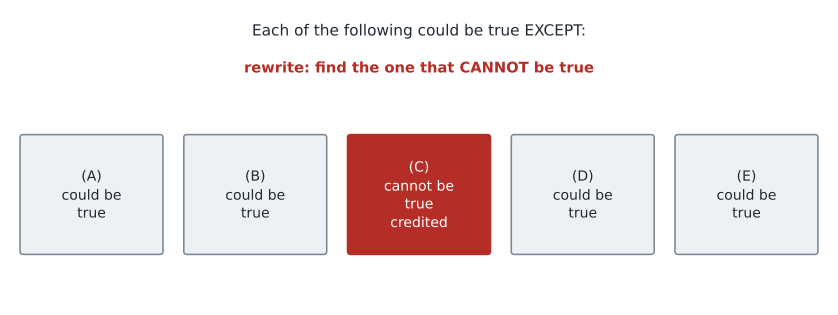
Harriet's advice was to rewrite every EXCEPT stem before reading the choices. 'Cross out EXCEPT and write the opposite property. "Each could be true EXCEPT" becomes "find the one that cannot be true." "Each helps explain EXCEPT" becomes "find the one that does not help."' The rewrite takes two seconds and prevents the autopilot error that Marcus had made that morning.
Avoid looking for the opposite of the right answer
A subtle trap on EXCEPT questions is to assume the credited choice must do the opposite of the other four. On "each strengthens EXCEPT," the credited choice might weaken, but it might also be irrelevant. On "each could be true EXCEPT," the credited choice cannot be true, but the other four need not be guaranteed. On "each must be true EXCEPT," the credited choice merely lacks a guarantee; it does not have to be false.
Élodie said this was the point that cleared up her confusion. 'I kept hunting for a choice that was the opposite. Sometimes the odd one out is just neutral.'
Working efficiently
Cannot-be-true questions often reward a quick prediction. If you run the stimulus's chains first, you know what must be true; the credited answer will usually negate one of those conclusions. Scan for a choice that says "not" to something you derived, or "none" to something you know is "some," or "fewer than half" to something you know is "most."
If no prediction is available, test each choice: "Could the stimulus be true while this choice is also true?" If yes, eliminate. The choice that survives is the one that cannot coexist with the stimulus.
Ji-won timed herself on both approaches during the session. On formal stimuli, predicting saved her about twenty seconds a question. On descriptive stimuli, it saved nothing, and she lost time looking for a prediction that was not there. She settled on a rule: predict when there are arrows, test when there are not.
The October 25 set
Harriet closed with a mixed set of eight questions: three must-be-true, three cannot-be-true and two EXCEPT forms, shuffled, in eleven minutes (Ji-won had sixteen and a half). Every student rewrote every stem before reading the choices; Harriet checked. Ji-won got eight. Élodie and Marcus got seven. Thomas got seven, his best result on an inference set. Dani got six, and both misses were on "could be true EXCEPT" questions where she had found a guaranteed choice and stopped. She added a line to her card: "Guaranteed is still possible."
Practice: a cannot-be-true question with a quantity twist
Worked problem
Sample question (written for this course)
Stimulus: "Most of the students in Professor Greer's seminar are history majors. Every history major in the seminar wrote a thesis on the nineteenth century. No student who wrote a thesis on the nineteenth century took the medieval studies elective." Stem: "If the statements above are true, which one of the following CANNOT be true?" (A) Some students in the seminar took the medieval studies elective. (B) Some history majors outside the seminar took the medieval studies elective. (C) Every student in the seminar wrote a thesis on the nineteenth century. (D) Most students in the seminar took the medieval studies elective. (E) Some students who did not take the medieval studies elective are not in the seminar.
Show solution
- Chain: History major in seminar → Nineteenth-century thesis → not Medieval elective. Most seminar students are history majors, so most seminar students did not take the elective.
- (D) says most took the elective. Since more than half did not, this contradicts the chain. Cannot be true.
- (A) is possible: the minority who are not history majors might have taken it. (B) concerns students outside the seminar, about whom nothing is said.
- (C) is possible; non-majors could also have written such theses. (E) is possible and unaddressed.
Answer: (D). "Most" passed through a chain produces a "most" conclusion, and its negation (half or fewer) is the impossible choice.
Practice: a "must be true EXCEPT" question
Worked problem
Sample question (written for this course)
Stimulus: "Every exhibit in the Merrowby Science Center's new wing is interactive. All interactive exhibits at the center are cleaned twice a day. Some exhibits in the new wing are designed for children under five." Stem: "If the statements above are true, each of the following must be true EXCEPT:" (A) Every exhibit in the new wing is cleaned twice a day. (B) Some exhibits designed for children under five are interactive. (C) Every interactive exhibit at the center is in the new wing. (D) Some exhibits cleaned twice a day are designed for children under five. (E) Some exhibits in the new wing are cleaned twice a day.
Show solution
- Rewrite the stem: find the one choice that is not guaranteed.
- Chain: New wing → Interactive → Cleaned twice. (A) and (E) follow from the chain. (B) and (D) follow from combining the chain with the "some" statement.
- (C) reverses the first rule. Interactive exhibits may exist elsewhere in the center. Not guaranteed.
Answer: (C). On "must be true EXCEPT," the credited answer only has to lack a guarantee; it need not be false.
Dani worked this one twice: once looking for a false choice (and finding none), then again looking for an unguaranteed one. 'The stem rewrite would have saved me a minute,' she said, and underlined it on her card.
Why the test writers like these questions
Harriet explained why cannot-be-true and EXCEPT questions appear so often. They test the same logic as must-be-true questions, but they punish a different habit: the habit of stopping at the first choice that seems connected to the stimulus. On a must-be-true question, a careless reader who picks a plausible choice is often wrong. On a cannot-be-true question, a careless reader who picks a guaranteed choice is always wrong. The flipped stem forces you to slow down and sort, which is exactly the discipline the rest of this course relies on.
Common mistakes
MistakeReading a cannot-be-true stem as must-be-true.
InsteadRewrite every stem before reading the choices, especially EXCEPT stems.
MistakeChoosing an unlikely answer as the one that cannot be true.
InsteadUnlikely is not impossible; the credited answer must contradict the stimulus.
MistakeUsing the wrong negation ("some are not" as the opposite of "some are").
InsteadThe opposite of "some are" is "none are."
MistakeAssuming the odd one out on an EXCEPT question must do the opposite of the others.
InsteadThe credited choice merely lacks the shared property; it may be neutral.
Summary and key terms
- Cannot-be-true questions credit the choice that contradicts the stimulus or its inferences.
- Sort choices into three bins: must be true, could be true, cannot be true.
- "Each could be true EXCEPT" is a cannot-be-true question in disguise.
- Contradictions often negate the last link of a conditional chain.
- Rewrite every EXCEPT stem as a search for the one choice lacking the shared property.
- Cannot-be-true question
- A question asking which choice is inconsistent with the stimulus.
- Consistent
- Able to be true at the same time as the stimulus.
- EXCEPT question
- A question in which four choices share a property and the credited choice lacks it.
- Three bins
- The sorting of answer choices into must be true, could be true and cannot be true.
Practice problems
Work each problem on paper first, then reveal the answer to check.
Stimulus: "All of the conference speakers are professors. Some professors at the conference are from Quebec." Can it be true that no conference speaker is from Quebec?
Show answer
Yes. The professors from Quebec might all be attendees rather than speakers.
Rewrite the stem: "Each of the following is strongly supported by the passage EXCEPT:"
Show answer
Find the one choice that is not strongly supported.
Stimulus: "Most of the tenants signed the petition." Which cannot be true: "Fewer than half of the tenants signed," or "Some tenants did not sign"?
Show answer
"Fewer than half of the tenants signed" cannot be true; "some did not sign" is consistent with "most signed."
Lesson quiz · 5 questions
Score 60% or more to complete this lesson.
Create a free account to save your progress, take quizzes and earn a certificate.