
LSAT-112 · Lesson 10 of 12 · 23 min
Resolve the paradox
▶ Video coming soon A video version of this lesson is on the way.
The Sunday clinic on November 15, 2026 was the first since Marcus had tested. He joined with the relaxed look of someone who no longer had to care, at least until December 2. 'I had two paradox questions in my first section,' he reported. 'I think I got both. That is the only thing I am allowed to say, according to Harriet.' Harriet confirmed that speculating about individual questions was pointless and, under LSAC's rules, test content is confidential anyway.
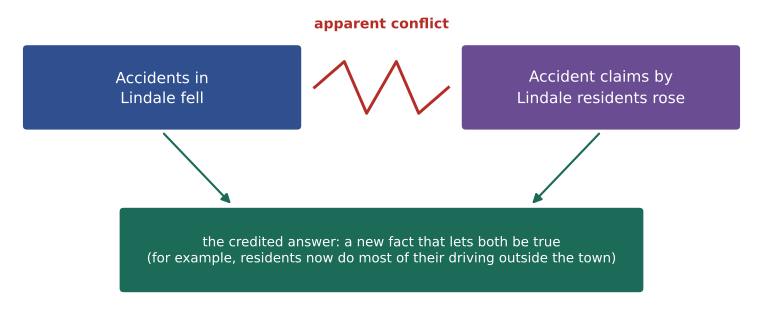
She then put a puzzle on the screen. "Over the past decade, the number of car accidents in the town of Lindale has fallen sharply. Yet over the same period, the number of insurance claims for car accidents filed by Lindale residents has risen." She asked for explanations. Within a minute the group had produced five: residents were driving more outside Lindale; claims had become easier to file; repair costs had risen so that minor damage that once went unclaimed was now worth claiming; the population had grown; the town had changed how it counted accidents.
'Every one of those could be the right answer,' Harriet said. 'That is what resolve-the-paradox questions are like. The test gives you two facts that seem to clash, and you pick the one answer choice that lets both be true.'
Recognizing the question
Paradox stems ask you to explain, resolve or reconcile:
- "Which one of the following, if true, most helps to resolve the apparent discrepancy described above?"
- "Which one of the following, if true, most helps to explain the situation described above?"
- "Which one of the following, if true, contributes most to an explanation of the apparent paradox?"
- "Which one of the following, if true, would most help to reconcile the two findings?"
The phrase "if true" tells you that the answer choices are new information, as in strengthen and weaken questions. You accept each choice as true and ask whether it makes the stimulus make sense.
What the stimulus looks like
Paradox stimuli have no conclusion. They present two facts (sometimes a fact and an expectation) that seem to conflict. Common signals: "yet," "however," "surprisingly," "despite," "although," "but." Often the first fact sets up an expectation and the second fact defies it.
Harriet asked the group to state every paradox in one sentence of the form "How can X when Y?" before reading the choices. For the Lindale puzzle: "How can accident claims rise when accidents fell?" This sentence becomes the test for every answer choice: does this choice make it possible for X and Y to both be true?
Do not deny the facts
The first rule of paradox questions is that both facts in the stimulus are true. An answer choice that disputes either fact is wrong, however neatly it would dissolve the puzzle. "The town's accident statistics are unreliable" does not resolve the paradox; it simply questions one side of it.
This mirrors the rule from weaken questions in LSAT-111: you never attack a premise. Here, every sentence of the stimulus is a premise.
The credited answer: a difference between the two facts
Most paradoxes depend on an assumption that the two facts are about the same thing, measured the same way, over the same scope. The credited answer usually reveals a difference.
- Different groups: the facts concern overlapping but distinct populations. In Lindale, accidents within the town fell, but residents' claims include accidents anywhere. "Lindale residents now commute to a nearby city, where accident rates are high" resolves it.
- Different measures: one fact counts events, the other counts something else (costs, claims, cases reported). "Since the town installed traffic cameras, drivers in minor accidents can more easily prove fault and file claims" resolves it.
- Different times: the facts concern different periods, or a lag between cause and effect.
- A third factor: something else changed that affects one fact but not the other. "Average repair costs for minor collisions doubled, so damage that was not worth claiming a decade ago now is" resolves it, if combined with the idea that more minor accidents are now claimed.
- Hidden counterbalancing effect: a change produced one expected effect and one unexpected effect that outweighs it.
| Resolution type | Paradox | Resolving fact |
|---|---|---|
| Different groups | The clinic's patient satisfaction rose, but complaints to the health ministry about it also rose | The clinic doubled its number of patients |
| Different measures | Crime fell, yet police reported more arrests | A new policy targets offenses that used to be ignored |
| Different times | The drug reduced symptoms in trials, yet patients report no benefit | Benefits appear only after six months, and most patients have taken it for less |
| Third factor | Sales of umbrellas rose in a dry year | A popular film made a certain umbrella fashionable |
| Counterbalancing effect | The bridge toll was cut, yet bridge revenue rose | Traffic on the bridge more than doubled |
Wrong answers
Wrong answers on paradox questions follow recognizable patterns:
- Explains only one side: the choice explains why accidents fell, or why claims rose, but not why both happened together. "The town added speed bumps on residential streets" explains the fall in accidents but makes the rise in claims more puzzling, not less.
- Deepens the paradox: the choice makes the clash sharper. "Lindale residents rarely drive outside the town" makes it harder to explain why claims rose.
- Irrelevant comparison: the choice compares Lindale to another town, or the present to some unrelated time, without connecting to either fact.
- Denies a fact: the choice questions the accuracy of one of the facts.
The most tempting wrong answer is the one that explains only one side, because it does explain something. Harriet's "How can X when Y?" sentence protects against it: a choice that answers only "why X?" or only "why Y?" does not answer "how can X when Y?"
Worked problem
Sample question (written for this course)
Stimulus: "After the Ashmere Public Library extended its weekday hours from 6 p.m. to 9 p.m., the total number of visitors per week rose by about a third. However, the number of books borrowed per week did not change." Stem: "Which one of the following, if true, most helps to resolve the apparent discrepancy described above?" (A) Most people who borrow books from the library visit on weekends. (B) The library added several thousand new titles to its collection last year. (C) The library's evening visitors mostly come to use its free computers and study spaces rather than to borrow books. (D) Other libraries in the region have also extended their hours. (E) The number of visitors per week is counted by an electronic gate at the entrance.
Show solution
- How can visitors rise by a third when borrowing stayed flat? The assumption is that more visitors means more borrowing.
- (C) breaks that assumption: the extra evening visitors come for computers and study space, not books. Both facts can be true. Strongly resolves.
- (A) explains why weekday hours might not affect borrowing much, but it does not explain why visitors rose; it only partly addresses one side. Weak at best.
- (B) would predict more borrowing, deepening the puzzle. (D) is an irrelevant comparison.
- (E) describes how visitors are counted without suggesting the count is wrong or explaining the gap.
Answer: (C). It identifies a difference between the two groups being measured: visitors in general versus borrowers.
Predict loosely
Unlike must-be-true questions, paradox questions rarely allow a precise prediction, because there are usually many possible explanations. The group's five explanations for the Lindale puzzle show why. Instead of predicting a specific answer, predict the kind of answer: "something that separates accidents in the town from claims by residents" or "something that makes each claim more likely or more valuable."
Thomas found this the most freeing part of the session. 'I keep wanting to know the answer before I look. Here I just need to know what shape it will have.'
EXCEPT paradox questions
Paradox questions frequently appear in EXCEPT form: "Each of the following, if true, contributes to an explanation of the discrepancy EXCEPT:" Four choices resolve the paradox; the credited choice does not. It may be irrelevant, it may explain only one side, or it may deepen the paradox. As you learned in lesson 6, rewrite the stem first: "Find the one that does not help explain it."
EXCEPT paradox questions reward the same loose prediction. Since four choices each offer a resolution, you will often see four different resolution types (different groups, different measures, a third factor, a counterbalancing effect). The odd one out is the choice that fits none of them.
Paradoxes in other clothing
Some questions that look like other types are really paradoxes. A stimulus may describe a plan that seems certain to work and then report that it failed; the question asks which choice "most helps to explain why the plan did not succeed." Or a stimulus may describe a person whose behavior seems inconsistent with their stated goals. In both cases, the task is the same: find the fact that makes the two sides compatible.
Élodie said this was what her political science professors called "explaining the anomaly." 'You do not throw out the data. You find the variable you missed.'
The November 15 set
Harriet closed the first half of the session with six paradox questions (four standard, two EXCEPT) in eight and a half minutes (Ji-won had twelve and three-quarters). Ji-won and Élodie got six. Marcus got five, and declared himself rusty after three days off. Thomas got five. Dani got five, and said her years at the immigration firm had trained her for this: 'Every file has two documents that do not agree. My job is finding out why.'
Practice: a paradox about a plan
Worked problem
Sample question (written for this course)
Stimulus: "To reduce traffic congestion downtown, the city of Lindale opened a large new parking garage at the edge of the downtown area, intending that drivers would park there and walk the last few blocks. A year later, congestion downtown had worsened." Stem: "Which one of the following, if true, most helps to explain why the plan did not reduce congestion?" (A) The garage's low parking rates attracted many people who had previously taken the bus downtown, and most of them drove through the downtown area to reach the garage. (B) The garage was built with energy-efficient lighting. (C) Congestion is a problem in many cities of Lindale's size. (D) The garage is open twenty-four hours a day. (E) Some downtown businesses supported the construction of the garage.
Show solution
- How can congestion worsen when the plan was meant to reduce it?
- (A) explains it: the garage drew new drivers who had used the bus, and their route took them through downtown. The plan had a counterbalancing effect.
- (B), (D) and (E) are irrelevant to congestion. (C) is an irrelevant comparison with other cities.
Answer: (A). Plan-failure questions are paradoxes: the credited answer shows how the plan could be carried out and still miss its goal.
Practice: an EXCEPT paradox question
Worked problem
Sample question (written for this course)
Stimulus: "The Fenwick Art Gallery dropped its admission fee last spring. Since then, the number of visitors has risen by half, but the total amount visitors spend in the gallery shop has fallen." Stem: "Each of the following, if true, helps to explain the situation described above EXCEPT:" (A) Many of the new visitors are students with little money to spend. (B) To make up for lost admission revenue, the gallery raised prices in the shop sharply. (C) The gallery now admits visitors through a side entrance that bypasses the shop. (D) The gallery repainted its main hall last spring. (E) The shop closed for renovations for three months during the period in question.
Show solution
- Rewrite the stem: find the one choice that does not help explain why visitors rose but shop spending fell.
- (A) new visitors spend less; (B) higher prices discourage buying; (C) visitors no longer pass the shop; (E) the shop was closed for part of the period. Each explains lower spending alongside more visitors.
- (D) has nothing to do with either visitor numbers or shop spending. It is the odd one out.
Answer: (D). Four choices each offered a different resolution; the odd one out was simply irrelevant, not the opposite of the others.
Two facts or one expectation?
Harriet pointed out a subtle variety of paradox stimulus: one in which the second fact clashes not with another fact but with an expectation the stimulus creates. "Most experts predicted the new vaccine would be in high demand; yet clinics report that few people have booked appointments." The expectation (high demand) is part of the stimulus, and the credited answer must explain why the expectation failed without denying that the experts predicted it. Choices that question the experts' competence are a version of denying a fact: they argue with the stimulus rather than reconciling it.
Common mistakes
MistakeChoosing an answer that disputes one of the facts.
InsteadBoth facts are true; the answer must let them coexist.
MistakeChoosing an answer that explains only one side of the paradox.
InsteadTest each choice against "How can X when Y?"
MistakeTrying to predict the exact answer.
InsteadPredict the kind of answer: a difference in groups, measures, times, or a third factor.
MistakeMissing that a choice deepens the paradox.
InsteadAsk whether the choice makes the clash sharper or softer.
Summary and key terms
- Paradox questions present two facts that seem to conflict and ask for a new fact that reconciles them.
- State the paradox as "How can X when Y?" before reading the choices.
- Never deny either fact.
- Credited answers usually reveal a difference in groups, measures or times, a third factor or a counterbalancing effect.
- Wrong answers explain one side only, deepen the paradox, make irrelevant comparisons or deny a fact.
- Paradox (discrepancy)
- Two facts in a stimulus that seem to conflict.
- Resolve
- To add information that allows both facts to be true at once.
- Counterbalancing effect
- A second effect of a change that outweighs the expected one.
- One-sided explanation
- A choice that explains one of the facts without reconciling it with the other.
Practice problems
Work each problem on paper first, then reveal the answer to check.
State as "How can X when Y?": "The company cut prices on its phones, yet its phone revenue increased."
Show answer
How can revenue rise when prices fell? (Likely resolution: sales volume rose enough to outweigh the lower price.)
Does this resolve the paradox above? "The company's competitors raised their prices at the same time."
Show answer
Yes, if it implies customers switched to the company, increasing volume; it explains how lower prices could raise revenue.
Does this resolve it? "The company's phones are popular with teenagers."
Show answer
No. It does not connect the price cut to the revenue increase.
Lesson quiz · 5 questions
Score 60% or more to complete this lesson.
Create a free account to save your progress, take quizzes and earn a certificate.