
LSAT-112 · Lesson 5 of 12 · 23 min
Most-strongly-supported questions
▶ Video coming soon A video version of this lesson is on the way.
After a short break in the October 18 session, Harriet put two stems side by side on the screen. The first read: "If the statements above are true, which one of the following must also be true?" The second read: "The statements above, if true, most strongly support which one of the following?" She asked the group what the difference was.
'The second one is easier,' Dani said. 'You do not need certainty.' Ji-won disagreed. 'The second one is harder, because you have to decide how much support is enough.' Harriet said they were both right, and that the rest of the session would be about getting the best of both views: the flexibility Dani saw, and the discipline Ji-won wanted.
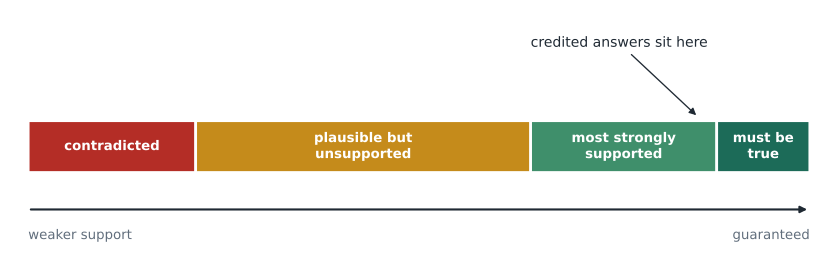
Most-strongly-supported questions are close cousins of must-be-true questions. They ask for the answer that the stimulus supports best, which is usually, but not always, an answer the stimulus guarantees. This lesson explains how the standard of support differs, how to handle descriptive stimuli and research findings, and how to resist the many attractive answers that go one step too far.
Recognizing the question
The stems ask for support rather than certainty:
- "The statements above, if true, most strongly support which one of the following?"
- "The information above provides the most support for which one of the following?"
- "Which one of the following is most strongly supported by the information above?"
- "The statements above most strongly suggest which one of the following?"
- "Which one of the following is best illustrated by the statements above?"
The words "support," "suggest" and "illustrate" all signal this question type. "Must," "properly inferred" and "follows logically" signal certainty.
The standard of support
On a must-be-true question, the correct answer survives the counterexample test: there is no way for the stimulus to be true and the answer false. On a most-strongly-supported question, the correct answer might, in principle, fail that test, but only through some far-fetched situation. It is the answer a careful, skeptical reader would accept on the strength of the stimulus alone.
In practice, the gap between the two standards is narrow. Harriet's experience, which she shared with the caveat that it was her own observation and not anything LSAC publishes, was that most credited answers to most-strongly-supported questions would also pass a strict must-be-true test. The remainder require only a very small step, such as treating a pattern observed across many cases as likely to hold in a typical case.
This has a practical consequence. Treat most-strongly-supported questions almost exactly like must-be-true questions. Use the counterexample test. If two choices survive, prefer the one that needs the smaller step.
Descriptive and research stimuli
Most-strongly-supported questions often use stimuli that describe a study, a historical trend or a scientific observation, rather than a set of rules. These stimuli invite over-reading, because they look like the opening of an argument that the test has left unfinished.
Harriet gave the group an example: "In a survey of homes in the Ashmere district, researchers found that homes with programmable thermostats used, on average, less heating fuel each winter than homes without them. Homes with programmable thermostats were also, on average, newer and better insulated."
Several conclusions tempt:
- "Programmable thermostats reduce heating fuel use." Not supported. The second sentence offers an alternative explanation (newer, better insulated homes), and the stimulus does not say which factor matters.
- "Insulation, not thermostats, explains the difference." Also not supported. The stimulus does not rule thermostats out.
- "At least some of the difference in fuel use between the two groups of homes may be due to factors other than the thermostats." Supported. The stimulus gives a reason to think other factors are involved, and the claim is modest ("may be due," "at least some").
Marcus said this felt like the opposite of a weaken question. 'In LSAT-111, a stimulus like this would have had a conclusion that thermostats save fuel, and we would have attacked it with the insulation point. Here the insulation point is already in the stimulus, and we just have to notice what it allows.' Harriet said that was exactly right.
The "one step too far" answer
The most common wrong answer on these questions takes a reasonable observation and pushes it one step further than the stimulus allows. It might generalize from the cases described to all cases, attribute a cause where the stimulus describes only a correlation, or predict a future result from a past trend.
Harriet called these "almost answers." 'If you read the right answer and think "well, obviously," and read an almost answer and think "that is a fascinating conclusion," pick the obvious one.'
Common forms of the almost answer:
- Causal leap: the stimulus reports that A and B occur together; the answer says A causes B.
- Universal leap: the stimulus describes several cases; the answer says all cases are like that.
- Predictive leap: the stimulus describes a past trend; the answer says it will continue.
- Normative leap: the stimulus describes facts; the answer says what someone should do.
- Comparative leap: the stimulus describes one group; the answer compares it with another group the stimulus never measured.
| Leap | Stimulus says | Almost answer says |
|---|---|---|
| Causal | Students who take music lessons have higher marks | Music lessons improve marks |
| Universal | The three bridges inspected had corroded cables | All the city's bridges have corroded cables |
| Predictive | Ridership has risen for five years | Ridership will rise next year |
| Normative | The program costs more than it saves | The program should be canceled |
| Comparative | Most residents of Lindale recycle | Lindale residents recycle more than residents elsewhere |
When the stimulus contains a conclusion
Sometimes a most-strongly-supported stimulus does contain a conclusion, or is a short argument. As with must-be-true questions, accept the conclusion as part of the information. But be careful: a conclusion on its own is a claim the author makes, and the question asks what the whole set of statements supports. Usually the correct answer will be something that combines the evidence with the conclusion, or a modest version of the conclusion itself.
Sometimes the stimulus is a set of facts that an author would naturally use to argue for something, but the argument is missing. In those cases, the right answer is often the conclusion the facts point toward, stated cautiously. Harriet called these "fill-in-the-conclusion" questions and said they reward the skill of finding the main point from LSAT-110, run in reverse: instead of finding a stated conclusion, you write one the facts support.
Worked problem
Sample question (written for this course)
Stimulus: "Archaeologists excavating a settlement near Fenwick Lake found grinding stones, storage pits and charred barley grains in houses dated to about 4,000 years ago. In houses at the same site dated to about 5,000 years ago, they found fish bones and hunting tools, but no grinding stones, storage pits or grains." Stem: "The information above most strongly supports which one of the following?" (A) The inhabitants of the settlement stopped eating fish about 4,000 years ago. (B) Barley was first domesticated in the region near Fenwick Lake. (C) Agriculture produced a more reliable food supply than hunting and fishing did. (D) The way of obtaining or storing food at the settlement changed in the thousand years between the two periods. (E) The settlement was abandoned and later reoccupied by a different population.
Show solution
- Facts: older houses show fishing and hunting evidence and no grain-processing evidence; younger houses show grain processing and storage. The stimulus does not say whether fish bones appear in the younger houses.
- (D) is modest: the evidence of food processing and storage differs between the periods, so something about obtaining or storing food changed. Strongly supported.
- (A) is a leap: the stimulus does not say fish bones were absent from the later houses.
- (B) is a leap about where barley was first domesticated; the settlement could have acquired it from elsewhere.
- (C) is a comparative and evaluative leap the stimulus gives no basis for. (E) is possible but not supported: a change in food practice does not show a change in population.
Answer: (D). The cautious description of what the evidence shows beats every choice that adds a story to it.
Strength of language, again
Quantity and certainty words matter just as much here as on must-be-true questions. Harriet reminded the group of a simple scale. Answer choices with "may," "can," "some," "at least one" and "not necessarily" are easier to support than choices with "must," "will," "most," "all" and "only." When the stimulus is cautious, the right answer will be cautious. When the stimulus is strong (for example, a set of universal rules), a strong answer can be supported.
Élodie said she now read every answer choice twice: once for meaning, and once just for its strength words. 'If the strength words are stronger than anything in the stimulus, I am done with that choice.'
Support versus relevance
One more trap catches students who have just finished studying strengthen and weaken questions. On a most-strongly-supported question, an answer that would strengthen some argument suggested by the stimulus is not thereby supported by it. The question is not "what is relevant to these facts?" but "what do these facts show?"
Thomas said this was the trap he fell into most. 'I see a choice that connects to the stimulus and my LSAT-111 brain says "yes, that is relevant, that strengthens it." But relevant is not the same as supported.' Harriet suggested he ask, for every choice, "Would I believe this if all I knew were the stimulus?"
The October 18 set
The session closed with a set of six most-strongly-supported questions in eight and a half minutes. Élodie got all six. Ji-won and Marcus got five. Dani got five, her best result on an inference set so far, and said the "almost answer" label had helped more than any rule. Thomas got four; both misses were causal leaps on research stimuli. He added a line to his error log: "Correlation in the stimulus is not causation in the answer."
Practice: the fill-in-the-conclusion question
Worked problem
Sample question (written for this course)
Stimulus: "Coral reefs that are exposed to unusually warm water for several weeks often lose the algae that live in their tissues and supply most of their food. Reefs that lose these algae turn white and, if the warm conditions persist, many of their corals die. Over the past two decades, periods of unusually warm water have become more frequent in many tropical seas." Stem: "The statements above, if true, most strongly support which one of the following?" (A) All tropical coral reefs will die within the next two decades. (B) Coral reefs cannot survive without the algae that live in their tissues. (C) Governments should take action to cool tropical seas. (D) Reefs in cooler seas are healthier than reefs in tropical seas. (E) The increasing frequency of warm-water periods has likely put many tropical coral reefs at greater risk of losing their algae.
Show solution
- Facts: warm water for weeks often causes algae loss; prolonged warm conditions kill many corals; warm periods are now more frequent in many tropical seas.
- (E) combines the facts cautiously ("likely," "many," "greater risk"). Strongly supported.
- (A) is a universal and predictive leap. (B) overstates: the stimulus says many corals die if conditions persist, not that no coral survives algae loss.
- (C) is a normative leap. (D) compares with reefs the stimulus never describes.
Answer: (E). The facts point toward a conclusion, and the credited answer states it with appropriate caution.
Practice: support versus relevance
Worked problem
Sample question (written for this course)
Stimulus: "Survey data from the Tarnwick transit authority show that riders who use the new mobile ticketing app take, on average, more trips per month than riders who pay with cash. The app was introduced two years ago and is free to download." Stem: "The information above provides the most support for which one of the following?" (A) Introducing the app increased the number of trips riders take. (B) Among the riders surveyed, app users tend to ride more often than cash users. (C) The transit authority should stop accepting cash. (D) Most of the authority's riders now use the app. (E) Riders who use the app are wealthier than riders who pay cash.
Show solution
- The stimulus reports an association between app use and trip frequency, nothing more.
- (B) restates the association for the riders surveyed. Strongly supported.
- (A) is a causal leap: frequent riders may simply be more likely to download the app. (C) is a normative leap.
- (D) introduces a claim about how many riders use the app. (E) introduces wealth, which the survey never mentions.
Answer: (B). If a choice would make an interesting argument, be suspicious; if it merely restates what the data show, look closely.
Common mistakes
MistakeTreating "most strongly supported" as permission to pick a plausible guess.
InsteadThe credited answer is almost always very nearly guaranteed; use the counterexample test.
MistakePicking the most interesting or far-reaching conclusion.
InsteadPrefer the modest answer that needs the smallest step.
MistakeTurning a correlation in the stimulus into a cause in the answer.
InsteadUnless the stimulus establishes causation, a causal answer is a leap.
MistakeChoosing an answer because it is relevant to the stimulus.
InsteadRelevance is not support; ask whether the stimulus alone would make you believe it.
Summary and key terms
- Most-strongly-supported questions ask for the best-supported answer, which is usually very nearly guaranteed.
- Treat them almost exactly like must-be-true questions, using the counterexample test.
- Descriptive and research stimuli invite over-reading; read for what the evidence actually shows.
- Wrong answers often take one step too far: causal, universal, predictive, normative or comparative leaps.
- Cautious stimuli support cautious answers.
- Most-strongly-supported question
- A question asking which answer choice the stimulus supports best.
- Almost answer
- A choice that goes one step beyond what the stimulus supports.
- Causal leap
- Concluding that one thing causes another from evidence that they occur together.
- Fill-in-the-conclusion question
- A support question whose stimulus contains evidence pointing toward an unstated conclusion.
Practice problems
Work each problem on paper first, then reveal the answer to check.
Stimulus: "Of the five pharmacies in Corrin that extended their hours, four reported higher evening sales." Is "Extending hours increases pharmacy sales" strongly supported?
Show answer
No. It is a causal leap from a small set of cases, and the stimulus does not compare these pharmacies with ones that did not extend hours.
Same stimulus. Is "At least some pharmacies in Corrin that extended their hours had higher evening sales" strongly supported?
Show answer
Yes. Four of the five reported higher evening sales, so this follows directly.
Classify the leap: "The museum attracted more visitors after its renovation, so other museums should renovate."
Show answer
A normative leap (and a causal one): it moves from a description to a recommendation.
Lesson quiz · 5 questions
Score 60% or more to complete this lesson.
Create a free account to save your progress, take quizzes and earn a certificate.