
LSAT-112 · Lesson 4 of 12 · 21 min
Must-be-true questions
▶ Video coming soon A video version of this lesson is on the way.
By the third Sunday clinic, on October 18, 2026, the group had the tools. Harriet now wanted them to use those tools on the question type that depends on them most: the must-be-true question. 'This is the purest test of reading on the LSAT,' she said. 'No argument to criticize, no new fact to add. Just a set of statements and a question: what do these force on you?'
Must-be-true questions ask you to find the one answer choice that is guaranteed by the stimulus. The other four may be plausible, likely, even true in the real world, but they are not guaranteed. This lesson sets out a method for these questions, explains how to predict when prediction is possible, and catalogs the wrong-answer types you will meet most often.
Recognizing the question
The stems vary, but they share one idea: certainty.
- "If the statements above are true, which one of the following must also be true?"
- "Which one of the following can be properly inferred from the information above?"
- "Which one of the following follows logically from the statements above?"
- "If all of the statements above are true, which one of the following must be true?"
- "The statements above, if true, logically imply which one of the following?"
Some stems add a condition: "If the statements above are true and Ferris did not attend the meeting, which one of the following must be true?" Treat the added condition as one more statement in the stimulus.
Harriet distinguished these from the "most strongly supported" stems of lesson 5. 'On must-be-true questions, "probably" is never good enough. If you can describe a situation in which every statement in the stimulus is true and the answer is false, the answer is wrong.'
The stimulus usually has no conclusion
Many must-be-true stimuli are just collections of facts with no conclusion at all. Others contain an argument, and the question asks what follows from all of it, including the conclusion. Either way, you accept everything as true.
If the stimulus does contain an argument, do not get distracted by its quality. A flawed argument still produces facts you must accept. The question is not whether the author reasoned well, but what must be true if everything the author said is true.
A four-step method
Harriet's method for must-be-true questions had four steps.
- Step 1: Read the stem. Confirm that it asks for certainty.
- Step 2: Read the stimulus slowly, marking every quantity word, conditional word and comparative. These are where the inferences live.
- Step 3: Predict if you can. If the stimulus contains conditionals that chain, or quantity statements that combine, draw the conclusion before looking at the choices. If the stimulus is a loose collection of facts, skip the prediction and go to step 4 with a firm grip on what was said.
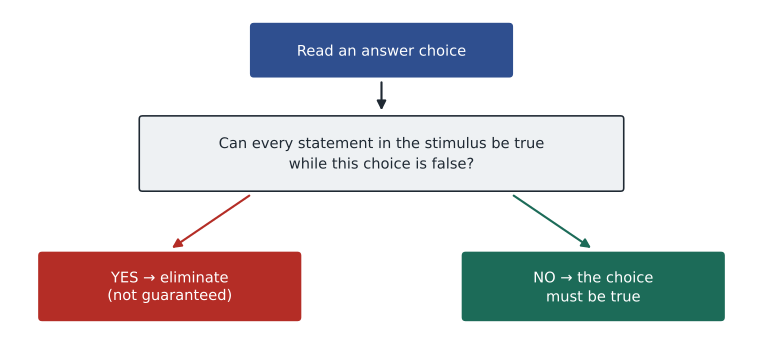
- Step 4: Test each choice against the stimulus. For each one, ask: "Can I imagine every statement in the stimulus being true while this choice is false?" If yes, eliminate it.
The test in step 4 is the heart of the method. Harriet called it "the counterexample test." You do not need to prove that a choice is false; you only need to show that it could be false consistent with the stimulus.
When prediction works
Prediction works best when the stimulus is formal: chains of conditionals, overlapping quantity statements, or a short list of rules with a fact that triggers them. In those stimuli, you can usually write down every valid conclusion in under a minute.
Marcus tried this on a stimulus Harriet wrote on the screen: "Every contractor bidding on the Lindale bridge project must hold a structural steel certification. No contractor with an unresolved safety violation may hold that certification. Dorsey Construction is bidding on the project."
He translated aloud: Bidding → Certified; Certified → not Violation (from the contrapositive form of "no one with a violation may hold it"). Chain: Bidding → Certified → not Violation. Fact: Dorsey is bidding. So Dorsey is certified and has no unresolved safety violation. 'And the contrapositive,' he added: 'any contractor with an unresolved violation is not bidding.'
With that prediction in hand, the right answer would be one of three things: Dorsey holds the certification; Dorsey has no unresolved safety violation; a contractor with an unresolved violation is not bidding on the project. Any choice that says something else is suspect.
When prediction does not work
Other must-be-true stimuli are descriptive: a paragraph about a historical event, a scientific finding or a policy, with no formal logic at all. Prediction is hard here, because a paragraph of facts supports dozens of small inferences. Harriet's advice for these was to read for scope and strength: note exactly who and what the stimulus discusses, and how strongly each claim is made. Then go to the choices and apply the counterexample test ruthlessly.
Thomas, who liked descriptive stimuli because they read like his history coursework, found this harder than he expected. 'I keep picking the answer that sounds like a good thesis statement,' he said. Harriet told him that the right answer to a must-be-true question is almost never a good thesis statement. It is usually a narrow observation, closer to a footnote.
The wrong answers
Wrong answers to must-be-true questions fall into a small number of patterns. Learning to name them speeds up elimination.
- Could be true: the choice is consistent with the stimulus but not required by it. This is the most common wrong answer, and the one most often chosen. The counterexample test catches it.
- Overstatement: the choice takes a claim from the stimulus and strengthens it ("some" to "most," "can" to "will," "often" to "always").
- Reversal: the choice reverses a conditional or an "all" statement.
- Out of scope: the choice introduces a comparison, cause, motive, recommendation or prediction the stimulus does not address.
- Contradiction: the choice conflicts with the stimulus. This is the right answer to a cannot-be-true question (lesson 6) but always wrong here.
- True but irrelevant to the facts: the choice states something that may be true in the world but has nothing to do with what was said.
| Wrong-answer type | What it looks like | How to catch it |
|---|---|---|
| Could be true | Consistent with the stimulus, not forced by it | Counterexample test |
| Overstatement | Stronger word than the stimulus uses | Compare quantity and certainty words |
| Reversal | Swaps the sides of a conditional or "all" claim | Check the arrow direction |
| Out of scope | New comparison, cause or recommendation | Ask: did the stimulus discuss this? |
| Contradiction | Conflicts with a stated fact | Eliminate on must-be-true; credit on cannot-be-true |
Combining facts
Many correct answers combine two facts from different parts of the stimulus. The test writers like these because they require you to hold the whole stimulus in mind, not just the last sentence you read.
A stimulus might say early on that "every exhibit in the museum's east wing is on loan from another institution," and later that "the Hollis tapestry is displayed in the east wing." Neither sentence alone says the tapestry is on loan; together they guarantee it. When you test an answer, look for the two sentences that, combined, would support it.
Worked problem
Sample question (written for this course)
Stimulus: "The Tarnwick Historical Society awards its preservation grant only to buildings that are at least a century old. This year, every applicant that received the grant also agreed to open the building to the public for at least one weekend a year. The Calder Mill, built in 1931, applied for this year's grant, which was awarded in 2026." Stem: "If the statements above are true, which one of the following must also be true?" (A) The Calder Mill will not be opened to the public this year. (B) Every building that is open to the public at least one weekend a year received the grant. (C) The Calder Mill did not receive the preservation grant this year. (D) Most applicants for the grant this year were at least a century old. (E) The Tarnwick Historical Society values public access more than architectural merit.
Show solution
- Translate: Grant → At least 100 years old. Grant (this year) → Agreed to open. Facts: the Calder Mill was built in 1931 and the grant was awarded in 2026, so the mill is 95 years old, not a century.
- Contrapositive of the first rule: not 100 years old → not Grant. So the Calder Mill did not receive the grant. That is (C).
- (A) does not follow: the mill might open to the public for its own reasons. Not receiving the grant does not prevent opening (that would deny a sufficient condition).
- (B) reverses the second rule. (D) is out of scope: the stimulus says nothing about most applicants.
- (E) is out of scope: the stimulus describes rules, not values or priorities.
Answer: (C). A rule plus a fact that fails its necessary condition, combined through the contrapositive.
Hidden facts in dates and numbers
The sample question above needed a small piece of arithmetic: a building from 1931 is not a century old in 2026. Observe that the stimulus stated the year of the award; the test never expects you to supply today's date yourself. The LSAT occasionally builds inferences on simple numbers like this. They are never difficult arithmetic, but they are easy to miss if you skim. When a stimulus mentions years, ages, prices or percentages alongside a rule, check whether the numbers trigger the rule.
Percentages need particular care. "Sixty percent of the applicants were from Ontario" tells you the share, not the number. If the stimulus also says the number of applicants rose, you still cannot conclude that the number from Ontario rose unless the share stayed the same or grew. You met this distinction in LSAT-111's lesson on statistical flaws; on must-be-true questions it decides whether a choice is guaranteed.
"Some" and "not necessarily" in the right answer
Correct answers often use weak, hedged language. "At least one of the society's grant recipients is open to the public" is a more defensible claim than "most grant recipients are open to the public." Some correct answers are even phrased negatively: "It is not necessarily the case that…" or "Not every…" These are true whenever the stimulus leaves room for an exception.
Dani found negatively phrased answers confusing at first. Harriet suggested rewriting them positively before testing them. "Not every applicant was interviewed" becomes "At least one applicant was not interviewed." Then ask whether the stimulus guarantees that.
A note on speed
Ji-won asked whether she should try to eliminate four choices or confirm one. Harriet said both strategies work, and the best students switch between them. If you have a strong prediction, scan for it and confirm it with the counterexample test. If you have no prediction, eliminate. Either way, never pick a choice until you have checked it against the stimulus.
The session closed with a set of six must-be-true questions in eight and a half minutes. Ji-won got all six. Élodie and Marcus got five each. Thomas got five, and said he had resisted at least two thesis statements. Dani got four, missing two questions that turned on "most."
Practice: a descriptive must-be-true stimulus
Worked problem
Sample question (written for this course)
Stimulus: "In the nineteenth century, the town of Thornmere grew rapidly after a railway line connected it to the coast. Before the railway, the town's population was under two thousand. Within thirty years of the railway's opening, the population had passed fifteen thousand, and three new churches and a public market had been built." Stem: "Which one of the following can be properly inferred from the information above?" (A) Thornmere's population more than doubled within thirty years of the railway's opening. (B) The railway caused Thornmere's population growth. (C) Most of Thornmere's new residents came from the coast. (D) Towns connected to railways grew faster than other towns. (E) The public market was built before the churches.
Show solution
- Facts: population under two thousand before the railway; over fifteen thousand within thirty years after it opened.
- (A) From under two thousand to over fifteen thousand is more than double. Guaranteed by simple arithmetic.
- (B) is a causal claim; "grew rapidly after" reports a sequence, not a proven cause. (C) introduces where residents came from, which is never stated.
- (D) compares with other towns the stimulus never mentions. (E) invents an order of construction.
Answer: (A). On descriptive stimuli, the credited answer is often a small, certain deduction from numbers or dates already given.
Thomas, the history graduate, admitted he had been drawn to the causal answer. 'In an essay I would write exactly that,' he said. Harriet reminded him that an essay can argue; a must-be-true answer cannot.
Common mistakes
MistakeChoosing an answer because it could easily be true.
InsteadThe answer must be guaranteed; if you can build a counterexample, eliminate it.
MistakeJudging the quality of an argument in a must-be-true stimulus.
InsteadAccept every statement, including any conclusion, as true.
MistakeReading only the last sentence of the stimulus closely.
InsteadCorrect answers often combine facts from different sentences.
MistakePicking the broad, thesis-like summary.
InsteadCorrect answers are usually narrow, hedged and modest.
Summary and key terms
- Must-be-true questions require certainty: the answer must hold whenever the stimulus holds.
- Predict when the stimulus is formal; read for scope and strength when it is descriptive.
- The counterexample test eliminates any choice that could be false while the stimulus is true.
- Common wrong answers: could be true, overstatement, reversal, out of scope, contradiction.
- Correct answers often combine two facts or use hedged, negative or "some" language.
- Counterexample test
- Checking whether every statement in the stimulus could be true while an answer choice is false.
- Could-be-true answer
- A choice consistent with the stimulus but not required by it.
- Scope
- The subjects and claims a stimulus actually addresses.
- Properly inferred
- Following with certainty from the given statements.
Practice problems
Work each problem on paper first, then reveal the answer to check.
Stimulus: "Every bus on route 9 has a wheelchair ramp. Some buses with wheelchair ramps are electric." Must some route 9 buses be electric?
Show answer
No. The electric buses with ramps might all be on other routes.
Same stimulus. Must every bus without a wheelchair ramp be off route 9?
Show answer
Yes. It is the contrapositive of the first sentence.
Rewrite positively and test: "It is not the case that every student passed." Stimulus: "Twelve students wrote the exam; the average mark was below the pass mark."
Show answer
"At least one student did not pass." If the average was below the pass mark, at least one mark was below it, so this must be true.
Lesson quiz · 5 questions
Score 60% or more to complete this lesson.
Create a free account to save your progress, take quizzes and earn a certificate.