
LSAT-112 · Lesson 1 of 12 · 19 min
Inference questions: what the test asks
▶ Video coming soon A video version of this lesson is on the way.
On Sunday morning, October 4, 2026, the Thursday Circle met for something new. Harriet had added a Sunday clinic to the schedule, a ninety-minute session every second or third weekend that would run alongside the Thursday arguments block and, later, the Tuesday workshops on flaws. The Sunday sessions had one subject: inference. 'For three weeks you have been taking arguments apart,' she told the group. 'Finding conclusions, naming assumptions. On Sundays we turn the telescope around. The stimulus is no longer the thing to criticize. It is the evidence, and your job is to work out what it proves.'
Dani, who had joined from her kitchen table in Tucson with a mug of coffee the size of a soup bowl, asked whether that meant the questions would be easier. Harriet smiled. 'Different, not easier. Most people find inference questions harder at first, because they have spent their lives being rewarded for reading between the lines. On these questions, reading between the lines is exactly how you lose points.'
This course covers the questions in Logical Reasoning that ask what follows from a stimulus, or what pattern a stimulus shares with another, or what would make sense of it. This first lesson sets out the territory: which question types belong to the inference family, how they differ from the argument-based questions of LSAT-110 and LSAT-111, and the one rule that governs all of them.
Two directions of reasoning
Every Logical Reasoning question involves a stimulus and a set of answer choices. What changes from one question type to the next is the direction in which support has to flow.
In the argument-based questions you studied in LSAT-110 and LSAT-111 (assumption, flaw, strengthen, weaken and evaluate), the stimulus contains an argument with a conclusion, and you judge how well the premises support it. The answer choices are new information that you bring to bear on that argument. Support flows from the answer choice up to the stimulus.
In inference questions, the direction reverses. The stimulus is a set of facts, sometimes with a conclusion and sometimes without one, and you treat everything in it as true. The answer choices are candidate conclusions. Your job is to find the choice that the stimulus supports. Support flows from the stimulus down to the answer choice.
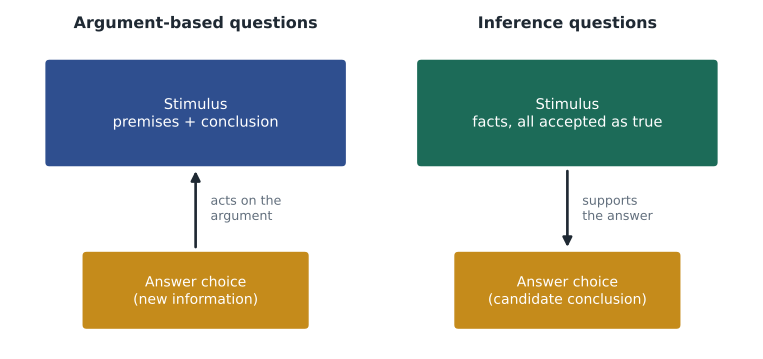
This reversal changes how you read. In an assumption or flaw question, you read sceptically, hunting for the gap between evidence and conclusion. In an inference question, you read like a careful clerk taking down a witness statement: every fact matters, nothing may be added, and the exact wording of each claim (some, most, all, only, unless) controls what you can conclude.
The inference family
Prep books name the inference family in different ways, and LSAC publishes no official list of question types. In this course we group these questions into six kinds:
- Must-be-true questions: "If the statements above are true, which one of the following must also be true?" The correct answer is guaranteed by the stimulus.
- Most-strongly-supported questions: "The statements above, if true, most strongly support which one of the following?" The correct answer is very likely given the stimulus, though not always guaranteed.
- Cannot-be-true questions: "If the statements above are true, which one of the following CANNOT be true?" The correct answer contradicts the stimulus.
- Principle questions: the stimulus states a general rule and you apply it, or the stimulus describes a case and you find the rule that justifies it.
- Parallel reasoning and parallel flaw questions: you find the answer choice whose logical structure matches the stimulus.
- Resolve-the-paradox and point-at-issue questions: you explain an apparent conflict between facts, or you identify the claim two speakers disagree about.
Strictly speaking, parallel reasoning and paradox questions are not pure inference. Parallel questions test your grasp of structure, and paradox questions ask you to add information, as strengthen questions do. We group them here because they all depend on the same habit: reading the stimulus precisely, without adding to it, and working out exactly what it does and does not say.
| Question type | Typical stem | What the right answer does |
|---|---|---|
| Must be true | Which one of the following must be true? | Follows with certainty from the stimulus |
| Most strongly supported | The statements above most strongly support which one of the following? | Is very well supported by the stimulus |
| Cannot be true | Which one of the following CANNOT be true? | Contradicts the stimulus |
| Principle (apply or identify) | Which one of the following judgments conforms most closely to the principle above? | Matches a rule to a case |
| Parallel reasoning or flaw | Which one of the following arguments is most similar in its reasoning? | Shares the stimulus's logical structure |
| Resolve the paradox | Which one of the following, if true, most helps to explain the apparent discrepancy? | Allows both facts to be true at once |
| Point at issue | The dialogue provides the most support for the claim that the two disagree over whether… | States a claim one speaker accepts and the other rejects |
The one rule: no outside help
Harriet wrote a single sentence on the shared screen and asked everyone to copy it onto a card: "The right answer to an inference question needs no help from me."
On an assumption question, the right answer is precisely the extra fact that the argument needs. On an inference question, the right answer must be supported by the stimulus alone. If you find yourself thinking "well, that is probably true in real life" or "that would follow if we also knew X," you are adding outside help, and the answer is almost certainly wrong.
Consider a simple stimulus: "Every employee at Ferrand Logistics who works the night shift receives a pay premium. Some employees at Ferrand Logistics who receive a pay premium work in the warehouse."
Several conclusions might feel natural:
- "Some night-shift employees work in the warehouse." This does not follow. The employees who receive a premium and work in the warehouse might all be day-shift workers who receive a premium for some other reason, such as hazardous work.
- "Night-shift employees earn more than day-shift employees." This does not follow either. A premium is extra pay, but day-shift employees might have higher base pay. The stimulus says nothing about total earnings.
- "Some employees at Ferrand Logistics receive a pay premium." This does follow, because the second sentence says so directly. It is not exciting, but it is guaranteed.
Thomas laughed at the third choice. 'That is the answer? It is just repeating the stimulus.' Harriet nodded. 'Sometimes it is. A correct inference can be boring. The test is not asking for the most interesting thing you could say about Ferrand Logistics. It is asking for something the facts force on you.'
Why careful readers miss these questions
Students who are good readers in everyday life often find inference questions frustrating, and Harriet spent some time explaining why. In normal conversation, we fill gaps generously. If a friend says "Most of my colleagues are vegetarian, and the office party had no meat," we infer that the party was planned around the colleagues. That is a reasonable inference in life, and a dangerous one on the LSAT. The test writers deliberately build wrong answers out of these generous inferences.
Élodie described it in her own way. 'In French class we called it "surinterprétation." Over-reading. My professors in political science reward it. The LSAT punishes it.' Harriet liked that so much she added it to the group's glossary.
Three features of wrong answers recur across the inference family:
- Overstatement. The stimulus says "many" and the answer says "most," or the stimulus says "often" and the answer says "always." A stronger claim needs stronger evidence.
- New material. The answer introduces a comparison, a cause, a motive or a group that the stimulus never mentions.
- Reversal. The stimulus says "all A are B" and the answer says "all B are A," or the stimulus gives a necessary condition and the answer treats it as sufficient. These traps come straight from the conditional logic you met in LSAT-110 and will study more closely in the next lesson.
Correct answers, by contrast, tend to be modest. They use hedged language ("some," "at least one," "can," "is not necessarily"), or they combine two statements from the stimulus into one small deduction.
Worked problem
Sample question (written for this course)
Stimulus: "The Corwin Public Library lends e-readers only to cardholders who have returned every previously borrowed item on time. Last month, Selma Ortiz borrowed an e-reader from the library." Stem: "If the statements above are true, which one of the following must also be true?" (A) Selma Ortiz has never returned an item late to the Corwin Public Library. (B) Selma Ortiz reads more electronic books than printed ones. (C) Most cardholders at the Corwin Public Library have borrowed an e-reader. (D) Selma Ortiz is a cardholder at the Corwin Public Library. (E) The Corwin Public Library lends e-readers to anyone who returns items on time.
Show solution
- Translate the rule: Borrows e-reader → cardholder with a perfect return record. Fact: Selma borrowed an e-reader. So she is a cardholder with a perfect record.
- (D) follows directly: she must be a cardholder. This is the guaranteed inference.
- (A) is tempting but goes too far. The rule requires that every previously borrowed item was returned on time at the time of lending; the stimulus does not say she has never been late in her life (she might have been late years ago, before the rule, or the rule may consider only current loans). More importantly, it adds "never," a stronger word than the stimulus supports.
- (B) introduces new material about her reading habits. (C) introduces a claim about most cardholders, which nothing supports.
- (E) reverses the conditional. A perfect record is necessary for borrowing an e-reader, not sufficient for it.
Answer: (D). The modest, directly guaranteed choice wins. The tempting choice overstated the rule, and the trap choice reversed it.
How the stem tells you what to do
Because the inference family contains questions that pull in opposite directions, reading the stem first matters even more here than in argument-based questions. Harriet asked the group to sort stems by the standard of support they require:
- Certainty: "must be true," "must be false," "cannot be true," "properly inferred," "logically follows." The right answer is guaranteed or ruled out by the stimulus.
- Strong support: "most strongly supported," "most strongly suggested," "the statements above provide the most support for." The right answer is the best supported, even if not strictly guaranteed. In practice, most correct answers to these questions are also very nearly guaranteed.
- Structure: "most similar in its reasoning," "most closely parallels." You compare the logical form of arguments.
- Explanation: "most helps to explain," "most helps to resolve." You add a fact that makes a puzzle make sense.
- Disagreement: "disagree over whether," "committed to disagreeing about." You find a claim on which two speakers take opposite positions.
Marcus, whose November test was then five and a half weeks away, asked how common these questions are. Harriet gave the honest answer: the mix varies from test to test, and LSAC does not publish fixed quotas. But across recent tests, inference-type questions (must be true, most strongly supported, cannot be true, principle, parallel, paradox and point at issue) make up a substantial share of every Logical Reasoning section, often close to half of it. With two scored Logical Reasoning sections on the current test, that is a lot of points.
The plan for this course
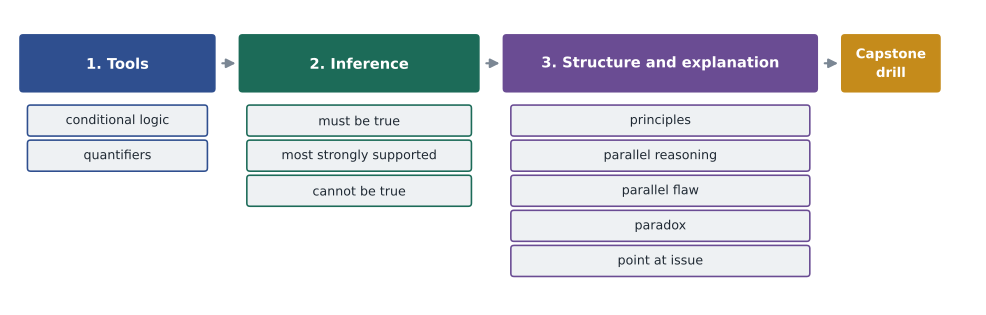
Harriet sketched the next seven Sunday sessions. The group would begin with the logical tools that make inference possible: conditional statements and their chains (lesson 2) and quantity words such as "some," "most" and "all" (lesson 3). Then they would move to the question types themselves: must-be-true (lesson 4), most-strongly-supported (lesson 5), cannot-be-true and EXCEPT forms (lesson 6), principle questions (lesson 7), parallel reasoning (lesson 8), parallel flaw (lesson 9), resolve-the-paradox (lesson 10) and point-at-issue (lesson 11). The course would end with a timed drill on Sunday, November 22 (lesson 12).
Ji-won asked whether she should expect to need her extra time more on these questions than on the argument questions. Harriet thought about it. 'Possibly. Inference questions reward slow, literal reading, and the stimulus often contains five or six separate facts. Your accommodation exists exactly so that you can read the way these questions need to be read. Use it without guilt.'
Common mistakes
MistakeChoosing an answer because it is probably true in real life.
InsteadOn inference questions, the answer must be supported by the stimulus alone; real-world likelihood is irrelevant.
MistakeRejecting an answer because it seems too obvious or simply repeats the stimulus.
InsteadCorrect inferences are often modest. A restatement or a small combination of two facts can be the credited answer.
MistakeReading an inference stimulus sceptically, looking for a flaw.
InsteadTreat every statement in the stimulus as true and ask what it guarantees.
MistakeAccepting an answer that uses a stronger word than the stimulus ("most" for "many," "always" for "often").
InsteadA stronger claim needs stronger evidence; overstatement is the most common trap.
Summary and key terms
- Inference questions reverse the direction of argument-based questions: the stimulus supports an answer choice.
- The inference family includes must-be-true, most-strongly-supported and cannot-be-true questions; principle, parallel, paradox and point-at-issue questions depend on the same precise reading.
- The right answer to an inference question needs no outside help.
- Wrong answers usually overstate, introduce new material or reverse a conditional.
- The stem tells you the standard of support: certainty, strong support, structure, explanation or disagreement.
- Inference
- A conclusion that is supported by given statements; on the LSAT, one supported by the stimulus without outside information.
- Stimulus
- The short passage that begins each Logical Reasoning question.
- Overstatement
- An answer choice that makes a stronger claim than the stimulus supports.
- Over-reading
- Adding plausible but unstated assumptions when drawing a conclusion from a text.
Practice problems
Work each problem on paper first, then reveal the answer to check.
Stimulus: "All of the city's bike lanes are cleared of snow before 7 a.m. Some streets with bike lanes are in the downtown core." Does it follow that some downtown streets are cleared of snow before 7 a.m.?
Show answer
Yes, at least their bike lanes are. Some streets with bike lanes are downtown, and every bike lane is cleared before 7 a.m., so some downtown streets have lanes cleared before 7 a.m.
Same stimulus. Does it follow that the downtown core has more bike lanes than other areas?
Show answer
No. That is new material; the stimulus makes no comparison between areas.
Classify the stem: "The information above provides the most support for which one of the following?"
Show answer
Strong support (most strongly supported). The right answer is the best supported, usually very nearly guaranteed.
Lesson quiz · 5 questions
Score 60% or more to complete this lesson.
Create a free account to save your progress, take quizzes and earn a certificate.