
LSAT-110 · Lesson 8 of 12 · 25 min
Conditional statements
▶ Video coming soon A video version of this lesson is on the way.
On Thursday, October 22, 2026, Harriet began with a sign she had photographed at a community pool: "Swimmers may use the deep end only if they have passed the swim test." She asked whether a swimmer who had passed the test was allowed in the deep end. Marcus said yes. Thomas said yes. Ji-won hesitated and said, 'Not necessarily. The sign says passing is required. It does not say passing is enough.'
Ji-won was right, and the distinction she drew is the subject of this lesson and the next. Conditional statements, "if" statements and their many disguises, appear in a large share of Logical Reasoning questions. They are central to assumption questions, to flaw questions about confused conditions, and to inference questions where you combine rules. Dani, who had told Harriet that formal logic language was her weakest area, had been dreading this session. By the end of it she said the rules were simpler than she had feared. 'There are only a few,' Harriet told her. 'The hard part is applying them without slipping.'
The basic form
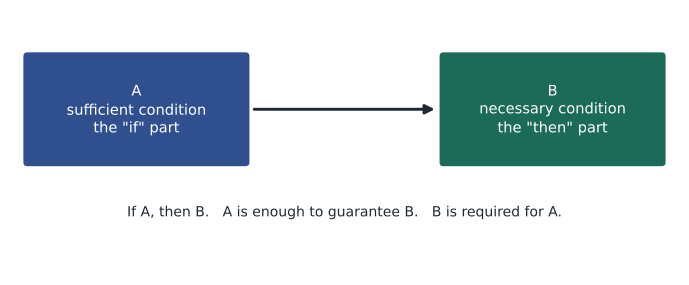
A conditional statement says that if one thing is true, another is true. "If it rains, the game is canceled." The part after "if" is the condition, or the sufficient condition: knowing it is true is enough to know the other part is true. The other part is the result, or the necessary condition: it must be true whenever the first is.
You can write a conditional as an arrow: Rain → Canceled. The arrow points from the sufficient condition to the necessary condition. Harriet asked the group to use the arrow for every conditional in the first two weeks, because writing it down catches errors that reading alone does not.
What a conditional does and does not tell you
A conditional tells you exactly one thing: whenever the sufficient condition holds, the necessary condition holds. Four situations are possible.
| Situation | Rain? | Canceled? | Consistent with "If it rains, the game is canceled"? |
|---|---|---|---|
| 1 | Yes | Yes | Yes |
| 2 | Yes | No | No: this is the only case the statement rules out |
| 3 | No | Yes | Yes: the game may be canceled for another reason |
| 4 | No | No | Yes |
The key line is situation 3. The conditional says nothing about what happens when it does not rain. The game could be canceled anyway, because of a power cut or a team that fails to show up. Many LSAT errors come from treating a conditional as if it also said "and only if".
Valid inferences
From "If A then B", two inferences are valid.
- If you know A is true, you can conclude B is true. (It rained, so the game was canceled.)
- If you know B is false, you can conclude A is false. (The game was not canceled, so it did not rain.)
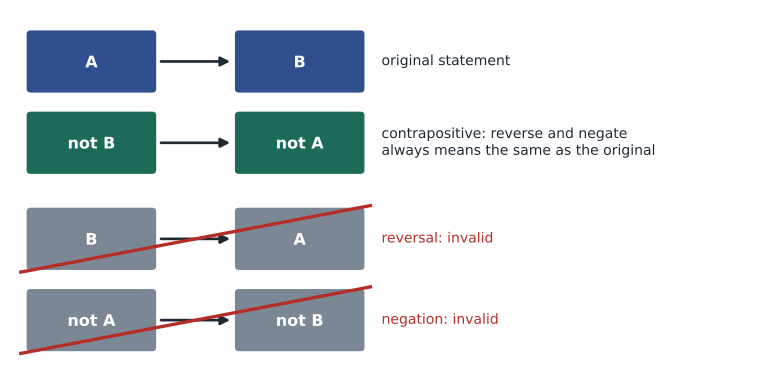
The second is called the contrapositive. It is formed by reversing the arrow and negating both sides: "If A then B" is equivalent to "If not B then not A." These two statements always mean the same thing. If one is true, so is the other.
Invalid inferences
Two other inferences look similar but are not valid.
- Reversal (also called affirming the consequent): "If A then B; B is true; so A is true." The game was canceled, so it rained. Invalid: the game could have been canceled for another reason.
- Negation (also called denying the antecedent): "If A then B; A is false; so B is false." It did not rain, so the game was not canceled. Invalid: again, other causes are possible.
These two errors are among the most frequently tested flaws on the LSAT. Wrong answer choices on assumption and inference questions often commit them too, so learning to spot them protects you on several question types.
Worked problem
Testing inferences
Rule: "If a student is on the honor roll, the student has a grade average of at least 85." Which of the following conclusions are valid? (1) Lena is on the honor roll, so her average is at least 85. (2) Sam's average is 88, so Sam is on the honor roll. (3) Kwame's average is 80, so Kwame is not on the honor roll. (4) Joy is not on the honor roll, so her average is below 85.
Show solution
- Write the rule: Honor roll → 85 or above.
- (1) Affirms the sufficient condition. Valid.
- (2) Affirms the necessary condition and concludes the sufficient one. That is a reversal. Invalid: an 85 average may be required but not enough (there might be other requirements).
- (3) Denies the necessary condition and concludes the denial of the sufficient one. That is the contrapositive. Valid.
- (4) Denies the sufficient condition. That is a negation. Invalid.
Answer: Only (1) and (3) are valid.
Translating conditional language
The LSAT rarely writes "if... then" plainly. It uses a wide range of phrases, and you must translate each one into an arrow correctly. The table below lists the most important. Learn it until you can translate without looking.
| Phrase | Translation | Example |
|---|---|---|
| If A, then B | A → B | If it is a weekday, the office is open: Weekday → Open |
| All A are B | A → B | All members pay dues: Member → Pays |
| Every A / any A / each A | A → B | Every pilot is certified: Pilot → Certified |
| A only if B | A → B | You may vote only if you are registered: Vote → Registered |
| Only A are B | B → A | Only members may vote: Vote → Member |
| A requires B / A depends on B | A → B | Success requires effort: Success → Effort |
| No A are B | A → not B | No minors may enter: Minor → not Enter |
| A unless B | not B → A | The event is held unless it rains: not Rain → Held |
| Without B, not A | not B → not A, so A → B | Without a ticket, no entry: Entry → Ticket |
| The only A are B | A → B | The only cars allowed are electric: Allowed car → Electric |
The two most important translations
Two phrases cause most of the errors: "only if" and "unless".
"Only if" introduces the necessary condition. "A only if B" means A → B. The pool sign said "Swimmers may use the deep end only if they have passed the test": Deep end → Passed. Passing is necessary, not sufficient. That is why Ji-won was right that passing alone does not guarantee permission.
Compare "if" with "only if". "You may enter if you have a ticket" means Ticket → Enter: having a ticket is enough. "You may enter only if you have a ticket" means Enter → Ticket: a ticket is required. One small word reverses the arrow.
"Unless" is best handled with a mechanical rule: the part after "unless" becomes the necessary condition, and you negate the other part to make the sufficient condition. "The picnic will be held unless it rains" becomes "If not held, then rain": not Held → Rain. Equivalently, by contrapositive, not Rain → Held. Both versions say the same thing: no rain guarantees the picnic.
Harriet's shortcut for "unless": replace "unless" with "if not". "The picnic will be held if it does not rain." That gives not Rain → Held directly.
Worked problem
Sample question (written for this course)
Stimulus: "A contractor can bid on the city's bridge project only if the contractor is bonded. Raycroft Builders is bonded." Stem: "Which one of the following can be properly inferred?" (A) Raycroft Builders will bid on the bridge project. (B) Raycroft Builders meets the bonding requirement for bidding on the bridge project. (C) Any bonded contractor can bid on the project. (D) Raycroft Builders cannot bid on the project. (E) Only Raycroft Builders is bonded.
Show solution
- Translate: Bid → Bonded. Being bonded is necessary.
- Raycroft is bonded. That affirms the necessary condition, which tells us nothing about whether it can bid.
- (A) and (C) treat bonding as sufficient: reversal. Invalid.
- (D) is not supported; Raycroft meets the one stated requirement.
- (E) is unsupported.
- (B) says only what follows: Raycroft meets this requirement. Whether it can bid, or will, remains open.
Answer: (B). Meeting a necessary condition is not enough to conclude the result.
"All", "some", "most" and "none"
Statements with "all" are conditionals. "All employees completed training" means Employee → Completed. Statements with "no" or "none" are conditionals with a negated result. "No employee missed the meeting" means Employee → not Missed. Their contrapositives follow the usual rule: "If someone missed the meeting, that person is not an employee."
Statements with "some" and "most" are not conditionals. "Some employees work remotely" says only that at least one does. It cannot be reversed into a rule, and it has no contrapositive. You will combine "some" and "most" statements with conditionals in LSAT-112. For now, know that "all" and "no" make arrows and "some" and "most" do not.
Chains
Conditionals can link. If A → B and B → C, then A → C. "All the trail's bridges are inspected yearly; every bridge inspected yearly is safe for bikes; so all the trail's bridges are safe for bikes." Chains appear often in sufficient assumption questions, where the right answer supplies the missing link. Lesson 11 returns to this.
Worked problem
Building a chain
Rules: "Anyone who completes the course earns a certificate. Anyone who earns a certificate can apply for the advanced program." Is this conclusion valid: "Anyone who completes the course can apply for the advanced program"? What about: "Anyone who can apply for the advanced program completed the course"?
Show solution
- Complete → Certificate. Certificate → Can apply.
- Chain: Complete → Certificate → Can apply. So Complete → Can apply. The first conclusion is valid.
- The second reverses the chain: Can apply → Complete. Invalid; there may be other ways to be eligible.
Answer: The first conclusion is valid by chaining. The second is a reversal and invalid.
Practice that sticks
Harriet assigned forty translation drills for the week: twenty sentences to translate into arrows, ten contrapositives to write, and ten inferences to mark valid or invalid. Dani completed them twice, a day apart, and kept a card with the "only if" and "unless" rules on her desk at work. By the next session her translation accuracy was 38 of 40.
Élodie noticed that French gave her an advantage and a trap. "Seulement si" mapped neatly onto "only if", but she sometimes read "à moins que" with a meaning slightly different from the LSAT's strict "unless". She decided to translate every "unless" mechanically for the rest of her preparation, whatever her instinct said.
Sample question: combining two rules
Worked problem
Sample question (written for this course)
Stimulus: "No one is admitted to the lab without a security badge. Every person with a security badge has completed the confidentiality training. Mehdi was admitted to the lab." Stem: "If the statements above are true, which one of the following must also be true?" (A) Mehdi works in the lab every day. (B) Mehdi has completed the confidentiality training. (C) Everyone who has completed the training is admitted to the lab. (D) Mehdi is the only person admitted to the lab. (E) Some people with badges have not completed the training.
Show solution
- Translate the first rule: "No one is admitted without a badge" means Admitted → Badge.
- Second rule: Badge → Training.
- Chain: Admitted → Badge → Training. Mehdi was admitted, so he has a badge and has completed the training.
- (B) follows.
- (A) and (D) are unsupported. (C) reverses the chain. (E) contradicts the second rule.
Answer: (B). Translate "without", chain the rules, and follow the arrows from what you know.
Harriet asked the group to notice the first rule's wording. "No one is admitted without a badge" has a "no" and a "without" together, which makes students hesitate. The cleanest translation uses the "without" rule from the table: without B, not A means A → B. Here, without a badge, not admitted, so Admitted → Badge. Writing the arrow takes two seconds and removes the hesitation.
Checking your translations
A quick check catches most translation errors: read your arrow back as an "if... then" sentence and compare it with the original. "If admitted, then has a badge." Does that say the same thing as "No one is admitted without a badge"? Yes. If the read-back sounds different from the original, the arrow is probably reversed.
Why the rules matter later
Dani asked whether all this translation would matter beyond this lesson. Harriet listed three places it would. Sufficient assumption questions in lesson 11 often ask for the missing link in a chain of conditionals. Flaw questions in the next course often describe reversals and negations in abstract language, such as "mistakes a condition required for an outcome for one that guarantees it". And inference questions in the course after that ask you to combine several rules and see what must follow. In each case, an error in translating a single "only if" or "unless" leads to a wrong answer, however well you understand the rest.
Common mistakes
Mistake"A only if B" means B → A.
Instead"Only if" introduces the necessary condition: A → B.
MistakeIf A → B and B is true, then A is true.
InsteadThat is a reversal; B may be true for other reasons.
MistakeIf A → B and A is false, then B is false.
InsteadThat is a negation; B may still be true.
Mistake"Some A are B" can be written as an arrow.
InsteadOnly "all" and "no" statements are conditionals; "some" and "most" are not.
MistakeThe contrapositive just reverses the arrow.
InsteadReverse the arrow and negate both sides.
Summary and key terms
- A conditional "If A then B" makes A sufficient for B and B necessary for A; write it as A → B.
- The only case it rules out is A true and B false.
- Valid: from A, conclude B; from not B, conclude not A (the contrapositive).
- Invalid: from B, conclude A (reversal); from not A, conclude not B (negation).
- "Only if" introduces the necessary condition; for "unless", replace it with "if not".
- "All" and "no" statements are conditionals; "some" and "most" are not. Conditionals can be chained.
- Conditional statement
- A statement that one thing is true if another is, written A → B.
- Sufficient condition
- A condition that, if true, guarantees the result; the "if" part.
- Necessary condition
- A condition that must be true for the other to be true; the "then" part.
- Contrapositive
- The equivalent statement formed by reversing and negating: not B → not A.
- Reversal
- The invalid inference from B to A (also called affirming the consequent).
- Negation
- The invalid inference from not A to not B (also called denying the antecedent).
Practice problems
Work each problem on paper first, then reveal the answer to check.
Translate: "The library will close early unless volunteers are available."
Show answer
not Volunteers → Close early (equivalently, not Close early → Volunteers).
Write the contrapositive of "All registered voters received a ballot."
Show answer
If someone did not receive a ballot, that person is not a registered voter.
Rule: "Only licensed drivers may rent a car." Mira rented a car. What follows?
Show answer
Mira is a licensed driver (Rent → Licensed).
Lesson quiz · 5 questions
Score 60% or more to complete this lesson.
Create a free account to save your progress, take quizzes and earn a certificate.