
LSAT-110 · Lesson 7 of 12 · 25 min
Method of reasoning and role questions
▶ Video coming soon A video version of this lesson is on the way.
Main point questions ask what an argument concludes. Two related question types ask how it gets there. Method of reasoning questions ask you to describe the technique the argument uses. Role questions, sometimes called argument part questions, ask what job one particular statement does. Harriet introduced both in the second half of the October 15 session, and warned the group that the answer choices would look different from anything they had seen so far.
'The answers are abstract,' she said. 'They will not say "the mayor's budget". They will say "a general principle is applied to a specific case" or "it is a claim the argument is designed to refute". You have to translate the argument into that language, and the language into the argument.'
Dani found this the hardest adjustment of the course. She could see exactly what an argument did, but the answer choices seemed to describe it in a foreign language. By the end of the month she had a glossary of her own, and her accuracy on both types had doubled. This lesson gives you that glossary and a method for using it.
Role questions
A role question names one statement from the stimulus and asks what part it plays. Typical stems:
- "The claim that [X] plays which one of the following roles in the argument?"
- "Which one of the following most accurately describes the role played in the argument by the statement that [X]?"
- "The statement that [X] figures in the argument in which one of the following ways?"
Some role questions name two statements and ask about both, with answer choices like "The first is a premise; the second is the main conclusion." These require you to get both roles right.
Role questions are a direct test of mapping. If you have mapped the argument, you know the answer before you read the choices.
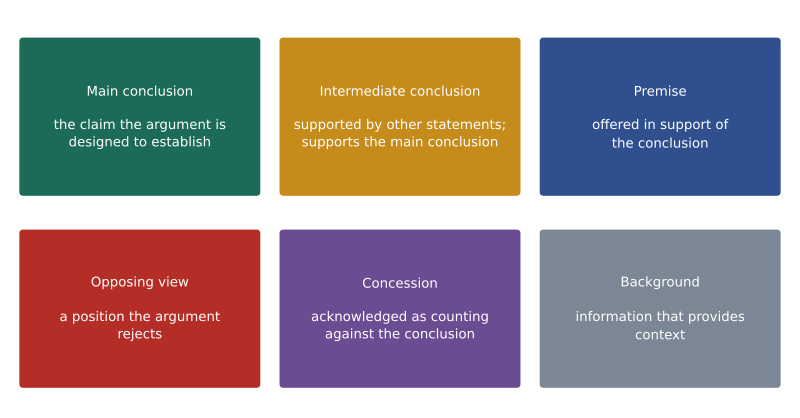
Translating roles into answer-choice language
Answer choices describe roles in abstract terms. Here is how each role usually appears.
| Role | How answer choices often describe it |
|---|---|
| Main conclusion | "the main conclusion"; "the claim the argument as a whole is structured to support"; "the position the argument seeks to establish" |
| Intermediate conclusion | "a subsidiary conclusion used to support the main conclusion"; "a conclusion for which support is provided and which is used to support the main conclusion" |
| Premise | "a premise offered in support of the conclusion"; "evidence for the main conclusion"; "a reason given for accepting the conclusion" |
| Opposing view | "a claim the argument is designed to refute"; "a position the argument rejects"; "a hypothesis the argument seeks to discredit" |
| Evidence for an opposing view | "evidence that has been offered in support of a position the argument rejects" |
| Concession | "a consideration that might be taken to count against the conclusion"; "a fact acknowledged in order to be shown not to undermine the conclusion" |
| Background | "a statement providing context"; "background information" |
Notice how much the wording matters. "A claim the argument is designed to refute" is an opposing view. "A claim that is used to support a conclusion the argument rejects" is evidence for an opposing view. Those describe different statements. Read each answer choice slowly enough to know which one it describes.
Worked problem
Sample role question (written for this course)
Stimulus: "Some historians claim that the canal was abandoned because the railway made it unprofitable. But the canal's own records show that traffic remained steady for a decade after the railway opened, and the company cited flood damage when it closed the canal. The railway, then, was probably not the main reason the canal was abandoned." Stem: "The claim that traffic on the canal remained steady for a decade after the railway opened plays which one of the following roles?" (A) It is the argument's main conclusion. (B) It is a claim the argument is designed to refute. (C) It is evidence offered against the historians' explanation. (D) It is evidence offered in support of the historians' explanation. (E) It is a concession that weakens the argument's conclusion.
Show solution
- Map: opposing view (historians: railway made canal unprofitable); "But"; premise 1 (steady traffic); premise 2 (flood damage cited); conclusion (railway probably not the main reason).
- The steady traffic is a premise supporting the author's conclusion, which rejects the historians' explanation.
- (A) is wrong: the conclusion is about the railway not being the main reason.
- (B) is wrong: the author relies on this claim; the historians' claim is the one refuted.
- (C) is right: it is evidence against the historians' explanation.
- (D) reverses the direction. (E) is wrong: it supports, not weakens, the conclusion.
Answer: (C). Because the author's conclusion rejects the historians' view, evidence for the author's conclusion is evidence against the historians.
Method of reasoning questions
Method of reasoning questions ask how the argument works as a whole. Typical stems:
- "The argument proceeds by..."
- "Which one of the following most accurately describes the technique of reasoning employed by the argument?"
- "The argument does which one of the following?"
- In dialogues: "Kai responds to Lena's argument by..."
The answer describes the argument's structure and type of reasoning in general terms. To answer, you need to know both the map (what supports what) and the kind of reasoning involved (analogy, counterexample, causal explanation, application of a principle, and so on).
Common methods
Most method of reasoning answers describe one of a dozen or so techniques. Learning their names and abstract descriptions is the fastest way to improve.
| Method | What the argument does | Abstract wording you might see |
|---|---|---|
| Analogy | Concludes something about one case because it resembles another | "draws a conclusion based on a comparison with a relevantly similar case" |
| Counterexample | Shows a general claim is false by giving an exception | "offers a counterexample to a general claim" |
| Applying a principle | Applies a general rule to a specific situation | "applies a general principle to a particular case" |
| Causal explanation | Explains an effect by identifying a cause | "proposes an explanation for an observed phenomenon" |
| Ruling out alternatives | Concludes one option by eliminating others | "argues that one possibility must be the case by eliminating alternatives" |
| Undermining evidence | Shows that an opponent's evidence does not support their claim | "questions the adequacy of the evidence offered for a claim" |
| Reductio | Shows a view leads to an absurd or contradictory result | "shows that a position leads to an unacceptable consequence" |
| Generalizing from examples | Draws a general conclusion from cases | "draws a general conclusion from a number of particular instances" |
| Clarifying a term | Argues about what a key word means | "points out that a key term is used in more than one sense" |
Match every part
Method of reasoning answers often have several parts: "It presents evidence that a claim is false and then concludes that a different explanation is more likely." Every part must fit the argument. A choice that fits the first half and not the second is wrong. Harriet asked the group to underline each clause of an answer choice and check it against the stimulus. If any clause does not match, the choice is out.
This is also where "too strong" answers appear. A choice that says the argument "proves" something, when it only makes something likely, is wrong. A choice that says the argument "rejects" a view, when it only questions the evidence for it, is wrong.
Worked problem
Sample method question (written for this course)
Stimulus: "The mayor says that no city of our size can support two professional sports teams. But Harmon, a city with almost exactly our population, has supported both a hockey team and a baseball team profitably for over twenty years." Stem: "The argument proceeds by" (A) arguing that the mayor's claim is true in most cases (B) offering a counterexample to a general claim (C) proposing an alternative explanation for a phenomenon (D) attacking the mayor's motives rather than the mayor's claim (E) concluding that the city should acquire a second team
Show solution
- The mayor makes a general claim: no city of this size can support two teams.
- The argument gives one case, Harmon, where a city of this size does.
- That is a counterexample. (B) matches.
- (A) is the opposite. (C) there is no phenomenon being explained. (D) the argument does not mention motives. (E) the argument draws no recommendation.
Answer: (B). One clear exception is enough to defeat a claim about "no city".
Dialogue methods
When the stem asks how one speaker responds to another, identify what the second speaker does with the first speaker's argument. Common responses include:
- Denying a premise: "That is not true; the survey was taken in winter."
- Accepting the premises but denying the conclusion follows: "Even if prices rise, demand may not fall."
- Offering a counterexample to the first speaker's general claim.
- Pointing out that the first speaker uses a term in two senses.
- Showing that the first speaker's principle, applied consistently, leads to an unacceptable result.
The difference between denying a premise and denying that the conclusion follows is tested often. In the first case, the second speaker disputes a fact. In the second, the second speaker accepts the facts but says they do not prove what the first speaker thinks.
Worked problem
Sample dialogue method question (written for this course)
Stimulus: "Priya: The new reading program must be effective. Test scores in the district rose the year it began. Theo: Scores also rose that year in districts that did not use the program." Stem: "Theo responds to Priya by" (A) denying that test scores rose (B) suggesting that something other than the program may explain the rise (C) arguing that the program is harmful (D) claiming that test scores do not measure reading ability (E) agreeing with Priya's conclusion but rejecting her evidence
Show solution
- Priya infers that the program caused the rise in scores.
- Theo accepts that scores rose, but points out they rose elsewhere too, without the program.
- That suggests another cause, such as an easier test or a statewide factor.
- (B) matches. (A) Theo does not deny the rise. (C) Theo says nothing about harm. (D) Theo does not discuss what tests measure. (E) Theo does not agree with Priya's conclusion.
Answer: (B). Theo accepts Priya's premise and challenges the causal conclusion.
Building your glossary
Dani's breakthrough came from a simple exercise Harriet assigned: for every role or method question she missed, she copied the credited response's abstract wording into a notebook, next to a plain-language translation. After three weeks the notebook had about forty entries, and she noticed that the same phrases kept returning. "Calls into question the evidence" meant undermining evidence. "Draws a conclusion about a specific case from a general rule" meant applying a principle. "A claim the argument is designed to refute" meant an opposing view.
Ji-won, who had a strong vocabulary already, found a different benefit. She had been eliminating correct answers because they were worded more abstractly than she expected. The glossary showed her that abstract wording was normal for these types, and that a vague-sounding choice could still match every part of the argument.
Sample question: holding an opponent to a principle
Worked problem
Sample question (written for this course)
Stimulus: "Councillor Avery argues that the city should not build the new library branch because construction costs have risen. But costs have risen for every public project, including the road repairs Avery voted for last month. If rising costs were a good reason to cancel the library, they would be an equally good reason to cancel the road repairs." Stem: "The argument proceeds by" (A) showing that Avery's reasoning, applied consistently, would require a conclusion Avery rejects (B) offering evidence that construction costs have not risen (C) attacking Avery's character instead of Avery's reasoning (D) arguing that the library will cost less than the road repairs (E) presenting a counterexample to a general claim about libraries
Show solution
- The argument does not deny that costs rose. It shows that Avery's principle, that rising costs justify canceling, would also cancel the road repairs Avery supports.
- That is the technique of applying an opponent's reasoning consistently to show it leads somewhere they do not accept.
- (A) matches.
- (B) is wrong: the argument accepts that costs rose. (C) is wrong: it addresses Avery's reasoning, not character. (D): no cost comparison is made. (E): no general claim about libraries is contradicted.
Answer: (A). The argument holds Avery to his own principle.
Some students would call this an attack on Avery for being inconsistent, and choose (C). But pointing out that someone's reasoning commits them to an unwelcome conclusion is a criticism of the reasoning, not of the person. Harriet asked the group to watch for that distinction, because LSAT-111 will test it again when it covers the flaw of attacking the person.
Common mistakes
MistakeA choice that describes part of the argument correctly is good enough.
InsteadEvery clause of a method answer must fit; one wrong part eliminates the choice.
Mistake"A claim the argument is designed to refute" describes evidence the author uses.
InsteadIt describes an opposing view; evidence the author uses is a premise.
MistakeAbstract wording means a choice is probably wrong.
InsteadMethod and role answers are normally abstract; translate them carefully.
MistakeIf a second speaker disagrees, they must be denying a premise.
InsteadThey may accept the premises and deny that the conclusion follows.
MistakeA counterexample must involve many cases.
InsteadOne clear exception is enough to defeat a claim about "all" or "no".
Summary and key terms
- Role questions ask what job a named statement does; method of reasoning questions ask how the argument works as a whole.
- Map the argument first; for role questions, this usually gives you the answer.
- Answer choices use abstract wording; learn how each role and method is typically described.
- Common methods include analogy, counterexample, applying a principle, causal explanation, ruling out alternatives and undermining evidence.
- Check every clause of a method answer against the argument.
- In dialogues, distinguish denying a premise from denying that the conclusion follows.
- Role question
- A question asking what part a particular statement plays in the argument.
- Method of reasoning question
- A question asking how the argument proceeds, described in general terms.
- Counterexample
- A case that shows a general claim to be false.
- Analogy
- Reasoning that one case is like another in a relevant way.
- Undermining evidence
- Showing that evidence offered for a claim does not adequately support it.
- Reductio
- Showing that a position leads to an absurd or unacceptable consequence.
Practice problems
Work each problem on paper first, then reveal the answer to check.
Translate into plain language: "The argument draws a general conclusion from a few particular instances."
Show answer
The argument generalizes from examples.
An argument says, "Our city should adopt rent control because it worked in Kelburn, a city much like ours." Name the method.
Show answer
Analogy: a conclusion about one city based on its similarity to another.
In a role question, a choice says the statement is "evidence offered in support of a position the argument rejects." Which part of an argument does that describe?
Show answer
The premises of an opposing view, not the author's own premises.
Lesson quiz · 5 questions
Score 60% or more to complete this lesson.
Create a free account to save your progress, take quizzes and earn a certificate.