
LSAT-110 · Lesson 11 of 12 · 25 min
Necessary and sufficient assumption questions
▶ Video coming soon A video version of this lesson is on the way.
Harriet began the second half of the October 29 session with two stems on the screen, one above the other. "The argument depends on assuming which one of the following?" and "The conclusion follows logically if which one of the following is assumed?" She asked whether the same answer could be right for both. Dani said yes, probably. Ji-won said sometimes. Harriet said Ji-won was closer, and that the difference between the two questions was worth more points than any other single idea in the course.
This lesson teaches both kinds of assumption question: necessary assumption questions, which ask what the argument requires, and sufficient assumption questions, which ask what would guarantee the conclusion. It gives you a test for each, shows the wrong-answer patterns, and explains why the right answer to one is often the wrong answer to the other.
Necessary assumption questions
A necessary assumption is something the argument cannot do without. Stems use words like "depends on", "requires", "relies on" or "is an assumption required by". The right answer need not be strong; it need only be something that must be true for the argument to work. In fact, right answers to necessary assumption questions are often modest, even minimal: "at least some", "not all", "does not entirely".
The negation test
The most reliable tool for necessary assumption questions is the negation test. Take an answer choice, negate it (state its logical opposite), and ask whether the argument falls apart. If negating the choice destroys the argument, the choice is a necessary assumption. If the argument survives, the choice is not required.
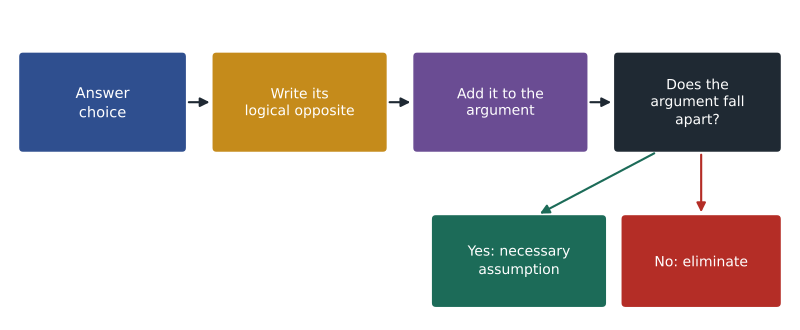
Negating correctly is a skill in itself. The negation of a statement is whatever makes it false, and nothing more.
| Statement | Correct negation | Not the negation (too strong) |
|---|---|---|
| All residents voted | Not all residents voted (at least one did not) | No residents voted |
| Some residents voted | No residents voted | Some residents did not vote |
| Most residents voted | Half or fewer of the residents voted | Almost no residents voted |
| The plan will succeed | The plan will not succeed | The plan will fail badly |
| X is the only cause | X is not the only cause | X is not a cause |
| The benefits outweigh the costs | The benefits do not outweigh the costs | The costs are enormous |
The pattern is that a correct negation is the weakest statement that makes the original false. "Not all" is the negation of "all", not "none". Students who negate too strongly will see arguments collapse that would actually survive the true negation, and will pick wrong answers.
Worked problem
Sample necessary assumption question (written for this course)
Stimulus: "The Eastfield Library's new evening hours have increased its total weekly visits. Therefore, the evening hours have attracted people who did not previously use the library." Stem: "The argument depends on assuming which one of the following?" (A) Most of the evening visitors are students. (B) Not all of the increase in visits comes from people who already used the library and simply visit more often. (C) The library should extend its weekend hours as well. (D) The evening hours were popular with library staff. (E) Every evening visitor is a new library user.
Show solution
- Premise: total visits rose. Conclusion: the hours attracted new users.
- Gap: more visits could come from existing users visiting more often.
- Negate (B): "All of the increase comes from existing users visiting more often." Then no new users were attracted. The argument collapses. So (B) is required.
- Negate (E): "Not every evening visitor is a new user." The argument survives; some new users are still possible. (E) is too strong to be required.
- (A) negated ("Half or fewer are students") does not matter. (C) and (D) are irrelevant.
Answer: (B). Its modest wording ("not all") is typical of necessary assumptions.
Strong choices are suspicious
Choice (E) in the example shows a common trap. "Every evening visitor is a new library user" would help the argument enormously. If it were true, the conclusion would be certain. But the argument does not need it. It needs only that some new users were attracted. On necessary assumption questions, choices with "all", "always", "only" or "every" are usually wrong unless the argument itself makes a claim that strong.
Sufficient assumption questions
A sufficient assumption is something that, added to the premises, makes the conclusion follow with certainty. Stems use words like "follows logically if", "enables the conclusion to be properly drawn", "if assumed, allows the conclusion to be properly inferred" or "justifies the conclusion".
The right answer may be much stronger than the argument needs. It does not have to be true, or likely; it only has to be enough. If you add it to the premises and the conclusion is guaranteed, it is the answer.
Bridging with a conditional
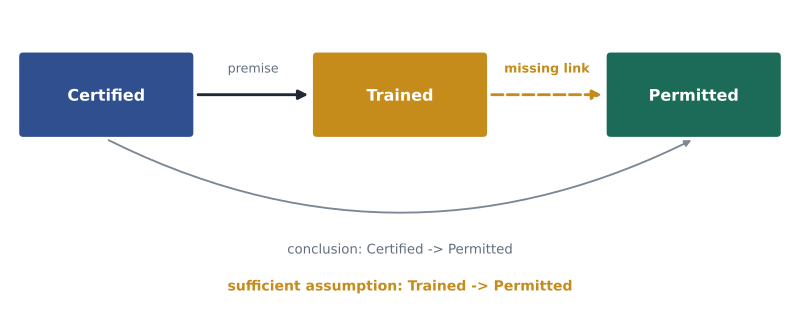
Sufficient assumption questions often have a mechanical structure. The premises connect some terms, the conclusion connects others, and the right answer supplies a conditional that bridges the missing link. You can map them with arrows from lesson 8.
Worked problem
Sample sufficient assumption question (written for this course)
Stimulus: "Every certified welder at the plant has completed advanced safety training. Therefore, every certified welder at the plant is permitted to work on the main line." Stem: "The conclusion follows logically if which one of the following is assumed?" (A) Some workers permitted on the main line are certified welders. (B) Anyone who has completed advanced safety training is permitted to work on the main line. (C) Anyone permitted to work on the main line has completed advanced safety training. (D) Most certified welders prefer the main line. (E) Advanced safety training is offered only to certified welders.
Show solution
- Premise: Certified → Trained. Conclusion: Certified → Permitted.
- Missing link: Trained → Permitted. With it, Certified → Trained → Permitted.
- (B) states Trained → Permitted. The conclusion now follows.
- (C) reverses it: Permitted → Trained. That does not complete the chain.
- (A) is a "some" statement; it cannot guarantee anything about every welder.
- (D) is irrelevant. (E) says Training offered → Certified, which does not link training to permission.
Answer: (B). It supplies exactly the missing link.
Testing a sufficient assumption
To test a choice on a sufficient assumption question, assume it is true, add it to the premises, and ask: does the conclusion now have to be true? If yes, it is the answer. If there is still any way the conclusion could be false, it is not.
Watch for reversed conditionals, as in choice (C) above. They are the most common wrong answers on sufficient assumption questions, because they use the right terms in the wrong direction.
Comparing the two
| Necessary assumption | Sufficient assumption | |
|---|---|---|
| Asks for | Something the argument requires | Something that guarantees the conclusion |
| Stem words | depends on, requires, relies on | follows logically if, enables the conclusion to be properly drawn |
| Typical strength of right answer | Modest: some, not all, at least | Often strong: all, every, any, only |
| Test | Negate it: does the argument collapse? | Add it: is the conclusion now certain? |
| Common wrong answer | Too strong: helpful but not needed | Reversed conditional or too weak to guarantee |
The same choice can be right for one type and wrong for the other. In the library example, "Every evening visitor is a new library user" would be sufficient (it guarantees new users were attracted), but it is not necessary. In the welder example, the bridge "Anyone who has completed advanced training is permitted on the main line" is sufficient, but the argument might work with something narrower, such as "Any certified welder who has completed the training is permitted". The narrower claim might be the necessary one.
Sometimes a choice is both necessary and sufficient. Those are the easiest cases. The hard ones are the choices that are only one.
Worked problem
Same argument, two questions
Stimulus: "Lucia has lived in the city for more than ten years. So Lucia is eligible for the long-term resident discount." Consider two choices. (1) "Anyone who has lived in the city for more than ten years is eligible for the discount." (2) "Having lived in the city for more than ten years does not disqualify a person from the discount." Which is sufficient, and which is necessary?
Show solution
- Choice (1) bridges Lived 10+ → Eligible. Add it and the conclusion follows. It is sufficient.
- Is (1) necessary? Negate it: "Not everyone who has lived here over ten years is eligible." Lucia could still be eligible (for example, if only some ten-year residents are excluded for reasons that do not apply to her). The argument weakens but does not necessarily collapse. So (1) is not strictly necessary.
- Choice (2): negate it: "Having lived here more than ten years disqualifies a person." Then Lucia, who has lived here that long, is disqualified, and the conclusion is false. The argument collapses. So (2) is necessary.
- Is (2) sufficient? No: not being disqualified does not make her eligible.
Answer: (1) is sufficient but not necessary; (2) is necessary but not sufficient.
Strategy for each
For necessary assumption questions, predict the gap and look for the choice that defends it, usually in modest language. If two choices remain, negate both and see which one breaks the argument.
For sufficient assumption questions, map the premises and conclusion with arrows when the argument is conditional, find the missing link, and look for a choice that supplies it in the right direction. When the argument is not conditional, look for the choice that, if true, leaves no way for the conclusion to be false.
Harriet also gave the group a rule about time. Sufficient assumption questions with conditional structure are often fast once mapped. Necessary assumption questions with subtle wording can be slow. On a timed section, she suggested, if a necessary assumption question is down to two choices after 90 seconds, negate both once, choose, flag and move on.
The group's results
At the end of October, every member of the Thursday Circle took a twenty-question assumption set. Thomas scored 14 of 20 timed and 17 in blind review. His remaining errors were almost all on sufficient assumption questions where he had chosen a reversed conditional. Dani scored 12 timed, with most errors on negations she had made too strong; her blind review score was 16. Marcus, two weeks from his test, scored 16 and said the negation test had changed how he read every stem. Élodie scored 17. Ji-won scored 18 under her extended timing and said she had stopped choosing answers just because they made the argument sound better.
Sample question: a modest conclusion, a modest assumption
Worked problem
Sample question (written for this course)
Stimulus: "The paint store's owner believes that moving the store to the new plaza will increase sales, since the plaza attracts many more shoppers than the store's current street. But most plaza shoppers come for groceries and leave quickly. So the move may not increase sales as much as the owner expects." Stem: "The argument depends on which one of the following assumptions?" (A) No plaza shopper buys paint. (B) At least some of the plaza's shoppers who come for groceries would not stop at a paint store. (C) The owner should not move the store. (D) Paint stores do better on streets than in plazas. (E) The store's current street attracts no shoppers.
Show solution
- Conclusion: the move may not increase sales as much as expected (a modest claim).
- Premise: most plaza shoppers come for groceries and leave quickly.
- Gap: the argument assumes that leaving quickly means many of them will not shop at the paint store.
- Negate (B): "Every grocery shopper would stop at a paint store." Then the crowds would help sales after all, and the argument collapses. Required.
- Negate (A): "Some plaza shoppers buy paint." The argument survives; it never claimed no one would buy. (A) is too strong.
- (C) goes beyond the conclusion. (D) is an unneeded generalization. (E) is extreme and irrelevant.
Answer: (B). A modest conclusion needs only a modest assumption.
Notice how the strength of the conclusion set the strength of the assumption. The argument concluded only that sales "may not" rise "as much as" expected. An assumption like "no plaza shopper buys paint" would support a much stronger conclusion than this one, so the argument does not need it. Matching the strength of the assumption to the strength of the conclusion is one of the fastest ways to eliminate wrong choices on necessary assumption questions.
When you are down to two
On hard necessary assumption questions, you will often narrow the field to two choices that both seem relevant. Negate both, carefully and minimally, and read each negation back into the argument. Usually one negation clearly breaks the argument and the other only makes it a little less convincing. Choose the one that breaks it. On sufficient assumption questions, do the opposite: add each finalist to the premises and ask which one leaves no way for the conclusion to be false.
Common mistakes
MistakeThe negation of "all" is "none".
InsteadThe negation of "all" is "not all": at least one exception.
MistakeThe strongest choice is safest on a necessary assumption question.
InsteadNecessary assumptions are often modest; strong choices are usually more than the argument needs.
MistakeA sufficient assumption must be something the argument requires.
InsteadIt need only guarantee the conclusion; it may be more than required.
MistakeA conditional with the right terms is always the bridge.
InsteadCheck direction; reversed conditionals are the commonest wrong answers.
Mistake"Some" statements can serve as sufficient assumptions for conclusions about "all".
InsteadA "some" statement cannot guarantee a conclusion about every member.
Summary and key terms
- Necessary assumption questions ask what the argument requires; use the negation test.
- Negate minimally: the opposite of "all" is "not all", of "some" is "none", of "most" is "half or fewer".
- Right answers to necessary assumption questions are often modest; strong choices are suspicious.
- Sufficient assumption questions ask what would guarantee the conclusion; add the choice and check whether the conclusion must follow.
- For conditional arguments, the sufficient assumption usually supplies a missing link in the right direction.
- A choice can be sufficient without being necessary, or necessary without being sufficient.
- Negation test
- Negating an answer choice to see whether the argument collapses; used for necessary assumptions.
- Logical negation
- The weakest statement that makes the original false.
- Bridge
- A conditional that links a premise term to a conclusion term.
- Reversed conditional
- A conditional with its sufficient and necessary conditions swapped, a common wrong answer.
Practice problems
Work each problem on paper first, then reveal the answer to check.
Negate: "Most applicants submitted their forms on time."
Show answer
Half or fewer of the applicants submitted their forms on time.
Premise: All interns attend orientation. Conclusion: All interns receive a badge. What is the sufficient assumption?
Show answer
Anyone who attends orientation receives a badge (Attend → Badge).
A choice reads, "Every customer who received the coupon used it." The stem asks what the argument depends on. Why should you be cautious?
Show answer
"Every" is strong; the argument may need only that some customers used it. Negate it ("not every customer used it") and check whether the argument still survives.
Lesson quiz · 5 questions
Score 60% or more to complete this lesson.
Create a free account to save your progress, take quizzes and earn a certificate.