
LSAT-110 · Lesson 6 of 12 · 25 min
Main point questions
▶ Video coming soon A video version of this lesson is on the way.
By Thursday, October 15, 2026, the Thursday Circle had spent three weeks on argument structure. Harriet decided it was time to turn the skill into points. 'Main point questions are the most direct test of what you have been practicing,' she said. 'They give you a stimulus and ask for its conclusion. If you can map an argument, these should become your most reliable questions.'
She was right for most of the group. Ji-won had not missed a main point question in two weeks. Thomas had gone from three wrong in his diagnostic to none on his last practice set. But Élodie was still missing about one in four, always on the harder ones, and always for the same reason: she picked an answer that described an intermediate conclusion. Dani was missing a different kind: she picked answers that restated the conclusion with a small change in strength.
This lesson covers main point questions in detail: how to recognize them, a method for answering them, the wrong-answer patterns that appear again and again, and how to handle the hardest versions.
Recognizing the question
Main point questions (also called main conclusion questions) ask you to identify the argument's main conclusion. Typical stems:
- "Which one of the following most accurately expresses the main conclusion of the argument?"
- "The overall conclusion drawn in the argument is that..."
- "Which one of the following most accurately expresses the conclusion drawn by the argument as a whole?"
- "The main point of the argument is that..."
A close cousin asks for the conclusion in a dialogue: "Which one of the following is the main point of [the second speaker's] response?" The same method applies; you find the conclusion of that speaker's argument.
Main point questions are different from inference questions that ask what the stimulus "most strongly supports". An inference question asks what follows from the stimulus; a main point question asks what the stimulus itself concludes. The right answer to a main point question is already in the stimulus, usually reworded.
The method
- Step 1: Read the stem and confirm it is a main point question.
- Step 2: Read the stimulus and map it: premises, intermediate conclusions, opposing views, concessions, main conclusion.
- Step 3: State the main conclusion in your own words, with its qualifiers, before looking at the choices. If the conclusion points backward ("this view is mistaken"), unpack it.
- Step 4: Find the choice that matches your statement. Then check the others against the wrong-answer patterns.
Predicting the answer before reading the choices is the key step. The answer choices are written to tempt you with plausible-sounding claims from the stimulus. If you read them before you know what you are looking for, you will be pulled toward whichever one sounds most important.
The wrong-answer patterns
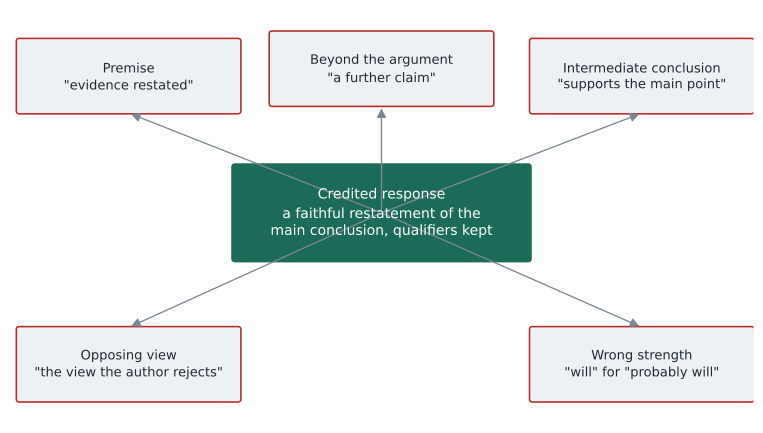
Wrong answers on main point questions come in five main types.
- A premise. The choice restates evidence. It is in the stimulus, it is true, but it is a reason, not the conclusion.
- An intermediate conclusion. The most tempting trap on hard questions. The choice states a claim that is concluded and then used to support something further.
- The opposing view. The choice states the position the author rejects, sometimes slightly reworded so it sounds like the author's view.
- Wrong strength. The choice states the conclusion but changes a qualifier: "will" instead of "probably will", "all" instead of "most", "is false" instead of "has not been shown".
- Beyond the argument. The choice draws a further inference the author never makes, or combines claims in a way the stimulus does not.
Worked problem
Sample question (written for this course)
Stimulus: "Many residents believe that the new shopping center has hurt the town's independent stores. But sales tax records show that independent stores' combined revenue has risen since the center opened, and three new independent stores have opened in the past year. Clearly, the shopping center has not harmed the town's independent stores as a group." Stem: "Which one of the following most accurately expresses the main conclusion of the argument?" (A) Independent stores' combined revenue has risen since the shopping center opened. (B) The shopping center has not harmed the town's independent stores as a group. (C) The shopping center has helped every independent store in town. (D) Many residents are mistaken about the town's economy in general. (E) The shopping center has hurt the town's independent stores.
Show solution
- Map: opposing view (residents' belief), "But", two premises (revenue up, new stores), and "Clearly" introducing the conclusion.
- Predict: the center has not harmed independent stores as a group.
- (A) is a premise.
- (B) matches the prediction, including "as a group".
- (C) is too strong: "helped every store" goes far beyond "not harmed as a group".
- (D) goes beyond the argument: it is about the economy in general, not independent stores.
- (E) is the opposing view.
Answer: (B). Every wrong choice is one of the standard traps.
Paraphrase: the right answer rarely copies
The credited response usually rewords the conclusion rather than copying it. "The council should postpone the vote" might appear as "It would be advisable for the council to delay voting." Wrong answers, by contrast, sometimes copy phrases from the stimulus word for word, because that makes them look familiar. Do not choose an answer because its words match; choose it because its meaning matches.
When the conclusion is compressed, the right answer may combine it with the claim it points to. If the stimulus ends with "So the critics are wrong," and the critics claimed that a policy would raise prices, the right answer might say "The policy will not raise prices." That is the conclusion unpacked.
Worked problem
A conclusion that must be unpacked
Stimulus: "According to the consultants' report, moving the company's headquarters downtown would attract younger employees. This prediction is unfounded. The report relied entirely on a survey of current employees, whose average age is fifty-two." Stem: "The main conclusion of the argument is that" (A) the consultants' report relied on a survey (B) moving downtown would not attract younger employees (C) the consultants' report does not adequately support its prediction that moving downtown would attract younger employees (D) current employees have an average age of fifty-two (E) the company should not move its headquarters
Show solution
- The conclusion is "This prediction is unfounded," pointing back to the report's prediction.
- Unpacked: the report's evidence does not support the prediction about younger employees.
- (B) is too strong: the author says the prediction is unfounded, not that it is false.
- (C) matches: the report does not adequately support its prediction.
- (A) and (D) are premises. (E) goes beyond the argument.
Answer: (C). "Unfounded" means "not supported", which is weaker than "false".
Dialogue main points
Some stimuli present two speakers. The stem might ask for the main point of the second speaker's response. Often the second speaker does not state a conclusion directly but implies one by responding to the first speaker. In that case, ask what the second speaker is trying to show about the first speaker's claim: that it is false, that it is unsupported, or that it misses something.
Worked problem
Sample dialogue question (written for this course)
Stimulus: "Nadia: Our city should ban gas-powered leaf blowers. They are loud and pollute the air. Owen: Electric blowers are just as loud, so if noise is your concern, banning gas blowers alone will not solve it." Stem: "Owen's response is most accurately described as arguing that" (A) gas-powered leaf blowers do not pollute the air (B) a ban on gas-powered blowers would not address the noise problem on its own (C) the city should ban all leaf blowers (D) electric blowers pollute more than gas blowers (E) noise is not a legitimate concern
Show solution
- Owen does not dispute pollution; he addresses noise only.
- His point: banning gas blowers alone will not solve the noise problem, because electric ones are as loud.
- (A) Owen does not deny pollution. (C) Owen never recommends a broader ban. (D) Owen says nothing about electric pollution. (E) Owen accepts noise as a concern.
- (B) matches.
Answer: (B). Owen's point is limited to noise, so the right answer is limited too.
Hard main point questions
The hardest main point questions combine several features: the main conclusion appears first or in the middle, a late "therefore" introduces an intermediate conclusion, the conclusion is compressed or points backward, and the answer choices include a tempting intermediate conclusion worded more strongly than the main point.
Élodie's fix was the "therefore" test applied to the two finalists. When she narrowed a question to two choices, she asked which one the other supported. In her next practice set, she got all four main point questions right, including two with this structure. 'I was choosing the claim that sounded most like a conclusion,' she said. 'Now I choose the one at the top of the map.'
Dani's fix was a strength check. After choosing an answer, she reread the stimulus's conclusion and compared every qualifier. Most of her errors had been answers that said "will" where the stimulus said "is likely to", or "the plan" where the stimulus said "this part of the plan". She added a column to her error log for "wrong strength" and watched it empty over two weeks.
| Trap | How to catch it |
|---|---|
| Premise | Ask: is this a reason given for something else? |
| Intermediate conclusion | Use the "therefore" test against your predicted main conclusion |
| Opposing view | Check who holds the view: the author or someone the author rejects |
| Wrong strength | Compare every qualifier with the stimulus |
| Beyond the argument | Ask: did the author actually say this? |
Timing
Main point questions tend to be among the faster questions in a section, because the answer is in the stimulus. Harriet set a target of about 60 to 70 seconds for most of them. That saved time is valuable: it can go to the assumption questions later in the section, which usually take longer. But she also warned against rushing hard main point questions. 'If you see a late "therefore" and a recommendation at the start, slow down for ten seconds and run the test. Those ten seconds are cheap.'
Marcus, testing in four weeks, set himself a rule: no main point question would get a second read of the answer choices unless he had first written his prediction. His accuracy on the type reached 100 percent across his last three practice sets before November 12.
Sample question: a recommendation right after a turn
Worked problem
Sample question (written for this course)
Stimulus: "Many teachers favor assigning more homework in the upper grades. In fact, the school should reduce homework in those grades. A district study found that students who spent more than two hours a night on homework reported more stress and no better grades than students who spent one hour. And extra time spent on homework comes out of sleep, which is itself linked to better learning." Stem: "Which one of the following most accurately expresses the main conclusion of the argument?" (A) Many teachers favor more homework in the upper grades. (B) Students who spend more than two hours on homework report more stress. (C) The school should reduce homework in the upper grades. (D) Sleep is linked to better learning. (E) Homework should be eliminated in all grades.
Show solution
- "In fact" introduces the author's claim against the teachers' view: reduce homework in the upper grades.
- The study and the point about sleep are premises.
- (A) is the opposing view. (B) and (D) are premises. (E) is too strong: "eliminated" and "all grades" both go beyond the conclusion.
- (C) matches.
Answer: (C). The conclusion came second, right after the turn, and the rest of the stimulus supported it.
Harriet pointed out that "In fact" often does the same job as "But": it turns from what others believe to what the author claims. When "In fact" appears in the second sentence of a stimulus, the conclusion is often right there.
When none of the choices matches your prediction
Occasionally your prediction will not match any choice exactly. That usually means the right answer paraphrases more loosely than you expected, or that you mapped the argument slightly wrong. Do not pick the closest-sounding choice. Instead, eliminate choices that are clearly premises, opposing views or wrong in strength, and compare the survivors with the stimulus, not with your prediction. If two remain, apply the "therefore" test between them.
Common mistakes
MistakeThe answer that copies the stimulus's words is probably right.
InsteadThe right answer usually paraphrases; match meaning, not wording.
MistakeThe strongest-sounding claim is the main point.
InsteadThe main point is the claim at the top of the argument map, whatever its tone.
MistakeReading the choices first helps you find the conclusion.
InsteadPredict the conclusion first; the choices are designed to tempt.
MistakeAn argument that a prediction is unfounded concludes the prediction is false.
InsteadIt concludes only that the prediction is not supported.
MistakeIn a dialogue, the second speaker always denies the first speaker's claim.
InsteadThe second speaker may only show that it is unsupported or incomplete.
Summary and key terms
- Main point questions ask for the argument's main conclusion, which is already in the stimulus, usually reworded.
- Map the argument and predict the conclusion, with its qualifiers, before reading the choices.
- The five traps are premises, intermediate conclusions, opposing views, wrong strength and claims beyond the argument.
- Unpack conclusions that point backward, such as "this prediction is unfounded".
- In dialogues, identify what the speaker is trying to show about the other speaker's claim.
- Main point questions are usually quick; use the saved time later, but slow down for hard structures.
- Main point question
- A question asking for the main conclusion of the argument.
- Prediction
- Your own statement of the answer, formed before reading the choices.
- Paraphrase
- A restatement in different words with the same meaning.
- Unfounded
- Not supported by adequate evidence; not the same as false.
Practice problems
Work each problem on paper first, then reveal the answer to check.
A stimulus ends, "Thus the safety concerns raised by the union are exaggerated." The union claimed the new machines were dangerous. How might the right answer read?
Show answer
Something like "The new machines are not as dangerous as the union claims." Keep the strength: exaggerated, not entirely false.
You have narrowed a main point question to two choices. One is a claim that supports the other. Which should you choose?
Show answer
The claim that is supported, since the main conclusion supports nothing else.
Why are main point questions usually faster than assumption questions?
Show answer
The answer is stated in the stimulus; you do not need to find an unstated gap.
Lesson quiz · 5 questions
Score 60% or more to complete this lesson.
Create a free account to save your progress, take quizzes and earn a certificate.