
LSAT-110 · Lesson 3 of 12 · 25 min
Premises, conclusions and indicator words
▶ Video coming soon A video version of this lesson is on the way.
On Thursday, October 1, 2026, the day of the November registration deadline, Marcus arrived at the session already registered and in a good mood. Harriet put him to work at once. 'Read this aloud,' she said, 'and tell me the moment you know which sentence is the conclusion.' The stimulus began, "Since the factory reopened, river samples have shown higher levels of the solvent." Marcus stopped after the first word. '"Since" — so that is a premise. The conclusion is coming.'
That instant recognition is what this lesson builds. Authors signal the structure of their arguments with small words: "therefore", "because", "thus", "since", "so", "hence", "after all". These indicator words are the fastest route to an argument's skeleton. They are not perfect, and the LSAT sometimes leaves them out or uses them in tricky ways, but learning them well saves time on almost every question.
Conclusion indicators
Conclusion indicators introduce the claim that follows from the rest. The most common are:
- therefore, thus, hence, so, consequently, accordingly
- it follows that, which shows that, which means that, which suggests that
- clearly, it is clear that, it must be that (often, though not always)
- we can conclude that, this indicates that, this proves that
Recommendation words often mark a conclusion too: "should", "ought to", "must", "it would be wise to". An author who says that the town "should" do something is usually drawing a conclusion from reasons, not stating a premise.
Premise indicators
Premise indicators introduce the reasons. The common ones are:
- because, since, for, as
- given that, in view of the fact that, owing to the fact that
- after all, for one thing, moreover, in addition, furthermore (these add a further premise)
- the reason is that, as shown by, as indicated by, this is so because
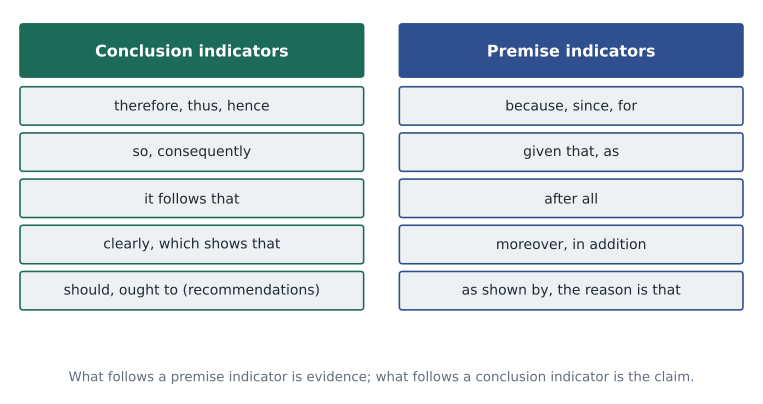
Notice that the two lists point in opposite directions. "A, therefore B" and "B, because A" express the same argument: A is the premise and B the conclusion. Marcus's instinct with "since" was right. "Since the factory reopened, river samples have shown higher levels" makes the factory's reopening part of a premise. The conclusion, a few words later, was that "the factory is probably the source of the solvent."
The "therefore" and "because" tests
Indicators are not always present. When they are missing, you can test a sentence's role by inserting one. Take two statements and try both orders.
- "A, therefore B." Does that make sense?
- "B, therefore A." Does that make sense?
Whichever version sounds like a sensible argument shows you the structure. Equivalently, put "because" in front of the candidate premise. "The bridge must be repaired, because inspectors found cracks in two supports" makes sense. "Inspectors found cracks in two supports, because the bridge must be repaired" does not. So the cracks are the premise and the repair is the conclusion.
Worked problem
Using the tests without indicator words
Stimulus: "The proposed tax credit will not increase home renovations. Homeowners surveyed last year said the main obstacle to renovating was the shortage of available contractors, not cost." Which sentence is the conclusion?
Show solution
- No indicator words appear. Try both orders.
- "The survey found contractor shortages were the main obstacle, therefore the tax credit will not increase renovations." This makes sense: a credit addresses cost, not the shortage.
- "The tax credit will not increase renovations, therefore the survey found contractor shortages were the main obstacle." This makes no sense: a prediction about a credit cannot cause last year's survey results.
Answer: The first sentence, that the credit will not increase renovations, is the conclusion. The survey result is the premise.
Words that look like indicators but are not
Some words can play an indicator role in one sentence and a different role in another. "Since" can mean "because" or "from the time that". In "Since 2019, the population has grown," it marks time, not a premise. "So" can mean "therefore" or "very": "The results were so clear that no one objected." "As" can introduce a reason or a comparison. Read for the meaning, not just the word.
Other words signal a change of direction rather than a premise or conclusion. These contrast words are important because they often introduce the author's own view after an opposing one.
- but, however, yet, nevertheless, nonetheless, still
- although, though, even though, while, whereas (these often introduce a concession)
- on the contrary, in fact, actually, despite
A common LSAT pattern is "Some people claim X. But Y. Therefore Z." The word "But" turns from the opposing view to the author's evidence. Another is "Although X, Y." The author concedes X and then asserts Y. Lesson 5 covers these patterns in detail.
| Word | Usual role | Watch out for |
|---|---|---|
| therefore, thus, hence | Introduces a conclusion | Sometimes introduces an intermediate conclusion, not the main one |
| because, since, for | Introduces a premise | "Since" marking time; "for" meaning "on behalf of" |
| so | Introduces a conclusion | "so" meaning "very" or "so that" |
| but, however, yet | Signals a change of direction | Often introduces the author's view after an opposing one |
| although, while | Introduces a concession | The main clause after it carries the author's claim |
| clearly, obviously | Often introduces a conclusion | Strong words can hide weak support |
When an indicator introduces a premise in disguise
The trickiest stimuli use a conclusion indicator to introduce an intermediate step rather than the main point. "The plant's emissions exceed the new limit, so it will need new filters. Therefore, the company should budget for the cost now." Here "so" introduces a sub-conclusion, that the plant will need filters, which then serves as a premise for the main conclusion, that the company should budget now. An argument can have two conclusion indicators, and only one of them marks the main conclusion. Lesson 5 shows how to sort these out.
Similarly, a premise indicator can appear inside the conclusion sentence. "The council should delay the vote, since the report is not yet finished" puts the conclusion and premise together in one sentence. The clause before "since" is the conclusion; the clause after is the premise. Do not assume that each sentence has exactly one role.
Worked problem
Sample question (written for this course)
Stimulus: "Since the regional airline added two daily flights to the capital, business travelers no longer need to stay overnight. Hotels near the regional airport are therefore likely to see fewer weekday bookings, and their owners should plan accordingly." Stem: "Which one of the following most accurately expresses the main conclusion of the argument?" (A) The airline added two daily flights to the capital. (B) Business travelers no longer need to stay overnight. (C) Hotel owners near the regional airport should plan for fewer weekday bookings. (D) Hotels near the airport will close. (E) Business travelers prefer not to stay overnight.
Show solution
- Premise: the added flights (introduced by "Since").
- First step: travelers no longer need to stay overnight.
- "Therefore" introduces the next step: hotels will likely see fewer weekday bookings.
- Then the recommendation: owners should plan accordingly. Everything else builds toward this.
- (A) is the premise. (B) is an early step. (D) is too strong; the argument says fewer bookings, not closure. (E) is not stated.
- (C) combines the predicted drop with the recommendation that rests on it, which is the main point.
Answer: (C). The word "therefore" marked a step, but the recommendation that follows it is where the argument ends up.
Reading without indicators: the "why" question
When there are no indicators at all, fall back on the most reliable method: pick a statement and ask, "Why should I believe this?" If other statements in the stimulus answer that question, the statement is a conclusion. If nothing in the stimulus answers it, the statement is a premise, or background.
Harriet gave the group an argument with no indicator words and asked each member to find the conclusion. "Most public pools in the region lose money. The Riverside pool has a large endowment. It can stay open even if attendance falls." Thomas went straight to the last sentence. Harriet asked him why. 'Because the endowment explains why it can stay open,' he said. 'Nothing explains why it has an endowment. That is just given.' The first sentence, about other pools, was background that set up a contrast.
Building the habit
For the week after October 1, Harriet asked the group to circle every indicator word in thirty stimuli and label it P (premise), C (conclusion), or T (turn, for contrast words). Then, for any stimulus with no indicators, they were to apply the "why" test and write the conclusion in the margin.
Dani said the drill felt elementary at first but showed her something important: she had been reading "so" as a premise indicator in some stimuli, because in her work at the immigration firm she wrote sentences like "the client is eligible, so we filed the petition," where the order matched the steps of a process rather than the logic of an argument. Once she noticed it, she stopped making the error.
Ji-won found that she was spending too long on stimuli without indicators. Harriet suggested a time limit: if the conclusion is not clear after one read, read the stem again, then the answer choices. Often a main point question's answer choices will make the structure obvious, because four of them describe premises, background or claims the argument does not make.
Worked problem
Spotting a concession
Stimulus: "Although electric buses cost more to buy than diesel buses, the transit authority should buy them. Their fuel and maintenance savings over a bus's life exceed the difference in price." Identify the conclusion and explain the role of the "Although" clause.
Show solution
- "Although" introduces a concession: a point that seems to count against the author's view.
- The main clause, "the transit authority should buy them," is the conclusion.
- The second sentence is the premise: lifetime savings exceed the price difference.
Answer: Conclusion: the authority should buy electric buses. The concession acknowledges the higher purchase cost; the premise explains why that cost is outweighed.
Sample question: indicators in a longer argument
Worked problem
Sample question (written for this course)
Stimulus: "The orchestra should move its summer concerts indoors. After all, the outdoor stage has no cover, and three of last summer's eight concerts were canceled because of rain. Moreover, ticket holders whose concerts were canceled received full refunds, so the cancellations cost the orchestra a large share of its summer revenue." Stem: "Which one of the following most accurately expresses the main conclusion of the argument?" (A) The outdoor stage has no cover. (B) Three of last summer's concerts were canceled because of rain. (C) The cancellations cost the orchestra a large share of its summer revenue. (D) The orchestra should hold its summer concerts indoors. (E) Ticket holders should not receive refunds for canceled concerts.
Show solution
- The first sentence is a recommendation. "After all" then introduces a premise, and "Moreover" adds another.
- Inside the last sentence, "so" introduces a small conclusion (the cancellations cost revenue), which is itself a reason for moving indoors.
- (A) and (B) are premises. (C) is the step introduced by "so", which supports the recommendation rather than being the main point.
- (E) is out of scope; the argument never criticizes refunds.
- (D) restates the recommendation in the first sentence.
Answer: (D). "After all" and "Moreover" told you the first sentence was being supported; "so" marked only a step.
Notice how much the indicator words did here. Before reading closely for meaning, you could see that two premise indicators pointed back at the first sentence. Harriet called this "following the arrows": every premise indicator points toward the conclusion, and when several point at the same sentence, you have found it.
A note on "after all" and "for"
Two premise indicators deserve special mention because they are easy to miss. "After all" sounds conversational, but on the LSAT it nearly always introduces a reason for the claim just made. "For" is easy to read past because it is so short: "The bridge must close, for its supports are cracked." When you see either, the sentence before is usually a conclusion, main or intermediate. Élodie added both to the top of her indicator list after missing two questions in a week where "after all" introduced the only premise.
Common mistakes
MistakeEvery "since" introduces a premise.
Instead"Since" can mark time ("since 2019"); read for meaning.
MistakeA conclusion indicator always marks the main conclusion.
InsteadIt can mark an intermediate conclusion that supports a further claim.
MistakeIf there are no indicator words, you cannot tell the structure.
InsteadUse the "therefore" test or ask "why should I believe this?"
MistakeContrast words like "but" are unimportant.
InsteadThey often turn from an opposing view to the author's position.
MistakeEach sentence has exactly one role.
InsteadOne sentence can contain both a conclusion and its premise, joined by "since" or "because".
Summary and key terms
- Conclusion indicators include therefore, thus, hence, so, consequently, it follows that and recommendation words like should.
- Premise indicators include because, since, for, given that, after all and moreover.
- When indicators are missing, use the "therefore" test or ask which statement the others give reasons for.
- Contrast words (but, however, although, yet) often mark the turn from an opposing view or concession to the author's claim.
- Some words look like indicators but are not, such as "since" marking time or "so" meaning "very".
- A conclusion indicator may mark an intermediate step, not the main conclusion.
- Indicator word
- A word or phrase that signals whether a statement is a premise or a conclusion.
- Conclusion indicator
- A word such as "therefore" or "so" that introduces a conclusion.
- Premise indicator
- A word such as "because" or "since" that introduces a reason.
- Contrast word
- A word such as "but" or "however" that signals a change of direction in the argument.
- Concession
- A point the author admits counts against their view before asserting it anyway.
Practice problems
Work each problem on paper first, then reveal the answer to check.
Label each part: "The clinic should hire another nurse, for its waiting times have doubled since spring."
Show answer
Conclusion: the clinic should hire another nurse. Premise ("for"): waiting times have doubled. "Since spring" marks time, not a premise.
Find the conclusion: "The orchard's yield will be low this year. A late frost damaged most of the blossoms in April."
Show answer
The yield will be low. The frost damage is the reason ("The yield will be low because a frost damaged the blossoms").
What does "however" usually signal in "Many expect the merger to cut prices. However, the two firms serve different markets"?
Show answer
A turn from the expectation (an opposing view) to the author's evidence against it.
Lesson quiz · 5 questions
Score 60% or more to complete this lesson.
Create a free account to save your progress, take quizzes and earn a certificate.