
LSAT-110 · Lesson 4 of 12 · 25 min
Finding the conclusion
▶ Video coming soon A video version of this lesson is on the way.
Harriet began the October 8, 2026 session with a confession. 'When I started teaching, I thought finding the conclusion was the easy part,' she said. 'Then I started keeping track of which errors my students made on hard assumption and flaw questions. More than a third of them started with the wrong conclusion. They found a gap, but it was the wrong gap, because they were looking at the wrong claim.'
Thomas recognized himself at once. His error log from September had six missed assumption questions. When he reworked them, he found that in three he had treated a premise as the conclusion. The assumptions he had picked connected the wrong things.
This lesson gives you a reliable method for finding the conclusion in any argument, including the hard ones: arguments with no indicator words, arguments whose conclusion is in the middle, arguments with more than one candidate, and arguments whose conclusion is stated in a disguised or compressed way.
A four-step method
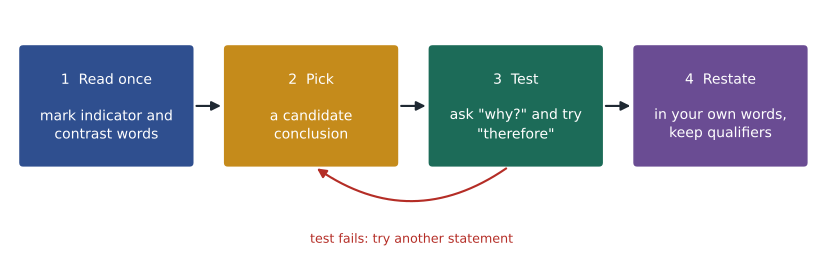
Harriet's method has four steps. On easy questions the steps take seconds; on hard ones, they keep you from guessing.
- Step 1: Read the whole stimulus once, noting indicator and contrast words.
- Step 2: Pick the statement you think is the conclusion.
- Step 3: Test it. Ask, "Why should I believe this?" The rest of the argument should answer. Then try putting "therefore" in front of it and "because" in front of the other statements.
- Step 4: Put the conclusion in your own words, briefly and precisely, including any qualifiers such as "probably", "some" or "should".
Where conclusions hide
Conclusions can be first, last or in the middle. On harder questions, the LSAT likes to put the conclusion first, then support it, then add a final sentence that is a further premise or even a restatement. Students who assume the last sentence is the conclusion get these wrong.
- First: "The proposal will fail. It depends on volunteers, and volunteer numbers have fallen for five years."
- Middle: "Volunteer numbers have fallen for five years. The proposal will therefore fail, since it depends entirely on volunteers."
- Last: "The proposal depends on volunteers, and volunteer numbers have fallen for five years. So it will fail."
All three versions are the same argument. Only the order changes. The method above finds the conclusion in each.
Conclusions after a turn
One of the most common LSAT structures sets up a view and then rejects it. "Some critics say the festival harms local businesses. But the festival brings thousands of visitors who shop locally. So the critics are wrong." The conclusion is the last sentence, but notice what it means: the festival does not harm local businesses. When the conclusion is stated as "the critics are wrong" or "this view is mistaken", you need to unpack it by looking back at the view being rejected.
Sometimes the turn itself carries the conclusion. "Many think the festival harms local businesses. In fact, it helps them, because visitors shop locally." Here "In fact" introduces the conclusion, the festival helps local businesses, and "because" introduces the premise.
Worked problem
Unpacking a conclusion that points backward
Stimulus: "Several council members have argued that the town's new parking fees will drive shoppers to the mall. This concern is misplaced. The fees apply only after two hours, and the town's own records show that the average downtown visit lasts under ninety minutes." State the conclusion precisely.
Show solution
- "This concern is misplaced" is the claim the rest supports. It is the conclusion.
- But "this concern" points back to the council members' worry.
- Unpacked: the new parking fees will not drive shoppers to the mall.
- The premises are the two-hour threshold and the average visit length.
Answer: The parking fees will not drive shoppers to the mall (the council members' concern is misplaced).
Precision: keep the qualifiers
Step 4 is where many errors begin. A conclusion that says something will "probably" happen is different from one that says it will happen. "Some residents" is different from "residents". "Should consider" is different from "should". Answer choices on main point questions often differ only in their qualifiers, and the wrong ones are usually too strong or too weak.
| Stated conclusion | Too strong | Too weak or different |
|---|---|---|
| The policy will probably reduce costs | The policy will reduce costs | The policy might affect costs |
| Some species benefit from the change | Most species benefit | The change is not harmful |
| The council should delay the vote | The council must cancel the vote | The vote could be delayed |
| The study does not establish that X causes Y | X does not cause Y | The study is about X |
Look closely at the last row. Saying that a study does not establish something is very different from saying the thing is false. Arguments that attack evidence usually conclude that the evidence is insufficient, not that the opposite is true. Answer choices that make the stronger claim are a classic trap.
When two statements both look like conclusions
Some arguments contain two claims that each seem to be supported. Usually one supports the other. The main conclusion is the one that is not offered as support for anything else. The other is an intermediate conclusion. Use a simple test: try each one with "therefore" between them.
- "Claim A, therefore Claim B." If this makes sense, A supports B, and B is the main conclusion.
- "Claim B, therefore Claim A." If this makes sense instead, A is the main conclusion.
Lesson 5 is devoted to arguments with intermediate conclusions, but the test is worth knowing now because it resolves most confusion.
Worked problem
Sample question (written for this course)
Stimulus: "Chef Morales should not have been dismissed for using the restaurant's ingredients for her own catering business. The owner had told staff in writing that leftover ingredients could be taken home, and the ingredients Morales used were all leftovers. Moreover, two other chefs had done the same without penalty." Stem: "The main conclusion of the argument is that" (A) the owner told staff in writing that leftover ingredients could be taken home (B) Chef Morales should not have been dismissed (C) Chef Morales used only leftover ingredients (D) other chefs were not penalized for similar conduct (E) the restaurant's policy on ingredients was unclear
Show solution
- The first sentence is a judgment. Ask: why should I believe it? The next two sentences answer: the written permission, the leftovers and the other chefs.
- (A), (C) and (D) are the three premises.
- (E) is out of scope; the argument says the policy was written and clear.
- (B) is the conclusion, stated first.
Answer: (B). The conclusion came first; "Moreover" added a further premise at the end.
Disguised conclusions
A conclusion is sometimes expressed as a rhetorical question ("Why, then, should we fund it?"), a sarcastic remark, or an evaluation of someone else's reasoning ("This argument overlooks a crucial point"). Each needs translating into a plain claim.
- "Why, then, should we fund it?" means "We should not fund it."
- "Surely no one would argue that the program has succeeded" means "The program has not succeeded."
- "The mayor's reasoning is flawed" means the mayor's conclusion has not been established by the reasons given.
Élodie had trouble with the last kind. When an argument concludes that another person's reasoning is flawed, she tended to pick answer choices saying that the other person's conclusion was false. Harriet drew the distinction on the shared screen: 'If I say your proof is wrong, I have not said your theorem is false. I have said you have not proved it.'
Background information
Many stimuli open with a sentence that sets the scene: "The city of Arden is building a new water treatment plant." This kind of sentence is background. It neither supports the conclusion nor is supported by anything. It just tells you what the argument is about. Background is never the main conclusion, and on role questions it is described as "background", "context" or "a statement of the issue".
To tell background from a premise, ask whether the conclusion would lose support if the sentence were removed. If the argument works just as well without it, it is background. If the argument loses a reason, it is a premise.
Worked problem
Separating background from premises
Stimulus: "The provincial ministry recently reviewed rural ambulance response times. In the northern district, response times rose by four minutes after two stations closed. The ministry should reopen at least one station." Which sentence is background?
Show solution
- Conclusion: the ministry should reopen at least one station.
- The second sentence gives the reason: response times rose after closures.
- The first sentence says a review happened. Removing it leaves the argument intact.
Answer: The first sentence is background. The second is the premise.
Practice under time
By mid-October, Harriet had the group practice finding conclusions under time: fifteen stimuli, five minutes, writing only the conclusion in their own words for each. The target was 90 percent accuracy at about 20 seconds a stimulus. Dani reached it by the third try. Thomas reached it on the second, and noticed that his assumption accuracy began to climb the same week. 'That is not a coincidence,' Harriet said. 'You were connecting the right things.'
Marcus, whose first LSAT had stalled at 158, said the drill exposed a habit: he skimmed the first sentence on the assumption that it was background, and missed conclusions that came first. He started reading the first sentence as carefully as the last.
A checklist for hard cases
- If you see two conclusion indicators, test which claim supports the other.
- If the conclusion points backward ("this view is wrong"), unpack it in plain words.
- If the conclusion is a question or a sarcastic remark, translate it.
- If the conclusion evaluates reasoning, remember that "not proven" is not "false".
- Keep every qualifier: probably, some, should, most, likely.
Sample question: a conclusion in the middle
Worked problem
Sample question (written for this course)
Stimulus: "The ferry company's new booking website has been criticized for crashing during busy periods. Yet the company's data show that online bookings rose by a third in the month after it launched. The website, then, has not discouraged customers from booking online, though the crashes should still be fixed. After all, customers who could not complete a booking may have phoned instead." Stem: "The main conclusion of the argument is that" (A) the booking website crashes during busy periods (B) online bookings rose by a third after the website launched (C) the new website has not discouraged customers from booking online (D) customers who could not book online phoned instead (E) the company should replace the website
Show solution
- The first sentence states a criticism, a concern the argument goes on to address. "Yet" turns to the evidence.
- "Then" introduces the conclusion: the website has not discouraged online booking. The clause about fixing crashes is a concession attached to it.
- The last sentence, introduced by "After all", explains why the crashes still matter, which relates to the concession, not the main point.
- (A) is the criticism. (B) is the premise. (D) is a possibility the author mentions, stated more strongly than the author does, and not the conclusion. (E) goes beyond the argument: the author says crashes should be fixed, not that the site should be replaced.
Answer: (C). The conclusion sat in the middle, and the final sentence was not the main point.
This question also shows why reading the last sentence as the conclusion is risky. A sentence beginning "After all" is almost always a premise or an explanation. If the stimulus ends with one, the conclusion is somewhere earlier.
Paraphrasing practice
Harriet asked the group to finish every conclusion drill by writing the conclusion in no more than twelve words. The limit forced precision. Dani found that her paraphrases often dropped qualifiers when she tried to be brief, so she added a rule: shorten anything except "probably", "some", "most", "should" and "not". Those words stay, even if the paraphrase runs long. Her accuracy on wrong-strength traps improved within a week.
A last check before you choose
Before confirming an answer on any question that depends on the conclusion, Harriet asked the group to run one final check: read the chosen conclusion back against the stimulus and ask whether the author would sign it, word for word. Would the author agree it says exactly what they meant, no more and no less? If the choice adds a word the author did not use, such as "all", "never" or "must", or drops one the author did use, such as "probably" or "some", the author would not sign it. The check takes five seconds and catches most wrong-strength errors before they reach the answer sheet.
Common mistakes
MistakeThe last sentence is usually the conclusion.
InsteadHarder questions often put the conclusion first or in the middle; test, do not assume.
Mistake"The critics are wrong" is the whole conclusion.
InsteadUnpack it: state what the critics claimed and that the author denies it.
MistakeShowing that evidence is weak proves the opposite conclusion.
InsteadAttacking evidence usually concludes only that a claim has not been established.
MistakeQualifiers like "probably" can be ignored when restating.
InsteadQualifiers are often exactly what separates the right answer from a wrong one.
MistakeThe first sentence is always background.
InsteadThe first sentence is often the conclusion; read it carefully.
Summary and key terms
- Find the conclusion by reading once, picking a candidate, testing it with "why?" and "therefore", and restating it precisely.
- Conclusions can appear first, in the middle or last.
- Conclusions that point backward ("this concern is misplaced") must be unpacked into plain claims.
- Keep qualifiers such as probably, some, most and should; wrong answers often change them.
- When two claims seem supported, the main conclusion is the one that supports nothing else.
- Background sets the scene and can be removed without weakening the argument.
- Main conclusion
- The claim the whole argument is ultimately trying to establish; it supports no other claim.
- Qualifier
- A word that limits the strength or scope of a claim, such as probably, some or most.
- Background
- Information that sets the scene but neither supports nor is supported by the argument.
- Rhetorical question
- A question used to make a claim, such as "Why should we pay for it?" meaning "We should not."
Practice problems
Work each problem on paper first, then reveal the answer to check.
State the conclusion: "Can anyone seriously believe the new stadium will pay for itself? Similar stadiums in four cities lost money every year."
Show answer
The new stadium will not pay for itself.
Which is the conclusion? "The study does not show that the supplement improves memory. Its participants knew which pill they were taking."
Show answer
The study does not show that the supplement improves memory. (Not that the supplement fails to improve memory.)
Restate precisely: "The new schedule will probably reduce overtime for most nurses."
Show answer
Most nurses will probably have less overtime under the new schedule; keep both "probably" and "most".
Lesson quiz · 5 questions
Score 60% or more to complete this lesson.
Create a free account to save your progress, take quizzes and earn a certificate.