
LES-216 · Lesson 7 of 12 · 21 min
Barricaded persons and hostage incidents
▶ Video coming soon A video version of this lesson is on the way.
At 15:20 on Sunday, May 3, a man called 911 from a neighbor's driveway on Ridley Crescent. His brother, Neil Ashby, fifty-two, had pointed a hunting rifle at him during an argument in Neil's kitchen, said he had 'nothing left' and told him to get out. Paul Ashby had run. Neil was alone in the house, which he had lived in for twenty years. He had been laid off in January and his wife had moved out in March. Officers Malhotra and Reyes, working a day shift that weekend, were two minutes away. By 21:55, more than six and a half hours later, Neil Ashby walked out of his front door with empty hands. He was arrested and taken to hospital for an emergency mental health evaluation. Nobody was hurt.
This lesson covers barricaded persons and hostage incidents: what they are, why time is the most important tool, what the first officers on scene must do, and how incident commanders, crisis negotiators and tactical teams work together to resolve them. Desjardins chose the Ridley Crescent call because it is typical. 'Most barricades are not hostage dramas,' he says. 'Most are one person, often in crisis, often with a weapon, often in their own home, often thinking about killing themselves. Those calls end well far more often than people think, and they end well because the police slowed down.'
Barricades and hostage incidents
A barricaded person is someone who has taken a position in a building, vehicle or other place, refuses to come out and is believed to be armed or dangerous. A hostage incident is one in which a person holds another person against their will, usually to force the police or someone else to do something. Many incidents fall between these: a person barricaded with family members who are not exactly hostages, or a domestic situation where a partner or child is inside. Negotiators distinguish hostage incidents from non-hostage incidents, because the dynamics are different. In a true hostage incident, the person holding hostages usually wants something they believe only the police can give. In a non-hostage incident, which is far more common, the person often has no clear demands and is driven by emotion, despair or crisis.
Research on these incidents is consistent. Most barricade and hostage incidents in North America are resolved without injury, and most are resolved by negotiation rather than tactical action. Reviews of incidents that ended badly often find that the police moved too fast, approached the building before containment and negotiation were in place, or did not have a trained negotiator available. The modern approach to these incidents, which grew out of the work of the New York City Police Department in the 1970s and the FBI's crisis negotiation programs, rests on a simple idea: if the person is contained and no one is in immediate danger, time helps everyone.
Why time helps
Time helps in several ways. Strong emotions such as anger, panic and despair rise quickly and then, given time and contact with a calm listener, usually fall. People in crisis often become more rational as hours pass and as basic needs such as sleep, food and the bathroom assert themselves. Time lets the police gather information, bring in trained negotiators and a tactical team, evacuate neighbors and plan. And time allows a relationship to form between the negotiator and the person, which is the main way negotiators influence behavior.
Time does not help when someone inside is being hurt or killed, or when there is a clear and immediate risk that they will be. Then the situation is no longer a barricade but an active threat, and the response changes, as lessons 8 and 9 explain. Part of the incident commander's job is to keep asking whether that line has been crossed.
The first officers' job
The first officers at a barricade call do not try to resolve it. Their job is to contain, isolate, evacuate and communicate, so that the commander, the negotiators and the tactical team can take over a scene that is stable. Containment means positions where officers can see the doors and sides of the house from cover, so that the person cannot leave without the police knowing. Isolation means cutting the person off from other people, such as family members arriving at the scene or neighbors walking by. Evacuation means moving people out of nearby homes or keeping them inside, depending on which is safer. Communication means telling dispatch what is happening, asking for a supervisor, a negotiator and a tactical team, and, if the person calls out or answers a phone, keeping contact calm and simple without making promises.
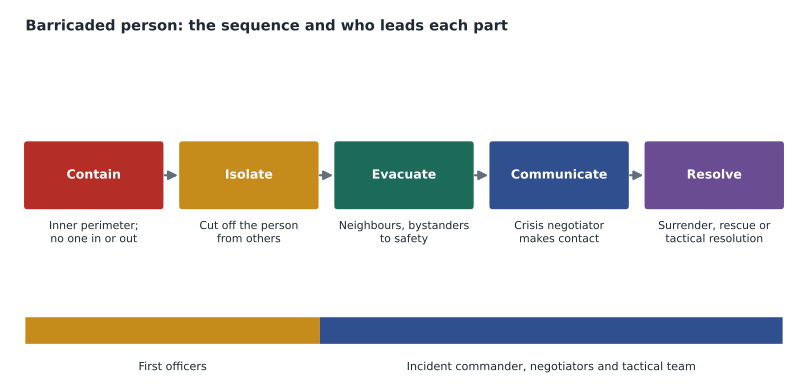
Malhotra and Reyes did exactly that. They stopped their car two houses away, out of the line of sight of the windows, and took positions behind a neighbor's truck and a stone wall where they could see the front and the side door. They spoke to Paul Ashby, who told them about the rifle, that Neil had a box of ammunition and that there was no one else inside. They asked for a supervisor, a negotiator and the tactical team. They told the people in the two neighboring houses to stay inside, away from the windows facing the Ashby house, and walked a family with young children out the back of the house across the street. Reyes kept a log of times on her phone. When Neil Ashby shouted from a window that he wanted everyone to leave, Malhotra answered once, calmly, that they were there to make sure everyone was safe, including him, and that someone would call him soon to talk.
| Time | Action |
|---|---|
| 15:22 | Arrive and stop out of sight of the windows |
| 15:24 | Positions covering the front and side doors; speak to Paul Ashby |
| 15:26 | Request supervisor, negotiator and tactical team; rifle and ammunition confirmed |
| 15:31 | Neighbors told to stay inside; family with children walked out the back |
| 15:35 | Neil Ashby shouts from window; one calm reply, no promises |
| 15:40 | Haddad arrives and takes command until the incident commander arrives |
Command, negotiators and tactical teams
In the United States, most larger agencies have a special weapons and tactics team, commonly known as SWAT, and a crisis or hostage negotiation team, and smaller agencies usually rely on a county or regional team. The National Tactical Officers Association publishes standards for tactical teams, and negotiation teams train to standards developed by the FBI and state and regional negotiator associations. Port Ardent has its own SWAT team and a team of trained crisis negotiators. Lieutenant Grace Lindqvist arrived at 16:05 and took over as incident commander from Haddad. Detective Omar Benali, the lead negotiator, arrived at 16:15. The SWAT team was in place by 16:30.
The incident commander is responsible for the whole response: the goal, the plan, the safety of everyone at the scene and the decisions about when and how the incident ends. The negotiation team, which usually has a primary negotiator, a secondary negotiator who listens, takes notes and suggests approaches, and a team leader, works to make contact, build a relationship and persuade the person to come out safely. The tactical team takes over the inner perimeter from patrol, prepares plans for rescue or arrest if negotiations fail or someone is in immediate danger, and protects the negotiators. The three work for one commander, and their plans fit together.
Benali tells the class that the relationship between negotiators and the tactical team is often misunderstood. 'People think we are opposites, talking versus force,' he says. 'We are one team. The tactical team's presence is part of what makes negotiation safe and part of what makes it work, because the person knows the situation is contained. And our work buys the tactical team time and information. On Ridley Crescent, I talked to Neil for six hours. The tactical team listened to every word, and so did the commander.'
Crisis negotiation
Crisis negotiators are officers with specialized training in communication with people in crisis. Their tools are active listening skills: paraphrasing what the person says, labeling emotions, asking open-ended questions, using short encouragers to show they are listening, using silence, and summarizing. The FBI's Behavioral Change Stairway Model describes the process as a series of steps: active listening leads to empathy, empathy leads to rapport, rapport allows influence, and influence can lead to a change in behavior, such as coming out. Negotiators avoid arguing, lying, making promises they cannot keep, or rushing toward a deadline.
| Skill | Example from Ridley Crescent |
|---|---|
| Paraphrasing | "So since January it feels like everything has been taken from you." |
| Labeling emotions | "You sound exhausted, and angry at how this has gone." |
| Open-ended questions | "Tell me about the house. How long have you lived there?" |
| Minimal encouragers | "Mm-hm." "Okay." "Go on." |
| Effective pauses | Silence after he talked about his daughter, to let him continue |
| Summarizing | Pulling together what he had said about his daughter and his work |
Benali made contact by phone at 16:40. For the first two hours, Neil Ashby mostly shouted, hung up and called back. Benali let him talk. In the third hour, Ashby began to talk about his daughter, who was at university in another city, and said he did not want her to see him like this. By the fifth hour, he was asking what would happen to him if he came out. Benali told him honestly: he would be arrested, handcuffed, and taken to the hospital first to see a doctor, and the charges would be dealt with later. At 21:40, Ashby agreed to put the rifle on the kitchen table and come out the front door. Benali talked him through each step on the phone while the tactical team received him.
Mental health, suicide and the person in crisis
Many barricaded people are in a mental health crisis, and many are thinking about suicide. Some may try to provoke the police into using force against them, which is sometimes called suicide by cop. That possibility is one more reason to slow down, keep distance and avoid putting officers in a position where they have to use lethal force in seconds. Negotiators are trained to ask directly about suicide, because asking does not increase the risk and opens the way to talking about it. Many services now include mental health professionals in their response, either at the scene or by phone with negotiators.
In Ohio, section 5122.10 of the Revised Code allows a police officer who has reason to believe that a person is a mentally ill person subject to court order and represents a substantial risk of physical harm to themselves or others if allowed to remain at liberty to take the person into custody and transport them to a hospital for examination. A person may also be arrested for criminal offenses and taken to hospital. Neil Ashby was arrested for aggravated menacing and taken to hospital for a psychiatric evaluation before any court appearance.
When negotiation is not enough
Sometimes negotiation fails, or the situation changes so that waiting is no longer safe, such as when the person begins to harm a hostage or fires at officers or neighbors. Tactical teams prepare for these possibilities from the moment they arrive, with plans for an emergency rescue if someone's life is in immediate danger, and deliberate plans for other options. These decisions belong to the incident commander and are among the most serious decisions in policing. Reviews of incidents that ended in tragedy often ask whether the commander had a clear reason to change from negotiation to tactical action, and whether that reason came from the facts or from fatigue and impatience after many hours.
Lindqvist tells the students that at the four-hour mark on Ridley Crescent, a neighbor called the media to complain about being kept in her house, and a city councillor called the chief. 'Pressure to end a barricade often comes from outside,' she says. 'The answer was simple. Nobody was in danger, he was talking, and every hour he talked was an hour closer to him walking out. We moved the neighbor out the back, gave her a coffee and kept going.'
Worked problem
Is waiting still the right decision?
Five hours into a barricade, a man alone in his apartment is still on the phone with the negotiator. He is armed with a knife, has made no threats against anyone else and has said he is tired. Neighbors have been evacuated. The commander is under pressure to end the incident before the evening rush hour. Should the tactical team enter?
Show solution
- Threat to others: none; he is alone and the building around him is evacuated.
- Contact: continuing, and he is tiring, which often comes before a surrender.
- Reason for change: rush hour traffic is an inconvenience, not a threat.
- Risk of entry: high, for the man and the officers, including a risk of lethal force.
Answer: No. Nothing in the facts makes waiting unsafe. The commander should manage the traffic and the pressure, keep negotiation going and keep the tactical team ready in case the facts change.
Common mistakes
MistakeThe first officers at a barricade should try to talk the person out.
InsteadThey contain, isolate, evacuate and keep contact simple until negotiators arrive.
MistakeMost barricades are hostage incidents with clear demands.
InsteadMost are non-hostage incidents involving one person, often in crisis, with no clear demands.
MistakeNegotiators and tactical teams work against each other.
InsteadThey are one team under one commander, and each supports the other.
MistakeAsking a person in crisis about suicide may put the idea in their head.
InsteadAsking directly does not increase the risk and opens the way to talking about it.
Summary and key terms
- Most barricades are non-hostage incidents involving one person, often in crisis, and most end without injury.
- When the person is contained and no one is in immediate danger, time helps everyone.
- First officers contain, isolate, evacuate and communicate, and do not try to resolve the incident.
- An incident commander, negotiators and a tactical team work as one team.
- Negotiators use active listening to build rapport and influence behavior, following the Behavioral Change Stairway Model.
- A change from negotiation to tactical action must come from the facts, not from fatigue or outside pressure.
- Barricaded person
- Someone who has taken a position, refuses to come out and is believed to be armed or dangerous.
- Crisis negotiator
- An officer trained to communicate with people in crisis to bring incidents to a safe end.
- Active listening
- A set of skills, such as paraphrasing and labeling emotions, that show understanding and build rapport.
- Behavioral Change Stairway Model
- The FBI's model: active listening, empathy, rapport, influence, behavioral change.
Practice problems
Work each problem on paper first, then reveal the answer to check.
What four things do first officers do at a barricade?
Show answer
Contain, isolate, evacuate and communicate.
What did Benali tell Neil Ashby would happen if he came out?
Show answer
He would be arrested, handcuffed and taken to the hospital first, with the charges dealt with later.
Why is a tactical team's presence part of what makes negotiation work?
Show answer
It keeps the scene contained and safe, and it shows the person that the situation is contained.
What kind of pressure did Lindqvist face, and how did she respond?
Show answer
Complaints from a neighbor and a councillor; she kept negotiating because no one was in danger.
Lesson quiz · 5 questions
Score 60% or more to complete this lesson.
Create a free account to save your progress, take quizzes and earn a certificate.