
LES-216 · Lesson 4 of 12 · 20 min
High-risk vehicle stops: decisions, roles and communication
▶ Video coming soon A video version of this lesson is on the way.
The camera footage from Malhotra's car begins at 23:05:40 on April 10. The gray Civic rolls slowly into the empty parking lot of Kingsway Plaza and stops near the closed grocery store. Three police cars follow it in. For the next four minutes, almost nobody on the video moves quickly. Malhotra speaks, slowly and clearly, through the car's public address system. The other officers stay behind their cars and say nothing. Haddad's voice is heard twice on the radio. Then the driver walks backward toward the officers, is handcuffed and is walked to a car. The passenger follows. At 23:09:55, Haddad says the car is clear. Desjardins plays the footage twice and then asks the class to describe it in one word. Someone says boring. 'Exactly,' he says. 'That is what a good high-risk stop looks like.'
A high-risk vehicle stop, often called a felony stop in the United States, is a stop of a vehicle whose occupants are believed to be dangerous, such as robbery suspects, people believed to be armed, or people wanted for a serious violent offense. It differs from an ordinary traffic stop in one fundamental way: the officers do not walk up to the car. Instead, they keep their distance and their cover and direct the occupants to come to them, one at a time, under control. This lesson covers the decisions, roles and communication that make that possible. The physical skills involved are taught in supervised academy and requalification training and are not part of this course.
Why officers do not approach the car
On an ordinary traffic stop, the officer walks up to the driver's window. That approach is reasonable because the risk is low and the purpose, such as explaining a ticket, requires conversation. On a high-risk stop, walking up to the car would put the officer within reach of a person who may be armed, in a position where the occupants can see the officer but the officer cannot see what the occupants are doing. Every review of officers shot on vehicle stops comes back to the same factors: officers alone, officers close to the car, and officers who could not see the occupants' hands.
Keeping distance and making the occupants come out one at a time reverses that. The officers can see each person, give clear instructions and decide what happens next. The occupants have time to understand what is being asked of them. And if anyone does present a threat, the officers have time and distance to respond, which reduces the chance that anyone, including the suspect, is hurt. Haddad says the method protects the occupants too. 'A person who is confused and moves suddenly near a police officer can be shot. A person who is forty feet away and being told exactly what to do one step at a time is much less likely to be hurt.'
Deciding to make a high-risk stop
The decision to make a high-risk stop, rather than an ordinary stop or no stop at all, is made by the supervisor or the senior officer, and it rests on the information covered in lesson 3. Most services require a supervisor to be told and, where possible, to approve or attend. The decision has three possible outcomes. The vehicle may be stopped as a high-risk stop, with several officers and a plan. It may be stopped as an ordinary stop with heightened caution, if the information is weak. Or officers may decide not to stop it at all and instead follow it, keep it under observation or let it go and arrest the occupants later, if a stop would be more dangerous than the alternatives.
| Decision | When it fits | Example |
|---|---|---|
| High-risk stop | Reliable information that occupants are dangerous; enough officers; safe location | The Civic on April 10 |
| Ordinary stop with caution | Weak or old information; low threat | A car registered to a person with an old caution |
| Follow or do not stop | Too few officers, poor location, or suspects can be arrested later | A suspect car entering a busy festival area |
Pursuits deserve a special mention. If a suspect vehicle flees when officers try to stop it, the decision to pursue is governed by separate pursuit policies and laws, and many services have restricted pursuits for anything other than serious violent offenses because of the danger they create for the public. On April 10, Haddad's contingency was that if the car fled, the officers would not pursue it past the plaza and would rely on the dog, other units and the partial plate to find the occupants later.
Roles
The heart of a high-risk stop is that each officer has one clear role, assigned before the stop begins. The exact names vary by service, but the same functions appear everywhere.
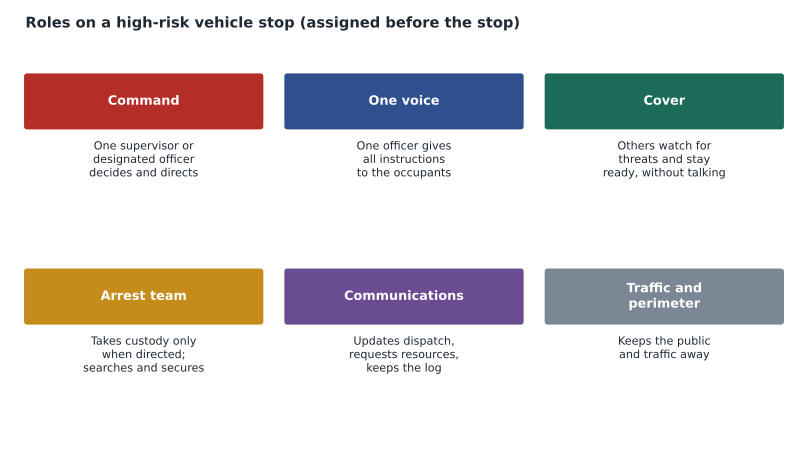
Command belongs to one person, usually the supervisor. The commander decides when the stop begins, when each occupant is called out, when the car is checked and when the stop is over. One voice belongs to one officer, who gives every instruction to the occupants. Cover officers watch the occupants and the car and stay ready to respond, but they do not speak to the occupants, because two voices giving instructions at once confuse people and lead to sudden movements. The arrest team takes each occupant into custody when directed. Communications keeps dispatch informed, asks for resources and notes the times. And at least one officer keeps traffic and the public away.
On April 10, Haddad took command. Officer Malhotra was the one voice. Probationary Officer Reyes and Officer Arjun Patel were cover and, when directed, the arrest team. Officer Erin Walsh, who had arrived with her police dog Juno, held the plaza entrance so that no car or pedestrian could enter. Haddad handled communications herself because the stop was small. Five officers, six roles, every one assigned before the lights came on.
The one voice
Instructions to the occupants are the main tool of a high-risk stop, and they work only if they are clear, short, calm and given by one person. The officer giving instructions identifies the police, tells the occupants why they are being stopped in general terms, and then gives one instruction at a time, waiting for each to be completed. People under stress cannot follow long or complicated directions. They may be frightened, intoxicated, hard of hearing or not fluent in the officer's language. Good instructions use plain words, repeat when needed, and tell the person what will happen next so that they are not surprised.
Malhotra's voice on the footage never rises. He begins by saying who he is and that the occupants are being stopped in connection with a serious incident, that they will be safe if they follow instructions, and that he will tell them exactly what to do. He then speaks only to the driver, by position, and tells him what to do one step at a time. When the driver hesitates, Malhotra repeats the last instruction rather than adding a new one. Later, Malhotra tells the class that he thinks of it as talking someone through something difficult. 'I want him to succeed,' he says. 'If he gets it right, everybody goes home.'
| Principle | Why it matters |
|---|---|
| One voice only | Two voices give conflicting instructions and cause sudden movements |
| Identify the police and the reason | Reduces fear and confusion; a lawful requirement in some situations |
| One instruction at a time | People under stress cannot follow long directions |
| Wait and repeat | Hesitation is often confusion, not defiance |
| Tell them what happens next | Surprises produce sudden movements |
| Check for understanding | Language, hearing, age and intoxication can all interfere |
Radio and communication within the team
While Malhotra talks to the occupants, the team talks to itself as little as possible. Radio traffic is kept to essentials: the stop has started, the location, how many occupants, any weapon seen, when each person is in custody and when the car is clear. Officers who see something important, such as movement in the back seat or an object in a hand, say it once, clearly, on the radio or aloud to the commander. Dispatch holds other radio traffic on the channel while the stop is in progress, which many services call an emergency or priority channel.
Reyes's single radio transmission during the stop is a model. At 23:08:10, as the driver walked backward toward the officers, she saw an object on the passenger seat through the open door. Her transmission was eleven words: 'Cover, Reyes. Black handgun on the front passenger seat. Passenger still inside.' Haddad acknowledged it and told Malhotra to keep the passenger in the car until the driver was secured. Nobody else spoke.
Occupants who do not follow instructions
Not every occupant follows instructions. Some are frightened, some are confused, some are intoxicated and some are deciding whether to run or fight. The response depends on what the person is doing. A person who is frozen or confused needs time and repeated, simple instructions. A person who refuses but is not threatening anyone gives the officers time to wait, call more resources and keep talking, because the car is contained and time is on the police side. A person who presents an immediate threat changes the situation, and the law of force from lesson 2 applies.
One of the most important decisions on a high-risk stop is what not to do when an occupant refuses to get out. Officers should not walk up to the car to pull the person out, because that throws away the distance and cover that make the stop safe. Instead, the commander may decide to wait, to bring in a negotiator, a dog or a tactical team, or, in some cases, to let time do the work. Haddad says the longest high-risk stop she has supervised lasted ninety minutes. 'He sat in the car and refused. We had him contained. Nobody was in danger. Eventually he got tired and came out. Ninety minutes is a long time to wait, and it is nothing compared with the rest of somebody's life.'
The car itself
After the occupants are out and in custody, the car may still hold another person who has not shown themselves, or a weapon. The commander decides how and when the car is checked, by whom and with what cover, and the check is done as a planned step, not as an afterthought. The handgun Reyes saw turned out, when it was examined later that night, to be an imitation firearm. Desjardins asks whether that changes anything about the stop. The answer from the class is no: from forty feet at night, an imitation handgun looks exactly like a real one, and the officers were right to treat it as real. Imitation firearms are a recurring factor in police shootings in both countries, which is why some jurisdictions regulate them.
Worked problem
Assigning roles with four officers
A supervisor has four officers, including herself, for a high-risk stop of a car with one occupant. The location is a quiet industrial road with almost no traffic. How should the roles be assigned?
Show solution
- Command: the supervisor.
- One voice: one officer, who speaks to the occupant and no one else.
- Cover: one officer, who later becomes the arrest officer when directed.
- Traffic and perimeter: one officer, at the road behind the stop.
- Communications: the supervisor, because the stop is small and traffic is light.
Answer: Four people can cover all six functions if each knows which roles they hold. If any role cannot be filled, especially cover, the supervisor should consider waiting for more officers before making the stop.
Common mistakes
MistakeOn a high-risk stop, officers should approach the car quickly to take control.
InsteadOfficers keep their distance and direct occupants to come to them, one at a time.
MistakeSeveral officers should shout instructions so the occupants know they are serious.
InsteadOne voice gives all instructions; others stay silent.
MistakeAn occupant who hesitates is defying the officers.
InsteadHesitation is often confusion or fear; repeat the instruction.
MistakeIf an occupant refuses to get out, officers must go and get them.
InsteadThe car is contained; time, more resources and continued communication are usually safer.
Summary and key terms
- A high-risk vehicle stop keeps officers at a distance and brings occupants out one at a time under clear direction.
- The supervisor decides between a high-risk stop, an ordinary stop with caution, or not stopping at all.
- Each officer has an assigned role: command, one voice, cover, arrest team, communications and perimeter.
- Instructions are given by one voice, one at a time, calmly and in plain words.
- Radio traffic is kept to essentials, and an occupant who refuses is usually best handled with time.
- An imitation firearm must be treated as real until proven otherwise.
- High-risk vehicle stop
- A stop of a vehicle whose occupants are believed dangerous, in which officers keep their distance and direct occupants out one at a time. Often called a felony stop.
- One voice
- The rule that only one officer gives instructions to the occupants.
- Cover officer
- An officer who watches for threats and stays ready but does not speak to the occupants.
- Imitation firearm
- An object that looks like a real firearm but is not one.
Practice problems
Work each problem on paper first, then reveal the answer to check.
Why do officers not approach the car on a high-risk stop?
Show answer
Approaching puts officers within reach of a possibly armed person who can see them while they cannot see what the person is doing.
What did Reyes say on the radio when she saw the object on the seat?
Show answer
Cover, Reyes. Black handgun on the front passenger seat. Passenger still inside.
What are three options if an occupant refuses to get out?
Show answer
Wait, keep talking, and bring in more resources such as a negotiator, a dog or a tactical team.
Why was it correct to treat the imitation handgun as real?
Show answer
At a distance at night it looked exactly like a real handgun, and officers cannot tell the difference.
Lesson quiz · 5 questions
Score 60% or more to complete this lesson.
Create a free account to save your progress, take quizzes and earn a certificate.