
LES-216 · Lesson 6 of 12 · 20 min
Building and area searches: decisions, containment and police dogs
▶ Video coming soon A video version of this lesson is on the way.
At 23:21 on April 10, twelve minutes after the Civic was cleared in the Kingsway Plaza lot, the alarm company called dispatch about a break-in alarm at Ardent Marine Supply, a closed warehouse on Dock Lane, a few blocks from the pharmacy. Pike had already told the officers that his friend had 'got out back by the docks.' Two patrol cars arrived within four minutes and found a side door forced open. The building was dark. The second robbery suspect might be inside, might be armed, and might be one of many people who could have forced that door. Patel, the first officer at the door, could hear nothing from inside. 'Everything in me wanted to go in,' he says later. 'Then I remembered that if he was in there, he had all the time in the world, and he knew where we would be coming from. We did not.'
Building and area searches are among the most dangerous tasks in patrol work. The person being searched for knows the area, can choose where to hide and can watch the officers coming. The officers do not know the layout, cannot see around corners and may not even know whether anyone is there. This lesson covers the decisions that come before any search: whether to search at all, how to contain the area, what legal authority exists to enter, and how police dogs, keyholders and other resources change the picture. It does not cover the physical methods of searching rooms, which are taught in supervised training.
The first decision: whether to search
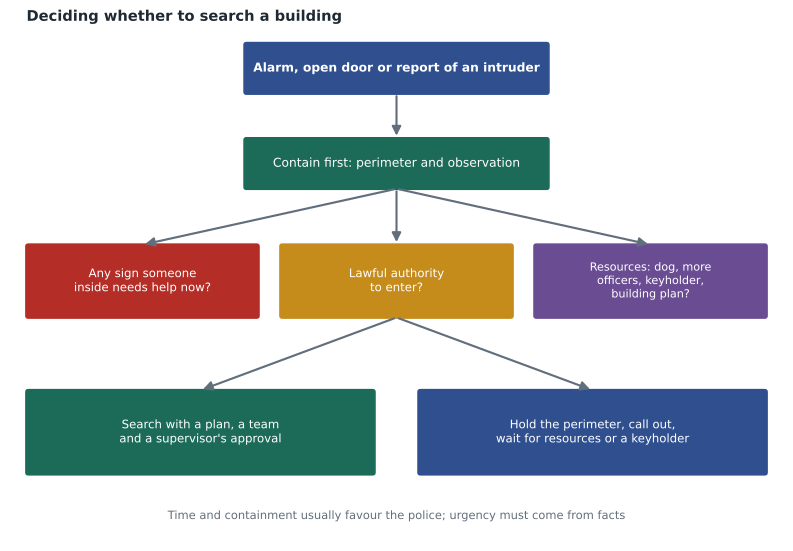
The most important decision on a building search call is whether a search is needed now. Many alarm calls turn out to be false alarms caused by wind, animals or faulty equipment. When a building has clearly been broken into, the intruder has often already left. And when an intruder is still inside and no one else is in danger, the police usually have time. They can contain the building and wait for resources, call out to the person, bring the keyholder, look at camera footage or use a dog, rather than sending officers into an unknown building in the dark.
The situation is different when there is reason to believe that someone inside needs help now, such as an employee who may be hurt, or that the intruder is about to harm someone. Then the urgency comes from the facts, and the decision may be to go in sooner with the officers available. Desjardins reminds the students of the rule from lesson 1: when the danger is contained and no one is being hurt, slow down and use time.
Containment comes first
Whatever the decision about searching, the first job is containment. Officers take positions where they can see the exits and the sides of the building without standing in front of doors or windows, and they report what they can see. The aim is that no one can leave without the police knowing. A contained building turns the call from a race into a problem that can be solved patiently. If the intruder tries to leave, officers can deal with them in the open, which is far safer than meeting them inside.
Containment has an outer layer too. On April 10, Haddad asked for an outer perimeter on the streets around Dock Lane, so that if the suspect had already left the warehouse he would be found or seen. She asked dispatch to check whether the service's drone team was available, and she asked for the keyholder to be called. Within twenty minutes, the building had officers on every side, two cars on the surrounding streets and the dog team at the door.
| Resource | Why it helps |
|---|---|
| More officers | Full containment on every side and an outer perimeter |
| Police dog team | Finds a hidden person by scent, without officers entering every space |
| Keyholder | Building layout, alarm zones, who should be inside, keys and lights |
| Alarm company | Which zones were triggered and in what order |
| Camera footage | Whether someone entered and whether they left |
| Drone team | A view of the roof and yard without exposing officers |
Legal authority to enter
The Fourth Amendment protects homes most strongly, and commercial premises somewhat less. For a commercial building after a break-in alarm, officers can usually enter under the exigent circumstances exception to investigate a burglary in progress and protect the property, and the owner's consent can be obtained through the keyholder. Homes are treated very differently. Under Payton v. New York in 1980, police need a warrant to enter a home to make a routine arrest. Exceptions include hot pursuit of a fleeing felon, as in Warden v. Hayden in 1967, where officers followed an armed robber into a house, and emergency aid to a person who is seriously injured or threatened, as in Brigham City v. Stuart in 2006. In Caniglia v. Strom in 2021, the Supreme Court held that there is no general community caretaking exception allowing warrantless entry into homes.
Haddad told dispatch the legal basis for entry at the warehouse before anyone went in: a break-in in progress at a closed business, a suspect believed to be inside connected to an armed robbery, and the keyholder's request that police enter. 'You do not want to be working that out afterward,' she says. 'And if it had been a house, the answer might have been different.'
Calling out
Before any search, officers announce their presence and call on anyone inside to come out. The announcement tells a person hiding inside that the police are there, which may persuade them to surrender. It also gives an innocent person, such as an employee working late or a homeless person sheltering in the building, the chance to identify themselves. Announcements are repeated, given loudly enough to be heard throughout the building, and recorded. Where a police dog will be used, the announcement includes a clear warning that a dog will be sent in and may bite, followed by a pause long enough for a person to respond.
Federal courts have held that a police dog trained to bite and hold is a significant use of force. In Kuha v. City of Minnetonka in 2003, the Eighth Circuit held that a jury could find it unreasonable to use such a dog without first giving a verbal warning and an opportunity to surrender, where a warning was feasible. Many agencies require handlers to give repeated warnings and to record them, and treat every bite as a use of force to be reported and reviewed under Graham v. Connor.
At 23:44, Walsh gave the first warning from the forced door. It was repeated three times over five minutes, by loudspeaker and in her own voice. There was no answer. Haddad then approved the dog search, with Walsh handling Juno and two officers covering her.
Police dogs
A police dog can find a hidden person by scent far faster and more safely than officers searching every space by sight. The dog and handler work as a team, and the handler is responsible for every decision about deploying the dog. Some dogs are trained to bark when they find a person, which is often called find and bark; others are trained to bite and hold. Services differ in which they use, and many have moved toward find-and-bark training and tighter policies on when a bite is allowed, because dog bites can cause serious injury.
Juno found Cal Ferris at 00:22, hiding in a storage loft at the back of the warehouse. She barked and held her position at the foot of the ladder. Walsh called out that the dog had found him and told him that if he came down slowly and showed his hands, the dog would not be sent up. Ferris climbed down and was arrested without injury. He had no weapon; he told detectives later that the imitation handgun had been his, and that he had left it in the car when he jumped out to run. Desjardins asks the class what would have happened if officers had searched the warehouse by sight at 23:30. 'Maybe nothing,' he says. 'Or maybe Patel climbs that ladder in the dark, and the first thing he sees is a man in a red jacket at the top who does not want to go to jail.'
Area searches
When a suspect has fled on foot into an area rather than a building, the same principles apply on a larger scale. Officers set up a perimeter around the area the suspect could have reached, using the time since the suspect was last seen and how fast a person on foot can travel. A tracking dog can follow the person's scent from the last known point. A helicopter or drone can search yards and rooftops without exposing officers. Residents can be asked to stay inside and to report anything they see, through door knocks or public alerts. And officers inside the perimeter search systematically rather than chasing every report.
Worked problem
How large should the perimeter be?
A suspect fled on foot six minutes ago. Officers estimate that a person moving quickly but trying not to attract attention can cover about 500 feet a minute. How far could the suspect have gone, and what does that mean for the perimeter?
Show solution
- \[6 \text{ min} \times 500 \text{ ft per min} = 3000 \text{ ft}\]
- The suspect could be up to about 3,000 feet, a little over half a mile, from the last known point, in any direction.
- Each minute of delay adds about 500 feet to the radius, so the area grows quickly.
Answer: A perimeter of roughly 3,000 feet around the last known point is needed now, and it should be set up quickly because the possible area grows every minute.
The arithmetic in the example shows why speed matters for area searches in a way it does not for contained buildings. A building that is contained does not grow. An area perimeter that is set up late has to be much bigger, or the suspect is already outside it. That is why Haddad asked for the outer perimeter around Dock Lane before anyone knew whether Ferris was in the warehouse.
People who should not be there, and people who should
Not everyone found in a building after an alarm is a criminal suspect. Officers regularly find employees who forgot to disarm the alarm, cleaners, contractors, teenagers who climbed in on a dare and people without homes sheltering from the cold. On a call connected to a robbery, officers must still be ready for the suspect, but they must also be ready for someone who has nothing to do with it. That is one reason the announcements matter, and why officers should listen to what a person says when found. If a police dog does bite someone, the handler calls off the dog at once, first aid is given and paramedics are called, the person is taken for treatment, a supervisor attends and the bite is reported and reviewed as a use of force.
Supervision and the search plan
If a building must be searched by officers, a supervisor should approve the search, and the team should agree on a plan before going in: who goes, who stays at the perimeter, how they will communicate, what areas will be searched in what order, how areas that have been searched will be marked, and what happens if the suspect is found or if an officer is hurt. Searches should be done by a team, never by one officer alone, and searched areas should not be left behind without someone watching them. Officers should also know when to stop: if the search becomes too dangerous, the right decision may be to pull back, hold the perimeter and call a tactical team.
Haddad adds a point about fatigue. 'At midnight after a robbery and a high-risk stop, everybody's adrenaline is wearing off and everybody is tired. That is when people take shortcuts. A dog does not get tired the way we do. Use the dog.'
Common mistakes
MistakeAn open door at a closed business means officers should go straight in.
InsteadContain first, then decide whether a search is needed now and with what resources.
MistakePolice may enter any building where they think a suspect is hiding.
InsteadEntry needs legal authority; homes are protected much more strongly than businesses.
MistakeWarnings before a dog search are optional politeness.
InsteadWarnings are required by policy, often expected by courts, and give people the chance to surrender.
MistakeA perimeter can be set up whenever officers are ready.
InsteadAn area perimeter must be set quickly because the possible area grows every minute.
Summary and key terms
- The first decision on a building call is whether a search is needed now; containment comes first either way.
- Time and containment usually favor the police unless someone inside needs help now.
- Entry needs legal authority: exigent circumstances or consent for businesses, and warrants or narrow exceptions for homes (Payton, Warden v. Hayden, Brigham City, Caniglia).
- Officers call out before searching and give clear, repeated warnings before using a police dog.
- Police dogs find hidden people more safely than officers searching by sight, but a bite is a use of force.
- Area searches depend on a fast perimeter, tracking, air support and help from residents.
- Containment
- Controlling the exits and surroundings so that no one can leave without police knowledge.
- Outer perimeter
- A wider ring of officers around an area to find a suspect who has already left the inner area.
- Keyholder
- A person responsible for a building who can provide access, layout and information.
- Find and bark
- A police dog method in which the dog barks to indicate a person rather than biting.
Practice problems
Work each problem on paper first, then reveal the answer to check.
Why did Patel not go into the warehouse at once?
Show answer
The suspect, if inside, had time and knew where officers would come from; the building could be contained and resources brought in.
What three things should an announcement before a dog search include?
Show answer
That police are present, a call to come out, and a clear warning that a dog will be sent in and may bite, followed by a pause.
How did Juno indicate where Ferris was?
Show answer
She barked and held her position at the foot of the ladder.
Why must an area perimeter be set up quickly?
Show answer
The area the suspect could have reached grows every minute.
Lesson quiz · 5 questions
Score 60% or more to complete this lesson.
Create a free account to save your progress, take quizzes and earn a certificate.