
LES-216 · Lesson 12 of 12 · 19 min
Capstone: an after-action review of the Harbor Pharmacy robbery night
▶ Video coming soon A video version of this lesson is on the way.
Four days after the robbery, on Tuesday, April 14, eleven people sat around the table in the training room at Port Ardent police headquarters: the officers from the stop and the warehouse, the dispatcher who had worked the radio, the robbery detective, the police dog handler, a paramedic supervisor who had staged nearby, and Desjardins, invited as an observer for the course. Haddad chaired. On the screen was a timeline that ran from 22:40 on April 10 to 02:30 on April 11. 'This is not a discipline meeting and nobody is in trouble,' she began. 'We got two armed robbery suspects into custody and nobody was hurt. We are here to find out how, so that we do it again, and to find the three or four things that could have gone the other way.'
This capstone lesson brings the course together through an after-action review of that night. It uses the same tools that services use in real reviews: a timeline, a comparison of what was planned with what happened, a scored review of each part of the response, and a list of actions with owners and dates. At the end, it returns to the other incidents in the course, the wrongful stop of April 7, the barricade on Ridley Crescent and the exercise at Harbor Point Mall, and pulls out the lessons that run through all of them.
What an after-action review is
An after-action review is a structured look back at an incident or exercise to learn from it. It asks four questions. What did we plan to happen? What actually happened? Why were there differences? And what will we keep doing and what will we change? A good review is built on facts, such as radio recordings, camera footage, notes, reports and logs, rather than memory alone. It includes everyone who played a part, including dispatchers, other agencies and specialist units. It focuses on the system rather than on blaming individuals. And it ends with specific actions, each with someone responsible and a date.
After-action reviews are different from investigations. An investigation, such as an oversight investigation or a professional standards investigation, asks whether someone broke the law or the rules. A review asks how the response could be better. Mixing the two makes people defensive and the review useless. That is why many services hold reviews only after any investigation is complete, or keep the two processes completely separate, and why Haddad began by saying that no one was in trouble.
The timeline
| Time | Event |
|---|---|
| 22:40 | Robbery at Harbor Pharmacy; one suspect displays what looks like a handgun |
| 22:41 | First broadcast; Haddad starts planning |
| 22:46 | Haddad: follow, do not stop; three cars before any stop |
| 22:58 | Malhotra and Reyes locate a gray Civic on Kingsway; partial plate matches |
| 23:04 | Radio briefing: roles, signal, contingency |
| 23:06 | High-risk stop in Kingsway Plaza lot |
| 23:08 | Reyes reports apparent handgun on passenger seat |
| 23:09 | Both occupants in custody; reasons given |
| 23:10 | Car clear; cover officers holster |
| 23:21 | Break-in alarm at Ardent Marine Supply, Dock Lane |
| 23:25 | Forced door found; containment and outer perimeter |
| 23:44 | First of repeated police dog warnings |
| 00:22 | Juno locates Ferris in the loft; arrested without injury |
| 02:30 | Hot debrief at the station |
Reading the timeline, the group noticed things that nobody had noticed during the call. Twelve minutes passed between Haddad's instruction to follow rather than stop and the moment the car was found, and the instruction was repeated twice in that time as new cars joined. Thirty-eight minutes passed between the first dog warning and the moment Ferris was found, which felt like hours to the officers at the perimeter but was, Walsh pointed out, fast for a building that size. And the timeline showed a gap: nobody had recorded when the keyholder arrived.
Planned against actual
The heart of the review was a comparison of the plan with what happened. Most of the plan worked as intended. The car was followed rather than stopped alone, the stop happened in a location Haddad chose, the roles were assigned before the lights came on, one voice gave every instruction, the radio stayed quiet, and force was reduced as soon as the car was clear. At the warehouse, the building was contained before anyone went in, the legal basis for entry was stated, warnings were given and repeated, and the dog found the suspect without anyone entering the dark loft.
| Planned | Actual | Why |
|---|---|---|
| All entrances to the plaza lot held | Main entrance held; side entrance from Harbor Street open | Lot plan not known; side entrance not visible from the road |
| First aid kit with the arrest team | Kit in the trunk of a car across the lot | No one assigned to bring it |
| Times logged at the warehouse | Keyholder arrival not recorded | No one assigned to keep a scene log there |
| After-action review within 48 hours | Held after four days | Shift schedules |
The side entrance was the finding that the group spent the most time on. Kingsway Plaza has a second entrance from Harbor Street, behind the grocery store, which cannot be seen from Kingsway. Nobody at the stop knew it was there. If the driver had decided to flee, he could have driven out the back into a residential street, and the officers would have been chasing a robbery suspect through a neighborhood at night, exactly what the plan was meant to avoid. During the stop, a delivery van drove in through that entrance and stopped a short distance from the Civic before its driver saw the police cars and reversed out. Haddad says that was the moment in the footage that made her stomach drop. 'A man in a van, in the middle of a high-risk stop, because we did not know the lot,' she says. 'Nothing happened. But it could have.'
The scored review
Port Ardent uses a simple scored review for high-risk calls. Each of ten areas is scored 2 if it was done well, 1 if it was done but with a gap, and 0 if it was not done. The total is out of 20. The score is not a grade for the officers; it is a way of making sure every area is looked at and of tracking improvement across reviews.
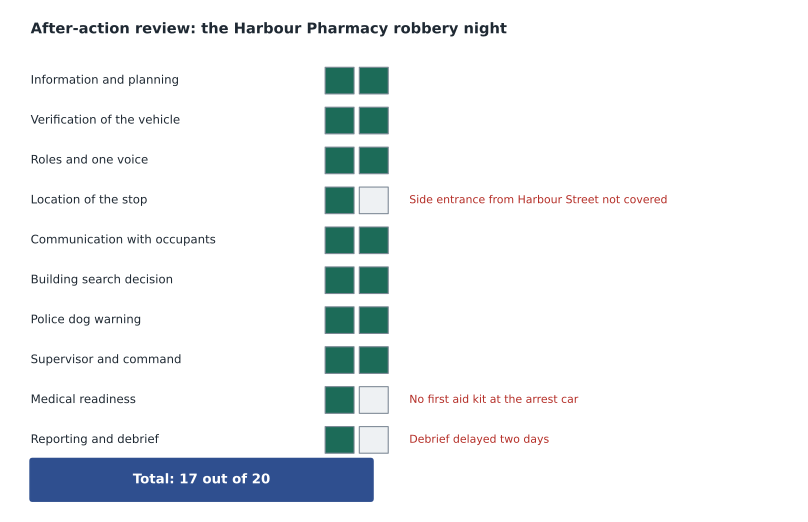
The group discussed whether 17 out of 20 was a good score. Desjardins asked them to think about what each lost point would have meant on a worse night. The location point could have meant a pursuit through a neighborhood or an innocent driver in the middle of a stop. The medical point could have meant minutes lost if anyone had been hurt. The debrief point was the least serious, but delays in debriefs mean memories fade and lessons are lost. 'The score is not the point,' he told the students afterward. 'The point is that every lost mark is a specific thing you can fix.'
Actions
A review that ends without actions has not finished. The group agreed on five actions, each with an owner and a date, and Haddad sent them to the platoon's inspector the same afternoon.
| Action | Owner | Due |
|---|---|---|
| Add lot layouts and all entrances for the ten most-used stop locations to the patrol map layer | Crime analysis unit | May 15 |
| Add "check all entrances" to the high-risk stop briefing card | Training unit | April 30 |
| Assign a medical role, with the first aid kit, at every high-risk stop | Haddad, for B platoon; training unit for the service | April 21 |
| Assign a scene log keeper at every building search | Haddad, for B platoon | April 21 |
| Hold after-action reviews within 48 hours, with overtime approved in advance | Platoon inspectors | Immediately |
Haddad also asked the group to name what should be sustained, the things that went well and must keep happening. They named five: following rather than stopping alone, a radio briefing before the stop, one voice, holstering as soon as the threat was controlled, and containment and repeated warnings before any building search. 'People only remember the gaps,' she says. 'But the things that went right are not automatic either. They went right because people were trained and because they chose to do them under pressure. Write them down.'
How reviews fail
Reviews fail in predictable ways. Some turn into blame sessions, and people stop speaking honestly. Some are held so late that memories have faded and the footage has been overwritten. Some produce long lists of recommendations with no owners, which nobody follows up. Some look only at the officers on the ground and never at the dispatch, policy, training, equipment or supervision decisions that shaped what they could do. And some are never shared, so the next platoon makes the same mistake. Haddad's approach addresses each failure: no blame, facts first, everyone in the room, actions with owners and dates, and a short written summary shared with the whole service.
Desjardins adds that the habit of review is part of being a professional. Doctors review complications, pilots review incidents, and good police services review high-risk calls whether they go well or badly. 'You will be in rooms like that for the rest of your career,' he tells the students. 'Sometimes you will be the person who made the mistake. If you can say so plainly, and help the group fix the system around it, you will be the kind of officer other people want on their team.'
Lessons across the course
Desjardins ends the course by putting the four incidents side by side. The wrongful stop on April 7 had good tactics and no verification, and an innocent nurse and her son paid for it. The robbery night had good verification, good planning and good roles, and three gaps that luck covered. The barricade on Ridley Crescent was resolved because officers contained, isolated, evacuated and communicated, and then a commander, a negotiator and a tactical team used six and a half hours of time. The exercise at Harbor Point Mall showed that on the one call where time is not on the police side, the first officers must move, command must be taken early and medical care must reach the wounded within minutes.
| Incident | What went well | Main lesson |
|---|---|---|
| April 7 wrongful stop | Distance, one voice, calm | Verify before a high-risk stop; aftercare matters |
| April 10 robbery night | Planning, roles, containment, warnings | Know the location; assign medical readiness |
| May 3 Ridley Crescent barricade | Contain, isolate, evacuate, negotiate | Time resolves barricades; resist outside pressure |
| June 7 Harbor Point Mall exercise | Fast entry, early command, rescue task forces | Radio discipline; identify armed people before acting |
The threads that run through all four are the principles from the first lesson. Everyone's safety matters, including the people in the car and the man in the house. Time is usually an ally, except when someone is being hurt now. Every person needs a clear role. Communication must be disciplined. And the law applies at every step: the stop, the detention, the entry, the search, the force and what happens afterward. Desjardins writes the word from the first class on the board again: deliberate. 'If you remember one thing from this course,' he says, 'remember that the best high-risk calls look boring on video. Boring means somebody planned it, everyone knew their job, and everyone went home.'
Worked problem
Scoring a review
A review of a high-risk stop scores ten areas from 0 to 2. Seven areas score 2, two score 1 and one scores 0. What is the total out of 20, and how many marks were lost?
Show solution
- Seven areas at 2 marks: 14.
- Two areas at 1 mark: 2.
- One area at 0 marks: 0.
- \[14 + 2 + 0 = 16\]
- \[20 - 16 = 4\]
Answer: The total is 16 out of 20, with 4 marks lost across three areas. Each of those three areas should produce an action item with an owner and a date.
Common mistakes
MistakeAn after-action review is the same as an investigation.
InsteadA review asks how to improve; an investigation asks whether rules or laws were broken. They are kept separate.
MistakeIf nobody was hurt, there is nothing to review.
InsteadSuccessful calls have gaps that luck covered; reviews find and fix them.
MistakeA review only needs to list what went wrong.
InsteadIt should also name what went well and must be sustained.
MistakeA review is finished when the discussion ends.
InsteadIt is finished when actions with owners and dates are agreed and followed up.
Summary and key terms
- An after-action review asks what was planned, what happened, why they differed and what to keep and change.
- Reviews are built on facts, include everyone involved, focus on the system and are kept separate from investigations.
- The robbery night scored 17 out of 20, with gaps in location knowledge, medical readiness and the timing of the debrief.
- Every gap became an action with an owner and a date, and what went well was recorded to be sustained.
- Across the course, the same principles explain success and failure: safety for all, time, roles, communication and law.
- After-action review
- A structured, fact-based look back at an incident or exercise to learn and improve.
- Planned against actual
- A comparison of the plan with what happened, to find differences and their causes.
- Action item
- A specific change agreed in a review, with an owner and a due date.
- Sustain
- Something that went well and must be deliberately kept.
Practice problems
Work each problem on paper first, then reveal the answer to check.
What four questions does an after-action review ask?
Show answer
What did we plan, what happened, why were there differences, and what will we keep and change?
What was the most serious gap found in the robbery night review, and why?
Show answer
The uncovered side entrance, because the driver could have fled into a residential street and a van drove into the stop.
Why did Haddad say no one was in trouble at the start of the review?
Show answer
Reviews work only if people can speak honestly about mistakes without fear of punishment.
Name three things the group said should be sustained.
Show answer
Any three of: following rather than stopping alone, a radio briefing, one voice, holstering when the threat was controlled, containment and warnings before a building search.
Lesson quiz · 5 questions
Score 60% or more to complete this lesson.
Create a free account to save your progress, take quizzes and earn a certificate.