
LES-216 · Lesson 2 of 12 · 19 min
Legal authority and the law of force on high-risk calls
▶ Video coming soon A video version of this lesson is on the way.
On the Monday after the Harbor Pharmacy robbery, Haddad brings the incident report to class and asks the students a question that surprises them. 'When Malhotra and Reyes pulled that car over, with their firearms drawn, what were they doing in law?' Someone suggests they were arresting the driver. 'Not yet,' Haddad says. 'At that point they had a car that matched a description and a plate that a witness had partly seen. The legal answer to my question decides what they could say, what they could do, how long they could hold the people in the car, and when they had to tell them why. Every one of those decisions was made in the first two minutes.'
High-risk calls do not have their own body of law. The same rules that govern any stop, detention, arrest, entry, search or use of force apply, and courts apply them with full force even when the threat is real. What changes is that the officers often act on more limited information, under more pressure and with more force displayed. That makes it more important, not less, that every officer understands the legal basis for each step.
Authority to stop and detain
In the United States, police may briefly stop a person or a vehicle for investigation when they have reasonable suspicion, based on specific and articulable facts, that the person is involved in criminal activity, as the Supreme Court held in Terry v. Ohio in 1968. For arrests, the Fourth Amendment requires probable cause, which means facts that would lead a reasonable officer to believe that the person committed a crime. In Ohio, section 2935.03 of the Revised Code gives officers authority to arrest without a warrant for offenses committed in their presence and, for felonies, when they have reasonable grounds to believe the person committed the offense. Miranda warnings are required before custodial interrogation, not at the moment of a stop.
A high-risk vehicle stop usually begins as an investigative stop. On April 10, Malhotra and Reyes had a gray Honda Civic matching the description, with the first three characters of the plate matching what the pharmacist saw, traveling away from the area fourteen minutes after the robbery. Those facts gave reasonable suspicion that the occupants were involved in the robbery. Federal courts have held that drawing firearms and ordering occupants out of a car does not automatically turn a stop into an arrest, but that the level of intrusion must be justified by the circumstances, such as a reasonable belief that the suspects are armed. Here it was: the robbery involved what looked like a handgun.
Haddad points out that the legal situation can change during the stop. Once the driver was out of the car and Reyes saw a black handgun on the passenger seat, the officers had grounds to arrest him for the robbery. At that moment, the detention became an arrest, and the full rights on arrest applied. 'You do not get to decide the legal label at the end,' she says. 'It changes as the facts change, and your notes need to show when.'
Rights on detention and arrest
The Fourth Amendment does not require police to tell a stopped person why they are being stopped, but many agencies require officers to explain the reason as soon as it is safe, and doing so reduces confusion and conflict. Miranda warnings are required before police question a person in custody. On a high-risk stop, officers often secure the occupants before any questioning, and agencies commonly train officers to give Miranda warnings before asking about the offense. The public safety exception recognized in New York v. Quarles in 1984 allows narrow questions needed to protect the public, such as where a discarded gun is, before warnings.
On April 10, Reyes told the driver, Jordan Pike, why he was being stopped once he was secured and the second occupant was out of the car, about three minutes after the stop began. Desjardins asks the students whether that delay was reasonable. Most agree that it was: until both occupants were out and the officers knew whether anyone else was in the car, there was a real safety reason to keep the instructions short and focused. He notes that Reyes wrote down the time and the reason for the delay in her notes.
The law of force
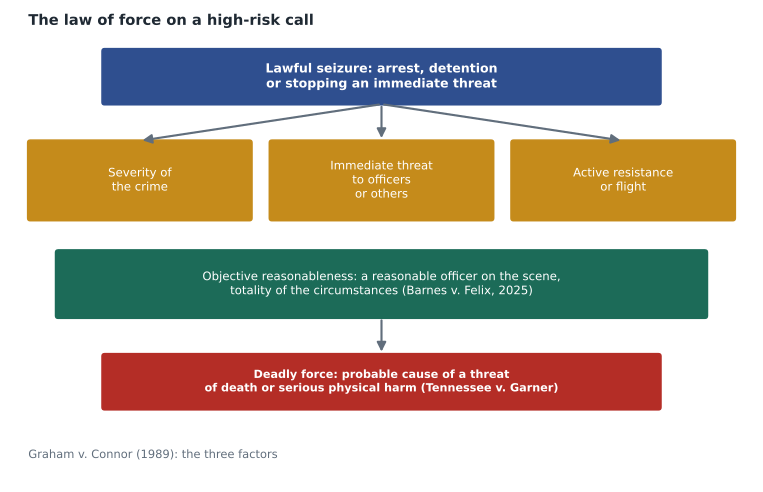
In Graham v. Connor in 1989, the Supreme Court held that force used during an arrest or other seizure is judged by objective reasonableness, from the perspective of a reasonable officer on the scene rather than with hindsight. The Court named three factors: the severity of the crime, whether the suspect poses an immediate threat to the safety of officers or others, and whether the suspect is actively resisting or attempting to evade arrest by flight. In Tennessee v. Garner in 1985, the Court held that deadly force may not be used to prevent the escape of a fleeing suspect unless the officer has probable cause to believe that the suspect poses a significant threat of death or serious physical injury to the officer or others. In Barnes v. Felix in 2025, the Court held that courts must consider the totality of the circumstances, not only the moment when the threat arose.
Ohio's certification standards, set by the Ohio Collaborative Community-Police Advisory Board, require agencies to adopt written policies that limit force, including deadly force, to what is objectively reasonable, and to train officers on them. Many agencies, and the 2023 National Consensus Policy and Discussion Paper on Use of Force from leading police organizations, go further than the constitutional minimum by requiring de-escalation when it is safe and feasible and by requiring officers to intervene when another officer uses clearly excessive force.
Pointing a firearm is force
One of the most important legal points for high-risk calls is that pointing a firearm at a person is itself a use of force. It is not a neutral precaution. Courts in both countries treat it as a serious intrusion that must be justified by the circumstances, and many services require officers to report it in the same way as other uses of force. The justification is usually straightforward when there is reliable information that the person is armed and dangerous, but it can be hard to justify when officers have only a vague suspicion, when the people involved are clearly unarmed, or when the firearm stays pointed after the threat is gone.
Federal courts have held in several cases that pointing a gun at a person who poses no threat can be excessive force under the Fourth Amendment, including cases involving children and bystanders during searches. Many agencies require officers to report pointing a firearm at a person, which allows the agency to see patterns, such as how often firearms are pointed at people who turn out to be unarmed or uninvolved.
Haddad tells the class that the practical rule is the same in both countries. Point a firearm only when the threat justifies it, lower it when the threat is controlled, and write down why. 'When Pike was face down and handcuffed, and we knew the car was empty, there was no reason for anyone to keep a firearm pointed at him,' she says. 'If you watch our camera footage, you will see the cover officers holster as soon as I say the car is clear. That is not just good tactics. It is the law.'
Force to prevent an offense and to protect others
The Graham v. Connor factors include the threat to others as well as to officers, and courts recognize that protecting a hostage, a family member or a bystander is one of the strongest justifications for police force. Ohio law and most agency policies also recognize the authority to use reasonable force to prevent a crime that threatens serious harm. The same principles of necessity and reasonableness apply.
Searching after a high-risk stop
Once the occupants were arrested, the officers could search them incident to arrest under Chimel v. California in 1969. For the car, Arizona v. Gant in 2009 allows a search incident to arrest only if the arrested person is unsecured and within reaching distance of the passenger compartment, or if it is reasonable to believe evidence of the offense of arrest is in the vehicle. Because the arrest was for the robbery and the car was the getaway vehicle, officers could search it for evidence of the robbery. Searching a cellphone found on Pike was a different matter: under Riley v. California in 2014, police generally need a warrant to search the digital contents of a phone seized on arrest. The department sought a warrant.
A protective search for weapons is narrower than a search for evidence. Before the occupants were arrested, officers could check them and the immediate area for weapons when they had reasonable grounds to believe there was a safety risk, but not search for evidence. Haddad reminds the students that a high-risk call does not widen any of these powers. 'The fact that the call was dangerous explains why we drew our firearms,' she says. 'It does not give us the right to search anything we like afterward.'
Notes that explain the law
Because the legal status of a high-risk call changes quickly, the officers' notes have to show each change and the facts behind it. Good notes record the information the officer had before acting and where it came from, the time and reason for each escalation of force and each reduction, when grounds for arrest arose and what they were, when rights were given and any reason for delay, and what was searched and on what basis. Reyes's notes from April 10 ran to four pages. Desjardins shows them to the class as an example of notes that a court would find easy to follow: short, timed entries in plain language, with each decision tied to a fact.
Each officer is judged separately
On a high-risk call, several officers may use or display force at the same time. The law judges each officer's actions separately. An officer who points a firearm because the officer beside them did, without seeing the threat themselves, may have a weaker justification. Many policies also impose a duty to intervene: an officer who sees another officer using clearly excessive force must act to stop it and must report it. This duty has been widely adopted since 2020 and is part of the national consensus policy in the United States and of many Canadian service policies.
| Time | Event | Legal status |
|---|---|---|
| 23:06 | Car stopped; occupants ordered to stay inside | Investigative stop |
| 23:07 | Driver ordered out and secured | Investigative stop; reasons delayed for safety |
| 23:08 | Handgun seen on passenger seat | Grounds to arrest driver |
| 23:09 | Passenger out and secured; car cleared | Both arrested; reasons given |
| 23:10 | Firearms holstered by cover officers | Force reduced as threat controlled |
Worked problem
When does the threat end?
After a high-risk stop, two occupants are handcuffed and seated on the curb, the car has been checked and no weapon is found. One officer keeps a firearm pointed at the occupants while others search the car. Is that lawful?
Show solution
- Purpose: the occupants are detained or arrested, which is lawful.
- Threat: both are secured, the car is clear and there is no information about other threats.
- Proportionality: pointing a firearm is significant force; the threat it addressed is now controlled.
- Practice: the officer should lower and holster the firearm and keep watching the occupants.
Answer: Continuing to point the firearm would be very hard to justify. Once the threat is controlled, the force must end or ease, and the officer's notes should show when it did.
Common mistakes
MistakeA high-risk stop is always an arrest.
InsteadIt often begins as an investigative detention and becomes an arrest only when grounds exist.
MistakePointing a firearm is just a precaution, not force.
InsteadPointing a firearm is a use of force that must be justified and, in many services, reported.
MistakeOfficers must give Miranda warnings the moment they stop a car.
InsteadMiranda applies to custodial interrogation; the public safety exception allows only narrow safety questions first.
MistakeIf one officer points a firearm, the others are justified in doing the same.
InsteadEach officer's force is judged on what that officer knew and saw.
Summary and key terms
- A stop requires reasonable suspicion (Terry v. Ohio); an arrest requires probable cause.
- Miranda applies to custodial interrogation; the public safety exception is narrow (Quarles).
- Force is governed by Graham v. Connor, Tennessee v. Garner and Barnes v. Felix.
- Pointing a firearm is force and must end when the threat is controlled.
- Each officer is judged separately, and many policies impose a duty to intervene.
- Reasonable suspicion
- Specific and articulable facts suggesting that a person is involved in criminal activity.
- Probable cause
- Facts that would lead a reasonable officer to believe a person committed a crime.
- Duty to intervene
- A policy duty to stop and report clearly excessive force by another officer.
- Public safety exception
- The narrow rule from New York v. Quarles allowing urgent safety questions before Miranda warnings.
Practice problems
Work each problem on paper first, then reveal the answer to check.
At what point did the April 10 stop become an arrest, and why?
Show answer
When Reyes saw a handgun on the passenger seat, which gave grounds to arrest.
What did Tennessee v. Garner decide?
Show answer
Deadly force may not be used to stop a fleeing suspect unless there is probable cause of a significant threat of death or serious injury.
Why did the cover officers holster their firearms at 23:10?
Show answer
The occupants were secured and the car was clear, so the threat the force addressed was controlled.
What is the duty to intervene?
Show answer
A duty to stop and report clearly excessive force used by another officer.
Lesson quiz · 5 questions
Score 60% or more to complete this lesson.
Create a free account to save your progress, take quizzes and earn a certificate.