
IRW-220 · Lesson 6 of 12 · 21 min
Epoxy-coated, galvanized and stainless bars
▶ Video coming soon A video version of this lesson is on the way.
Ordinary reinforcing bar is carbon steel, often called black bar. Inside sound concrete it does not rust, because the concrete is alkaline and forms a thin protective film on the steel. That protection fails when salt reaches the bar, from de-icing salts on bridges and parking decks or from seawater, or when the concrete slowly carbonates over decades. Once the steel rusts, the rust takes up more room than the steel, it cracks the concrete from the inside, and pieces fall off. Parking structures in a northern climate are some of the worst cases, because cars bring salty slush in all winter and drip it onto the decks.
At the Saturday session on November 7, Tobias put four short pieces of bar on the bench: a green one, a dull gray one, a bright silver one and one that looked like a pale brown plastic rod. "Four ways to stop a deck from falling apart," he said. "Each one gets handled differently, and each one gets ruined by somebody who handles it like black bar."
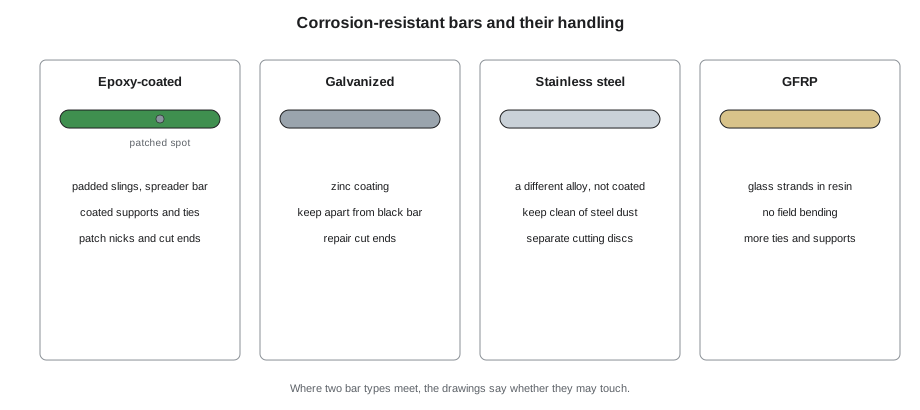
This lesson covers the corrosion-resistant bars rodbusters meet: epoxy-coated, galvanized, stainless steel and glass fiber reinforced polymer bars, and the handling, cutting, tying and repair rules for each.
Epoxy-coated bars
Epoxy-coated bars have a fusion-bonded epoxy coating applied in a plant to clean, heated bars. There are two main kinds. Bars to ASTM A775 are coated straight and then bent, so the coating must be flexible. Bars to ASTM A934 are bent first and then coated, and their coating is more brittle, so they must not be bent again. ACI 318, ACI 301 and the owner's specification, such as ODOT's for Ohio bridges, set the requirements for coated bars on a project, often referring to these standards and to CRSI's guidance on field handling.
The coating works only if it is unbroken. A nick, scrape or crack leaves bare steel that can rust, and rust at a small defect can creep under the coating. Most of the damage to epoxy-coated bars happens after they leave the plant: in loading, shipping, unloading, storage and placing, and when workers walk on the mats. So the handling rules are about protecting the coating.
- Lifting: use nylon or padded slings, never bare wire rope or chain against the bars, and lift with a spreader bar so that long bundles do not sag and rub.
- Storage: store bundles off the ground on padded timbers, with enough supports that the bars do not sag, and keep them covered if they will be outside more than a short time, because sunlight degrades the coating.
- No dragging: bars are never dragged across the ground, the deck or each other.
- Supports and ties: use plastic, epoxy-coated or plastic-tipped supports and coated or plastic-coated tie wire, so that no bare steel touches the bars.
- Walking: keep foot traffic on the mats to a minimum, and use walkways where the gang must cross.
- Keep them apart: coated bars are not mixed with black bars in the same mat unless the drawings show it.
Worked problem
Supports for stored bars
A bundle of epoxy-coated #5 bars 40 ft long is to be stored on timbers about 10 ft apart, as the specification suggests. How many timbers does it need?
Show solution
- 40 ÷ 10 = 4 spaces.
- Four spaces need 4 + 1 = 5 timbers, one at each end and three between.
Answer: Five padded timbers. Fewer would let the bundle sag between them, and bars that sag and bounce in the wind rub their coating off.
Cutting, bending and repairing epoxy-coated bars
Field cutting and bending of coated bars is kept to a minimum and done only where the specification allows. When a coated bar is cut, the cut end is bare steel and must be coated with the patching material the bar supplier provides. Damaged spots found during placing are patched the same way, before the pour and after cleaning the area, and the patching material is applied as its instructions say, usually within its working temperature range.
Specifications set limits on how much damage is acceptable. Typical rules allow small damaged areas to be patched, but require a bar to be replaced if the total damaged area on it is more than a small fraction of its surface, or if the coating has cracked or come off in large pieces. The exact limits are in the project specification, and the inspector applies them. On the 2024 overpass, the inspector walked the deck with a can of patching material before each pour and marked every spot for the gang to touch up.
Galvanized bars
Galvanized bars are coated with zinc by dipping them in a bath of molten zinc, to ASTM A767, or by continuous galvanizing, to ASTM A1094. Zinc protects steel in two ways: as a barrier, and by corroding in its place, so that small scratches do not rust the way they would on an epoxy bar. Galvanized coatings are tougher than epoxy and stand up better to handling.
The rules for galvanized bars are simpler but still important.
- Use galvanized, plastic or coated supports and galvanized or coated tie wire, so that no bare black steel touches the bars.
- Do not mix galvanized and black bars in contact in the same element unless the drawings allow it, because zinc next to bare steel in concrete corrodes faster.
- Repair cut ends and damaged areas with a zinc-rich paint or other repair material approved in the specification.
- Bars that are bent after galvanizing can crack the coating if the bend is tight, so bending is usually done before galvanizing, to the bend diameters the specification gives.
Stainless steel bars
Stainless steel bars are not coated at all. They are made of a different steel, an alloy with chromium and often nickel and molybdenum, which forms its own protective film even in the presence of salt. They are made to ASTM A955 and come in several grades, some of them duplex stainless steels. Stainless bars cost several times as much as black bars but can last the life of a structure without corrosion, so owners use them in the most exposed places, such as bridge deck top mats, barrier walls and parking structure decks.
Stainless bars can be handled with ordinary equipment, but they must be kept clean and kept apart from carbon steel.
- Do not let stainless bars pick up carbon steel particles from grinding, cutting or from being dragged across black bars, because those particles rust on the surface.
- Cut them with tools and discs kept for stainless, or with abrasive discs that are not used on black steel.
- Use stainless, plastic or coated supports and stainless or coated tie wire.
- Where stainless and black bars meet, follow the drawings. Some designs allow contact deep inside the concrete; others require separation.
Stainless bars are also harder and springier than black bar of the same size, and they bend differently, so field bending is done only with the specified bend diameters and the supplier's guidance.
Glass fiber reinforced polymer bars
Glass fiber reinforced polymer bars, called GFRP bars, are not steel at all. They are made of glass fibers held in a resin and do not corrode. They are light, about a quarter of the weight of steel bars of the same size, and they do not conduct electricity or interfere with magnetic fields, which is why they are used around medical equipment, in some bridge decks and barriers, and in marine structures.
GFRP bars are made to ASTM D7957, and their design is covered by ACI CODE-440.11 for buildings and the AASHTO guide specifications for bridges.
GFRP bars behave very differently from steel on site.
- They cannot be bent on site. Every bend is made by the manufacturer before the resin cures, so bent bars come from the plant and are ordered exactly.
- They are cut with diamond or abrasive blades, with dust control and respiratory protection, because the cut releases glass fiber dust.
- They are lighter and more flexible, so they need more supports and more ties to stay in place during the pour, and they can float in wet concrete if not tied down.
- They are tied with plastic-coated wire or plastic ties.
- They do not yield; they are elastic until they break, so the designer's details must be followed exactly.
Mixing bar types
Many structures use more than one type. A bridge deck may have stainless bars in the top mat and black or epoxy bars in the bottom mat; a parking structure may have epoxy-coated bars in the top deck and black bars in the columns. Wherever two types meet, the drawings say whether they may touch, whether they need plastic spacers between them, and how they are lapped. The placing drawings and bar lists mark each bar's type, and the bundle tags show it, so that the gang can keep them apart from the truck to the deck.
Coatings in a post-tensioned deck
In a post-tensioned parking structure, the strand is protected by its own grease and sheathing and by encapsulated anchors, as lesson 10 explains. The mild steel in the same deck may be black, epoxy-coated or galvanized, as the specification says. At Quarry Point Center, the specification calls for epoxy-coated bars in the top of the roof deck, which takes the weather directly, and black bars below. Tobias has already asked Northbar to tag the roof bundles in a separate color.
Receiving coated bars
Coated bars are inspected when they arrive, not only when they are placed. On the 2024 overpass, Renata checked each load before the truck left: the bundle tags against the bar list, the coating type against the specification, and the coating itself for damage from shipping. Bundles that arrived with bare spots where the binding straps had cut in were photographed and noted on the delivery ticket, so that the coating plant, not the rod gang, paid for the repairs. Bundles were unloaded with the site crane, nylon slings and a spreader bar, never pushed off the truck, and set straight onto padded timbers.
The specification also usually requires the coating supplier's certificate, showing the coating material, thickness and tests, for each shipment. The inspector checks these against the deliveries, and the certificates go into the job file with the mill certificates for the bars.
Placing coated bars
Placing coated bars takes longer than placing black bars. They are slippery, so workers walking on them need care and walkways. They cannot be thrown into position or levered with a bar, so they are carried and set. Tie wire must be coated, so it is stiffer and slower to twist. Supports must be plastic or coated, which are taller and lighter and can tip if not tied. Tobias allows about a fifth more time for a coated mat than for the same mat in black bar.
Coated bars also slide more in the concrete, because the coating reduces the grip between bar and concrete, so the design gives them longer development and lap lengths than black bars of the same size. The bar list already includes the longer laps, and the gang must not shorten a coated lap to the black-bar length because it was what they used on the last job.
Field bending of coated and stainless bars
Where the specification allows field bending of epoxy-coated bars, the bending is done slowly, with the bender's pins and mandrel covered with plastic sleeves, at a temperature above the minimum the coating maker sets, because cold epoxy cracks. Every bend is inspected afterwards for cracks in the coating, and any crack is patched. Stainless bars are bent on benders kept clean of carbon steel, with the larger bend diameters stainless needs. GFRP bars are never field bent at all. When a bar of any of these types will not fit, the answer is the same as for black bar: report it, do not force it.
Patching before the pour
Patching material is applied to clean, dry steel at the temperatures its label gives, and it must cure before the concrete is placed, usually within a few hours. Patching on a wet morning, or minutes before the concrete arrives, leaves soft patches that the concrete pushes off. On the 2024 overpass, the inspector's final walk was timed for the afternoon before each pour, so that the gang could patch everything marked and let it cure overnight.
Common mistakes
MistakeLifting epoxy-coated bundles with wire rope chokers.
InsteadUse nylon or padded slings and a spreader bar.
MistakeTying coated bars with bare black wire.
InsteadUse coated or plastic-coated tie wire and coated or plastic supports.
MistakeLeaving cut ends of coated bars bare.
InsteadPatch cut ends and damage with the supplier's material before the pour.
MistakeGrinding near stainless bars with a disc used on black steel.
InsteadKeep stainless clean; use separate discs and tools.
MistakeBending a GFRP bar on site.
InsteadGFRP bends are made only in the plant; order bent bars exactly.
Summary and key terms
- Salt and carbonation break down concrete's protection and make black bar rust and crack the concrete.
- Epoxy-coated bars (ASTM A775 and A934) need padded handling, coated supports and ties, and patching of all damage and cut ends.
- Galvanized bars (ASTM A767 and A1094) are tougher; keep them out of contact with black steel and repair cut ends.
- Stainless bars (ASTM A955) are a different alloy; keep them clean and away from carbon steel particles.
- GFRP bars (ASTM D7957) do not corrode, cannot be bent on site and need more ties and supports.
- Where bar types meet, the drawings decide whether they may touch.
- Black bar
- Uncoated carbon steel reinforcing bar.
- Epoxy-coated bar
- A bar with a fusion-bonded epoxy coating applied in a plant.
- Galvanized bar
- A bar coated with zinc.
- Stainless steel bar
- A bar made of corrosion-resistant stainless alloy.
- GFRP bar
- A glass fiber reinforced polymer bar that does not corrode.
- Patching material
- The coating material used to repair damage and cut ends on coated bars.
- Carbonation
- The slow reaction of concrete with carbon dioxide that reduces its alkalinity.
Practice problems
Work each problem on paper first, then reveal the answer to check.
A coated bundle 30 ft long is stored on timbers 10 ft apart. How many timbers?
Show answer
30 ÷ 10 = 3 spaces, so 4 timbers.
Which epoxy-coated bars must not be bent after coating?
Show answer
ASTM A934 bars, which are bent before coating.
What standard covers GFRP bars in the US?
Show answer
ASTM D7957.
Why are stainless bars kept away from black steel grinding dust?
Show answer
Carbon steel particles rust on the stainless surface.
Can a galvanized bar touch a black bar in the same element?
Show answer
Only if the drawings allow it.
Lesson quiz · 5 questions
Score 60% or more to complete this lesson.
Create a free account to save your progress, take quizzes and earn a certificate.